
Affiliate Disclosure
Some links on this page are affiliate links. As an Amazon Associate, we earn from qualifying purchases — at no extra cost to you. We do not buy, test, or physically handle the products we cover; our rankings come from aggregated owner reviews, ratings and expert consensus. Commissions never change our verdicts. How we rank & full disclosure.
10-Inch Subwoofer
A 10" driver moves less cone area, so it reacts faster and hits tight, punchy bass. It fits smaller enclosures and is the go-to for accurate, musical low end without swallowing the trunk.
Best for: Rock, metal, jazz and daily drivers who want fast, articulate bass and a compact box
Typically $60–$220 per driver, plus $60–$140 for a ported or sealed box
- Tighter, faster transient response — cleaner kick drums and plucked bass notes
- Needs a smaller enclosure, so it swallows far less trunk or cargo space
- Easier for a modest amp to control; often sounds "right" on 300–500 watts
- Reaches higher into the midbass, blending better with door speakers
- Lighter cone means quicker starts and stops for detailed, articulate output
- Less cone area means less raw air moved, so lower ultimate SPL and slam
- Rolls off sooner in the deep sub-bass — 30 Hz rumble is harder to reproduce
- A single 10 rarely satisfies bass-heavy hip-hop or SPL competition goals
- You may end up adding a second 10 to match one 12, erasing the size saving
12-Inch Subwoofer
A 12" driver moves more air per stroke, digging deeper and playing louder for the same excursion. It is the default choice for hip-hop, EDM and anyone chasing that chest-thumping low end.
Best for: Hip-hop, EDM, reggae and anyone who prioritizes deep, loud, room-filling bass
Typically $70–$260 per driver, plus $80–$170 for a ported or sealed box
- More cone area moves more air, so higher output and deeper reach for the same excursion
- Digs into the 25–35 Hz sub-bass that hip-hop and EDM live in
- Effortless volume — cruises where a 10 would be working hard
- A single 12 often does the job two 10s would take, saving an amp channel
- The most common size, so boxes, grilles and spares are everywhere
- Heavier cone can sound slower or "boomier" if the box and amp aren't dialed in
- Demands a larger enclosure — a real bite out of trunk or hatch space
- Wants more power to wake up; underpowering a 12 sounds flat and lazy
- Overkill for someone who just wants clean, musical bass at moderate volume
How they score, side by side
Scores reflect aggregated owner reviews and expert consensus — not our own bench testing.
- Deep-bass output / slam79
- Transient speed / tightness97
- Musical accuracy98
- Space efficiency96
- Loudness ceiling69
- Value per driver88
Spec-by-spec comparison chart
| Factor | 10-Inch Subwoofer | 12-Inch Subwoofer |
|---|---|---|
| Cone area (Sd, approx.) | ~55 sq in | ~78 sq in (about 40% more) |
| Air moved per stroke | Less — quicker to settle | More — deeper & louder |
| Transient speed | Faster, tighter | Slightly slower, weightier |
| Deep-bass reach | Strong to ~30–35 Hz | Strong into the mid-20s Hz |
| Typical enclosure volume | ~0.6–1.0 cu ft | ~1.0–1.75 cu ft |
| Power that suits it | ~300–500W RMS | ~500–1000W RMS |
| Best-fit genres | Rock, metal, jazz, indie | Hip-hop, EDM, reggae, trap |
| Price per driver | $60–$220 | $70–$260 |
| Trunk space cost | Low | Moderate–high |
| Ultimate SPL potential | Moderate | High |
Our Top 3 Picks
The three highest-rated options in this category, if you'd rather skip straight to a proven pick.

Best for the cleanest all-round upgrade over factory paper
- 6.5" two-way with a lightweight IMPP cone
- Bright, non-harsh PEI dome tweeter
- 40W RMS / 240W peak per speaker
- Shallow mount fits most factory doors
Why buy it: the pair owners keep telling newcomers to buy first — rated 4.6 across more than 20,000 reviews for a crisp, balanced sound that embarrasses stock speakers without touching the wallet.

Best for the most detailed top end on a budget
- 6.5" three-way A-Series coaxial
- 70W RMS / 320W peak per speaker
- Multilayer mica matrix cone
- Separate tweeter and midrange for clarity
Why buy it: owners consistently report the extra tweeter and midrange give it the most open, detailed sound in this price bracket — the pick if vocals and cymbals matter more than raw thump.

Best for the toughest build that survives real doors
- 6.5" three-way full-range coaxial
- 45W RMS / 90W peak per speaker
- Integrated concave tweeter + midrange
- Sealed motor tolerates door moisture
Why buy it: rated 4.7 across thousands of owner reviews, the R165X3 is the durability favorite — buyers routinely praise how it holds up in wet doors where cheaper cones give out.
Prices are pulled from Amazon and were accurate as of Aug 22, 2026, 6:54 PM EDT. Product prices and availability are subject to change — the live price is shown on Amazon.
What actually separates a 10 from a 12
On paper it is only two inches, but that gap changes the physics in a way you hear immediately. The single most important number is cone area — how much surface the sub has to push air with. A typical 10" driver has roughly 55 square inches of effective cone area; a 12" is closer to 78. That is about 40% more air moved on every stroke, and moving air is exactly what bass is.
More cone area does two things. First, it raises the ceiling on how loud the sub can get before it runs out of excursion (how far the cone can travel). Second, it makes deep frequencies easier to reproduce, because reaching down into the 25–30 Hz range takes a lot of displaced air and a 12 has more of it in reserve. This is why the consensus among installers is blunt: for the same excursion and power, a 12 will be louder and dig deeper than a 10.
But the 10 gives something back for its smaller cone. A lighter, smaller cone has less moving mass, so it starts and stops faster. That speed is what people mean when they call a 10 "tight" or "fast" — the sub tracks quick transients like a double-kick drum or a plucked bass string more precisely, without the trailing overhang a heavier cone can add. Owner reviews consistently describe well-built 10s as more "musical" and 12s as more "authoritative," and both descriptions are fair. Neither is better in the abstract; they are tuned for different priorities.
How each one actually sounds
Strip away the marketing and the difference comes down to two words enthusiasts use constantly: speed versus slam.
A 10-inch sub excels at articulation. The lighter cone reproduces the leading edge of a note cleanly, so kick drums sound punchy rather than smeared and fast basslines stay defined instead of turning into a low drone. It also tends to reach a little higher in frequency, which helps it hand off smoothly to your door speakers so the bass feels connected to the rest of the music rather than thumping from behind you. The trade-off is that when a track calls for deep, sustained sub-bass, a single 10 can start to sound like it is working — the output flattens where a 12 would still have headroom.
A 12-inch sub is about weight and effortlessness. It moves enough air that low notes arrive with physical pressure — the chest-thump and window-flex that bass-heavy genres are built around — and it does so without straining. Because it has reserve capacity, it stays composed at high volume where a 10 would be near its limit. The honest downside, and the one owners run into most, is that a 12 in an undersized box or on a weak amp can sound slow and "boomy," with one-note bass that overhangs. A 12 rewards a proper enclosure and adequate power more than a 10 does; get those wrong and it can actually sound worse than a well-set-up 10.
Which size suits your music
This is where the decision usually resolves itself, because bass content varies enormously by genre. Match the sub to what you actually listen to:
- Rock, metal, punk, indie, jazz, classical: these lean on fast kick drums and melodic bass guitar rather than deep synth sub-bass. A 10 is often the more satisfying choice — its speed keeps the low end tight and it blends beautifully with the rest of the mix.
- Hip-hop, rap, trap, EDM, dubstep, reggae: these are engineered around deep, sustained sub-bass, often below 40 Hz. This is the 12's home turf. The extra air and deeper reach deliver the pressure these genres are mixed to produce.
- Pop, country, mixed playlists: either works. If your listening is genuinely all over the map and you want one sub to do everything at moderate volume, a single 12 in a sealed box is the safe, versatile pick — sealed keeps it tight, the 12 keeps the depth.
The other axis is how loud you actually play. If you rarely push past a comfortable listening level, a 10 will likely please you and save space. If "loud" is part of the point — you want the car to move — the 12's higher ceiling is the honest answer, and you will appreciate the reserve on long drives.
Enclosure, power and the space trade-off
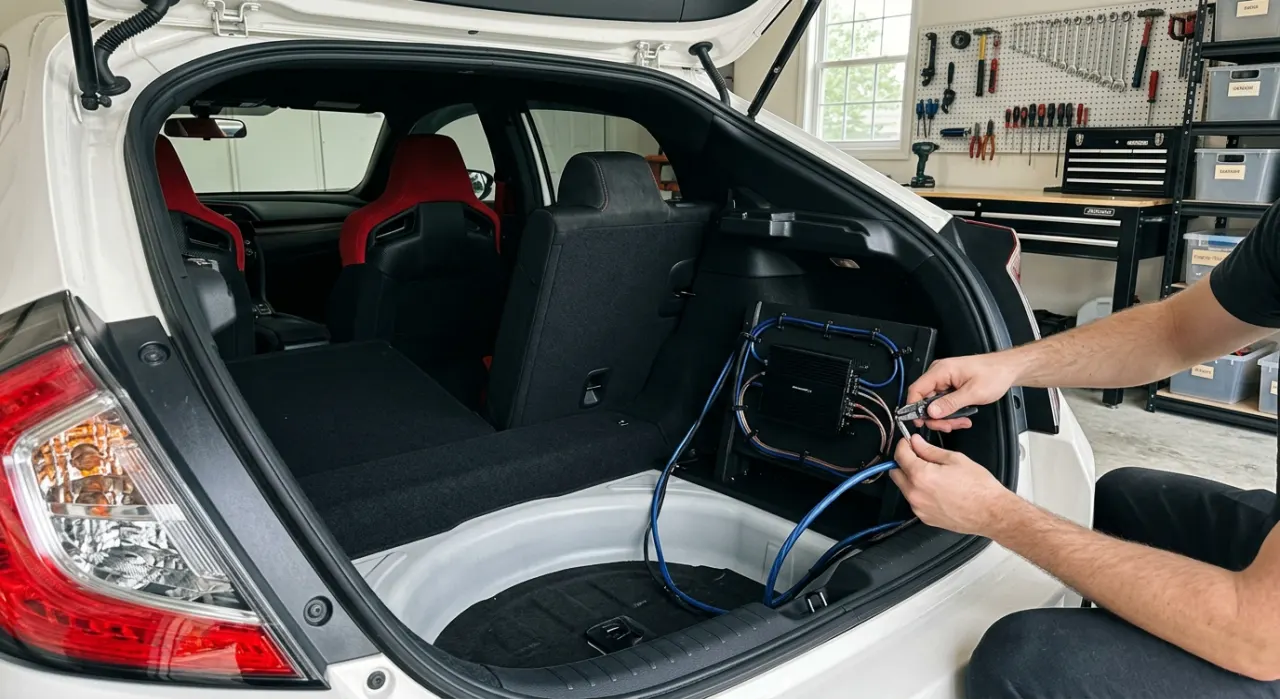
Here is the part beginners underestimate: the enclosure and amplifier matter more than the two-inch difference in cone size. A 10 in the right ported box with a healthy amp will out-perform a 12 stuffed in a too-small trunk box on an underpowered head-unit output, every time.
Box size. A 10 typically wants around 0.6–1.0 cubic foot; a 12 wants roughly 1.0–1.75. That difference is the real cost of going bigger — a 12 box takes a noticeable bite out of trunk or hatch space, while a 10 box often tucks away with room to spare. If cargo room is precious, the 10's smaller footprint is a genuine advantage, not a minor one.
Sealed vs ported. Sealed boxes are smaller and give the tightest, most accurate response — a natural pairing for a 10 or for anyone chasing "clean." Ported boxes are larger and trade some tightness for more output and deeper extension, which is why SPL-focused 12 setups usually run ported. The box type shifts the character of either sub dramatically, so it is a real part of the decision, not an afterthought.
Power. A 10 is generally happy on roughly 300–500 watts RMS and is easier for a modest amp to control. A 12 typically wants 500–1000 watts RMS to come alive; underpower a 12 and it sounds flat and lazy, undercutting the whole reason you chose it. Always match the amp's RMS output to the sub's RMS rating — not the inflated "peak" number on the box — and buy the enclosure the manufacturer specs for your driver.
Common myths and mistakes
"A 12 is always louder than a 10." All else equal, yes — but all else is rarely equal. A quality 10 with a proper ported box and a strong amp will bury a cheap 12 in a sealed shoebox on weak power. Size is one variable among several, and it is not the one that most often decides who wins.
"Bigger is always better, so just get the 12." Only if your music and your goals call for it. For rock and metal at sane volumes, many owners actually prefer a 10 and are happier with the tighter sound and the reclaimed trunk space. Buying a 12 you then have to tame with EQ is a common regret.
"Two 10s equal one 12." Roughly, two 10s (about 110 sq in of cone) actually out-area a single 12 (about 78), so a pair of 10s can be louder while keeping some of that fast character — but they need two spots, more box volume total, and often more amplifier. It is a legitimate path, just not the space-saver people assume.
"The peak wattage rating is what matters." No. Peak numbers are marketing. Match your amp to the sub's RMS rating and set the gain properly. Overpowering with a clipping amp, or underpowering so you crank the gain into distortion, kills more subs than raw size ever will.
Which should you buy — and how to decide
There is no universal winner, because a 10 and a 12 are solving different problems. Decide with three honest questions: what do you listen to, how loud do you play, and how much space can you give up?
Buy a 10 if you mostly play rock, metal, jazz or other transient-heavy music, you want tight and accurate bass more than maximum volume, and you value your trunk space. Pair it with a sealed or modestly ported box and a clean 300–500W RMS amp and it will sound fast and musical.
Buy a 12 if you live on hip-hop, EDM or reggae, you want deep, loud, physical bass, and you have the room. Give it the box the manufacturer specs and 500–1000W RMS, and it will deliver the chest-thump those genres are built for with power to spare.
Still torn? A single 12 in a sealed box is the most forgiving all-rounder — deep enough for bass-heavy tracks, tight enough to stay musical, and simpler than running a pair. Whatever you choose, spend on a matched amp and the correct enclosure before you agonize over the last inch of cone; that is where the sound is actually won.
Recommended Products
Our top picks in this category, ranked on aggregated owner reviews.
Best for the cleanest all-round upgrade over factory paper
- 6.5" two-way with a lightweight IMPP cone
- Bright, non-harsh PEI dome tweeter
- 40W RMS / 240W peak per speaker
- Shallow mount fits most factory doors
Why buy it: the pair owners keep telling newcomers to buy first — rated 4.6 across more than 20,000 reviews for a crisp, balanced sound that embarrasses stock speakers without touching the wallet.
Best for the most detailed top end on a budget
- 6.5" three-way A-Series coaxial
- 70W RMS / 320W peak per speaker
- Multilayer mica matrix cone
- Separate tweeter and midrange for clarity
Why buy it: owners consistently report the extra tweeter and midrange give it the most open, detailed sound in this price bracket — the pick if vocals and cymbals matter more than raw thump.
Best for the toughest build that survives real doors
- 6.5" three-way full-range coaxial
- 45W RMS / 90W peak per speaker
- Integrated concave tweeter + midrange
- Sealed motor tolerates door moisture
Why buy it: rated 4.7 across thousands of owner reviews, the R165X3 is the durability favorite — buyers routinely praise how it holds up in wet doors where cheaper cones give out.

Best for the warmest low end without adding a sub
- 6.5" two-way with a stiff polypropylene cone
- 100W RMS / 300W peak per speaker
- Heavy-duty motor for extra mid-bass
- Zero-protrusion tweeter, easy drop-in
Why buy it: based on thousands of owner reviews, the CSC65 is the one people reach for when they want punch — the beefier motor gives it noticeably fuller mid-bass than most speakers at the price.

Best for filling out the rear deck on the cheap
- 6x9" four-way A-Series coaxial
- 100W RMS / 450W peak per speaker
- Larger cone moves more air than a 6.5"
- Drop-in fit for most rear-deck cutouts
Why buy it: the rear-deck default — owners rate it 4.6 for the extra low-end body a 6x9 brings, an easy way to round out the sound before you ever think about a subwoofer.

Best for the absolute cheapest step up from blown factory speakers
- 6.5" two-way, sold as a pair
- 125W RMS / 250W peak per pair
- Poly-injection cone, rubber surround
- Shallow 2.1" mount depth
Why buy it: a wildly popular throwaway-price pair with 15,000+ reviews — nobody claims it is audiophile, but owners agree it is a real, dirt-cheap improvement over dead or crackling stock speakers.
Prices are pulled from Amazon and were accurate as of Aug 22, 2026, 6:54 PM EDT. Product prices and availability are subject to change — the live price is shown on Amazon.