
Affiliate Disclosure
Some links on this page are affiliate links. As an Amazon Associate, we earn from qualifying purchases — at no extra cost to you. We do not buy, test, or physically handle the products we cover; our rankings come from aggregated owner reviews, ratings and expert consensus. Commissions never change our verdicts. How we rank & full disclosure.
2 Ohm Subwoofer
A lower-impedance voice coil that lets the amplifier push more current, which usually means more raw power and higher output for the same amp. The go-to choice for loud, bass-forward builds.
Best for: SPL and bass-heavy builds where maximum loudness matters more than absolute accuracy
Typically $60–$250 per sub, same as an equivalent 4 ohm model
- Draws more power from the same amp — often the loudest option on a given amplifier
- Ideal for daily "loud" builds and rap, hip-hop and EDM that live on low bass
- Cheap Class-D mono amps are frequently rated highest into a 2 ohm load
- Dual voice coil 2 ohm subs are the most flexible for wiring multi-sub setups
- No price penalty — a 2 ohm coil costs the same as the 4 ohm version of the same driver
- Pulls more current, so it runs the amp harder and hotter
- Cheap amps can overheat or go into protect if pushed near their 2 ohm limit
- Slightly more prone to a "boomy," less controlled sound at the extremes
- Wiring two 2 ohm DVC subs can drop below what many amps handle safely
4 Ohm Subwoofer
A higher-impedance voice coil that draws less current, so the amp runs cooler and cleaner. It usually trades a little maximum loudness for tighter, more controlled low end.
Best for: Sound-quality (SQ) builds, factory-style upgrades and easier, cooler-running amp setups
Typically $60–$250 per sub, same as an equivalent 2 ohm model
- Easier electrical load — the amp runs cooler and is less likely to hit protect
- Often described as tighter and more accurate, favored in SQ builds
- Simpler to wire in pairs without dropping to a dangerously low final impedance
- Safer match for factory or budget amps not rated for low-ohm loads
- Produces less power from the same amp, so it is usually the quieter of the two
- Most affordable mono amps make their headline wattage at 2 ohm, not 4
- Can leave power on the table if your amp is built to drive a low load
How they score, side by side
Scores reflect aggregated owner reviews and expert consensus — not our own bench testing.
- Max loudness potential97
- Sonic tightness / control79
- Amp friendliness (heat/stability)69
- Wiring flexibility97
- Value for the money88
- Beginner-proof setup69
Spec-by-spec comparison chart
| Factor | 2 Ohm Subwoofer | 4 Ohm Subwoofer |
|---|---|---|
| What the number means | Voice-coil resistance to current (lower) | Voice-coil resistance to current (higher) |
| Power from the same amp | More — amp pushes more current | Less — amp pushes less current |
| Typical loudness edge | Louder in most head-to-heads | Quieter unless the amp is 4 ohm–optimized |
| Sound character (consensus) | Big, boomy, bass-forward | Tighter, more controlled |
| Load on the amplifier | Heavier — runs hotter | Lighter — runs cooler |
| Best-suited music | Rap, hip-hop, EDM, SPL builds | Rock, jazz, vocals, all-round SQ |
| Amp compatibility | Needs an amp stable at 2 ohm | Safe on nearly any mono amp |
| Price for the same model | $60–$250 (no premium) | $60–$250 (no premium) |
| Wiring flexibility (DVC) | Very flexible; can drop low fast | Flexible; less risk of going too low |
| Who it favors | Loud daily drivers, bass heads | SQ listeners, factory-style upgrades |
Our Top 3 Picks
The three highest-rated options in this category, if you'd rather skip straight to a proven pick.

Best for the cleanest all-round upgrade over factory paper
- 6.5" two-way with a lightweight IMPP cone
- Bright, non-harsh PEI dome tweeter
- 40W RMS / 240W peak per speaker
- Shallow mount fits most factory doors
Why buy it: the pair owners keep telling newcomers to buy first — rated 4.6 across more than 20,000 reviews for a crisp, balanced sound that embarrasses stock speakers without touching the wallet.

Best for the most detailed top end on a budget
- 6.5" three-way A-Series coaxial
- 70W RMS / 320W peak per speaker
- Multilayer mica matrix cone
- Separate tweeter and midrange for clarity
Why buy it: owners consistently report the extra tweeter and midrange give it the most open, detailed sound in this price bracket — the pick if vocals and cymbals matter more than raw thump.

Best for the toughest build that survives real doors
- 6.5" three-way full-range coaxial
- 45W RMS / 90W peak per speaker
- Integrated concave tweeter + midrange
- Sealed motor tolerates door moisture
Why buy it: rated 4.7 across thousands of owner reviews, the R165X3 is the durability favorite — buyers routinely praise how it holds up in wet doors where cheaper cones give out.
Prices are pulled from Amazon and were accurate as of Aug 22, 2026, 6:54 PM EDT. Product prices and availability are subject to change — the live price is shown on Amazon.
What "2 ohm" and "4 ohm" actually mean
The ohm rating on a subwoofer is its voice coil impedance — how much the coil resists the flow of electrical current from your amplifier. It is measured in ohms, and for car subs the two numbers you see almost everywhere are 2 ohm and 4 ohm. That is the entire difference on the spec sheet: a lower number resists current less, a higher number resists it more.
Here is the part people miss. Impedance is not a measure of quality, power handling, or how "good" a sub is. A 2 ohm and a 4 ohm version of the exact same driver usually share the same cone, the same magnet, the same suspension and the same RMS rating. The only meaningful thing that changes is how the coil is wound, and therefore how hard it makes your amplifier work. The consensus among installers is blunt: you are not choosing a better sub, you are choosing an electrical load.
Because of Ohm's law, a lower-impedance load lets an amplifier push more current, and more current at the same voltage means more power delivered to the sub. That is why a 2 ohm sub typically pulls more watts out of a given amp than the 4 ohm version — and why the 2 ohm side wins most loudness comparisons. It is also why the 2 ohm load runs your amp hotter, which is the trade-off nobody mentions on the box.

Power, loudness and why lower ohms hits harder
Look at almost any mono subwoofer amplifier and you will see a power rating that climbs as impedance drops — something like 300 watts at 4 ohms, 500 watts at 2 ohms, and 800 watts at 1 ohm. That single line explains the whole "2 ohm is louder" reputation. Feed the amp an easier-to-drive 2 ohm load and it delivers more of the power it is capable of. Feed it a 4 ohm load and it holds back, running cooler but quieter.
So in a straight fight on the same amplifier, a 2 ohm sub is almost always the louder one, and by a meaningful margin. Aggregated owner reviews and SPL-build write-ups consistently favor the lower-impedance setup when the goal is raw output — the kind of bass you feel in your chest and see in your mirror. If you listen to bass-heavy rap, hip-hop or EDM and "loud" is the priority, the 2 ohm route generally gets you there on a smaller, cheaper amp.
But loudness on the same amp is only half the story. If you instead buy an amplifier that is specifically rated to make its full power at 4 ohms, the 4 ohm sub can match it watt for watt while asking far less of the amp electrically. In other words, "2 ohm is louder" is only true when you hold the amp constant. Change the amp to suit the sub and the loudness gap can close completely.

Does impedance change how it sounds?
This is where opinions get strong and the truth gets nuanced. A common claim is that 4 ohm subs sound "tighter" and 2 ohm subs sound "boomy." There is a grain of truth to it, but the cause is usually indirect. Impedance itself does not have a tone. What actually shapes the sound is the power level and the control the amp keeps over the cone.
Because a 2 ohm setup often pushes more power, it tends to move more air and emphasize the low, felt end of the spectrum — which many people describe as boomy or bass-forward. A 4 ohm setup, drawing less current and running an amp well within its comfort zone, is frequently described as more controlled and accurate. Detailers and SQ competitors who chase clean, articulate bass often lean 4 ohm for exactly this reason.
The honest takeaway from the mechanic and installer consensus: a well-matched, properly powered sub of either impedance can sound excellent, and a mismatched or under-powered one of either impedance can sound bad. Enclosure design, tuning frequency, and gain setting influence "tight versus boomy" far more than the ohm number does. If sound quality is your priority, spend your attention on the box and the tune before you agonize over 2 versus 4.
The part that really matters: matching your amp
If you take one thing from this comparison, take this: the sub's impedance must match what your amplifier is rated to drive safely. This decision outranks loudness, sound character and price combined, because getting it wrong can cook your amplifier.
Every amp has a minimum stable impedance — the lowest load it can handle without overheating or shutting down. Drive an amp below that limit and it draws more current than it was designed for; the best case is that it drops into protect mode and goes silent, and the worst case is that it overheats and fails. On the flip side, running a 4 ohm sub on an amp that only makes big power at 2 ohms leaves a chunk of that amp's capability unused.
- If your amp is rated for its headline power at 2 ohms (most affordable Class-D mono amps are), a 2 ohm final load lets it deliver that power and is the natural match.
- If your amp is a 4 ohm–stable or SQ-focused unit, a 4 ohm sub keeps it cool, clean and safely inside its limits.
- If you are buying both amp and sub together, pick the amp's target impedance first, then buy the sub — or the dual-voice-coil configuration — that lands on it.
The number on the sub is only meaningful in relation to the amp behind it. A 2 ohm sub is not "better" and a 4 ohm sub is not "safer" in a vacuum — they are better or worse for a specific amplifier.
Dual voice coils and final impedance
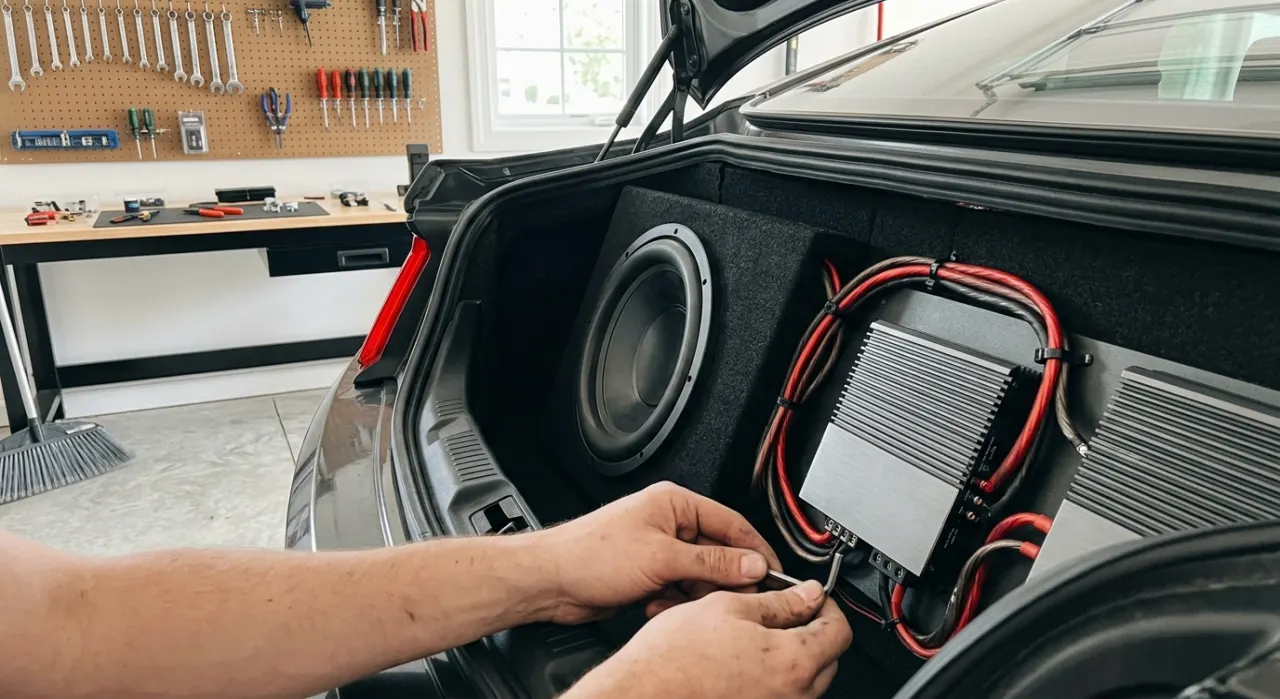
Most modern aftermarket subs are dual voice coil (DVC), and this is where the 2-versus-4 conversation gets more flexible than the label suggests. A DVC sub has two separate coils that you can wire in series or in parallel, which changes the final impedance the amp actually sees.
- A DVC 2 ohm sub can be wired to a 4 ohm final load (coils in series) or a 1 ohm final load (coils in parallel).
- A DVC 4 ohm sub can be wired to an 8 ohm final load (series) or a 2 ohm final load (parallel).
- With two subs, the combinations multiply — which is exactly how installers land on the precise load an amp wants.
This is why experienced builders often prefer DVC 2 ohm subs: they offer the widest range of usable final impedances for common single- and dual-sub setups. But flexibility cuts both ways. Wire two DVC 2 ohm subs carelessly and you can end up at a fraction of an ohm — a load almost no consumer amp can survive. The consensus advice is to sketch the wiring and confirm the final impedance against the amp's minimum before you connect anything, using the manufacturer's wiring diagrams rather than guessing.
Common myths and mistakes
"2 ohm subs are just better / louder, period." Only on the same amp. Loudness comes from power, and a 2 ohm load pulls more power from a given amp. Pair a 4 ohm sub with a 4 ohm–rated amp and the gap can vanish.
"4 ohm sounds cleaner because of the ohms." The impedance has no tone of its own. "Tight versus boomy" tracks power level, gain setting, enclosure design and tuning far more than the coil rating.
"Lower ohms means the sub is more powerful." No. A 2 ohm and 4 ohm version of the same model usually share identical RMS power handling. The ohm rating changes the amp's output, not the sub's strength.
"I can just wire it however to hit 2 ohms." Careless DVC wiring can drop a pair of subs to well under 1 ohm, which most amps cannot handle. Always confirm the final load against the amp's minimum stable impedance first.
"I'll pay more for the 2 ohm version." You won't. The two impedance options of the same driver almost always cost the same — impedance is not a premium feature.
Which should you buy — and how to decide
There is no universal winner, because impedance is a matching decision, not a quality one. Start from your amplifier, not the sub, and the answer falls out on its own.
Buy a 2 ohm sub (or wire your DVC sub to a 2 ohm final load) if your amp makes its full power at 2 ohms, you want the loudest result on a given budget amp, and your music lives on heavy, felt bass. This is the default for daily "loud" builds and SPL-leaning setups, and it costs no more than the alternative.
Buy a 4 ohm sub (or wire to a 4 ohm final load) if your amp is 4 ohm–rated or SQ-focused, you value tight, controlled bass and a cooler-running system, or you are keeping things simple and safe with a factory-style or budget amp. It is the more forgiving, harder-to-get-wrong option.
Whichever you choose, the winning move is the same: identify your amplifier's rated power and minimum stable impedance first, then pick the sub — or the DVC wiring — that lands on that load. Get the electrical match right and both impedances can build a system that slaps. Get it wrong and neither will.
Recommended Products
Our top picks in this category, ranked on aggregated owner reviews.
Best for the cleanest all-round upgrade over factory paper
- 6.5" two-way with a lightweight IMPP cone
- Bright, non-harsh PEI dome tweeter
- 40W RMS / 240W peak per speaker
- Shallow mount fits most factory doors
Why buy it: the pair owners keep telling newcomers to buy first — rated 4.6 across more than 20,000 reviews for a crisp, balanced sound that embarrasses stock speakers without touching the wallet.
Best for the most detailed top end on a budget
- 6.5" three-way A-Series coaxial
- 70W RMS / 320W peak per speaker
- Multilayer mica matrix cone
- Separate tweeter and midrange for clarity
Why buy it: owners consistently report the extra tweeter and midrange give it the most open, detailed sound in this price bracket — the pick if vocals and cymbals matter more than raw thump.
Best for the toughest build that survives real doors
- 6.5" three-way full-range coaxial
- 45W RMS / 90W peak per speaker
- Integrated concave tweeter + midrange
- Sealed motor tolerates door moisture
Why buy it: rated 4.7 across thousands of owner reviews, the R165X3 is the durability favorite — buyers routinely praise how it holds up in wet doors where cheaper cones give out.

Best for the warmest low end without adding a sub
- 6.5" two-way with a stiff polypropylene cone
- 100W RMS / 300W peak per speaker
- Heavy-duty motor for extra mid-bass
- Zero-protrusion tweeter, easy drop-in
Why buy it: based on thousands of owner reviews, the CSC65 is the one people reach for when they want punch — the beefier motor gives it noticeably fuller mid-bass than most speakers at the price.

Best for filling out the rear deck on the cheap
- 6x9" four-way A-Series coaxial
- 100W RMS / 450W peak per speaker
- Larger cone moves more air than a 6.5"
- Drop-in fit for most rear-deck cutouts
Why buy it: the rear-deck default — owners rate it 4.6 for the extra low-end body a 6x9 brings, an easy way to round out the sound before you ever think about a subwoofer.

Best for the absolute cheapest step up from blown factory speakers
- 6.5" two-way, sold as a pair
- 125W RMS / 250W peak per pair
- Poly-injection cone, rubber surround
- Shallow 2.1" mount depth
Why buy it: a wildly popular throwaway-price pair with 15,000+ reviews — nobody claims it is audiophile, but owners agree it is a real, dirt-cheap improvement over dead or crackling stock speakers.
Prices are pulled from Amazon and were accurate as of Aug 22, 2026, 6:54 PM EDT. Product prices and availability are subject to change — the live price is shown on Amazon.