
Affiliate Disclosure
Some links on this page are affiliate links. As an Amazon Associate, we earn from qualifying purchases — at no extra cost to you. We do not buy, test, or physically handle the products we cover; our rankings come from aggregated owner reviews, ratings and expert consensus. Commissions never change our verdicts. How we rank & full disclosure.
AGM Battery
An Absorbent Glass Mat battery holds its acid in fiberglass mats packed between the plates instead of free liquid. It is sealed, spill-proof, and built to survive deep cycling and constant electrical demand.
Best for: Modern cars with start-stop, heavy electronics, towing accessories, or any factory that specced AGM originally
Typically $180–$320 for a common Group 35/48/H6 size
- Handles start-stop cycling and deep discharge far better — the reason automakers spec it
- Sealed and spill-proof, so it can mount at odd angles or inside the cabin/trunk
- Very low internal resistance delivers stronger cold-cranking and faster recharge
- Near-zero maintenance — no water to top off and minimal terminal corrosion
- Owners consistently report 4–7 year lifespans versus 3–5 for flooded
- Roughly 40–100% more expensive than an equivalent flooded battery
- Sensitive to overcharging — a failing or wrong-set alternator/charger can cook it early
- Needs an AGM-aware charger; a cheap trickle charger can damage it
- Heavier than a comparable flooded unit of the same group size
Flooded (Conventional) Battery
A standard flooded lead-acid battery suspends its plates in free liquid electrolyte. It is the century-old design in most older and economy cars — cheap, proven, and easy to replace anywhere.
Best for: Older vehicles without start-stop, budget replacements, and cars whose original battery was flooded
Typically $110–$200 for the same group size
- Cheapest way to get a car cranking again — often 30–50% less than AGM
- Sold everywhere and quick to source, even in small towns
- Tolerant of a slightly overcharging or aging charging system
- Serviceable caps on some models let you top off water and extend life
- Poor at deep cycling — repeated deep discharges kill it quickly
- Vents gas and can leak or spill acid if tipped, cracked, or overfilled
- Higher self-discharge, so it fades faster when a car sits parked
- Not rated for factory start-stop systems that cycle the battery constantly
How they score, side by side
Scores reflect aggregated owner reviews and expert consensus — not our own bench testing.
- Lifespan & durability96
- Deep-cycle / start-stop103
- Cold-crank & recharge97
- Upfront affordability59
- Maintenance-free convenience106
- Charging-system forgiveness68
Spec-by-spec comparison chart
| Factor | AGM Battery | Flooded (Conventional) Battery |
|---|---|---|
| Electrolyte | Absorbed in fiberglass mats (sealed) | Free liquid acid (vented) |
| Spill-proof / mount angle | Yes — any orientation | No — must stay upright |
| Deep-cycle tolerance | Good — designed for it | Poor — degrades fast |
| Start-stop rated | Yes | No |
| Cold-cranking (CCA) delivery | Higher, lower internal resistance | Adequate for its rating |
| Recharge speed | Faster — accepts higher current | Slower |
| Maintenance | None (fully sealed) | Water top-off on serviceable models |
| Typical price (Group 35/48) | $180–$320 | $110–$200 |
| Typical service life | 4–7 years | 3–5 years |
| Charger requirement | AGM-aware charger required | Any standard charger |
| Sensitivity to overcharge | High — can be damaged | More tolerant |
Our Top 3 Picks
The three highest-rated options in this category, if you'd rather skip straight to a proven pick.

Best for recovering a flat car or truck battery in an afternoon
- 10A on 6V and 12V, 12V repair mode
- Selectable AGM and lithium profiles
- Thermal sensor adjusts for ambient temp
- Force mode charges from 0 volts
Why buy it: the 10-amp smart charger owners rate highest — fast enough to refill a dead group-35 battery in a few hours, then safe to leave on float indefinitely.

Best for one car, one charger, no complications
- 5A four-stage switch-mode charging
- Lead-acid, AGM, gel and lithium settings
- Automatic float when charging completes
- Clamps plus quick-connect ring harness
Why buy it: the sensible middle of the range — 5 amps suits a normal car battery, and owners like that it drops to float and can simply stay connected.
Best for app monitoring and adjustable charge profiles
- 15A adaptive multi-stage charging
- Bluetooth app with live and historic data
- IP65 water and dust resistant housing
- Lead-acid and LiFePO4 algorithms
Why buy it: the charger enthusiasts and van owners buy once — you can watch every stage on your phone and tune the profile to the exact battery.
Prices are pulled from Amazon and were accurate as of Aug 22, 2026, 6:44 PM EDT. Product prices and availability are subject to change — the live price is shown on Amazon.
What actually separates AGM from flooded
Both of these are lead-acid batteries. Both use the same basic chemistry — lead plates, sulfuric acid electrolyte, and the same 12.6-volt resting target when fully charged. The difference is entirely in how the acid is held, and that single change reshapes almost everything else about how the battery behaves.
A flooded battery — the conventional design that has powered cars for over a century — suspends its plates in free liquid electrolyte. The acid sloshes around inside the case, the battery vents hydrogen gas as it charges, and on serviceable models you can pop the caps and top off distilled water as it evaporates. It is simple, cheap, and proven, but it has to stay upright, it can spill if cracked, and its plates shed material every time it is deeply discharged.
An AGM battery — Absorbent Glass Mat — takes that same acid and soaks it into thin fiberglass mats sandwiched tightly between the plates. Nothing is free to slosh. The mats hold the electrolyte against the plate surface under slight compression, which lets the plates pack closer together, lowers internal resistance, and seals the whole unit so it cannot spill. That construction is why an AGM can mount at any angle, crank harder, recharge faster, and survive the deep discharge cycles that quietly destroy a flooded battery.
The clean way to remember it: AGM is not a different chemistry, it is a better cage for the same chemistry. Everything AGM does better — cycling, cranking, sealing, longevity — traces back to holding the acid in a mat instead of letting it float loose. That improvement is also exactly why it costs more.
Start-stop and why the factory choice matters
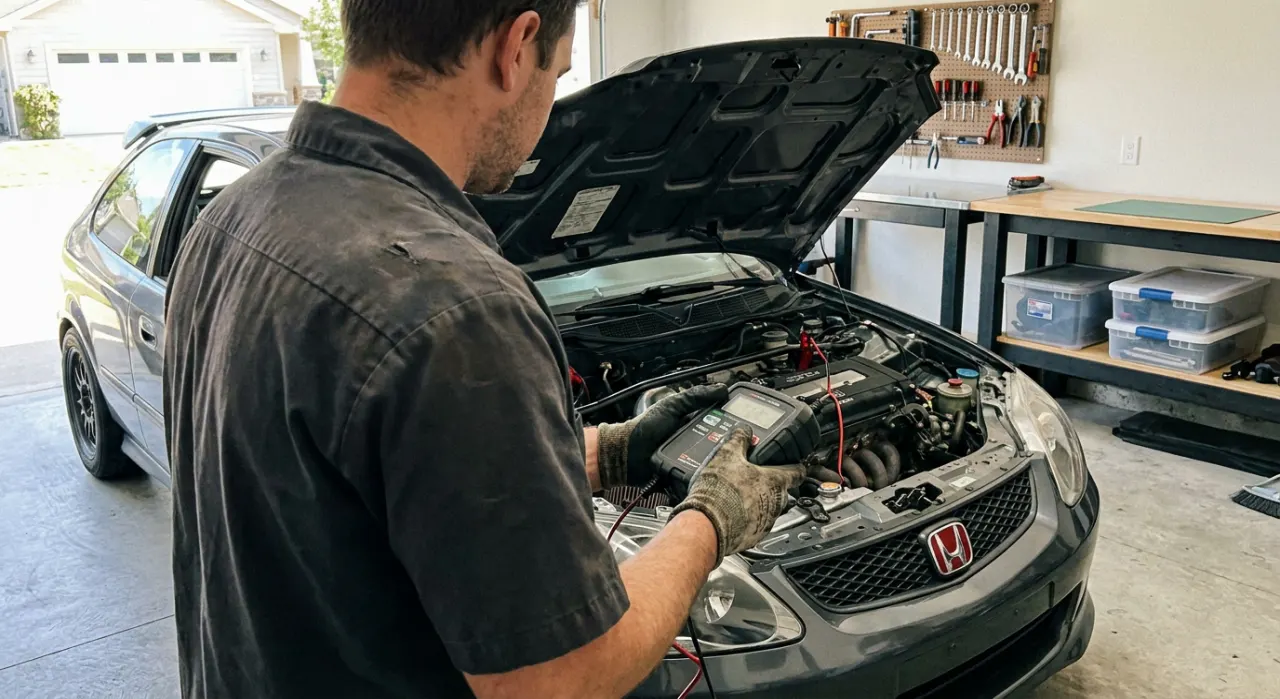
The most important thing to check before you buy is not the price — it is what your car was engineered around. Over the past decade, automakers have rolled out start-stop systems that shut the engine off at every red light and restart it when you lift off the brake. Each of those restarts pulls a heavy current draw, and between them the battery runs accessories with the engine off. That is deep cycling, over and over, hundreds of times a day.
A flooded battery is simply not built for that. Its plates shed active material under repeated deep discharge, so a conventional battery dropped into a start-stop car can fail in as little as a year or two. Automakers know this, which is why virtually every start-stop vehicle ships with AGM (or the closely related EFB) from the factory, and the charging system is tuned for AGM's voltage profile. The mechanic consensus is blunt here: if your car has start-stop, an AGM replacement is not an upgrade, it is a requirement.
Beyond start-stop, the same logic applies to any car carrying a heavy electrical load — big infotainment screens, driver-assist sensors, remote start, or aftermarket audio, dash cams, winches, and trailer accessories that keep drawing when the engine is off. All of that adds cycling and standby drain that AGM handles far better. If your factory battery was AGM, the honest advice is to replace it with AGM. Downgrading to flooded to save a few dollars fights the way your charging system was calibrated and typically ends in a short battery life.

Lifespan, cost of ownership and value
On the shelf the gap looks stark — a flooded Group 35 might run $110–$200 while the AGM equivalent runs $180–$320. But the honest comparison is cost over the life of the car, not the sticker on day one, and that reframes the math considerably.
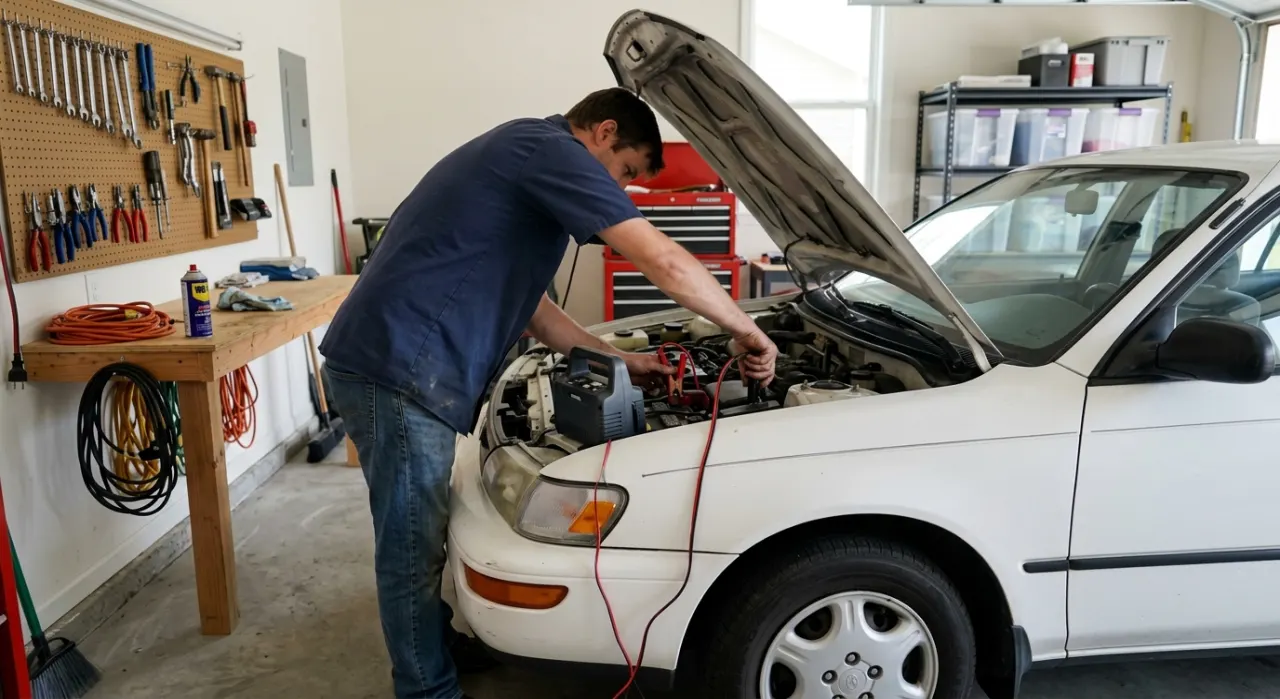
Based on aggregated owner reviews, a quality AGM battery commonly lasts four to seven years, while a flooded battery in the same duty more typically returns three to five. In a hot climate the flooded number drops further, because heat accelerates the evaporation and plate corrosion that a sealed AGM resists better. If an AGM lasts six years and a flooded lasts four, the AGM's higher price is spread across 50% more service life — and you have skipped one extra replacement and one extra afternoon in a parking lot with jumper cables.
That said, value is about fit, not just longevity. On an older, simpler car with no start-stop and a modest electrical load, a flooded battery will do everything the car asks of it and the extra AGM spend genuinely buys you very little. Paying AGM money to crank a 2005 economy sedan that only ever sees short daily trips is money that could stay in your pocket. Value comes from matching the battery to the demand: heavy cycling and standby drain reward AGM, light and simple duty does not.
One more real-world cost factor: AGM's sealed, low-corrosion design means cleaner terminals and less maintenance over its life. If you are the kind of owner who never opens the hood between oil changes, that zero-maintenance nature is worth something on its own.
Charging, overcharge risk and chargers
Here is where flooded actually has an edge, and it is worth being honest about it. AGM batteries are more sensitive to overcharging than flooded ones. Because the electrolyte is locked in mats and the case is sealed, an AGM cannot vent and replace lost water the way a flooded battery can. Feed it too much voltage — from a failing alternator, a badly set voltage regulator, or a cheap non-AGM trickle charger — and you drive off gas it cannot recombine, dry out the mats, and shorten its life. A flooded battery is more forgiving of a slightly high charging voltage because it can vent and, if serviceable, be topped back up.
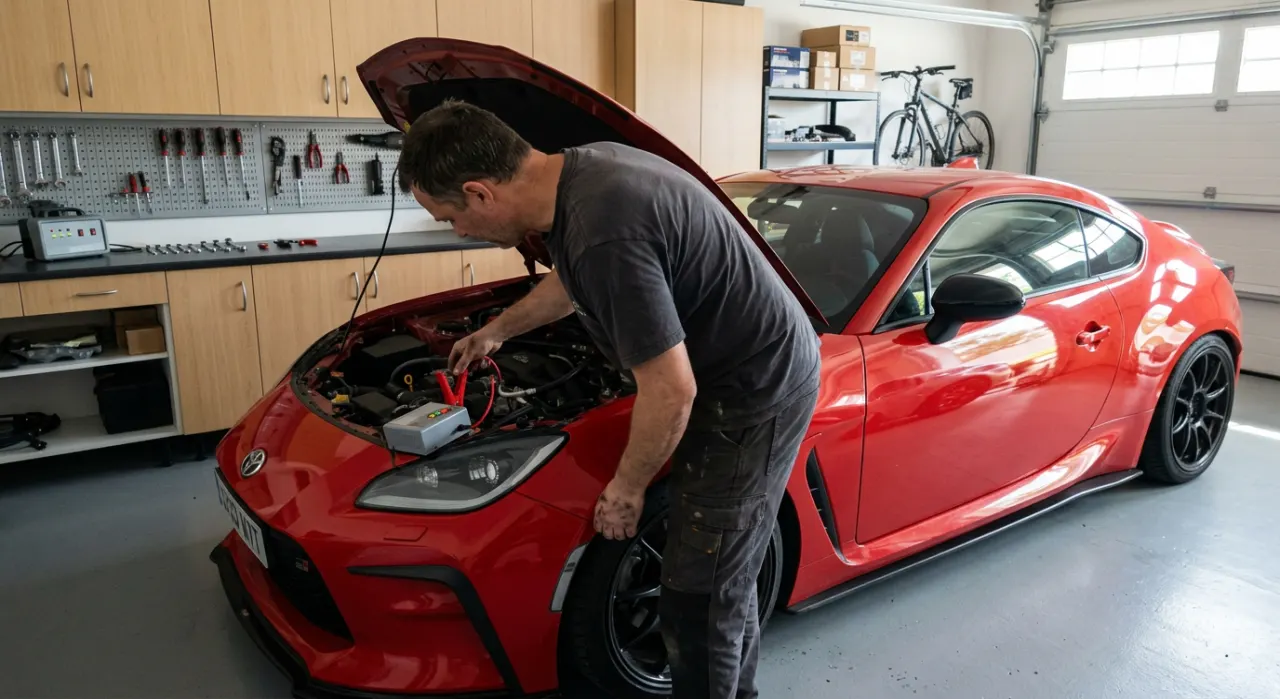
The practical consequences are simple. First, if you are charging or maintaining an AGM off the car, use a charger with an AGM or smart mode that caps the voltage correctly — most modern multi-stage chargers have one. A dumb, unregulated trickle charger left on an AGM for days is a known way to kill it. Second, if you are moving a car up from flooded to AGM, confirm the charging system is healthy and, on many vehicles, that the battery is registered/coded so the car charges it on the correct AGM profile. Many European cars in particular track battery type in the ECU and will mischarge a battery that does not match what they think is installed.
None of this makes AGM fragile in normal use — a healthy factory charging system tuned for AGM will treat it perfectly for years. It just means AGM assumes a properly regulated charge, whereas flooded shrugs off a sloppier one. If your charging system is old and running high, fix that before it eats an expensive AGM.
Common myths and mistakes
"AGM is a lithium battery." No. AGM is still lead-acid — same plates, same acid, same voltages. It just holds the electrolyte in glass mats. Lithium (LiFePO4) is a completely different chemistry with different charging needs and a much higher price; do not confuse the two.
"I can drop a cheaper flooded battery into my start-stop car to save money." This is the most expensive mistake on the list. The car will cycle a flooded battery to death in a fraction of its normal life, may throw charging or start-stop faults, and you will be buying another battery far sooner than you expected. Replace AGM with AGM.
"AGM never needs any care." It is maintenance-free in the sense that there is no water to add, but it still needs a healthy, correctly regulated charging system and an AGM-aware charger when maintained off the car. Overcharging is the one thing that will cut an AGM's life short.
"A higher CCA number means a better battery." Cold-cranking amps only measure cranking punch. It says nothing about cycle life, which is the whole reason AGM exists. For a start-stop or heavy-electronics car, cycle durability matters more than a few extra CCA, and that is AGM's real advantage.
"Any battery of the right size will fit." Group size gets you the physical fit and terminal layout, but chemistry and rating still have to match what the car expects. On coded systems, installing the wrong type without registering it means the car charges it incorrectly from day one.
Which should you buy — and how to decide
Start with what the factory installed and what your car demands, not with the price tag. That one check answers the question for most people before they compare a single spec.
Buy AGM if your car has start-stop, came with AGM from the factory, carries a heavy electrical load (big infotainment, driver-assist, remote start, aftermarket audio or accessories), gets parked for long stretches, or you simply want the longest, most maintenance-free service life and don't mind paying for it. For the majority of vehicles on the road built in the last ten years, this is the correct answer — and on a start-stop car it is the only correct answer.
Buy flooded if you have an older, simpler vehicle with no start-stop and a light electrical load, you want the cheapest reliable replacement, or you value being able to source a battery quickly and cheaply anywhere. On the right car, a flooded battery does the whole job and the AGM premium buys you almost nothing.
Whichever you choose, match the group size and terminal layout to your car, confirm the chemistry your charging system expects, register the battery if your vehicle codes it, and keep the terminals clean. Get the fit and the chemistry right first, and the AGM-versus-flooded question mostly answers itself.
Recommended Products
Our top picks in this category, ranked on aggregated owner reviews.
Best for recovering a flat car or truck battery in an afternoon
- 10A on 6V and 12V, 12V repair mode
- Selectable AGM and lithium profiles
- Thermal sensor adjusts for ambient temp
- Force mode charges from 0 volts
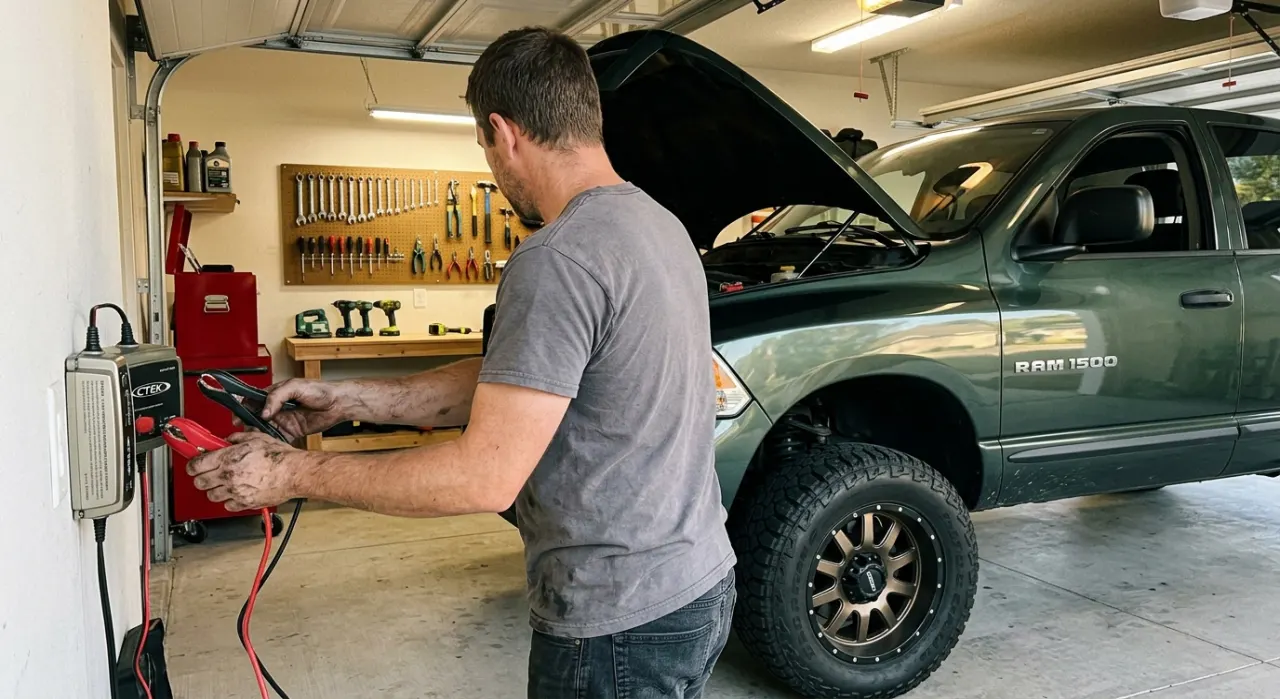
Why buy it: the 10-amp smart charger owners rate highest — fast enough to refill a dead group-35 battery in a few hours, then safe to leave on float indefinitely.
Best for one car, one charger, no complications
- 5A four-stage switch-mode charging
- Lead-acid, AGM, gel and lithium settings
- Automatic float when charging completes
- Clamps plus quick-connect ring harness
Why buy it: the sensible middle of the range — 5 amps suits a normal car battery, and owners like that it drops to float and can simply stay connected.
Best for app monitoring and adjustable charge profiles
- 15A adaptive multi-stage charging
- Bluetooth app with live and historic data
- IP65 water and dust resistant housing
- Lead-acid and LiFePO4 algorithms
Why buy it: the charger enthusiasts and van owners buy once — you can watch every stage on your phone and tune the profile to the exact battery.

Best for a charger that can also crank the engine right now
- 6A charge, 30A boost, 100A engine start
- 6V and 12V, automatic voltage detection
- Built-in battery and alternator tester
- Float mode for long-term maintenance
Why buy it: the do-everything wall charger — owners keep it for the engine-start mode that gets a dead vehicle moving without a second device.

Best for a small charger that still charges properly
- 5A on 6V and 12V, palm-sized housing
- AGM, lithium and repair modes
- Charges batteries down to 1 volt
- Mounting bracket and eyelets included
Why buy it: the charger that fits in a glovebox but behaves like a full smart charger — the best pick if garage wall space is the constraint.

Best for trucks, fleets and deeply discharged big batteries
- 30A bench charge, 80A engine start
- 2A maintainer mode built in
- 120V AC power outlet on the unit
- Digital display with alternator check
Why buy it: the shop-grade unit owners with diesel trucks and multiple vehicles buy — 30 amps refills a big battery fast when time actually matters.
Prices are pulled from Amazon and were accurate as of Aug 22, 2026, 6:44 PM EDT. Product prices and availability are subject to change — the live price is shown on Amazon.