
Affiliate Disclosure
Some links on this page are affiliate links. As an Amazon Associate, we earn from qualifying purchases — at no extra cost to you. We do not buy, test, or physically handle the products we cover; our rankings come from aggregated owner reviews, ratings and expert consensus. Commissions never change our verdicts. How we rank & full disclosure.
AGM Battery
An Absorbent Glass Mat battery holds its acid in a fine fiberglass mat pressed between the plates. It is the mainstream sealed-lead-acid upgrade found in most modern cars with start-stop systems.
Best for: Daily drivers, start-stop vehicles, trucks and anything with heavy factory electrical loads
Typically $180–$320 for a common Group 34/48/H6 size
- Handles the high cranking amps and constant cycling of start-stop engines
- Sealed and spill-proof — mounts in any orientation and needs no watering
- Much lower internal resistance, so it charges faster and holds voltage under load
- Widely stocked in every common car size; easy drop-in replacement
- Strong deep-cycle recovery compared to a standard flooded battery
- Costs roughly two to three times a basic flooded battery
- Very sensitive to overcharging — a bad alternator or charger can cook it
- Sealed design means a shorted cell can't be topped up or serviced
- Prefers an AGM-aware charger to avoid overvoltage on maintenance charging
Gel Battery
A gel cell suspends its electrolyte in a silica-thickened gel rather than a liquid or mat. It is a deep-cycle specialist common in mobility scooters, solar banks, and marine house-bank duty.
Best for: Deep-cycle house/solar/mobility duty and hot climates where slow, gentle discharge matters
Typically $200–$400 for a comparable deep-cycle size
- Exceptional deep-cycle life — tolerates being drained far lower than most batteries
- Very low self-discharge and strong tolerance to high ambient heat
- Fully sealed, spill-proof and vibration-resistant like AGM
- Handles long, slow discharges (solar, trolling motors) without damage
- Poor cold-cranking output — the gel restricts the huge current a starter needs
- Extremely fussy about charge voltage; overcharging permanently ruins the gel
- Requires a dedicated gel charge profile, not a generic charger
- More expensive and far less commonly stocked in automotive sizes
How they score, side by side
Scores reflect aggregated owner reviews and expert consensus — not our own bench testing.
- Engine cranking power94
- Deep-cycle endurance710
- Charging forgiveness63
- Heat / hot-climate tolerance79
- Automotive availability94
- Value for a car battery84
Spec-by-spec comparison chart
| Factor | AGM Battery | Gel Battery |
|---|---|---|
| Electrolyte form | Acid absorbed in a fiberglass mat | Acid set into a silica gel |
| Best role | Engine starting + light cycling | Deep cycling / slow discharge |
| Cold cranking amps | High — strong starter output | Low — poor for cranking engines |
| Deep-discharge tolerance | Good | Excellent — the deepest of the two |
| Charge voltage sensitivity | Sensitive — likes AGM profile | Very sensitive — needs gel profile |
| Heat tolerance | Good | Excellent in high ambient heat |
| Spill-proof / mount any way | Yes | Yes |
| Automotive size availability | Excellent — every common group | Limited — few car sizes |
| Typical price | $180–$320 | $200–$400 |
| Typical service life | 4–7 years in car duty | 5–10 years in deep-cycle duty |
Our Top 3 Picks
The three highest-rated options in this category, if you'd rather skip straight to a proven pick.

Best for recovering a flat car or truck battery in an afternoon
- 10A on 6V and 12V, 12V repair mode
- Selectable AGM and lithium profiles
- Thermal sensor adjusts for ambient temp
- Force mode charges from 0 volts
Why buy it: the 10-amp smart charger owners rate highest — fast enough to refill a dead group-35 battery in a few hours, then safe to leave on float indefinitely.

Best for one car, one charger, no complications
- 5A four-stage switch-mode charging
- Lead-acid, AGM, gel and lithium settings
- Automatic float when charging completes
- Clamps plus quick-connect ring harness
Why buy it: the sensible middle of the range — 5 amps suits a normal car battery, and owners like that it drops to float and can simply stay connected.
Best for app monitoring and adjustable charge profiles
- 15A adaptive multi-stage charging
- Bluetooth app with live and historic data
- IP65 water and dust resistant housing
- Lead-acid and LiFePO4 algorithms
Why buy it: the charger enthusiasts and van owners buy once — you can watch every stage on your phone and tune the profile to the exact battery.
Prices are pulled from Amazon and were accurate as of Aug 22, 2026, 6:44 PM EDT. Product prices and availability are subject to change — the live price is shown on Amazon.
What actually separates AGM from gel
Both AGM and gel are types of sealed, valve-regulated lead-acid (VRLA) battery, which is why they get lumped together and confused. Neither one sloshes liquid acid around, both are spill-proof, and both can mount at almost any angle. But the way each immobilizes its electrolyte changes everything about what the battery is good at.
In an AGM battery, the sulfuric-acid electrolyte is soaked into a thin, dense fiberglass mat — the "absorbent glass mat" — that is packed tight against the lead plates. Because the acid sits right on the plate surface with very little resistance in between, an AGM can deliver a huge burst of current on demand. That low internal resistance is exactly what a starter motor needs, and it is why nearly every start-stop vehicle rolls out of the factory with an AGM under the hood.
In a gel battery, the same acid is mixed with fumed silica until it sets into a thick, immobile gel, like a firm jelly. The gel is fantastic at surviving deep discharges and high heat without stratifying, but it also slows the movement of ions through the electrolyte. That raises internal resistance, which caps how much instantaneous current the battery can shove into a starter. The gel's strength is stamina, not a big burst.
The cleanest way to hold the difference in your head: AGM is a sprinter, gel is a marathon runner. AGM is built to dump a big pulse of amps to crank an engine and then get recharged; gel is built to give up its charge slowly over hours and be drained deeply again and again. Spec sheets bear this out — AGM units publish far higher cold-cranking-amp (CCA) ratings, while gel data sheets emphasize cycle life at deep depth-of-discharge.

Cranking power vs deep-cycle endurance
This is the trade-off that decides almost every real purchase, so it is worth being precise about what each battery actually does well.
Cold-cranking amps (CCA) measure how much current a battery can push at 0°F for 30 seconds without its voltage collapsing — in other words, how well it starts an engine on a cold morning. Because of its low internal resistance, an AGM battery posts strong CCA numbers and holds voltage while the starter drags. A gel battery's higher internal resistance means it simply cannot deliver that same surge; the consensus among installers is that gel makes a mediocre starting battery and a poor one in cold weather.
Deep cycling is the opposite skill: how many times the battery can be drained far down and recharged before it dies. Here gel is the champion. Owner reports and manufacturer cycle-life charts consistently show gel surviving deeper, more repeated discharges than AGM, which is why gel dominates in solar storage, mobility scooters, wheelchairs and marine house banks — loads that trickle current out for hours rather than demanding a two-second burst.
AGM sits in a useful middle. It cranks like a strong starting battery and tolerates moderate cycling — running accessories, winches, and start-stop restarts — better than a plain flooded battery. That dual-purpose flexibility is a big part of why AGM, not gel, became the mainstream automotive upgrade. For a vehicle you actually start and drive, AGM's balance beats gel's specialization nearly every time.
Charging: why voltage is the whole game
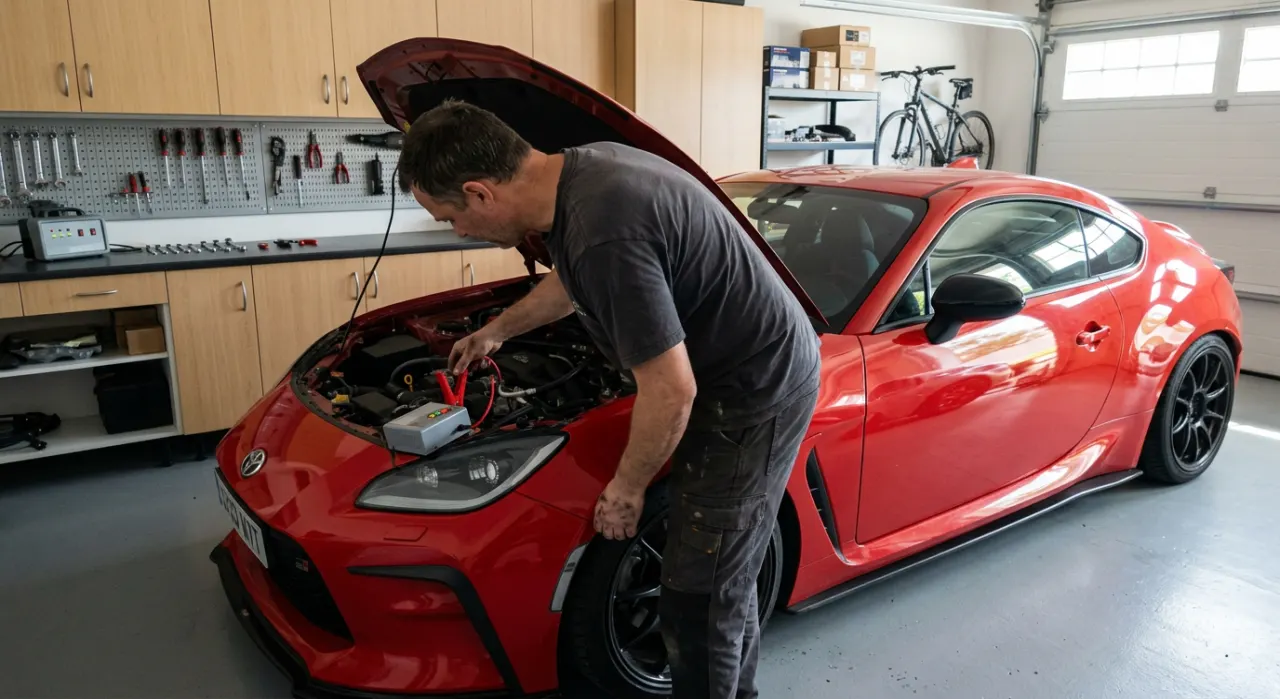
Both chemistries are far fussier about charging than an old flooded battery, and this is where people quietly destroy expensive batteries. VRLA cells are sealed, so any gas they vent from overcharging is lost for good — you cannot pop a cap and add distilled water to recover them.
AGM batteries want a charge voltage in the rough range of 14.4–14.7V absorption and around 13.5–13.8V float, and they strongly prefer a charger with an "AGM" setting that respects those ceilings. Most modern vehicle alternators are already tuned for AGM, which is why a factory-fit AGM lives happily on the car. The main hazard is a failing voltage regulator or a cheap charger that pushes too high and slowly cooks the mat dry.
Gel is even less forgiving. Its safe charge window is narrower and lower — typically capped nearer 14.1–14.4V — and pushing past it bakes bubbles into the gel that never heal, permanently reducing capacity. A generic charger, or a standard car alternator not set for gel, can ruin a gel battery in short order. The strong consensus is that gel demands a dedicated gel charge profile, full stop. This charging fragility, more than anything, is why gel never caught on as a car-starting battery: a normal automotive charging system is simply too aggressive for it.
The practical rule: match the charger to the chemistry. An AGM-aware smart charger for an AGM, a true gel profile for a gel, and never assume a charger labeled "for all lead-acid" actually protects either one.
Real cost and lifespan over the years
On the shelf, both cost well more than a basic flooded battery, and they land close to each other. A common automotive AGM in a Group 34, 48/H6 or 65 size typically runs $180–$320. A comparable deep-cycle gel unit usually runs $200–$400 and, critically, is harder to find in a size that fits a car battery tray at all.
The honest value comparison depends entirely on the job. For an engine-starting battery, AGM wins on cost and availability — you can buy one at any parts store, it drops straight in, and it will typically give four to seven years in normal car duty. Buying a gel battery to start a car means paying more for a battery that cranks worse and is fussier to keep charged; it is the wrong tool wearing a premium price tag.
For genuine deep-cycle duty, gel's math flips. In solar banks, mobility devices and marine house use, a gel battery routinely delivers more usable cycles at deep discharge and shrugs off high ambient heat, often lasting five to ten years where an AGM would tire sooner. Spread across hundreds of deep cycles, that longer service life can undercut the cost-per-cycle of an AGM even though the sticker price is higher. The lesson is that neither is "cheaper" in the abstract — value only appears once you fix the battery to its intended workload.

Common myths and mistakes
"Gel is just a better, premium AGM." No — they are different tools. Gel trades cranking power for deep-cycle stamina and heat tolerance. For starting an engine, that trade makes gel worse, not better. Neither is universally superior; they are optimized for opposite jobs.
"I can drop a gel battery into my car for longer life." This is the most expensive mistake. A standard alternator's charge voltage is usually too high for gel and will slowly cook it, and the gel's weak CCA means hard starts, especially in the cold. For a vehicle, AGM is the sealed upgrade that actually fits the electrical system.
"AGM and gel use the same charger." They don't. Their safe voltage windows differ, and a charger set for one can overcharge the other. Always select the correct AGM or gel profile — a "universal lead-acid" charger is not a guarantee.
"Sealed means maintenance-free forever." Sealed means you can't add water — it does not mean immortal. Chronic overcharging or deep abuse still kills both, and because they're sealed you can't recover a dried-out or shorted cell. Protecting the charge voltage is the real maintenance.
"They're interchangeable if the size matches." Physical fit is only half the story. Even where a gel battery fits the tray, its charging needs and cranking behavior differ from what the car expects. Match the chemistry to the electrical system, not just the dimensions.
Which should you buy — and how to decide
For anything that starts an engine, buy AGM. It delivers the high cranking amps a starter needs, tolerates the constant restarts of a start-stop system, plays nicely with modern alternators, and is stocked in every common automotive group size at a fair price. If your car came with an AGM from the factory — which most start-stop vehicles did — replace it with another AGM; a downgrade to flooded can confuse the charging system and shorten battery life.
Buy gel only for true deep-cycle duty — solar and off-grid storage, mobility scooters and wheelchairs, trolling motors, or a marine house bank — especially in hot climates where its heat tolerance shines. In those roles gel's deep-discharge endurance and long cycle life justify the higher price and the need for a dedicated gel charger.
Before you buy either, confirm two things: the correct group size for your application, and that your charging source (alternator or standalone charger) can supply the right voltage profile for that chemistry. Get those two right and the choice makes itself — AGM to crank an engine, gel to cycle deeply — and you avoid the costly mistake of forcing one battery to do the other's job.
Recommended Products
Our top picks in this category, ranked on aggregated owner reviews.
Best for recovering a flat car or truck battery in an afternoon
- 10A on 6V and 12V, 12V repair mode
- Selectable AGM and lithium profiles
- Thermal sensor adjusts for ambient temp
- Force mode charges from 0 volts
Why buy it: the 10-amp smart charger owners rate highest — fast enough to refill a dead group-35 battery in a few hours, then safe to leave on float indefinitely.
Best for one car, one charger, no complications
- 5A four-stage switch-mode charging
- Lead-acid, AGM, gel and lithium settings
- Automatic float when charging completes
- Clamps plus quick-connect ring harness
Why buy it: the sensible middle of the range — 5 amps suits a normal car battery, and owners like that it drops to float and can simply stay connected.
Best for app monitoring and adjustable charge profiles
- 15A adaptive multi-stage charging
- Bluetooth app with live and historic data
- IP65 water and dust resistant housing
- Lead-acid and LiFePO4 algorithms
Why buy it: the charger enthusiasts and van owners buy once — you can watch every stage on your phone and tune the profile to the exact battery.

Best for a charger that can also crank the engine right now
- 6A charge, 30A boost, 100A engine start
- 6V and 12V, automatic voltage detection
- Built-in battery and alternator tester
- Float mode for long-term maintenance
Why buy it: the do-everything wall charger — owners keep it for the engine-start mode that gets a dead vehicle moving without a second device.
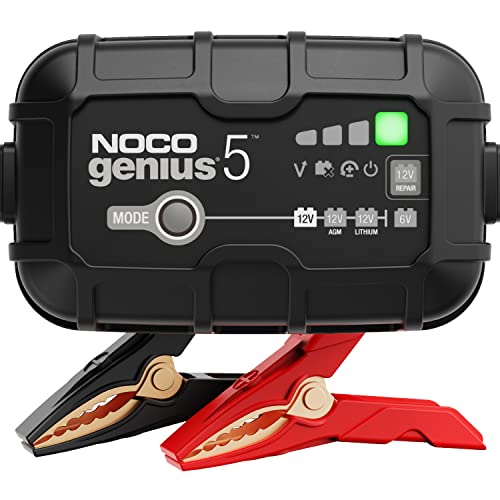
Best for a small charger that still charges properly
- 5A on 6V and 12V, palm-sized housing
- AGM, lithium and repair modes
- Charges batteries down to 1 volt
- Mounting bracket and eyelets included
Why buy it: the charger that fits in a glovebox but behaves like a full smart charger — the best pick if garage wall space is the constraint.

Best for trucks, fleets and deeply discharged big batteries
- 30A bench charge, 80A engine start
- 2A maintainer mode built in
- 120V AC power outlet on the unit
- Digital display with alternator check
Why buy it: the shop-grade unit owners with diesel trucks and multiple vehicles buy — 30 amps refills a big battery fast when time actually matters.
Prices are pulled from Amazon and were accurate as of Aug 22, 2026, 6:44 PM EDT. Product prices and availability are subject to change — the live price is shown on Amazon.