
Affiliate Disclosure
Some links on this page are affiliate links. As an Amazon Associate, we earn from qualifying purchases — at no extra cost to you. We do not buy, test, or physically handle the products we cover; our rankings come from aggregated owner reviews, ratings and expert consensus. Commissions never change our verdicts. How we rank & full disclosure.
All-Season Tires
A jack-of-all-trades tire tuned to work acceptably in dry, wet and light snow across a wide temperature band, so you can run one set year-round.
Best for: Mild-winter regions, low-snow commuters, anyone wanting one set of tires
Typically $110–$220 each (most passenger sizes)
- One set covers the whole year — no swap, no second storage
- Longer tread life, commonly warranted 50,000–80,000 miles
- Quieter and more fuel-efficient on warm, dry pavement
- Cheaper overall — no second set, wheels, or mounting fees
- Widely stocked in nearly every size at every shop
- Rubber stiffens below ~45°F, cutting grip on cold-but-dry roads
- Braking and traction on ice and packed snow are markedly worse
- Most lack the 3PMSF severe-snow rating winter tires carry
- A compromise everywhere — never the best tire for real winter
Winter (Snow) Tires
A cold-weather specialist with a soft silica compound and heavily siped tread that stays pliable and bites into snow and ice where all-seasons go hard and slick.
Best for: Snow-belt drivers, mountain commutes, anyone facing regular ice or deep cold
Typically $120–$260 each, plus optional dedicated wheels
- Compound stays flexible in deep cold for dramatically shorter ice stops
- Aggressive siping and biting edges grip packed snow and slush
- Carries the 3PMSF severe-snow rating for legal winter compliance
- Restores confident braking and cornering when temps drop below freezing
- Useless as a year-round tire — soft compound wears fast in summer heat
- Requires a seasonal swap twice a year plus off-season storage
- Higher total cost once a second set and mounting are counted
- Slightly noisier with marginally worse dry-road handling and economy
How they score, side by side
Scores reflect aggregated owner reviews and expert consensus — not our own bench testing.
- Cold / ice grip410
- Snow traction59
- Dry warm-road performance87
- Tread longevity95
- Year-round convenience104
- Value in a mild climate93
- Value in a snow belt49
Spec-by-spec comparison chart
| Factor | All-Season Tires | Winter (Snow) Tires |
|---|---|---|
| Best temperature range | Above ~45°F (7°C) | Below ~45°F (7°C) |
| Ice braking (0–20 mph, packed) | Long — reference baseline | ~30–40% shorter stops |
| Packed-snow traction | Marginal to fair | Strong — designed for it |
| Dry warm-road handling | Good | Slightly vague, softer |
| 3PMSF severe-snow rating | Rare (most lack it) | Standard on all true winters |
| Tread life | 50,000–80,000 mi warranty | ~20,000–40,000 mi (season use) |
| Rolling resistance / MPG | Lower — better economy | Higher — softer compound |
| Road noise | Quieter | Noisier, more aggressive tread |
| Seasonal swap needed | No — run year-round | Yes — twice a year |
| Cost per tire | $110–$220 | $120–$260 (+ swap/storage) |
Our Top 3 Picks
The three highest-rated options in this category, if you'd rather skip straight to a proven pick.
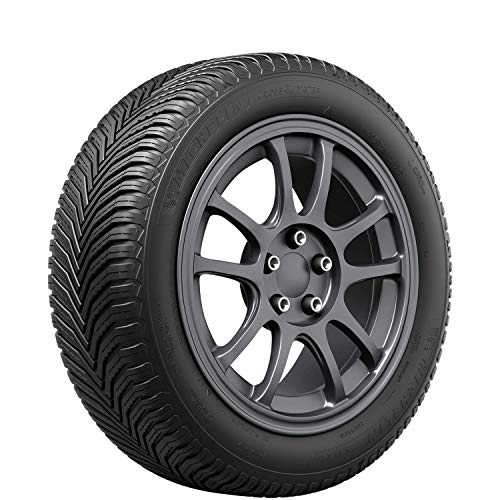
Best for the best all-round grip, wear and light-snow ability
- V-shaped tread with 3-peak-mountain-snowflake rating
- Class-leading wet and dry braking
- 60,000-mile treadwear warranty
- Real light-snow traction for an all-season
Why buy it: the tire owners and experts keep crowning as the best all-rounder — it brakes shorter in the wet than most rivals and genuinely handles snow, so it fits almost any driver in a four-season climate.

Best for the longest tread life on a sedan or minivan
- Up to 80,000-mile treadwear warranty
- Quiet, comfortable highway ride
- Strong wet grip and even wear
- Michelin’s longest-lasting all-season
Why buy it: the set-and-forget touring tire owners rate for outlasting everything else — fit it once and forget about tires for years.

Best for premium wet braking at a mid-range price
- Up to 80,000-mile treadwear warranty
- EcoPlus compound for shorter wet stops
- Fuel-efficient, low rolling resistance
- Wear indicators built into the tread
Why buy it: a hugely popular touring tire that delivers premium-brand wet performance and an 80k warranty for less than the flagships.
Prices are pulled from Amazon and were accurate as of Aug 22, 2026, 6:54 PM EDT. Product prices and availability are subject to change — the live price is shown on Amazon.
What actually separates the two tires
On the shelf they can look similar, but an all-season tire and a winter tire are engineered around opposite priorities, and the split comes down to two things: rubber chemistry and tread geometry.
All-season tires use a harder rubber compound tuned to survive summer heat and deliver long, even tread life. That hardness is a liability in the cold. As temperatures fall below roughly 45°F, the compound stiffens toward the consistency of a hockey puck, and a stiff tire cannot conform to the road surface to generate grip. The tread pattern is a moderate one, biased toward quiet highway manners and water evacuation rather than clawing into snow.
Winter tires flip both variables. The compound is a soft, silica-rich rubber specifically formulated to stay pliable in deep cold, so it keeps gripping when all-season rubber has gone slick. The tread carries dense siping — hundreds of tiny zig-zag slits that open into thousands of biting edges — plus deeper, blockier grooves that pack with snow. Counterintuitively, snow grips snow better than rubber does, so a tread that traps snow in its voids actually improves traction on a snowy road.
The consensus among tire engineers and winter-driving instructors is that this is not a marketing distinction. Independent braking tests, from bodies like Consumer Reports and various European auto clubs, consistently show large, repeatable gaps between the two categories once the thermometer drops — gaps big enough to matter in an emergency stop.
The 45°F rule: why temperature beats snow
The most common mistake drivers make is treating winter tires as "snow tires" — something you only need if there is snow on the ground. The more accurate mental model is that they are cold-weather tires. The dividing line the industry uses is about 45°F (7°C), and it is a chemistry threshold, not a weather one.
Below that temperature, an all-season compound hardens and its grip falls off measurably even on bare, dry pavement — dry braking distances lengthen and cornering grip drops before a single snowflake has fallen. A winter compound, meanwhile, is doing exactly what it was designed to do. This is why owners in cold-but-dry climates who assume they "don't get enough snow to bother" are often surprised by how much more planted a winter set feels on a frosty, clear morning.
The practical takeaway is to look at your winter lows, not just your snowfall totals. A region that stays around 20–35°F for months with only occasional snow is still squarely winter-tire territory, because the all-season rubber is compromised the entire season. Conversely, a place that gets a rare dusting but stays above 45°F most of the time gains little from a dedicated winter tire.
Ice and snow braking: the numbers that matter
Grip is invisible until you need to stop, so braking distance is the single most useful way to compare these tires. Aggregated test data tells a consistent story:
- On ice, winter tires typically stop a car in roughly 30–40% less distance than all-seasons from low speed. At 20 mph on glare ice that difference can be one to two full car lengths — frequently the gap between stopping short and hitting the car ahead.
- On packed snow, the advantage is similar in magnitude, and it shows up in acceleration and cornering too, not just braking.
- On cold, dry pavement, the gap narrows but still favors the winter tire below freezing, because the compound advantage applies regardless of surface.
One point worth stressing: all-wheel drive does not close this gap. AWD helps you accelerate and get moving, but it does nothing for braking or cornering grip — those come entirely from the four contact patches. A heavy AWD SUV on hard all-season rubber can out-accelerate and then dramatically out-stop a light front-drive car on winter tires, and owners who learn this the hard way usually learn it at an intersection. Tires, not drivetrain, are what stop you.
Real cost over the life of the tires
On paper the winter-tire route looks expensive: you are buying a second set of four, and if you mount them on dedicated wheels, that is another cost up front. But the honest accounting is more even than the sticker suggests, because you are not running two sets simultaneously — you are alternating them.
Every mile you drive on winters is a mile you are not putting on your all-seasons. Two sets sharing the annual mileage each last roughly twice as long in calendar years, so the total tread you buy over a decade is not far off what you would have bought anyway. The genuine extra costs are the second set of wheels (optional but strongly recommended — bare tire swaps twice a year add up in mounting and balancing fees) and off-season storage space.
The other side of the ledger is harder to price but real: a single avoided winter collision — deductible, premium increase, downtime — dwarfs the cost of a tire set. For a snow-belt driver, dedicated winters are closer to cheap insurance than to a luxury. For a mild-climate driver, none of that applies and the second set is simply money spent on capability you will not use.
Common myths and mistakes
A few persistent misconceptions steer people wrong:
- "I only need two winter tires on the drive wheels." This is dangerous. Mixing winter tires on one axle and all-seasons on the other creates a grip imbalance that can snap the low-grip end loose — front understeer or rear oversteer — mid-corner. Winter tires go on all four wheels, always.
- "All-season means all-weather, so I'm covered." The name oversells it. "All-season" is really three-season; the category was named decades ago and most all-seasons do not carry the severe-snow rating.
- "My AWD makes winter tires unnecessary." As above — AWD helps you go, not stop or turn. It is a traction aid, not a grip substitute.
- "I can leave winters on all year to save the swap." The soft compound wears rapidly in summer heat and delivers vague, squirmy handling, so you burn through an expensive tire for worse performance. Swap them off in spring.
All-season vs all-weather: not the same thing
There is a genuine middle option that muddies the choice, and it is worth naming clearly. All-weather tires (sometimes called all-season 3PMSF) are a distinct newer category: they carry the Three-Peak Mountain Snowflake severe-snow rating that standard all-seasons lack, using a more cold-tolerant compound while still being legal and durable enough to run year-round.
They are a real compromise, not a gimmick — the consensus is that a good all-weather tire gives up some peak winter grip to a dedicated snow tire and some summer longevity to a standard all-season, landing usefully in between. For a driver in a moderate winter climate who genuinely will not swap tires seasonally, an all-weather set is often the honest best answer, and worth asking for by name. Just do not confuse the 3PMSF-rated all-weather tire with an ordinary all-season, which is not built for real snow.
Which one should you actually buy?
Choose dedicated winter tires if your region regularly drops near or below freezing for a chunk of the year, you see recurring snow or ice, you commute over a mountain pass, or you simply want the shortest possible stopping distance when conditions turn — the safety margin is large and measurable, and it is the one thing no all-season can match.
Choose all-season tires if you live somewhere that rarely freezes and almost never accumulates snow. In a mild climate a winter tire is wasted money that wears out in the heat, and a quality all-season delivers longer life, lower noise, better economy and the convenience of never swapping.
If you are honestly in between — moderate cold, occasional snow, and no appetite for a seasonal swap — look hard at a 3PMSF-rated all-weather tire rather than defaulting to a standard all-season. The right move here is dictated by your climate and your willingness to swap, which is exactly why this comparison has no universal winner.
Recommended Products
Our top picks in this category, ranked on aggregated owner reviews.
Best for the best all-round grip, wear and light-snow ability
- V-shaped tread with 3-peak-mountain-snowflake rating
- Class-leading wet and dry braking
- 60,000-mile treadwear warranty
- Real light-snow traction for an all-season
Why buy it: the tire owners and experts keep crowning as the best all-rounder — it brakes shorter in the wet than most rivals and genuinely handles snow, so it fits almost any driver in a four-season climate.
Best for the longest tread life on a sedan or minivan
- Up to 80,000-mile treadwear warranty
- Quiet, comfortable highway ride
- Strong wet grip and even wear
- Michelin’s longest-lasting all-season
Why buy it: the set-and-forget touring tire owners rate for outlasting everything else — fit it once and forget about tires for years.
Best for premium wet braking at a mid-range price
- Up to 80,000-mile treadwear warranty
- EcoPlus compound for shorter wet stops
- Fuel-efficient, low rolling resistance
- Wear indicators built into the tread
Why buy it: a hugely popular touring tire that delivers premium-brand wet performance and an 80k warranty for less than the flagships.

Best for the most tire for the money
- Up to 75,000-mile treadwear warranty
- "Replace Tire" wear indicator in the tread
- Reliable wet braking and light-snow grip
- Backed by Continental’s parent company
Why buy it: the value pick owners rate again and again — a genuinely good touring tire with a 75k warranty at a bargain price.

Best for confidence in rain and winter slush
- 3-peak-mountain-snowflake certified
- Evolving Traction Grooves for wet grip
- 60,000-mile treadwear warranty
- Strong all-weather safety focus
Why buy it: the pick for drivers who see a lot of rain and the occasional storm — a true all-weather tire that carries the winter certification most all-seasons lack.

Best for sporty cars that still need year-round use
- Ultra-high-performance all-season design
- Excellent dry, wet and light-snow grip
- Tread wear indicators (DWS letters)
- A perennial enthusiast favorite
Why buy it: the enthusiast’s all-season — near-summer-tire dry grip with real wet and light-snow ability, so a sports sedan can run one set all year.
Prices are pulled from Amazon and were accurate as of Aug 22, 2026, 6:54 PM EDT. Product prices and availability are subject to change — the live price is shown on Amazon.