
Affiliate Disclosure
Some links on this page are affiliate links. As an Amazon Associate, we earn from qualifying purchases — at no extra cost to you. We do not buy, test, or physically handle the products we cover; our rankings come from aggregated owner reviews, ratings and expert consensus. Commissions never change our verdicts. How we rank & full disclosure.
Aluminum Floor Jack
A lightweight, racing-derived jack built from aircraft-grade aluminum. Prized by track-day drivers and anyone who lifts the jack in and out of a trunk more than they lift cars with it.
Best for: Track days, autocross, transporting the jack, low or tight cars, and damp garages where rust is a real concern
Typically $150–$400 (dual-pump racing aluminum can run $300–$600)
- Roughly half the weight of comparable steel — commonly 25–60 lb, easy to carry to the track
- Corrosion-resistant — shrugs off humidity and road salt that would rust a steel jack
- Often built low-profile with dual-piston "quick lift" pumps that reach the car in 3–4 strokes
- Genuinely portable for track days, autocross, trailers and roadside use
- Aluminum saddle and frame keep the whole package light without feeling flimsy on quality units
- Costs two to three times a steel jack of the same rated capacity
- Most models top out at 1.5–3 tons; higher-capacity aluminum is rare and expensive
- Aluminum tolerates less abuse — overloading or hard drops can crack a casting or weld
- Heavy-duty aluminum jacks add so much material they erase much of the weight savings
Steel Floor Jack
The classic garage workhorse — heavy, inexpensive and close to indestructible, with capacity to spare for trucks and SUVs. Built to sit in one bay and outlast the car it lifts.
Best for: Home and pro garages where the jack stays put, higher-capacity lifting, and the best value per dollar
Typically $60–$250 (heavy-duty 3–4 ton shop jacks $150–$350)
- Far cheaper — the best value per ton of capacity by a wide margin
- Higher capacities are easy to find — 2, 3 and 4 tons and up for trucks and SUVs
- Tolerates drops, overloading and general shop abuse far better than aluminum
- Simple, proven hydraulics that are cheap and easy to reseal instead of replace
- Heavy — commonly 60–95+ lb, awkward to lift into a trunk or carry any distance
- Prone to rust, especially in humid climates or where roads are salted
- Bulk and weight make it a poor track-day or roadside companion
How they score, side by side
Scores reflect aggregated owner reviews and expert consensus — not our own bench testing.
- Portability / low weight93
- Maximum lifting capacity69
- Value for money59
- Durability / abuse tolerance79
- Corrosion resistance95
- Lift speed & ease of use87
Spec-by-spec comparison chart
| Factor | Aluminum Floor Jack | Steel Floor Jack |
|---|---|---|
| Jack weight (the tool itself) | Light — commonly 25–60 lb | Heavy — commonly 60–95+ lb |
| Typical capacity | 1.5–3 tons | 2–4 tons (and higher) |
| Price range | $150–$400+ | $60–$250 |
| Value per ton of capacity | High cost per ton | Best value per ton |
| Portability | Excellent — built to travel | Poor — meant to stay put |
| Corrosion resistance | Excellent — will not rust | Poor — rusts without care |
| Abuse / drop tolerance | Lower — castings can crack | High — shrugs off shop life |
| Low-profile / quick-lift options | Very common (racing-derived) | Common on mid and premium models |
| Best environment | Track, trailer, damp garage, roadside | Fixed home or pro garage |
| Typical service life | Long if never overloaded | Long; easy and cheap to reseal |
Our Top 3 Picks
The three highest-rated options in this category, if you'd rather skip straight to a proven pick.

Best for the best mix of brand pedigree, warranty and price
- 72-tooth ratchets for a 5° swing arc
- Polished chrome-vanadium, anti-slip sockets
- DEWALT full lifetime warranty
- Compact SAE + metric set in a blow-mould case
Why buy it: a name-brand kit that owners rate at the very top of the budget class — the lifetime warranty and fine-tooth ratchets punch well above the price, which is why it keeps getting recommended to first-time wrenchers.
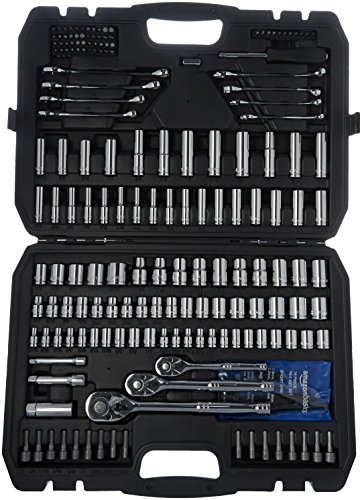
Best for the most sockets and bits per dollar
- 201 pieces across 1/4", 3/8" and 1/2" drives
- Chrome-vanadium forged, polished-chrome finish
- Full SAE + metric coverage
- Molded case keeps every socket in its slot
Why buy it: a socket-heavy kit that owners repeatedly call the best money-for-metal buy on Amazon — if your jobs are mostly nuts and bolts, nothing here gives you more drive tools for the outlay.

Best for trusted-brand tools with a lifetime guarantee
- 72-tooth reversible ratchets
- Alloy-steel sockets, off-corner loading grip
- Crescent lifetime warranty
- Closed, latching blow-mould case
Why buy it: an Apex Tool Group set that owners rate for genuine fit and finish — the off-corner grip protects rounded fasteners, and the lifetime backing means a cracked socket is a free swap.
Prices are pulled from Amazon and were accurate as of Aug 22, 2026, 6:54 PM EDT. Product prices and availability are subject to change — the live price is shown on Amazon.
What actually separates aluminum from steel
Both jacks do the exact same job — a hydraulic pump forces oil into a cylinder, a piston pushes a lift arm, and a saddle raises one corner of your car. The mechanism is identical. What changes is the metal the frame, lift arm and saddle are built from, and that single choice cascades into weight, price, capacity and how long the jack survives.
The catch is that aluminum has a lower yield strength than steel, pound for pound of a finished part. To hit the same rated capacity, an aluminum jack needs thicker, bulkier castings and reinforcement. That is why a 3-ton aluminum jack still weighs far less than a 3-ton steel one, but also why aluminum gets expensive and heavy fast as capacity climbs — the design has to add a lot of material to stay safe. Steel does the structural work with thinner sections, so it is cheaper to build strong, just heavier to carry.
The consensus among mechanics and track-day regulars is blunt: aluminum is a portability play, steel is a value play. Neither is "better" in a vacuum — they are optimized for opposite priorities, and the honest comparison is about which priority is yours.
Weight and portability — the real dividing line
This is the whole reason aluminum jacks exist, and it is where the two diverge most. A quality aluminum service jack commonly weighs 25–60 lb. A comparable steel jack of the same capacity routinely runs 60–95 lb or more, and heavy-duty 3–4 ton steel shop jacks can push past 100 lb. That is the difference between one-handing the jack into a trunk and wrestling a dead weight across the garage floor.
If the jack lives on one concrete slab and never moves, that weight is irrelevant — arguably a heavy steel base feels more planted. But the moment you need the jack somewhere else, the calculus flips hard:
- Track days and autocross: you are loading the jack into a car or trailer before every event and using it in a hot paddock. Aluminum's weight saving is the entire point, which is why almost every paddock jack is aluminum.
- Roadside or a second location: a 30 lb aluminum jack rides in a hatchback or truck bed; a 90 lb steel unit does not.
- Apartment or shared garages: if the jack gets carried or stored on a shelf, aluminum is far easier to live with.
One honest caveat owners raise often: the weight gap shrinks at the top of the range. A genuine heavy-duty 3-ton aluminum jack packs in so much reinforcement that it can weigh 55–65 lb — no longer featherweight. The dramatic savings live in the 1.5–2 ton low-profile aluminum jacks, which is exactly the segment track drivers buy.
Lifting capacity and what your car actually needs
Capacity ratings scare people into overbuying, so it is worth being precise. A "2-ton" jack is rated to lift 4,000 lb — but you are only lifting one corner of the car at a time, not the whole thing. A corner of a typical sedan carries roughly 700–1,200 lb, so a 2-ton jack has a large safety margin for most passenger cars.
Where capacity actually matters is heavier metal. A full-size truck or body-on-frame SUV puts far more on each corner, and the jack also has to reach a taller frame, so buyers there step up to 3-ton (and heavier) jacks. This is where steel pulls ahead: 3-ton and 4-ton steel jacks are common, affordable and everywhere, while high-capacity aluminum is a specialty item that costs a premium. The spec sheets tell the story plainly — aluminum clusters at 1.5–3 tons, steel spans 2 tons up to 10-plus for shop and truck duty.
A few capacity realities worth internalizing:
- Match capacity to your heaviest vehicle, not your lightest. A 2-ton aluminum jack is perfect for a Miata and marginal under a loaded pickup.
- Lift range matters as much as tonnage. Check minimum saddle height (low-profile jacks start near 3–3.5 inches for lowered cars) against maximum lift, which needs to clear a truck's frame.
- A jack is never a support. Whatever the metal or rating, the hydraulic seal can fail — the mechanic consensus is absolute: raise the car, then set jack stands and let the car rest on them before any part of you goes underneath.
Durability, corrosion and lifespan
Both jacks last a long time when treated well, but they fail differently. Steel is the abuse champion: aggregated owner reports show steel jacks surviving drops, overloading and years of professional shop life that would crack an aluminum casting. When a steel jack finally tires, it is usually a leaking hydraulic seal — a cheap, easy reseal rather than a replacement. That reparability is a quiet part of steel's value story.
Steel's weakness is rust. In a humid climate, a coastal region or anywhere roads get salted, an unprotected steel jack develops surface corrosion on the ram and pivots, and a pitted ram eventually chews up its seal. Aluminum simply does not rust, which is why owners in damp garages, boats-and-trailers households, and salt-belt states gravitate toward it despite the price.
Aluminum's vulnerability is the flip side of its strength. It tolerates less overload before the metal yields, and a hard drop or a heavily abused racing jack can crack a weld or casting rather than bend gracefully the way steel does. Buy a reputable aluminum jack that meets the ASME PALD safety standard, never exceed its rating, and it will last for years — but it rewards being respected in a way a steel jack does not demand.
Real cost and value over the life of the jack
On price the gap is stark and consistent. A solid steel 2-ton jack lands around $60–$120; a 3-ton around $120–$250. A comparable aluminum jack starts near $150 and a dual-pump racing aluminum unit runs $300–$600. Measured as cost per ton of capacity — the fairest way to compare — steel is dramatically cheaper, and that advantage widens as you climb into higher tonnage.
So the value question is really "what am I paying the premium for?" With aluminum, you are buying weight savings and corrosion resistance, full stop. If you transport the jack or fight rust, that premium buys something you use every single time. If the jack sits in a dry garage and never travels, you are paying more for a benefit you will not feel — steel gives you the same lift, more capacity headroom, and a repairable design for less money.
There is a sensible middle path worth knowing about: hybrid jacks that pair an aluminum body with a steel lift arm or components. They land between the two on both weight and price, keeping the jack manageable to carry while restoring some of steel's strength and capacity. For a buyer who occasionally moves the jack but still wants respectable tonnage, a hybrid is often the smartest spend.

Common myths and mistakes
"Aluminum jacks are flimsy toys." Not if you buy a reputable one rated for your load. Quality aluminum jacks meet the same ASME PALD safety standard as steel and are trusted under six-figure race cars every weekend. The real limit is overloading — respect the rating and they are perfectly safe.
"Get the highest tonnage you can afford." Overbuying capacity mostly buys weight and cost. You lift one corner, not the whole car, so a 2-ton jack clears most passenger cars easily. Spend the extra on lift range, a low-profile design or build quality instead of chasing tonnage you will never use.
"A heavier jack is a safer jack." Weight is not strength. A well-engineered aluminum jack at its rated capacity is exactly as safe as a heavier steel one at the same rating. What keeps you alive is jack stands and staying within the rating — not the mass of the tool.
"Any jack that lifts the car is fine to work under." Never. The single most repeated mistake in aggregated reports is trusting hydraulics alone. Both metals can drop a car if a seal blows. Lift, place stands, lower onto them, and confirm the car is stable before you slide under.
Which should you buy — and how to decide
There is no universal winner — the deciding question is simply how often the jack will travel. Answer that honestly and the choice makes itself.
Buy aluminum if you take the jack to a track or a second location, lift a low or lowered car, store the jack on a shelf, or fight rust in a humid or salted environment. Prioritize a low-profile model with a dual-piston quick-lift pump, and match its 1.5–3 ton rating to your car — this is where aluminum is genuinely worth its premium.
Buy steel if the jack lives in one garage, you want maximum value per dollar, or you lift a truck or SUV that needs 3-plus tons and a taller lift range. You will accept the weight and a little rust care in exchange for a cheaper, tougher, repairable tool.
Consider a hybrid if you land in the middle — you move the jack occasionally but still want real capacity. Whatever you choose, buy from a reputable brand, confirm it meets the ASME PALD standard, check minimum and maximum lift height against your actual vehicle, and pair it with a good set of jack stands. Get the use case right first, and the aluminum-versus-steel question answers itself.
Recommended Products
Our top picks in this category, ranked on aggregated owner reviews.
Best for the best mix of brand pedigree, warranty and price
- 72-tooth ratchets for a 5° swing arc
- Polished chrome-vanadium, anti-slip sockets
- DEWALT full lifetime warranty
- Compact SAE + metric set in a blow-mould case
Why buy it: a name-brand kit that owners rate at the very top of the budget class — the lifetime warranty and fine-tooth ratchets punch well above the price, which is why it keeps getting recommended to first-time wrenchers.
Best for the most sockets and bits per dollar
- 201 pieces across 1/4", 3/8" and 1/2" drives
- Chrome-vanadium forged, polished-chrome finish
- Full SAE + metric coverage
- Molded case keeps every socket in its slot
Why buy it: a socket-heavy kit that owners repeatedly call the best money-for-metal buy on Amazon — if your jobs are mostly nuts and bolts, nothing here gives you more drive tools for the outlay.
Best for trusted-brand tools with a lifetime guarantee
- 72-tooth reversible ratchets
- Alloy-steel sockets, off-corner loading grip
- Crescent lifetime warranty
- Closed, latching blow-mould case
Why buy it: an Apex Tool Group set that owners rate for genuine fit and finish — the off-corner grip protects rounded fasteners, and the lifetime backing means a cracked socket is a free swap.

Best for a first-ever kit that covers the whole garage and house
- Sockets, wrenches, screwdrivers, hammer, pliers
- Heat-treated carbon steel, rust-resistant
- Compact blow-mould carry case
- One of Amazon’s best-selling tool kits
Why buy it: the entry point owners recommend for a first toolbox — rated across tens of thousands of reviews, it handles light auto work and household jobs without asking much of your wallet.
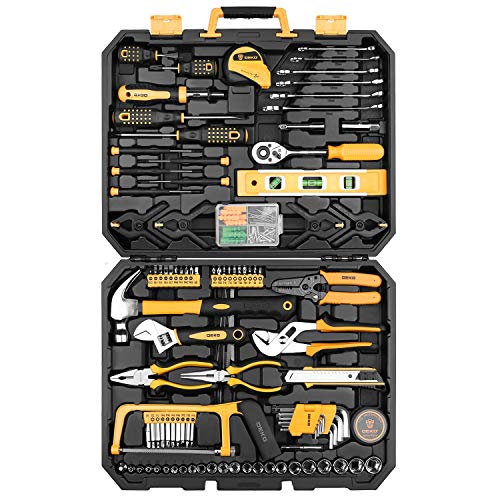
Best for a purpose-built car-repair combination
- 168-piece socket + wrench combination
- Ratchet handle, extension bars, spark-plug socket
- Chrome-vanadium and carbon-steel mix
- Deep plastic storage case
Why buy it: a combination set owners lean on for actual under-hood jobs — the spark-plug socket, extensions and combination wrenches mean fewer trips to buy the one tool you’re missing.

Best for the most complete kit before you leave the budget tier
- 201-piece mechanics set, SAE + metric
- 72-tooth quick-release ratchets
- Black-chrome sockets with laser-etched sizes
- Sturdy structural-foam case
Why buy it: the ceiling of the budget class — owners rate its ratchets and easy-read sockets highly, and the Stanley name carries a reputation that a no-name kit can’t match at the same money.
Prices are pulled from Amazon and were accurate as of Aug 22, 2026, 6:54 PM EDT. Product prices and availability are subject to change — the live price is shown on Amazon.