
Affiliate Disclosure
Some links on this page are affiliate links. As an Amazon Associate, we earn from qualifying purchases — at no extra cost to you. We do not buy, test, or physically handle the products we cover; our rankings come from aggregated owner reviews, ratings and expert consensus. Commissions never change our verdicts. How we rank & full disclosure.
Power Capacitor
A large stiffening capacitor (typically 1–5 farads) wired next to the amplifier to buffer the electrical system during split-second bass peaks. It stores a small charge and dumps it fast to steady voltage.
Best for: Fixing brief headlight flicker on a modest single-amp system that is only slightly over its electrical headroom
Typically $40–$150 for a 1–5 farad cap, plus a few dollars in wire and fusing
- Cheap and compact compared with a second battery and its mounting hardware
- Delivers current extremely fast, so it can smooth very short transient bass hits
- Simple to add — mounts near the amp and wires in parallel with the power feed
- Adds almost no weight, unlike a 40–50 lb AGM battery
- No maintenance, no charging concerns, no separate isolator needed
- Stores only a tiny amount of energy — it buffers milliseconds, not sustained draw
- Does nothing about a weak alternator or an undersized main battery
- Must be charged before first use and can arc or spark if hooked up carelessly
- Installer consensus is that it masks symptoms rather than fixing the real shortfall
Second (Auxiliary) Battery
A dedicated AGM or deep-cycle battery added to the electrical system to hold real reserve energy for the amplifiers. It carries sustained current the alternator cannot supply on its own.
Best for: Higher-power builds and daily drivers whose lights dim under continuous bass or long idle listening
Typically $150–$350 for a quality AGM battery, plus $50–$150 for mounting, wiring and an isolator
- Holds real usable energy — supports sustained bass and long idle sessions, not just spikes
- A quality AGM tolerates the deep, repeated draw of car audio far better than a cap
- Genuinely extends how long you can play with the engine off before voltage sags
- Doubles as backup starting reserve when wired through a proper isolator
- Scales with the system — the fix that actually grows with more amplifier power
- Heavier, bulkier and more expensive to buy and mount than a capacitor
- Wants an isolator or DC-DC charger so it does not drain your starting battery
- Still limited by alternator output — it recharges from the same source
- AGM batteries need eventual replacement and add 40–50 lb to the vehicle
How they score, side by side
Scores reflect aggregated owner reviews and expert consensus — not our own bench testing.
- Sustained bass support39
- Transient peak smoothing77
- Fixes dimming lights48
- Value for the money58
- Ease of install85
- Weight / space cost94
Spec-by-spec comparison chart
| Factor | Power Capacitor | Second (Auxiliary) Battery |
|---|---|---|
| What it stores | A tiny charge (measured in farads) | Real energy (measured in amp-hours) |
| Best at | Very short transient bass peaks | Sustained draw and idle listening |
| Helps a weak alternator | No | Partly — adds reserve, not output |
| Typical size | 1–5 farads | 35–80 amp-hours (AGM) |
| Weight added | Roughly 3–8 lb | Roughly 40–50 lb |
| Part cost | $40–$150 | $150–$350 |
| Extra hardware | Fuse & short power lead | Isolator or DC-DC charger, mount, big cable |
| Backup starting power | None | Yes, wired through an isolator |
| Maintenance | Essentially none | Eventual replacement; keep it charged |
| Installer consensus | Largely outdated / overrated | The more reliable fix for most builds |
Our Top 3 Picks
The three highest-rated options in this category, if you'd rather skip straight to a proven pick.

Best for recovering a flat car or truck battery in an afternoon
- 10A on 6V and 12V, 12V repair mode
- Selectable AGM and lithium profiles
- Thermal sensor adjusts for ambient temp
- Force mode charges from 0 volts
Why buy it: the 10-amp smart charger owners rate highest — fast enough to refill a dead group-35 battery in a few hours, then safe to leave on float indefinitely.

Best for one car, one charger, no complications
- 5A four-stage switch-mode charging
- Lead-acid, AGM, gel and lithium settings
- Automatic float when charging completes
- Clamps plus quick-connect ring harness
Why buy it: the sensible middle of the range — 5 amps suits a normal car battery, and owners like that it drops to float and can simply stay connected.
Best for app monitoring and adjustable charge profiles
- 15A adaptive multi-stage charging
- Bluetooth app with live and historic data
- IP65 water and dust resistant housing
- Lead-acid and LiFePO4 algorithms
Why buy it: the charger enthusiasts and van owners buy once — you can watch every stage on your phone and tune the profile to the exact battery.
Prices are pulled from Amazon and were accurate as of Aug 22, 2026, 6:44 PM EDT. Product prices and availability are subject to change — the live price is shown on Amazon.
What a cap and a battery actually do
This comparison confuses people because a capacitor and a battery both promise the same headline result — steadier voltage so your lights stop dimming and your amp stops clipping on hard bass. But they solve the problem in fundamentally different ways, and understanding that difference is the whole decision.
A power capacitor — usually a 1 to 5 farad "stiffening cap" — stores a very small amount of energy and can release it almost instantly. Think of it as a fast, shallow bucket. When a kick drum or a bass drop demands a huge current spike for a fraction of a second, the cap dumps its charge to fill that gap before the alternator and battery can respond. The catch is right there in the physics: even a big 5-farad cap holds only a tiny fraction of the energy a battery does. It smooths milliseconds, not seconds.
A second battery is a deep, slow reservoir. A quality AGM auxiliary battery holds tens of amp-hours of usable energy, so it can feed the amplifiers through sustained bass passages, long songs, and extended listening at idle with the engine off. Where the cap is a sprinter that empties in an instant, the battery is the endurance runner. The consensus among car audio installers is that this difference is why the two parts are not really interchangeable — they cover different failure modes.
The cleanest way to remember it: a capacitor helps with the spike, a battery helps with the duration. Most people who notice dimming lights are actually short on duration, which is why the battery tends to win in the real world.
The real fix for dimming headlights
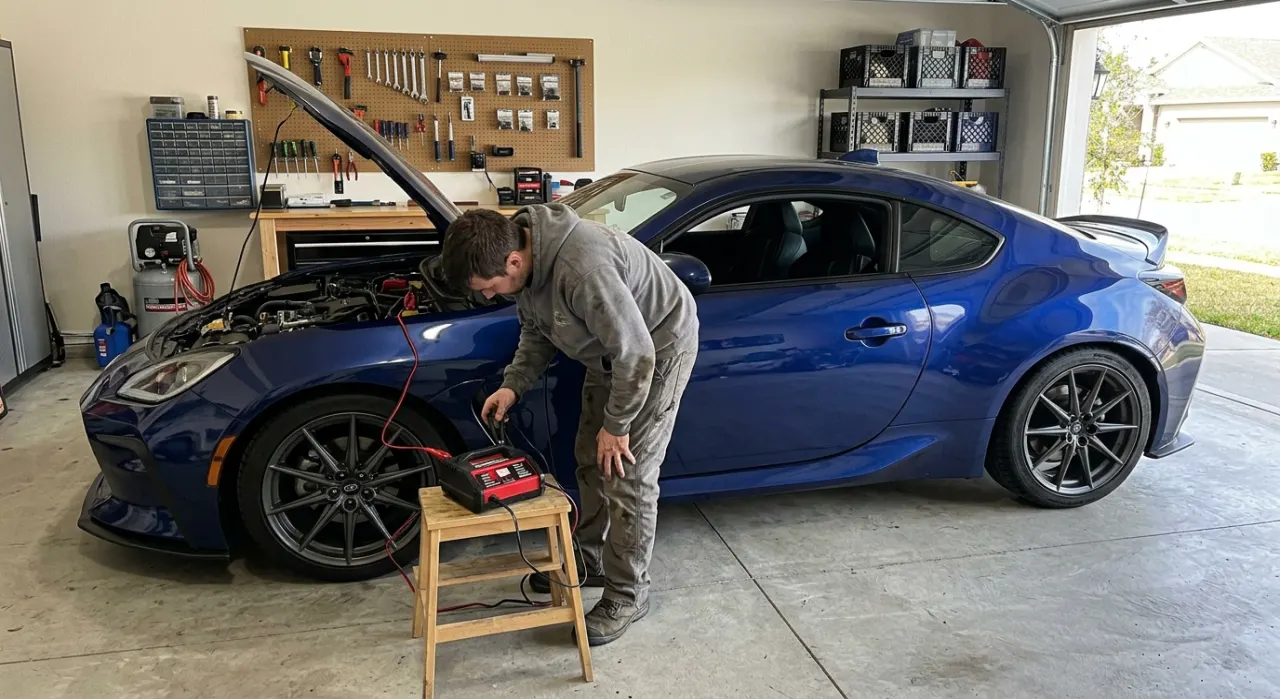
Dimming headlights on bass hits is the single most common reason people go shopping for a cap, so it deserves an honest answer. The dimming happens because your amplifier is momentarily pulling more current than the charging system can supply, and system voltage sags below the ~14.4 volts it should hold at.
Owners consistently report that a capacitor produces, at best, a marginal improvement here — it can take the very sharpest edge off a flicker on a modestly overtaxed system, but it does not stop the deeper, sustained dimming that shows up during continuous bass. That is because the cap empties in milliseconds and then becomes just another load waiting to recharge. Aggregated owner reviews and shop feedback point the same direction again and again: people who install a cap hoping to cure heavy dimming are usually disappointed.
A second battery helps more because it holds real reserve, so the system can lean on stored energy through a whole bass-heavy track instead of a single transient. But here is the part most sales pages leave out: if your alternator genuinely cannot make enough current, neither part is a cure. The battery buys you reserve, but it recharges from the same overworked alternator. The durable fix for serious dimming is more charging capacity — a high-output alternator and heavier gauge wiring — with a battery to hold the reserve.
How a stiffening capacitor actually works
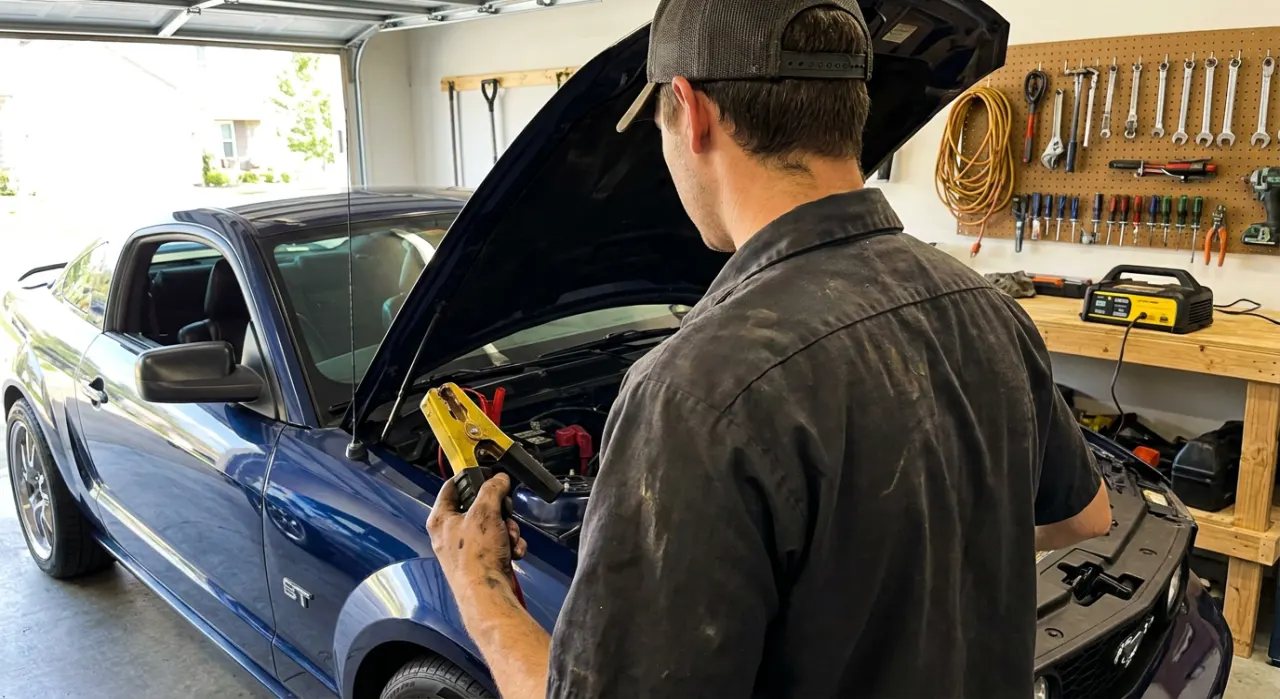
A stiffening cap wires in parallel with your amplifier's power feed, physically close to the amp so the buffered current has the shortest path. When system voltage is high, the cap charges up; when a bass transient drags voltage down, the cap discharges to prop it back up for that instant. It is doing genuine work — the effect is just very brief.
There are a couple of practical realities buyers should know. First, a capacitor must be pre-charged before you connect it, usually through a resistor or a test light, because slapping a fully discharged cap onto a live power wire causes a large spark and can pit the terminals. Second, the "digital voltmeter" on the face of most caps is a novelty, not a diagnostic tool — it reads the same voltage as any cheap meter.
Where a cap earns its keep is a narrow case: a single moderate amp that is only slightly beyond the comfortable headroom of an otherwise healthy electrical system, where the symptom is a quick flicker rather than sustained sag. In that specific scenario a cap is a cheap, light, no-maintenance way to tidy up the last bit of transient dip. Outside that narrow window, the installer consensus has shifted hard against caps over the last decade — many shops now consider them largely outdated for anything beyond mild systems.
What a second battery adds
A dedicated auxiliary battery — almost always an AGM (absorbed glass mat) type for audio — brings three things a cap cannot. It adds real usable capacity, so the amps ride through sustained bass instead of a single spike. It tolerates the deep, repeated discharge cycles of loud music far better than a standard flooded starter battery, which is why AGM is the near-universal recommendation. And wired through a proper isolator or DC-DC charger, it doubles as backup starting reserve, so a long parking-lot listening session with the engine off is less likely to leave you stranded.
The trade-offs are honest and physical. A quality AGM adds 40 to 50 pounds and needs a secure, vented-appropriate mounting location and heavy interconnect cable. You also want an isolator or a DC-DC charger so the audio battery does not quietly drain your starting battery when the engine is off — a mistake that leaves plenty of first-timers with a no-start in the morning. Done right, though, a second battery is the upgrade that actually scales: add more amplifier power later and the reserve is already there.
One nuance worth stating plainly: a second battery does not increase how much current your alternator can make. It only stores more of what the alternator produces. On a big system the battery and the alternator upgrade go together — the battery is the buffer, the alternator is the supply.

Why the alternator is the real bottleneck
This is the section the marketing skips, and it is the most important one. Your alternator is the source of all the current your audio system uses while driving. A typical factory alternator puts out somewhere around 90 to 140 amps, and a large chunk of that is already spoken for by the engine, lights, climate system and ignition. A pair of hungry amplifiers can easily ask for more than what is left.
When demand outruns supply, voltage sags — and that is the true root cause behind most dimming and clipping. A capacitor cannot manufacture current; it only briefly reshuffles what is already there. A second battery holds more reserve, but it refills from the same alternator, so on a sustained heavy load it too eventually runs the well dry. The consensus among serious installers is blunt: on any genuinely high-power build, the high-output alternator plus upgraded "big three" wiring (battery-to-chassis, engine-to-chassis, and alternator-to-battery grounds and feeds) is the fix that actually raises the ceiling. The battery is the reserve; the alternator is the answer.
If you are only chasing a mild flicker, you may never need to touch the alternator. But if you are stacking amps and still fighting voltage after adding a cap or a battery, stop throwing storage at the problem — you are short on supply, and only the charging system fixes that.

Common myths and mistakes
"A big farad cap will stop my lights from dimming." Mostly no. A cap smooths a millisecond transient, not the sustained sag that causes noticeable dimming. Owners chasing heavy dimming with a cap are usually let down. Reach for reserve and charging capacity instead.
"More farads is always better." Past a point, extra capacitance does little on a system that is really short on current. The old rule of thumb of "1 farad per 1,000 watts" is a loose guideline, not a cure for an undersized alternator.
"A second battery means I can skip the alternator upgrade." Only up to a point. The battery stores energy but recharges from the alternator. On a big build both are needed — the battery buffers, the alternator supplies.
"Any battery works as an audio battery." No. Deep, repeated audio discharge chews through a standard flooded starter battery. AGM is the near-universal recommendation for a reason, and it should be wired through an isolator so it doesn't drain your starting battery.
"I can just bolt the cap straight on." Skip the pre-charge step and you get a loud spark and pitted terminals. Charge it through a resistor or test light first, and fuse the power lead close to the source.
Which should you buy — and how to decide
For most people fighting real dimming, the second battery is the better buy of the two — it stores usable reserve, tolerates audio duty, and scales with the system. A capacitor only makes sense in a narrow case, and even then it is a patch rather than a fix.
Buy a capacitor if you run a single moderate amp on an otherwise healthy electrical system, the only symptom is a brief flicker on the sharpest bass hits, and you want the cheapest, lightest, no-maintenance way to take the last edge off. Keep expectations modest and pre-charge it properly.
Buy a second (AGM) battery if your lights dim through sustained bass, you listen at idle with the engine off, or you plan to add more amplifier power over time. Wire it through an isolator or DC-DC charger, use heavy cable, and mount it securely.
Upgrade the alternator and the "big three" wiring if you are running serious power and still fighting voltage after adding storage — that is the only path that raises the actual supply ceiling. In big builds, the honest recommendation is a high-output alternator with an AGM reserve battery, and the capacitor left on the shelf.
Recommended Products
Our top picks in this category, ranked on aggregated owner reviews.
Best for recovering a flat car or truck battery in an afternoon
- 10A on 6V and 12V, 12V repair mode
- Selectable AGM and lithium profiles
- Thermal sensor adjusts for ambient temp
- Force mode charges from 0 volts
Why buy it: the 10-amp smart charger owners rate highest — fast enough to refill a dead group-35 battery in a few hours, then safe to leave on float indefinitely.
Best for one car, one charger, no complications
- 5A four-stage switch-mode charging
- Lead-acid, AGM, gel and lithium settings
- Automatic float when charging completes
- Clamps plus quick-connect ring harness
Why buy it: the sensible middle of the range — 5 amps suits a normal car battery, and owners like that it drops to float and can simply stay connected.
Best for app monitoring and adjustable charge profiles
- 15A adaptive multi-stage charging
- Bluetooth app with live and historic data
- IP65 water and dust resistant housing
- Lead-acid and LiFePO4 algorithms
Why buy it: the charger enthusiasts and van owners buy once — you can watch every stage on your phone and tune the profile to the exact battery.

Best for a charger that can also crank the engine right now
- 6A charge, 30A boost, 100A engine start
- 6V and 12V, automatic voltage detection
- Built-in battery and alternator tester
- Float mode for long-term maintenance
Why buy it: the do-everything wall charger — owners keep it for the engine-start mode that gets a dead vehicle moving without a second device.

Best for a small charger that still charges properly
- 5A on 6V and 12V, palm-sized housing
- AGM, lithium and repair modes
- Charges batteries down to 1 volt
- Mounting bracket and eyelets included
Why buy it: the charger that fits in a glovebox but behaves like a full smart charger — the best pick if garage wall space is the constraint.

Best for trucks, fleets and deeply discharged big batteries
- 30A bench charge, 80A engine start
- 2A maintainer mode built in
- 120V AC power outlet on the unit
- Digital display with alternator check
Why buy it: the shop-grade unit owners with diesel trucks and multiple vehicles buy — 30 amps refills a big battery fast when time actually matters.
Prices are pulled from Amazon and were accurate as of Aug 22, 2026, 6:44 PM EDT. Product prices and availability are subject to change — the live price is shown on Amazon.