
Affiliate Disclosure
Some links on this page are affiliate links. As an Amazon Associate, we earn from qualifying purchases — at no extra cost to you. We do not buy, test, or physically handle the products we cover; our rankings come from aggregated owner reviews, ratings and expert consensus. Commissions never change our verdicts. How we rank & full disclosure.
Car Wax
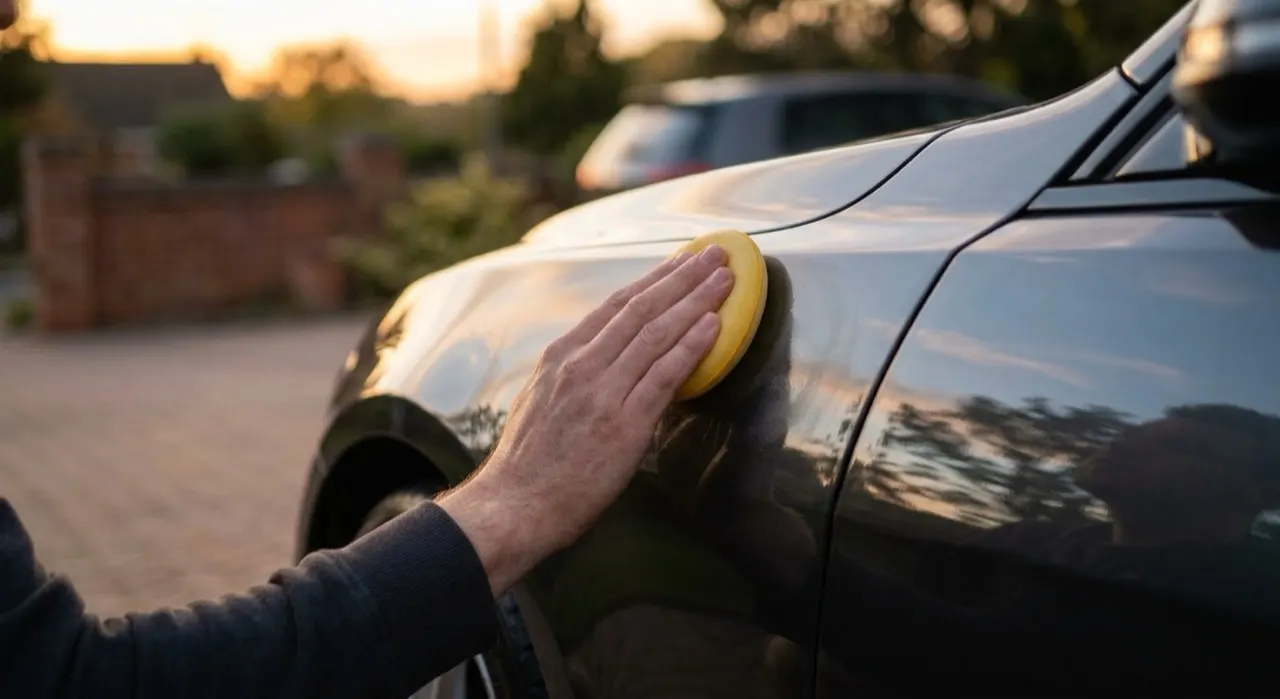
A protective topping — natural carnauba or a synthetic sealant — that lays a sacrificial layer over your clear coat. It adds gloss, depth and water beading, but it corrects nothing underneath it.
Best for: Sealing and protecting paint that is already smooth, and boosting shine between details
Typically $12–$30 for a paste or liquid; premium carnaubas and hybrids $30–$80
- Adds a protective, sacrificial layer against UV, road grime, bird droppings and light contaminants
- Delivers instant gloss, depth and hydrophobic water beading
- Easy to apply by hand — no machine, no special skill needed
- Cheap per application and forgiving of mistakes
- Works on any smooth, cleaned surface in 20–40 minutes
- Purely cosmetic protection — it cannot remove a single swirl, scratch or oxidation mark
- Short-lived: natural carnauba often lasts only 4–8 weeks
- Traps and seals in any defects that were on the paint before you applied it
- Adds no real depth to already-dull or hazy clear coat
Car Polish
An abrasive corrective compound that physically levels a microscopic layer of clear coat to remove swirls, oxidation, water spots and light scratches. It restores clarity, but it leaves no protection behind.
Best for: Correcting dull, swirled or oxidized paint before you protect it
Typically $10–$25 for a bottle; a dual-action polisher adds $90–$200 one time
- Actually removes swirls, holograms, oxidation and light scratches
- Restores true depth, clarity and reflectivity to tired clear coat
- A single bottle corrects many panels — very low cost per use
- Prepares a truly smooth surface so wax or sealant bonds and lasts longer
- Removes a thin layer of clear coat, which is a finite resource over the car's life
- Leaves zero protection — bare, corrected paint must be waxed or sealed immediately after
- Best results need a machine polisher and some technique
- Aggressive compounds can burn edges or induce haze if used carelessly
How they score, side by side
Scores reflect aggregated owner reviews and expert consensus — not our own bench testing.
- Defect correction19
- Gloss & depth boost78
- Protection / durability81
- Ease of use95
- Cost per use88
- Beginner friendliness94
Spec-by-spec comparison chart
| Factor | Car Wax | Car Polish |
|---|---|---|
| Primary job | Protect & add gloss | Correct defects in the paint |
| Contains abrasives | No | Yes — that's the whole point |
| Removes swirls / oxidation | No | Yes |
| Leaves protection behind | Yes — a sacrificial layer | No — bare corrected paint |
| Order in the process | Last (top coat) | Before wax (correction) |
| Removes clear coat | No | Yes — a microscopic layer |
| Typical product cost | $12–$30 (up to $80 premium) | $10–$25 per bottle |
| Tools needed | Applicator pad & towel | Ideally a DA polisher & pads |
| Time per full car | ~20–40 min by hand | ~1.5–4 hrs (machine, per stage) |
| How often | Every 4–12 weeks | Once or twice a year at most |
| DIY difficulty | Easy | Moderate (machine) / hard by hand |
Our Top 3 Picks
The three highest-rated options in this category, if you'd rather skip straight to a proven pick.

Best for anyone who wants one do-it-all wax
- Synthetic hydrophobic polymer
- Deep, wet-look gloss
- 3–5 months of durability
- Kit includes pad + microfiber towel
Why buy it: the best balance of shine, months-long durability and beginner-easy application.

Best for maximum durability between coats
- 5–7 months of protection
- A little goes a long way
- Cheapest per use
Why buy it: nothing here survives weather longer — the durability champion.

Best for fast, cheap protection in minutes
- SiO₂ spray-on / wipe-off
- Fastest application here
- Strong water beading
Why buy it: the cheapest, fastest protection — spray on wet or dry and go.
Prices are pulled from Amazon and were accurate as of Aug 22, 2026, 6:54 PM EDT. Product prices and availability are subject to change — the live price is shown on Amazon.
What actually separates wax from polish
This is the comparison the detailing world sees confused most often, because both products come in similar tubs and bottles, both promise "shine," and plenty of shelves file them side by side. But they do opposite things to your paint, and using one when you needed the other is the reason so many cars still look swirled after a full afternoon of work.
Polish is a corrective abrasive. It contains either diminishing abrasives (that break down into a finer cut as you work them) or engineered non-diminishing abrasives that hold a consistent grade. When you rub or machine polish over the paint, those abrasives physically shave off a microscopically thin layer of clear coat, taking the tops of the swirls, oxidation, water-etching and light scratches down until the surface is level and clear again. That is why polish restores real depth and reflectivity — it is removing the damaged, light-scattering surface, not covering it. Crucially, polish leaves nothing behind. Once you are done, the corrected clear coat is bare and vulnerable.
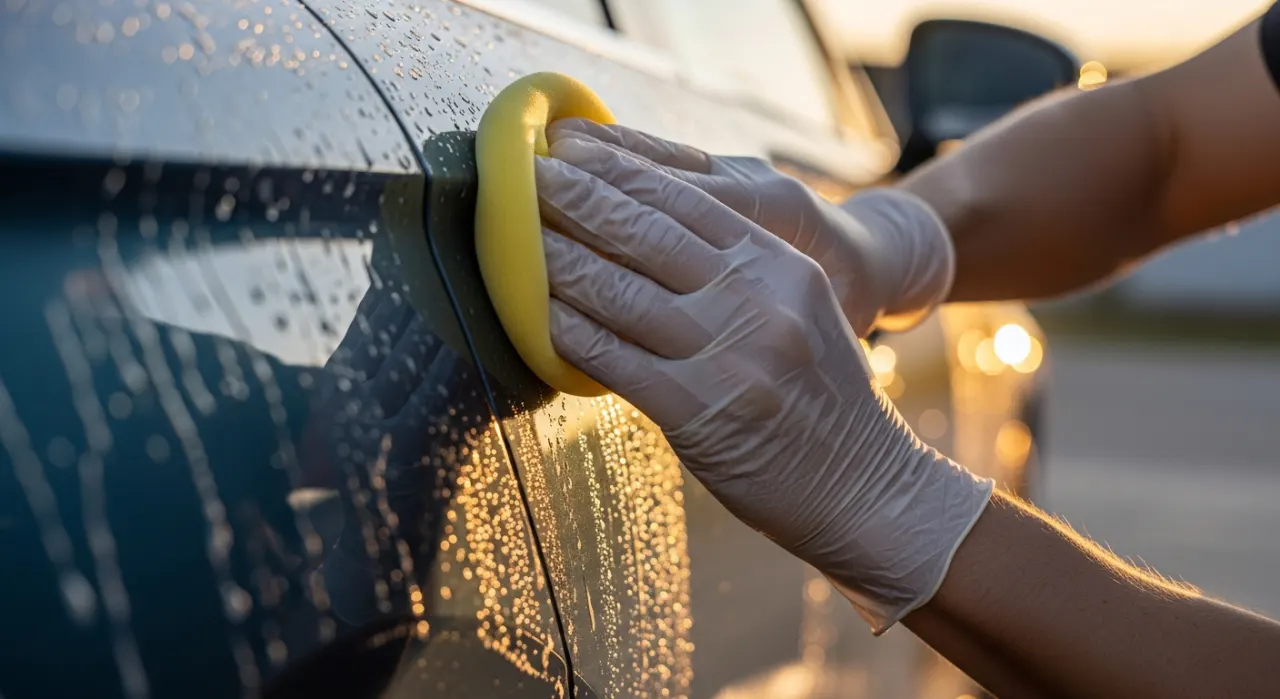
Wax is a protective top coat. Natural carnauba or a synthetic polymer sealant lays a thin sacrificial film over whatever surface you put it on. That film adds gloss and warmth, makes water bead and sheet away, and takes the first hit from UV rays, road film, bug splatter and bird droppings so your clear coat doesn't. What wax categorically does not do is correct anything. It has no abrasives. Apply it over a swirled hood and you get a shiny, well-protected, still-swirled hood.
The cleanest way detailers frame it: polish fixes the paint, wax protects it. One is a body shop in a bottle; the other is a raincoat. They are sequential, not interchangeable.
The correct order: polish first, then wax
Because polish leaves the clear coat bare and wax seals whatever is underneath it, the order is not optional — it is the entire logic of a proper detail. The standard professional sequence runs:
- Wash and dry to strip loose dirt so you don't grind grit into the paint.
- Clay (or use a clay mitt) to pull out bonded contaminants — rail dust, overspray, tree sap specks — that you can feel as roughness. This is decontamination, not correction.
- Polish to level the clear coat and remove swirls, haze and oxidation. This is the corrective stage, and it is the only stage that actually improves the paint itself.
- Wax or seal to protect the freshly corrected, now-bare clear coat and lock in the gloss.
Reverse the last two and you waste the whole job. Waxing before you polish means you either can't polish effectively (the wax has to come off first) or you polish the wax right back off. And skipping the wax after polishing leaves corrected paint completely unprotected, where it will oxidize and re-swirl faster than before. The consensus among detailers is blunt: if you only ever do one of these steps casually, wax; if you want the paint to actually look better, polish first and then always wax over it.
Which one does your paint actually need?
Instead of asking "wax or polish," diagnose the paint and the answer picks itself. The quick tests owners and shops rely on:
- Look at it under bright, direct sun or a single point light. If you see fine cobweb-like swirls, spider-webbing or hazy dullness, that is clear-coat damage. Wax will not touch it — you need to polish.
- Run a clean hand across the washed panel. If it feels gritty or rough, you have bonded contamination to clay first; if it feels glassy but still looks dull, that's an oxidation or swirl problem for polish.
- Check the water behavior. If old water beading has gone flat and water now sheets and clings, your existing protection has worn off and it's time to wax or seal again — no correction needed if the paint is already smooth and clear.
- Newer or already-corrected car that just looks a bit tired? A wax refresh every month or two is all it needs. Polishing perfectly good paint just wears clear coat for nothing.
The practical takeaway is that most cars need both, but on very different schedules. Polish is an occasional corrective event — maybe once or twice a year, and some cars go years between polishes. Wax is routine maintenance you top up every few weeks. Treating polish like a frequent shine product is how people prematurely thin their clear coat.
Where compound, glaze and sealant fit in
Two products sit next to polish on the shelf and cause real confusion. Compound is simply a more aggressive polish — coarser abrasives that cut faster to remove deeper scratches and heavy oxidation, at the cost of leaving its own micro-marring that a finer polish then refines out. The typical heavy-correction order is compound, then polish, then protect. For most owners with light swirls, a good one-step polish skips the compound entirely.
Glaze is the opposite of polish: it contains oils and fillers that temporarily hide swirls and add wet-look gloss without removing anything. It masks rather than corrects, and it washes away over time. Body shops and show-car detailers use glaze under a wax for a quick pop; it is a cosmetic cheat, not a fix.
Sealant belongs in the same bucket as wax — it is protection, applied after polishing. The difference is chemistry: sealants are synthetic polymers that bond to the clear coat and typically last 3–6 months, versus natural carnauba wax's warmer glow but shorter 4–8 week life. Many people layer a sealant for durability and a carnauba over it for looks. Ceramic coatings take that protection role to the extreme with 1–5 year durability, but they still demand fully polished paint underneath first — because a coating, like wax, permanently locks in whatever defects were there.
Real cost and how long each one lasts
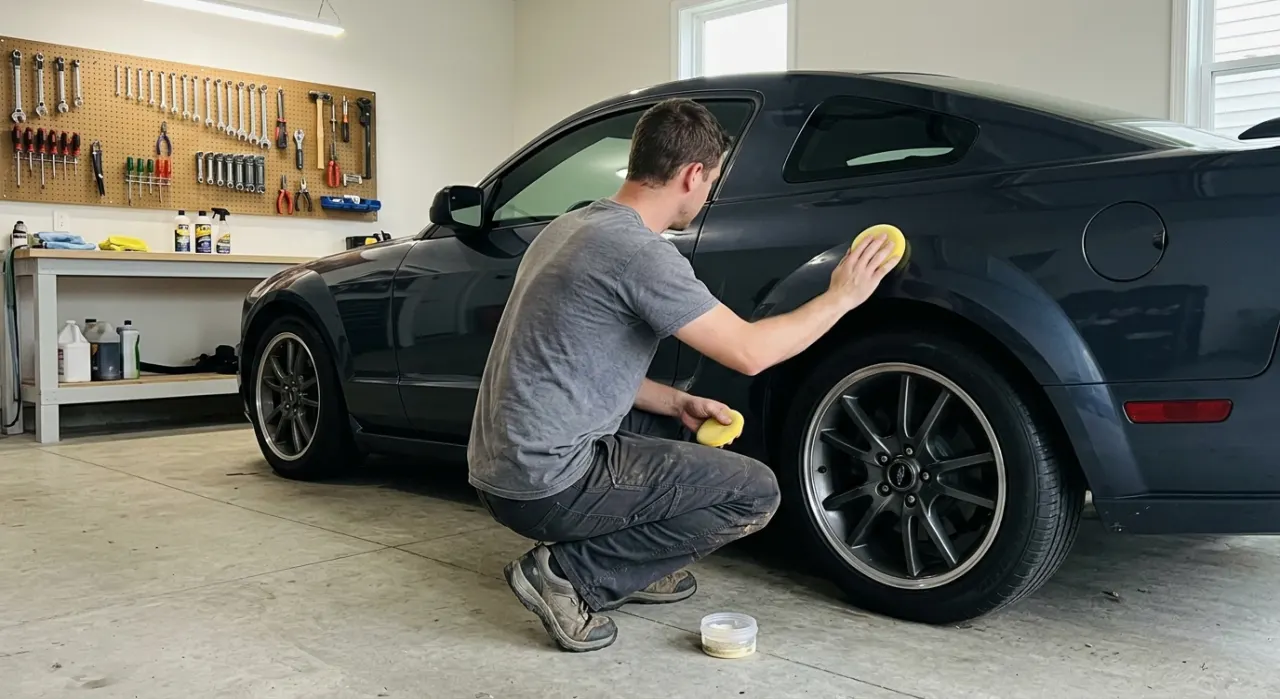
On the shelf the two look similarly priced — a bottle of quality polish runs $10–$25, a tub of wax $12–$30 — but the real cost picture is about tools and frequency, not the bottle. A good dual-action polisher is a one-time $90–$200 outlay, plus a set of pads, and it turns polishing from a grueling hand exercise into a manageable one. Wax needs nothing but an applicator pad and a microfiber towel.
Durability is where they diverge sharply. Natural carnauba wax commonly lasts 4–8 weeks before the beading flattens; synthetic sealants push 3–6 months; a ceramic coating can hold for years. Polish, by contrast, is not something that "lasts" at all — its correction is permanent until new swirls are introduced, which is why you polish rarely and protect often. Over a year, a typical owner might polish once and wax six-to-ten times. That cadence is the honest way to budget: polish is the occasional big job, wax is the cheap habit that keeps the results looking fresh.
There is a real long-term cost to over-polishing, though. Every polishing pass removes clear coat, and factory clear is often only around 40–50 microns thick with limited room for correction over the car's life. Aggressive or unnecessary polishing thins that layer permanently. Waxing removes nothing, so you can wax as often as you like with zero cost to the paint's lifespan.
Common myths and mistakes
"A good wax will get rid of my swirls." It won't. Wax has no abrasives — it can hide swirls slightly by filling with oils (and glazes do this on purpose), but the moment that layer washes off, the swirls are right back. Correction is a polishing job, full stop.
"Polish already protects the paint, so I can skip wax." The opposite is true. Polishing leaves the clear coat bare and more vulnerable than before. Freshly polished paint should be waxed or sealed the same day, or it will oxidize and re-swirl faster.
"I'll just use an all-in-one to do both at once." All-in-one (AIO) products do combine a light cleaner, mild polish and a protectant, and they are genuinely good for lightly swirled daily drivers on a time budget. But their abrasives are mild and their protection is thinner than a dedicated wax — they are a compromise, not a replacement for correcting and protecting as separate, deliberate steps when the paint really needs it.
"More polishing equals more shine." Only up to the point of correction. Once the swirls are gone, further polishing just removes clear coat for no visual gain and shortens the paint's life. Stop when the defects are gone, then protect.
Which should you buy — and how to decide
There is no universal winner here, because it isn't a versus — it's a sequence. The right answer is dictated entirely by the state of your paint and what you're trying to achieve.
You need polish if your paint shows swirls, spider-webbing, haze, oxidation or light scratches under direct light. No wax will fix those; only abrasive correction will. Pair it with a dual-action polisher for safe, even results, start with the least aggressive product that clears the defects, and always protect immediately afterward.
You need wax (or a sealant) if your paint is already smooth and clear and you simply want gloss, water beading and protection — or you've just finished polishing and need to lock the result in. It's the easy, cheap, forgiving step, and it's the one you'll repeat most often.
For most people the honest answer is buy both: a polish for the once-or-twice-a-year correction, and a wax or sealant for regular protection. Diagnose the paint first — swirled means polish, smooth-but-unprotected means wax — and the "which one" question answers itself every single time.
Recommended Products
Our top picks in this category, ranked on aggregated owner reviews.
Best for anyone who wants one do-it-all wax
- Synthetic hydrophobic polymer
- Deep, wet-look gloss
- 3–5 months of durability
- Kit includes pad + microfiber towel
Why buy it: the best balance of shine, months-long durability and beginner-easy application.
Best for maximum durability between coats
- 5–7 months of protection
- A little goes a long way
- Cheapest per use
Why buy it: nothing here survives weather longer — the durability champion.
Best for fast, cheap protection in minutes
- SiO₂ spray-on / wipe-off
- Fastest application here
- Strong water beading
Why buy it: the cheapest, fastest protection — spray on wet or dry and go.

Best for first-timers who want a foolproof shine
- Foolproof carnauba liquid
- Warm, wet look
- Wipes off clean even if it dries
Why buy it: almost impossible to mess up — the perfect first wax.

Best for show cars and dark paint
- Premium carnauba paste
- Concours-grade warm gloss
- Easy to apply for a paste
Why buy it: stunning depth on dark paint — a show finish you use for the ritual.

Best for detailing hobbyists chasing gloss
- Soft carnauba paste
- Excellent gloss
- Buffs off easily
Why buy it: a detailing-hobbyist favorite that finishes beautifully.
Prices are pulled from Amazon and were accurate as of Aug 22, 2026, 6:54 PM EDT. Product prices and availability are subject to change — the live price is shown on Amazon.