
Affiliate Disclosure
Some links on this page are affiliate links. As an Amazon Associate, we earn from qualifying purchases — at no extra cost to you. We do not buy, test, or physically handle the products we cover; our rankings come from aggregated owner reviews, ratings and expert consensus. Commissions never change our verdicts. How we rank & full disclosure.
Carnauba Wax
A natural paint protectant made from the wax of the Brazilian carnauba palm, blended with oils and solvents into a paste or liquid. It is prized for the deep, warm glow it leaves on paint.
Best for: Show cars, dark and metallic paint, and enthusiasts who enjoy frequent hand application for the best possible finish
Typically $15–$40 for a can that lasts many applications; premium show waxes $50–$150+
- Widely considered to produce the warmest, deepest wet look, especially on black and dark paint
- A natural product with a long, trusted track record among detailers
- Buffs to a rich glow and adds noticeable depth and clarity
- Easy to layer — a second coat an hour later builds gloss and protection
- Forgiving to apply and remove by hand, hard to damage paint with
- Short durability — owners typically report 4–8 weeks before it fades
- Softens and breaks down in high heat, so summer and dark paint shorten its life
- Needs reapplication several times a year to stay protected
- Beading and water sheeting are good but generally not as slick as a modern synthetic
Synthetic Wax / Sealant
A lab-engineered protectant built from polymers (and sometimes silica resins) that chemically bond to the clear coat. Marketed as "synthetic wax," "paint sealant," or "polymer sealant," it trades a little warmth for far more durability.
Best for: Daily drivers, light-colored paint, and owners who want long-lasting protection with minimal reapplication
Typically $12–$35 for a bottle; premium polymer sealants $40–$80
- Long durability — owners commonly report 3–6 months, sometimes longer
- Handles heat and UV far better than natural wax, so it holds up through summer
- Very slick surface with strong, tight water beading and sheeting
- Thin, even coats go on fast and wipe off easily, often by machine
- Better cost-per-month of protection thanks to fewer applications
- Finish reads slightly cooler or "glassier" — some enthusiasts find it less warm than carnauba
- Can be less forgiving; streaks if applied too thick or in direct sun
- Bonding sealants want a truly clean, decontaminated surface to adhere properly
- On very dark paint the extra depth of carnauba is missed by purists
How they score, side by side
Scores reflect aggregated owner reviews and expert consensus — not our own bench testing.
- Depth / warmth of shine97
- Durability49
- Heat & UV resistance49
- Slickness & beading79
- Ease of application97
- Value per month protected59
Spec-by-spec comparison chart
| Factor | Carnauba Wax | Synthetic Wax / Sealant |
|---|---|---|
| What it is | Natural palm wax + oils | Engineered polymers / silica resins |
| Typical durability | 4–8 weeks | 3–6 months (sometimes longer) |
| Signature look | Warm, deep, "wet" glow | Slick, bright, glassy reflection |
| Best on | Dark & metallic paint | Light paint & daily drivers |
| Heat / UV resistance | Lower — softens in heat | Higher — holds through summer |
| Water behavior | Good rounded beading | Very tight beading & sheeting |
| Ease of application | Very forgiving by hand | Easy, but thin coats only |
| Surface prep needed | Clean paint | Clean & decontaminated for bonding |
| Price per container | $15–$40 (show waxes more) | $12–$35 (premium $40–$80) |
| Cost per month protected | Higher (reapply often) | Lower (fewer applications) |
| Layering | Layers easily for more depth | Bonds in one durable coat |
Our Top 3 Picks
The three highest-rated options in this category, if you'd rather skip straight to a proven pick.

Best for anyone who wants one do-it-all wax
- Synthetic hydrophobic polymer
- Deep, wet-look gloss
- 3–5 months of durability
- Kit includes pad + microfiber towel
Why buy it: the best balance of shine, months-long durability and beginner-easy application.

Best for maximum durability between coats
- 5–7 months of protection
- A little goes a long way
- Cheapest per use
Why buy it: nothing here survives weather longer — the durability champion.

Best for fast, cheap protection in minutes
- SiO₂ spray-on / wipe-off
- Fastest application here
- Strong water beading
Why buy it: the cheapest, fastest protection — spray on wet or dry and go.
Prices are pulled from Amazon and were accurate as of Aug 22, 2026, 6:54 PM EDT. Product prices and availability are subject to change — the live price is shown on Amazon.
What actually separates carnauba from synthetic
On the shelf these two look like the same product in different jars, and the marketing doesn't help — plenty of bottles say "synthetic wax" or "hybrid wax" to blur the line. But chemically they are doing the same job in two very different ways, and understanding that difference is the whole decision.
Carnauba wax is a natural product. It comes from the leaves of the Brazilian carnauba palm, which secretes a hard wax to survive heat and drought. Detailers have used it for a century because raw carnauba is one of the hardest natural waxes and produces a uniquely deep, warm shine. In a can, it's blended with oils, solvents and softer waxes (like beeswax) so it spreads — a paste that's "100% carnauba" doesn't exist, and even premium show waxes are usually well under half carnauba by content. It sits on top of the clear coat as a sacrificial layer and slowly wears away.
Synthetic wax, more accurately called a paint sealant or polymer sealant, is engineered in a lab. Instead of a natural wax it uses long-chain polymers — and in newer formulas, silica (SiO2) resins that inch toward ceramic-coating chemistry. The consensus among detailers is that the key distinction is bonding: many sealants chemically cross-link with the clear coat rather than just resting on it, which is why they last far longer and shrug off heat that would melt a natural wax.
The cleanest way to remember it: carnauba is a natural topping you reapply often for looks; synthetic is an engineered coating you apply less often for protection. One optimizes the finish, the other optimizes longevity — and that single trade-off drives every other difference below.
The look: warm glow vs glassy slickness
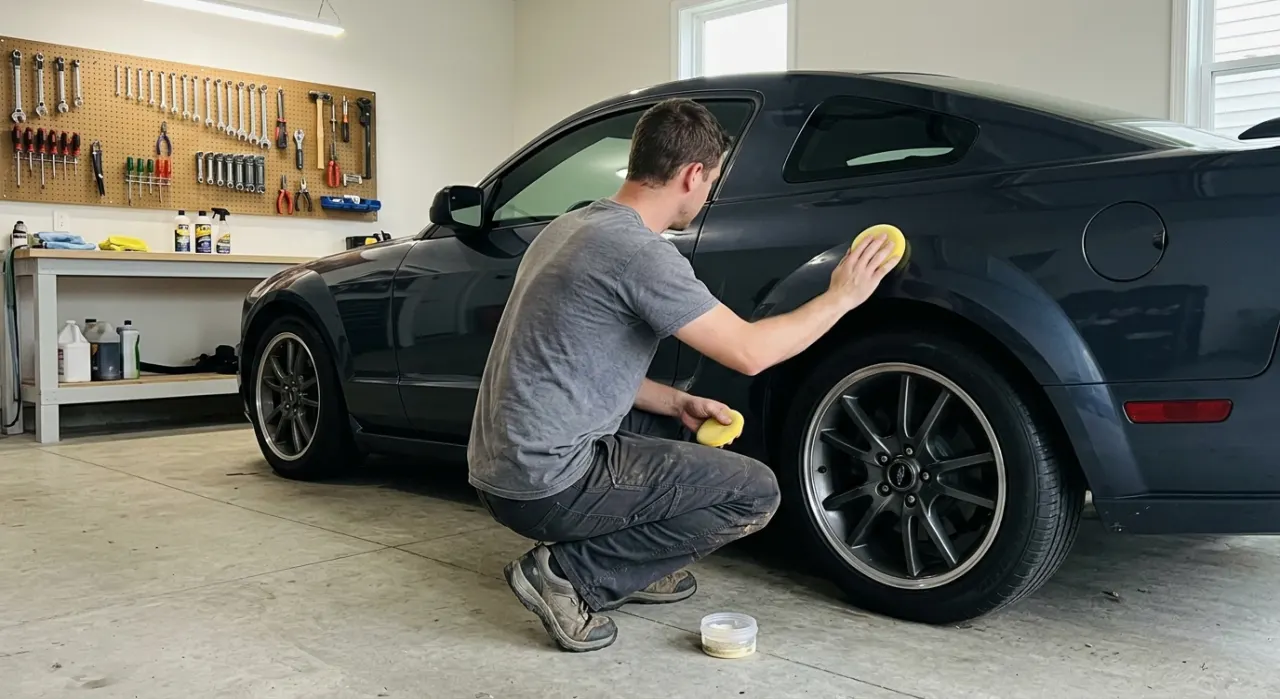
This is where carnauba earns its loyal following, and where the honest answer depends on your paint color. Aggregated detailer opinion is remarkably consistent on the character of each finish:
- Carnauba produces a warm, deep, "wet" glow. It seems to add depth and richness, as if you're looking further into the paint. On black, dark blue, deep red and other dark or metallic colors, that added warmth is the effect enthusiasts chase — it makes the paint look liquid.
- Synthetic sealants produce a brighter, slicker, more "glassy" reflection. The surface is exceptionally smooth and the reflection is sharp and clean, but some purists describe it as cooler or more clinical — technically flawless, slightly less soulful.
- On light paint the gap nearly vanishes. White, silver and light gray don't show depth the way dark colors do, so the warmth advantage of carnauba is largely invisible. Here a synthetic's slickness and durability win easily.
It's worth being realistic: on a freshly polished car in good light, most people cannot reliably pick carnauba from synthetic in a blind look. The difference is real but subtle, and it's most pronounced on dark paint viewed up close. If you have black paint and you polish for the love of it, carnauba's glow is the reason to reach for it. If you have a silver commuter, you're paying for a look you'll struggle to see.
Durability and why synthetic lasts longer
This is the decisive practical difference, and it isn't close. Because carnauba is a natural wax sitting on top of the paint, it wears off quickly. Owners consistently report 4–8 weeks of real protection from a carnauba, and less in tough conditions — heat is its enemy. Carnauba begins to soften well before water boils, so a black hood baking in summer sun, repeated car washes, and UV all strip it faster. By the tail end of its life the beading gets lazy and the shine dulls.
Synthetic sealants bond to the clear coat and are built from polymers engineered specifically to resist UV and heat. The result is durability owners commonly put at 3–6 months, and silica-rich formulas can push longer. Through a hot summer, the synthetic is still beading tightly while a carnauba applied the same day would have long since failed. That heat and UV resistance is the single biggest reason to choose synthetic for any car that lives outside.
A few honest caveats. Durability claims on the bottle are best-case lab numbers — real life with automatic car washes, road grime and sun runs shorter than the marketing. And bonding sealants are needy about prep: they want a genuinely clean, decontaminated surface (a wash, a clay treatment, ideally a light polish) to adhere properly. Slap a sealant over a dirty or contaminated panel and it won't bond, cutting its life dramatically. Carnauba is more forgiving of a quick wash-and-go because it isn't trying to bond in the first place.
Real cost and value over a year
Sticker prices are similar — a good carnauba runs $15–$40 and a solid synthetic sealant $12–$35, with premium show waxes and silica sealants climbing higher. So the honest comparison isn't the price of the jar; it's the cost per month of protection, and that's where synthetic pulls ahead.
Run the math over a year. A carnauba protecting for roughly 6 weeks needs applying around 8–9 times a year to stay covered. A 3–4 month synthetic needs applying 3–4 times. Even if the containers cost the same, you're spending double the product and — more importantly — double the labor on the carnauba. A wax job is an afternoon; multiply that by nine and the "cheap" natural wax is the expensive one in hours of your life.
That said, value depends entirely on your goals. If waxing the car is a hobby you enjoy — a Sunday ritual with a favorite paste — the frequent reapplication isn't a cost, it's the point, and carnauba delivers a look no sealant quite matches. If waxing is a chore you'd rather do twice a year, synthetic is unambiguously the better value: more protected months for less effort and roughly the same money. The most efficient owners often keep both and let each do its job.
Common myths and mistakes
"Carnauba is 100% natural wax, so it must protect better." Natural doesn't mean tougher. Carnauba is a soft, meltable layer that sits on the paint; a synthetic polymer is engineered specifically to bond and endure heat and UV. For raw protection and longevity, the lab product wins clearly — the "natural is better" instinct is backwards here.
"A synthetic sealant looks cheap or plasticky." Modern sealants produce an excellent, slick, high-gloss finish. The difference from carnauba is warmth and depth on dark paint, not quality — and on light colors the finishes are nearly indistinguishable. Judging a good sealant as "plasticky" is usually a decade out of date.
"More coats of carnauba means dramatically more protection." Layering carnauba does build a little gloss and a bit of protection, but wax doesn't stack indefinitely — much of a second coat removes some of the first. Two thin coats is a sensible ceiling; you're mostly adding shine, not months of durability.
"I can put wax straight over a dirty car." Either product needs a clean surface, and a bonding sealant needs a decontaminated one. Applying protectant over grit grinds it into the clear coat and the sealant simply won't adhere. Wash, and ideally clay, first — skipping prep is the most common reason protection fails early.
"Wax and ceramic coating are the same idea." They're a spectrum. Carnauba lasts weeks, synthetic sealants last months, and a true professional ceramic coating lasts years — but costs far more and is much harder to apply. Silica "spray sealants" sit in the middle. If you want years of protection, neither wax in this comparison is the answer; a coating is.
Which should you buy — and how to decide
There's no universal winner because they optimize for different things. Match the product to your paint, your climate and how much you enjoy the process.
Buy carnauba if you have dark or metallic paint you love, you enjoy waxing by hand, and you want the deepest, warmest show finish — accepting that you'll reapply every 4–8 weeks. It's the enthusiast's choice for a garaged weekend car, and the go-to topper the night before a show.
Buy a synthetic wax or sealant if you have a daily driver, light-colored paint, a hot or sunny climate, or you simply want to protect the car and forget it for a few months. It's the better value, the tougher protector, and the smarter default for most people's actual cars.
Buy both if you want the ideal setup: lay down a synthetic sealant as a durable, long-lasting base, then top it with a carnauba for warmth and depth when you want the car looking its best. The sealant handles the months of protection; the carnauba handles the glow. Whatever you choose, prep the surface properly, apply thin, and match the product to the job — that matters more than which camp you pick.
Recommended Products
Our top picks in this category, ranked on aggregated owner reviews.
Best for anyone who wants one do-it-all wax
- Synthetic hydrophobic polymer
- Deep, wet-look gloss
- 3–5 months of durability
- Kit includes pad + microfiber towel
Why buy it: the best balance of shine, months-long durability and beginner-easy application.
Best for maximum durability between coats
- 5–7 months of protection
- A little goes a long way
- Cheapest per use
Why buy it: nothing here survives weather longer — the durability champion.
Best for fast, cheap protection in minutes
- SiO₂ spray-on / wipe-off
- Fastest application here
- Strong water beading
Why buy it: the cheapest, fastest protection — spray on wet or dry and go.

Best for first-timers who want a foolproof shine
- Foolproof carnauba liquid
- Warm, wet look
- Wipes off clean even if it dries
Why buy it: almost impossible to mess up — the perfect first wax.

Best for show cars and dark paint
- Premium carnauba paste
- Concours-grade warm gloss
- Easy to apply for a paste
Why buy it: stunning depth on dark paint — a show finish you use for the ritual.

Best for detailing hobbyists chasing gloss
- Soft carnauba paste
- Excellent gloss
- Buffs off easily
Why buy it: a detailing-hobbyist favorite that finishes beautifully.
Prices are pulled from Amazon and were accurate as of Aug 22, 2026, 6:54 PM EDT. Product prices and availability are subject to change — the live price is shown on Amazon.