
Affiliate Disclosure
Some links on this page are affiliate links. As an Amazon Associate, we earn from qualifying purchases — at no extra cost to you. We do not buy, test, or physically handle the products we cover; our rankings come from aggregated owner reviews, ratings and expert consensus. Commissions never change our verdicts. How we rank & full disclosure.
Compound (Cutting Compound)
An aggressive abrasive paste or liquid that shears a thin layer off the clear coat to erase deeper defects — swirls, oxidation, sanding marks and light scratches. It corrects damage rather than hiding it.
Best for: Neglected, oxidized or heavily swirled paint that needs real defect removal before anything else
Typically $12–$30 per bottle; a dual-action polisher to use it well runs $120–$250
- Removes real defects — swirls, oxidation, water spots and light scratches actually go away
- Fast cutting power restores flat, clear paint that no wax can fake
- A necessary first step before polishing on a truly rough finish
- Modern "diminishing" compounds break down as you work for a cleaner cut
- One aggressive pass often does what many light passes cannot
- Removes clear coat — a finite resource you can only cut so many times
- Leaves its own fine haze or micro-marring that must be polished out after
- Aggressive by hand and unforgiving; easy to burn an edge with a machine
- Overkill and wasteful on paint that only needs a light refresh
Polish (Finishing Polish)
A finer abrasive that refines the surface — removing the haze compound leaves and lifting light swirls to bring back deep gloss and clarity. It perfects rather than corrects.
Best for: Paint in decent shape, or the second step after compounding, to maximize gloss before sealing
Typically $12–$28 per bottle; shares the same polisher and pads as compound
- Restores gloss, clarity and reflection without heavy clear-coat removal
- Removes the haze and micro-marring a compound leaves behind
- Gentle enough for regular use on well-kept paint
- Finishes down to a swirl-free, ready-to-seal surface
- Lower risk of burning paint than an aggressive compound
- Not aggressive enough to remove deeper scratches or heavy oxidation
- On rough paint it just polishes the defects instead of erasing them
- Often a wasted step if the finish was never compounded first when needed
- Results look great but can mask, not fix, damage a compound would remove
How they score, side by side
Scores reflect aggregated owner reviews and expert consensus — not our own bench testing.
- Defect removal94
- Final gloss / clarity69
- Clear-coat safety49
- Beginner friendliness58
- Value on rough paint94
- Value on good paint39
Spec-by-spec comparison chart
| Factor | Compound (Cutting Compound) | Polish (Finishing Polish) |
|---|---|---|
| Primary job | Cut & remove defects | Refine & restore gloss |
| Abrasiveness | Coarse — high cut | Fine — low cut |
| Removes swirls / scratches | Yes — deeper defects | Light swirls only |
| Removes oxidation | Yes — its main strength | Only very light haze |
| Clear-coat removed | Meaningful — use sparingly | Minimal |
| Finish left behind | Can haze / micro-mar | High gloss, ready to seal |
| Where in the process | First (correction) step | Second (finishing) step |
| Best applied with | Dual-action or rotary polisher | Dual-action polisher or by hand |
| Risk of burning paint | Higher, especially by machine | Lower |
| Price per bottle | $12–$30 | $12–$28 |
Our Top 3 Picks
The three highest-rated options in this category, if you'd rather skip straight to a proven pick.

Best for anyone who wants one do-it-all wax
- Synthetic hydrophobic polymer
- Deep, wet-look gloss
- 3–5 months of durability
- Kit includes pad + microfiber towel
Why buy it: the best balance of shine, months-long durability and beginner-easy application.

Best for maximum durability between coats
- 5–7 months of protection
- A little goes a long way
- Cheapest per use
Why buy it: nothing here survives weather longer — the durability champion.

Best for fast, cheap protection in minutes
- SiO₂ spray-on / wipe-off
- Fastest application here
- Strong water beading
Why buy it: the cheapest, fastest protection — spray on wet or dry and go.
Prices are pulled from Amazon and were accurate as of Aug 22, 2026, 6:54 PM EDT. Product prices and availability are subject to change — the live price is shown on Amazon.
What actually separates compound from polish
This is one of the most misunderstood pairings in car care, because the bottles look almost identical, they're applied the same way, and both promise "restored" paint. But they do fundamentally different work, and using the wrong one — or skipping one entirely — is why so many DIY correction jobs end up either hazy or underwhelming.
Both products are abrasives. That's the key thing to understand: neither one fills or hides anything, they physically cut the surface. The difference is grit. A compound uses coarser, more aggressive abrasives designed to shear away a measurable layer of clear coat, taking the defects — swirls, oxidation, water-etching, light scratches — down with it. Think of it as the coarse sandpaper of the liquid world. It has real cutting power, and that power is exactly what removes damage a wax could never touch.
A polish uses much finer abrasives. It removes far less material and is designed to refine the surface rather than reshape it — lifting fine haze, erasing light swirl marks, and bringing back the deep, wet-looking gloss and clarity that reflect light cleanly. The consensus among detailers frames it neatly: compound corrects, polish perfects. A compound makes the paint flat and defect-free but slightly dull; a polish then makes that flat surface brilliant.
Critically, neither one is a wax, sealant or coating. Nothing here protects the paint. Compound and polish are the correction stage — you cut and refine first, and only then lay down a protective layer to lock the result in.
Which one does your paint actually need?
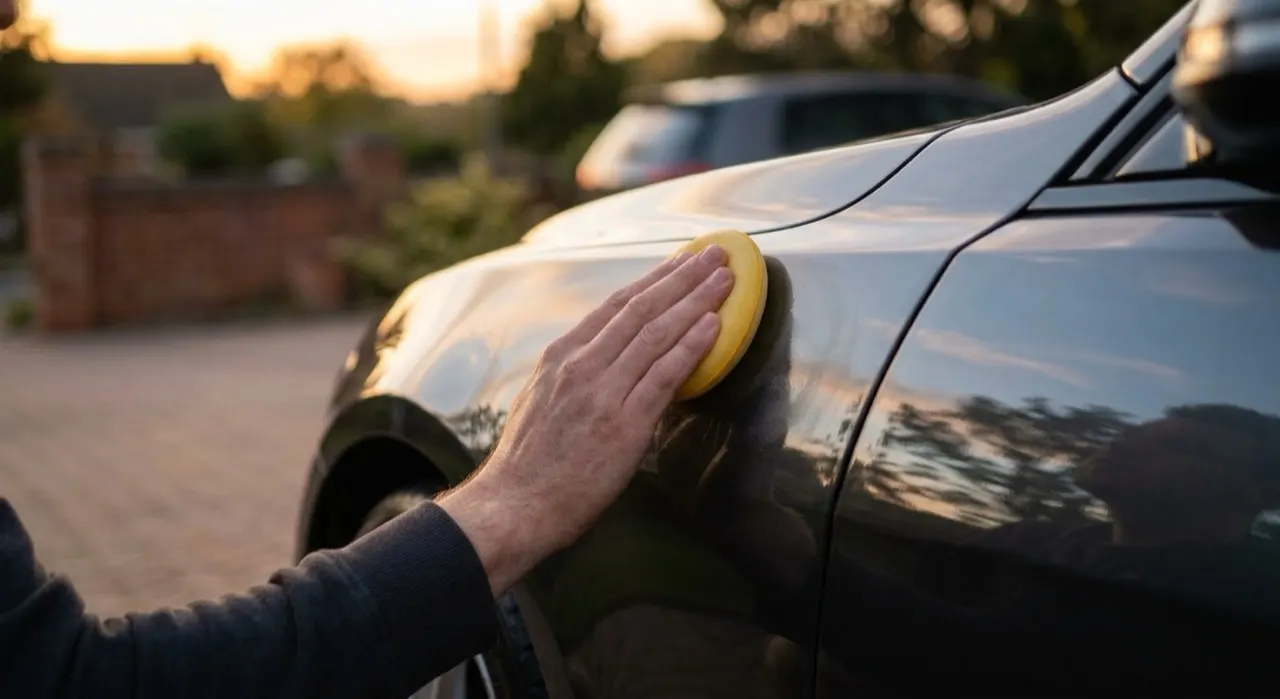
Because these are steps and not competitors, the real question is not "compound or polish" but "how much correction does this paint actually need." Owners waste money and clear coat by reaching for a compound out of habit. Use the damage to decide:
- Heavy oxidation, chalky faded paint, deep swirls, or visible scratches that you can't feel with a fingernail — this is compound territory. Polish alone will not remove them; it will just make the defects glossier. You compound first, then polish.
- Light swirls, minor haze, and a finish that's dull but not damaged — a good polish is usually all you need. Many drivers are shocked how much gloss returns from polish alone on paint that was simply neglected, not damaged.
- Paint that already looks decent and you just want to maximize shine before waxing or coating — polish only, and often just once a year.
- A brand-new or freshly corrected car — neither, beyond an occasional light polish. There's nothing to correct, and compounding sound paint just wastes clear coat.
A useful field test: wash and dry the panel, then run a fingernail lightly across a scratch. If it catches, it's too deep for either product to fully remove and may need wet-sanding or a body shop. If it doesn't catch but you can see it, a compound can likely cut it out. If the paint just looks hazy or lightly swirled with no distinct scratches, start with polish — you can always step up to a compound if it isn't enough, but you can't put clear coat back.
Why the order matters — compound then polish
When paint genuinely needs both, the sequence is not optional: compound first, polish second. This trips people up because a fresh compound job can look worse than where you started — flat, but slightly hazy or micro-marred, especially under direct light. That haze is normal. The aggressive abrasives that removed your swirls leave their own faint marring behind, and the polish step exists specifically to remove it.
Do it backwards and you accomplish nothing. Polishing rough, oxidized paint first just refines the surface around the defects — you get a shiny finish with all the original swirls still in it. Then when you compound, you undo the polish work and have to polish again anyway. The correct flow on damaged paint is always: wash and decontaminate, clay if needed, compound to remove defects, polish to refine and restore gloss, then seal with a wax, sealant or ceramic coating to protect it.
There's also an "all-in-one" category worth knowing about — products that blend a mild compound and a polish (sometimes with a filler or sealant) into a single step. They're a genuine convenience for lightly-swirled daily drivers and save time, but the trade-off is honesty: on badly damaged paint an all-in-one under-corrects, and some rely partly on fillers that wash away over a few weeks, letting the defects reappear. For real correction, separate compound and polish steps remain the detailer standard.
The clear-coat cost you cannot get back
Here's the single most important thing to internalize before you open a bottle of compound: your clear coat is a finite resource. Modern automotive paint is only around 1.5 to 2.0 thousandths of an inch of clear coat over the color — roughly the thickness of a sheet of paper — and every compounding pass permanently removes a slice of it. You typically only get a handful of meaningful correction cycles over a car's whole life before you risk cutting through to the color coat, which means a repaint.
This is why the honest rule is to use the least aggressive product that gets the job done. Detailers commonly talk about a "test spot": correct one small section first, wipe it down, and inspect. If a polish clears the defect, you never needed the compound and you just saved clear coat. If the polish isn't enough, step up to a compound — but only as far as you must. Reaching straight for the most aggressive compound "to be safe" is exactly backwards; it's the fastest way to thin paint you can never replace.
Polish, by contrast, removes so little material that occasional use is genuinely low-risk. That asymmetry — compound is precious-resource spending, polish is nearly free — should shape every decision. Compound when there's real damage to justify it; polish freely to keep the finish sharp.
By hand vs by machine
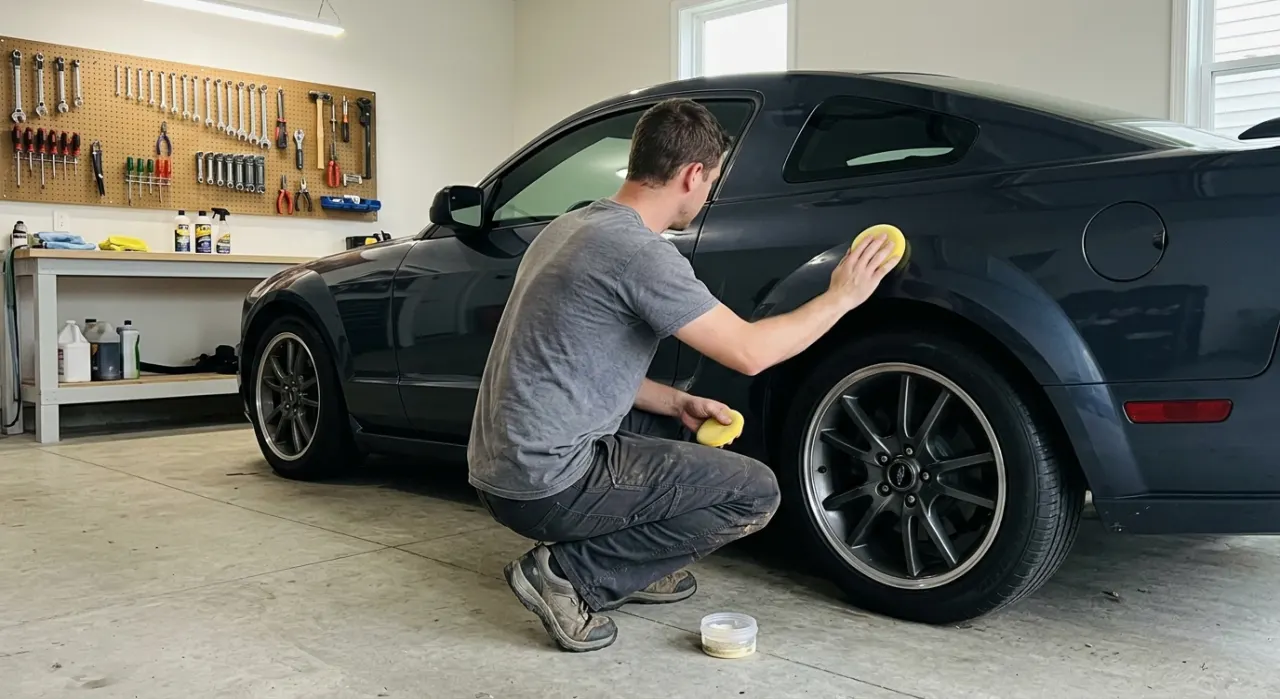
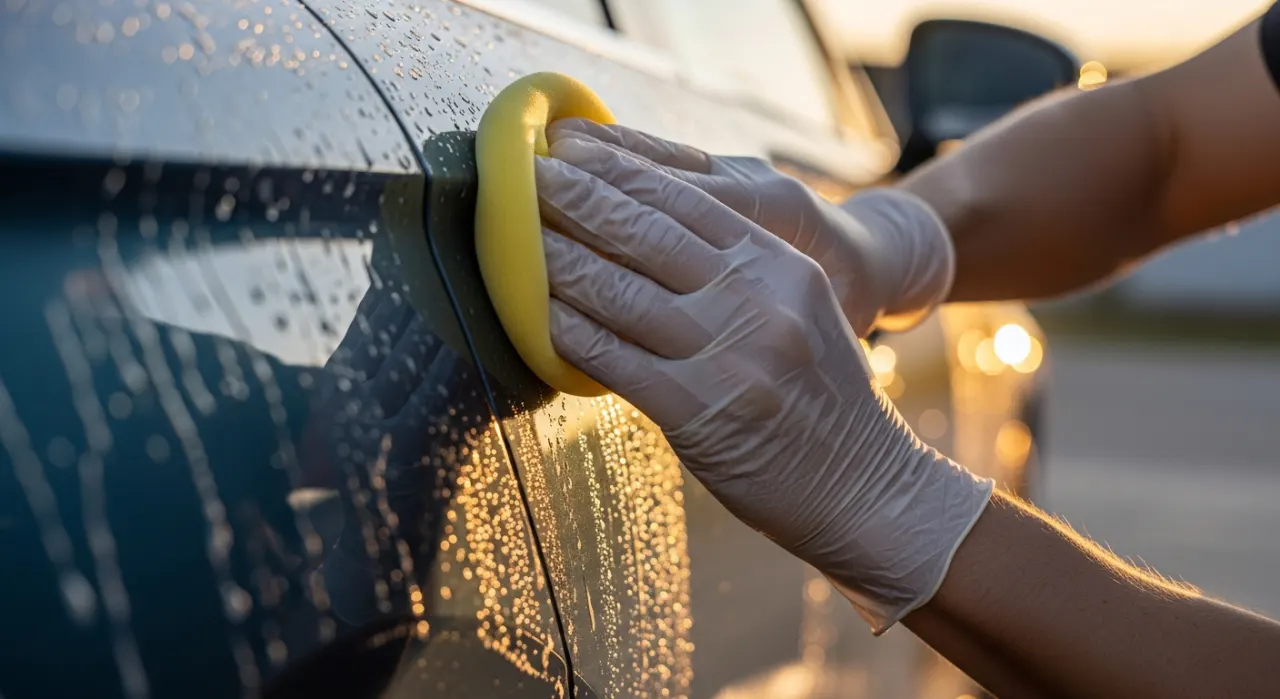
Both products can be worked by hand, but the results diverge sharply. By hand, a compound has limited effectiveness — you simply can't generate the sustained pressure and speed a machine does, so hand-compounding removes light defects at best and is exhausting on a full car. Polish works better by hand because its job is lighter to begin with, and a hand-applied polish on already-decent paint can look excellent.
For real correction, the consensus is a dual-action (DA) polisher. It's the tool that makes a compound actually cut and a polish actually refine, and its random orbit makes it far more forgiving than a rotary — much harder to burn paint or leave holograms. A quality DA runs roughly $120–$250 and, paired with the right cutting and finishing pads, does more for your results than any single bottle choice. Rotary polishers cut faster and are what pros reach for on severe correction, but they're genuinely easy to damage paint with and aren't a beginner tool.
Pads matter as much as liquid: a coarse cutting pad amplifies a compound, and a soft finishing pad lets a polish finish down cleanly. Owner reviews consistently note that people who blame a "weak polish" were often using the wrong pad. Match aggressive-with-aggressive and fine-with-fine, keep the pads clean, and let the abrasives — not brute force — do the work.
Common myths and mistakes
"Compound and polish are basically the same thing." No. They share a delivery method but differ in grit and purpose. Compound cuts away defects and clear coat; polish refines and restores gloss with minimal removal. Using them interchangeably is the root of most bad results.
"More aggressive is safer — it'll definitely fix it." Backwards. Aggressive compound removes precious clear coat and leaves haze you then have to polish out. Always start with the least aggressive product that works and step up only if needed.
"Polish fills scratches." A true polish is an abrasive — it lifts light defects by leveling the surface, it doesn't fill. Products that fill are glazes or all-in-ones with fillers, and that filling washes away over time, so the defect returns. Real correction removes, it doesn't hide.
"I can skip the polish step after compounding." Only if you enjoy hazy paint. Compound almost always leaves fine marring; polish is what turns that flat, corrected surface into a deep gloss. Skipping it wastes the hardest part of the work.
"Compound once and my swirls are gone forever." Swirls come back with poor wash technique — dirty mitts, no two-bucket method, drive-through washes. Correction resets the paint; protecting it and washing properly is what keeps it clear.
Which should you buy — and how to decide
There's no winner here because it isn't a versus — it's a sequence, and most serious correction jobs want both bottles on the shelf. What changes is which one you actually reach for, and how often.
Buy a compound if your paint has real damage — heavy oxidation, distinct swirls, water spots or scratches that don't catch a fingernail. Pair it with a dual-action polisher and a cutting pad, work a test spot first, and cut only as much as the defects demand. Then always follow with polish.
Buy a polish if your paint is in decent shape and you want gloss back, or as the mandatory second step after any compounding. It's the lower-risk, more frequently used product, and for a well-kept car it may be the only correction you ever need.
Buy an all-in-one if you have a lightly-swirled daily driver, limited time, and want a real-but-modest improvement in one step — just know it under-corrects serious damage. For most owners the smart kit is a mild compound, a good finishing polish, a DA polisher with two pad grades, and a sealant to lock it in. Identify how much correction your paint needs, use the gentlest product that does the job, and the "which one" question answers itself.
Recommended Products
Our top picks in this category, ranked on aggregated owner reviews.
Best for anyone who wants one do-it-all wax
- Synthetic hydrophobic polymer
- Deep, wet-look gloss
- 3–5 months of durability
- Kit includes pad + microfiber towel
Why buy it: the best balance of shine, months-long durability and beginner-easy application.
Best for maximum durability between coats
- 5–7 months of protection
- A little goes a long way
- Cheapest per use
Why buy it: nothing here survives weather longer — the durability champion.
Best for fast, cheap protection in minutes
- SiO₂ spray-on / wipe-off
- Fastest application here
- Strong water beading
Why buy it: the cheapest, fastest protection — spray on wet or dry and go.

Best for first-timers who want a foolproof shine
- Foolproof carnauba liquid
- Warm, wet look
- Wipes off clean even if it dries
Why buy it: almost impossible to mess up — the perfect first wax.

Best for show cars and dark paint
- Premium carnauba paste
- Concours-grade warm gloss
- Easy to apply for a paste
Why buy it: stunning depth on dark paint — a show finish you use for the ritual.

Best for detailing hobbyists chasing gloss
- Soft carnauba paste
- Excellent gloss
- Buffs off easily
Why buy it: a detailing-hobbyist favorite that finishes beautifully.
Prices are pulled from Amazon and were accurate as of Aug 22, 2026, 6:54 PM EDT. Product prices and availability are subject to change — the live price is shown on Amazon.