
Affiliate Disclosure
Some links on this page are affiliate links. As an Amazon Associate, we earn from qualifying purchases — at no extra cost to you. We do not buy, test, or physically handle the products we cover; our rankings come from aggregated owner reviews, ratings and expert consensus. Commissions never change our verdicts. How we rank & full disclosure.
Cutting Compound
The most aggressive polishing abrasive short of wet-sanding. Cutting compound uses larger, harder grit to remove a heavier layer of clear coat fast, erasing deep scratches, sanding marks and heavy oxidation.
Best for: Neglected, heavily oxidized or deeply scratched paint that a milder polish can't touch
Typically $12–$25 for a 16 oz bottle (Meguiar's Ultimate Compound, 3D ACA 500, Chemical Guys V32)
- Cuts fastest — removes 1200–1500 grit sanding marks and deep swirls in fewer passes
- Restores badly oxidized, chalky single-stage and clear-coat paint others give up on
- Best value per correction step for a full paint restoration job
- Modern "diminishing" abrasives break down and refine as you work, softening the haze
- Saves hours versus trying to hog out a deep defect with fine polish
- Removes more clear coat — you only have so much to give over a car's life
- Usually leaves fine haze or micro-marring that needs a follow-up polish
- Too aggressive for light swirls; easy to over-correct thin or soft paint
- On dark colors especially, a one-step cut rarely looks finished on its own
Rubbing Compound
A slightly milder abrasive than a true cutting compound, aimed at moderate correction. It levels light-to-medium scratches and oxidation while leaving a cleaner, more finish-ready surface behind.
Best for: Moderate swirls, light scratches and general paint cleanup where full cutting is overkill
Typically $10–$22 for a 16 oz bottle (Turtle Wax, 3M Rubbing Compound, Meguiar's)
- Corrects moderate defects while removing less clear coat than a heavy cut
- Finishes cleaner — often needs less follow-up polishing to look right
- More forgiving on thinner or softer clear coats
- Widely stocked and cheap at any auto parts store
- Not aggressive enough for deep scratches or heavy oxidation
- Terminology is inconsistent — some "rubbing" compounds cut harder than some "cutting" ones
- Still abrasive; overuse thins clear coat just like any correction step
- On severely neglected paint you'll waste effort where a cutting compound was the right call
How they score, side by side
Scores reflect aggregated owner reviews and expert consensus — not our own bench testing.
- Cutting power96
- Finish quality (standalone)58
- Clear-coat safety58
- Value for heavy correction95
- Beginner-friendliness58
- Availability99
Spec-by-spec comparison chart
| Factor | Cutting Compound | Rubbing Compound |
|---|---|---|
| Abrasiveness | High — coarser, harder grit | Medium — finer grit |
| Best on | Deep scratches, heavy oxidation, sanding marks | Moderate swirls, light scratches, cleanup |
| Clear coat removed | More per pass | Less per pass |
| Finish left behind | Often hazy — needs follow-up polish | Cleaner — may need little or none |
| Removes 1500-grit sand marks | Yes | Usually not fully |
| Application | DA polisher or hand (polisher preferred) | DA polisher or hand |
| Typical pad | Cutting / heavy foam or microfiber | Polishing / medium foam |
| Follow-up needed | Usually a finishing polish | Sometimes none |
| Price (16 oz) | $12–$25 | $10–$22 |
| Risk of over-correction | Higher on thin/soft paint | Lower |
Our Top 3 Picks
The three highest-rated options in this category, if you'd rather skip straight to a proven pick.

Best for anyone who wants one do-it-all wax
- Synthetic hydrophobic polymer
- Deep, wet-look gloss
- 3–5 months of durability
- Kit includes pad + microfiber towel
Why buy it: the best balance of shine, months-long durability and beginner-easy application.

Best for maximum durability between coats
- 5–7 months of protection
- A little goes a long way
- Cheapest per use
Why buy it: nothing here survives weather longer — the durability champion.

Best for fast, cheap protection in minutes
- SiO₂ spray-on / wipe-off
- Fastest application here
- Strong water beading
Why buy it: the cheapest, fastest protection — spray on wet or dry and go.
Prices are pulled from Amazon and were accurate as of Aug 22, 2026, 6:54 PM EDT. Product prices and availability are subject to change — the live price is shown on Amazon.
What actually separates the two compounds
Both cutting compound and rubbing compound do the exact same thing in principle: they are abrasive liquids that shave a microscopically thin layer off your paint's clear coat to level out scratches, swirls and oxidation. The only real difference is how aggressive that abrasive is — the size, hardness and shape of the grit suspended in the paste. Cutting compound sits at the coarse end; rubbing compound sits a notch milder. Everything else that people argue about flows from that single fact.
Think of it like sandpaper. You wouldn't reach for 400-grit to remove a light water spot, and you wouldn't try to sand out a deep gouge with 3000-grit — it would take all day. Compounds work the same way. A cutting compound is the coarse paper: it removes material fast, which is exactly what you want when the paint is chalky with oxidation or carries scratches you can feel with a fingernail. A rubbing compound is the medium paper: it corrects moderate defects while taking off less clear coat and leaving a surface that's closer to ready for wax or sealant.
The consensus among professional detailers is that this is a spectrum, not a pair of opposites. In a full paint-correction workflow the two often appear as consecutive steps — a heavy cutting compound to knock down the worst defects, then a milder compound or polish to refine the haze the cut leaves behind. They aren't competing for the same job so much as covering different distances on the same road.
The naming trap: why the label lies
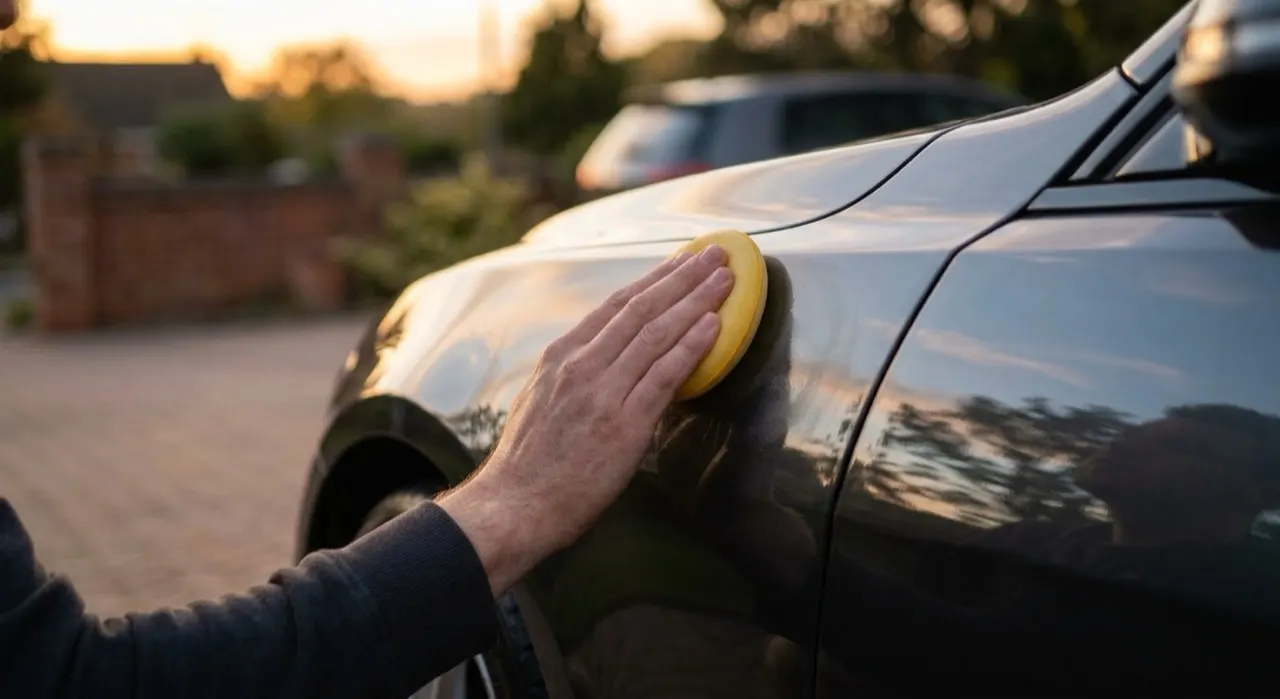
Here is the single most important thing to understand before you buy either one: the words "cutting" and "rubbing" are marketing, not a standard. There is no industry body that says a "rubbing compound" must be milder than a "cutting compound." Manufacturers name products however they like, and the result is genuine chaos on the shelf.
Aggregated owner and detailer reports are full of examples where a bottle labeled "rubbing compound" from one brand cuts harder than a bottle labeled "cutting compound" from another. Some all-in-one products — Meguiar's Ultimate Compound is the classic example — are marketed as compounds but are formulated closer to a heavy polish, using diminishing abrasives that start with real bite and then break down to a finer finish as you work them.
So how do you actually tell them apart? Ignore the front label and look for the objective clues:
- A printed cut rating. Better brands (3D, Sonax, Menzerna, Rupes) print a cut/gloss scale or a numeric grade. That number is far more reliable than the word "cutting."
- The grit or micron figure, when listed — a lower micron number means a finer, less aggressive abrasive.
- The recommended pad. If the maker pairs the product with a heavy cutting pad, it's aggressive; if it recommends a polishing pad, it's milder regardless of its name.
- "Diminishing" vs "non-diminishing." Diminishing abrasives break down as you work, softening from cut to finish; that's why so many "one-step" compounds can both correct and leave a decent shine.
The practical rule detailers repeat: buy on the printed cut level and the manufacturer's pad pairing, never on the word "cutting" or "rubbing" alone. Two bottles with the same name can behave completely differently.
Clear coat is finite — how much you're spending
Every time you compound, you are permanently removing clear coat, and you can never put it back. Factory clear coat is typically only about 1.5 to 2.0 mils thick — roughly 40 to 50 microns — and a meaningful correction can eat 3 to 5 microns in a pass. That doesn't sound like much, but a car only has a handful of serious corrections in it over its life before the clear gets too thin, starts to fail, and can't be polished at all.
This is the real cost difference between the two, and it has nothing to do with the $12–$25 price on the bottle. A cutting compound removes more clear coat per pass than a rubbing compound, so it "spends" more of that finite budget every time you use it. On a young car with light swirls, reaching straight for an aggressive cut is like using a belt sander to remove a smudge — you fix the problem and create a bigger one.
That's why the governing principle in paint correction is the least-aggressive-that-works approach: always test the mildest product and pad combination first on a small section, inspect it under good light, and only step up to something more aggressive if the defect is still there. A rubbing compound or even a plain polish will handle a surprising amount of "damage" that owners assume needs heavy cutting. Save the cutting compound for the paint that genuinely earns it — real oxidation, real scratches, or leveling wet-sanded areas.
Pad and machine matter as much as the bottle
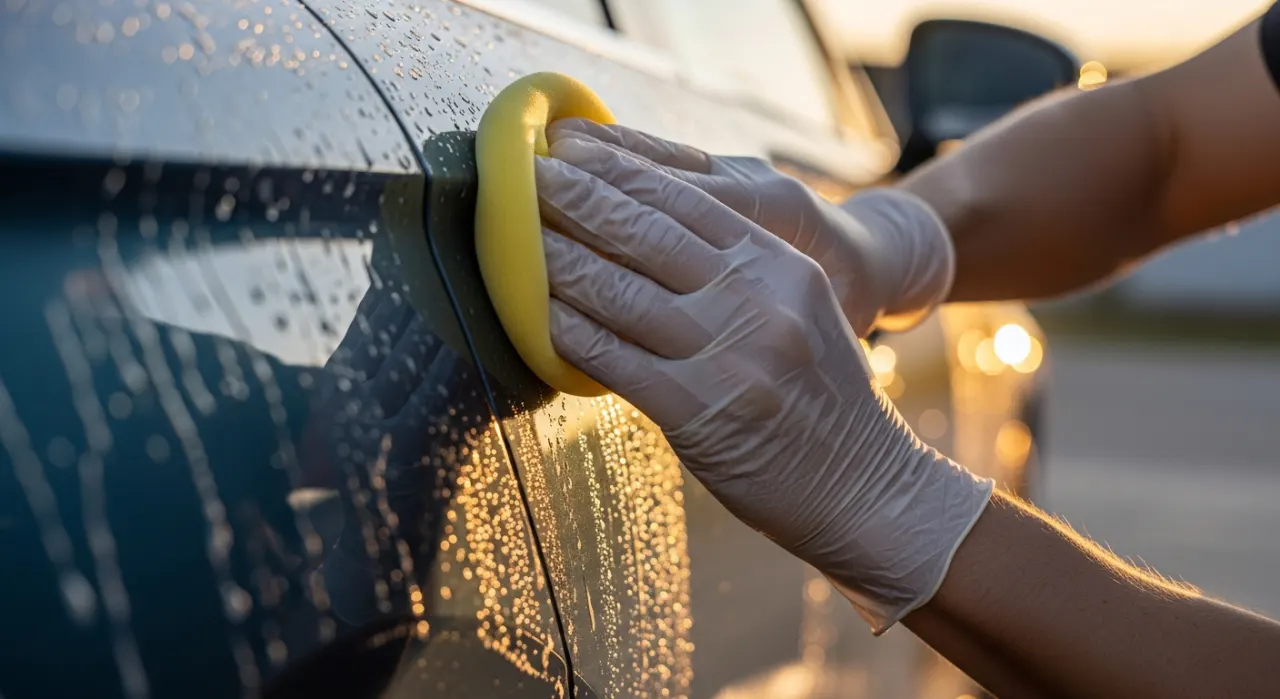
One of the biggest mistakes new detailers make is treating the compound as the whole story. In reality the cutting action is a partnership between the abrasive and the pad, and the pad can swing the result dramatically in either direction.
Pair a mild rubbing compound with an aggressive microfiber cutting pad and you'll get far more correction than the bottle alone suggests. Pair a genuine cutting compound with a soft finishing pad and you'll tame its aggressiveness and finish cleaner. The pad is a variable you control on the fly — which is exactly why experienced detailers keep a range of pads and adjust the pad before they reach for a harsher liquid.
The machine matters too. Applied by hand, even a strong cutting compound loses a lot of its bite — hands simply can't generate the sustained pressure and speed to fully break the abrasives down, so you often get less correction and a hazier finish. A dual-action (DA) polisher is the sweet spot for most people: it works the compound properly, cuts far better than hand application, and is very hard to burn paint with. Rotary polishers cut the hardest and finish potentially the best in skilled hands, but they're also the fastest way to burn through an edge, so they're not a beginner tool. Whichever compound you choose, the honest advice is that the machine and pad you pair it with will influence the outcome at least as much as the name on the bottle.
Common myths and mistakes
"Cutting compound and rubbing compound are totally different products." Not really — they're the same category at different aggressiveness levels. The confusion comes almost entirely from inconsistent naming, not from a hard chemical divide.
"More aggressive is always faster, so just start with cutting compound." Faster to correct, yes — but it removes more clear coat and usually leaves haze that forces a second refining step. Start too aggressive and you often add work and thin your paint for no reason.
"A cutting compound will finish glossy on its own." Sometimes on lighter colors, rarely on dark ones. Most true cutting compounds leave micro-marring or haze that needs a follow-up polish to reach full gloss. Modern one-step "compounds" with diminishing abrasives blur this line, but a genuine heavy cut usually needs refining.
"If it says rubbing compound, it's safe for any light job." Not guaranteed. Because naming isn't standardized, some "rubbing" compounds are quite aggressive. Always test on a small area first and judge by results, not the label.
"You can compound as many times as you want." No. Clear coat is finite. Repeated heavy correction eventually thins it to the point of failure, after which no compound can save it — only a repaint will.
Which should you use — and how to decide
There's no universal winner here, because it's a matter of matching aggressiveness to damage. The right choice is dictated entirely by the state of your paint and, honestly, by the printed cut level rather than the word on the front of the bottle.
Use a cutting compound when the paint is heavily oxidized and chalky, carries scratches you can catch with a fingernail, or you're leveling 1200–1500 grit wet-sanding marks. Plan on following it with a finishing polish to remove the haze, and take a paint-thickness reading first if you can — deep or repeatedly corrected paint may not have the clear coat to spare.
Use a rubbing compound (or a lighter polish) when you're dealing with moderate swirls, light scratches, water spots or general dullness. It corrects most everyday defects while spending less of your clear coat, and it often finishes clean enough to go straight to wax on lighter colors.
Whatever you pick, follow the three rules the professionals live by: test the least aggressive combination first, let the pad and machine do part of the work so you don't over-buy on abrasiveness, and buy on the printed cut rating, not the marketing name. Get the damage assessed correctly, and the "which compound" question mostly answers itself.
Recommended Products
Our top picks in this category, ranked on aggregated owner reviews.
Best for anyone who wants one do-it-all wax
- Synthetic hydrophobic polymer
- Deep, wet-look gloss
- 3–5 months of durability
- Kit includes pad + microfiber towel
Why buy it: the best balance of shine, months-long durability and beginner-easy application.
Best for maximum durability between coats
- 5–7 months of protection
- A little goes a long way
- Cheapest per use
Why buy it: nothing here survives weather longer — the durability champion.
Best for fast, cheap protection in minutes
- SiO₂ spray-on / wipe-off
- Fastest application here
- Strong water beading
Why buy it: the cheapest, fastest protection — spray on wet or dry and go.

Best for first-timers who want a foolproof shine
- Foolproof carnauba liquid
- Warm, wet look
- Wipes off clean even if it dries
Why buy it: almost impossible to mess up — the perfect first wax.

Best for show cars and dark paint
- Premium carnauba paste
- Concours-grade warm gloss
- Easy to apply for a paste
Why buy it: stunning depth on dark paint — a show finish you use for the ritual.

Best for detailing hobbyists chasing gloss
- Soft carnauba paste
- Excellent gloss
- Buffs off easily
Why buy it: a detailing-hobbyist favorite that finishes beautifully.
Prices are pulled from Amazon and were accurate as of Aug 22, 2026, 6:54 PM EDT. Product prices and availability are subject to change — the live price is shown on Amazon.