
Affiliate Disclosure
Some links on this page are affiliate links. As an Amazon Associate, we earn from qualifying purchases — at no extra cost to you. We do not buy, test, or physically handle the products we cover; our rankings come from aggregated owner reviews, ratings and expert consensus. Commissions never change our verdicts. How we rank & full disclosure.
Dual Action (DA) Polisher
A powerful random-orbital polisher whose backing plate spins freely on a bearing while it orbits, giving it enough action to actually cut and correct paint when paired with cutting pads and compound.
Best for: Anyone who wants to remove swirls, oxidation and light scratches — or prep paint for a coating
Typically $100–$200 for a quality DA; budget kits from ~$60, pro units (Rupes) $300+
- Genuinely corrects swirls, oxidation and light scratches with the right pad and compound
- Free-spinning action stalls under pressure, so it rarely burns through paint — beginner-safe
- Variable speed (typically ~2,500–6,000 OPM) lets you compound, polish and finish with one tool
- Accepts a full 5–6" pad ecosystem — cutting, polishing and finishing foam or microfiber
- One machine covers correction, one-step enhancement and coating prep
- Two to three times the price of a basic orbital buffer
- Heavier and higher-vibration — long sessions tire your hands and forearms
- Needs a pad, compound and polish system to work; the tool alone does nothing
- A real learning curve on speed, pressure, pad choice and section size
Orbital Buffer / Waxer
An inexpensive, low-powered orbital polisher designed to spread and remove wax or sealant. It oscillates gently with a soft foam bonnet and lacks the power, throw and pad system to cut paint.
Best for: Applying and removing wax or sealant, and light spot-buffing on already-decent paint
Typically $30–$70 for an orbital buffer/waxer
- Cheap — often a third the price of a real DA polisher
- Almost impossible to damage paint because it is too weak to cut
- Light, low-vibration and effortless for spreading wax over a whole car fast
- Zero learning curve — turn it on and glide it around
- Cannot correct swirls or scratches — at best it temporarily fills them with wax
- Underpowered motor bogs down the moment you add pressure
- Soft bonnet and fixed orbit won't accept a proper cutting-pad system
- You outgrow it the day you want your paint to actually look better, not just shinier
How they score, side by side
Scores reflect aggregated owner reviews and expert consensus — not our own bench testing.
- Paint correction ability82
- Finish quality achievable94
- Beginner safety89
- Ease of use79
- Wax application78
- Value for real detailing93
Spec-by-spec comparison chart
| Factor | Dual Action (DA) Polisher | Orbital Buffer / Waxer |
|---|---|---|
| Primary purpose | Paint correction + finishing | Applying / removing wax & sealant |
| Motion | Free-spinning random orbital ("dual action") | Gentle orbital oscillation, weak or no free spin |
| Motor strength | Strong (typically ~3.5–7 amp / 500–900W) | Weak (often under 2 amp) |
| Orbit / throw | Purpose-built 8–21mm stroke | Small, fixed, non-adjustable |
| Pad system | Rigid plate; 5–6" cutting/polishing/finishing pads | Soft foam bonnet or applicator only |
| Corrects swirls & scratches | Yes — with the right pad and compound | No — only hides them under wax |
| Variable speed | Yes (dial, ~2,500–6,000 OPM) | Often single fixed speed |
| Beginner-safe | Yes — action stalls under pressure | Yes — too weak to do damage |
| Price each | $100–$200 (budget from ~$60) | $30–$70 |
| Learning curve | Moderate — pressure, speed, pad choice | Minimal — turn it on and glide |
| Best use | Defect removal, one-step polish, coating prep | Spreading wax, light spot-buffing |
Our Top 3 Picks
The three highest-rated options in this category, if you'd rather skip straight to a proven pick.

Best for anyone who wants one do-it-all wax
- Synthetic hydrophobic polymer
- Deep, wet-look gloss
- 3–5 months of durability
- Kit includes pad + microfiber towel
Why buy it: the best balance of shine, months-long durability and beginner-easy application.

Best for maximum durability between coats
- 5–7 months of protection
- A little goes a long way
- Cheapest per use
Why buy it: nothing here survives weather longer — the durability champion.

Best for fast, cheap protection in minutes
- SiO₂ spray-on / wipe-off
- Fastest application here
- Strong water beading
Why buy it: the cheapest, fastest protection — spray on wet or dry and go.
Prices are pulled from Amazon and were accurate as of Aug 22, 2026, 6:54 PM EDT. Product prices and availability are subject to change — the live price is shown on Amazon.
What separates a DA polisher from an orbital
This comparison trips people up because of a genuine terminology trap: a dual-action polisher is itself a random-orbital polisher. The words overlap. But when someone shops "dual action polisher vs orbital," the word "orbital" almost always means the cheap orbital buffer or waxer — the $30–$70 machine with a soft foam bonnet sold to spread wax. So the real question isn't which motion is better; it's which of two very different tools you actually need.
A dual-action (DA) polisher is a purpose-built correction tool. Its backing plate sits on an offset bearing that lets the plate spin freely while it also orbits — two motions at once, which is where "dual action" comes from. Paired with a firm 5–6 inch cutting pad and an abrasive compound, that combination generates enough controlled friction to level clear-coat imperfections: swirl marks, wash haze, oxidation and light scratches. It has a strong motor, a variable-speed dial and a rigid plate, and it accepts a whole ecosystem of pads for cutting, polishing and finishing.
An orbital buffer/waxer looks similar in a listing photo but is built for the opposite end of the job. The motor is weak, the orbit is small and fixed, and the business end is a soft foam bonnet meant to glide product on and buff it off. It has no meaningful cutting ability. The consensus among detailers is blunt: an orbital buffer applies wax; a DA polisher corrects paint. They are not two price points of the same tool.
The cleanest way to remember it: every dual-action polisher is an orbital, but not every orbital is a dual-action polisher. The cheap orbital was given one gentle job. The DA was engineered to do real work.
The dual-action motion and why it matters
The magic of a DA is that the pad does two things simultaneously. It orbits around a central axis in a circle of a fixed diameter — the "throw" or "stroke," usually 8mm, 12mm, 15mm or 21mm depending on the machine — and, at the same time, the pad is free to rotate on its own bearing. Nothing forces that rotation; friction against the paint drives it. Add a longer throw and more power and you get more correction per pass, which is why long-throw 15mm and 21mm DAs became popular for cutting large panels quickly.
A basic orbital buffer technically orbits too, but that's where the similarity ends. Its throw is tiny, its motor can't sustain the pad's motion under any load, and the soft bonnet doesn't transfer force into the paint. Press down and it simply bogs to a near-stop. The result is a machine that jiggles wax around beautifully and does effectively nothing to the clear coat underneath.
Spec sheets tell the story at a glance. A DA polisher commonly draws 3.5–7 amps and spins at a variable 2,500–6,000 orbits per minute; a wax-spreading orbital often draws under 2 amps and runs a single fixed speed. That power-and-control gap — not the word "orbital" — is what actually separates them.
Can each actually correct paint?
Only one of them can, and being honest about that saves people a wasted purchase. Based on aggregated owner reviews and detailer consensus, here's the realistic picture:
- Dual-action polisher — yes. With a cutting pad and a quality compound it removes the majority of swirl marks, wash-induced hazing and oxidation, and knocks down many light scratches (anything you can't catch with a fingernail). Step down to a polishing pad and finishing polish and it refines the paint to a clean, glossy finish. It's also the standard tool for prepping paint before a ceramic coating.
- Orbital buffer — no, not really. It can't level a defect. What it can do is spread a filler-heavy glaze or wax that temporarily masks fine swirls, so the car looks better for a few washes until the product breaks down and the swirls reappear exactly as before. That's cosmetic, not correction.
The trap owners fall into is expecting a $40 orbital to "buff out" scratches. It won't. If your goal is to genuinely improve how the paint looks — not just to make waxing easier — the DA is the tool that does it. If your paint is already in good shape and you only want to lay down protection, the orbital is perfectly adequate for that narrow job.
Why the DA is beginner-safe
The single biggest reason the dual-action polisher, and not a rotary, is recommended to first-timers is its built-in fail-safe. Because the pad's rotation is free rather than forced, pressing too hard causes the pad to stop spinning — it just orbits in place. That stall is a feature: it dramatically limits how much heat you can build in one spot, which is what causes clear-coat burn-through with an aggressive rotary buffer. You can make a DA less effective by leaning on it, but it's very hard to actually damage paint.
The orbital buffer is "safe" for a different and less flattering reason: it's simply too weak to hurt anything. There's not enough power or friction to generate damaging heat no matter what you do. So both tools are beginner-friendly, but only the DA is safe and capable. The orbital trades all its capability for that safety; the DA keeps the capability and engineers the safety in.
A couple of real cautions still apply to the DA: keep the cord clear of the pad, don't run a dry or crumbling pad, and don't polish sharp panel edges aggressively, where clear coat is thinnest. None of that makes it dangerous — it just rewards a little care.
Real cost and what a full kit needs
On the sticker, the orbital wins easily — $30–$70 versus $100–$200 for a solid DA (budget DA kits start around $60; pro Rupes and Flex units run $300 and up). But the honest number is the cost of the result you want, and the two tools deliver different results.
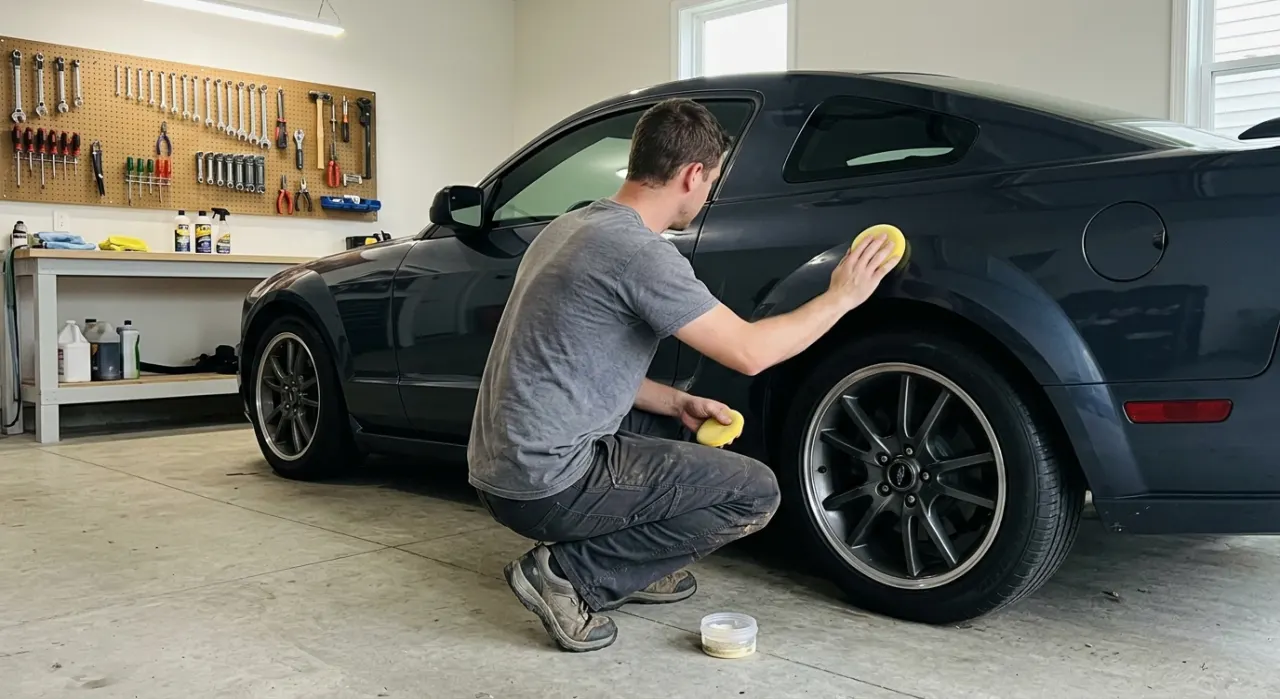
The important thing new buyers miss is that a DA polisher is useless on its own. The machine is only the applicator; the correction comes from the consumables. A realistic starter kit adds a backing plate (often included), a set of cutting, polishing and finishing pads ($30–$60), a compound and a finishing polish ($30–$50), a few microfiber towels, and painter's tape for trim. All in, a genuine correction setup lands closer to $180–$300 the first time, then far less on refills because you're only replacing pads and product.
An orbital buffer's total cost is basically the tool plus a tub of wax and a bonnet — call it under $80 complete. That's the fair way to frame the gap: the orbital is cheap because it does a cheap job. The DA costs more because it's buying you the ability to actually change how your paint looks, repeatedly, for years. Many owners who start with a bargain orbital buffer end up buying a DA within a season once they realize the buffer can't fix the swirls that bothered them in the first place — spending twice.
Common myths and mistakes
"An orbital buffer will remove my swirl marks." It won't level them. At most it spreads a filler that hides them temporarily. Real swirl removal needs the cutting action of a DA (or rotary) with an abrasive compound.
"A dual-action polisher and a random orbital are different tools." They're the same category — "dual action" describes the free-spin-plus-orbit motion that defines a random orbital polisher. The meaningful contrast is DA vs the cheap orbital buffer, not DA vs "random orbital."
"More speed on the DA means faster correction." Only up to a point. Correction comes from the right pad, compound, throw and steady, moderate pressure — not from pinning the dial. Too much speed or pressure just stalls the pad or slings product.
"The DA is dangerous like a rotary." No. The forced rotation of a rotary is what makes it easy to burn paint. The DA's free-spinning pad stalls under pressure instead, which is exactly why it's the beginner recommendation.
"I can put a cutting pad and compound on my orbital waxer and correct paint." The motor and fixed orbit can't sustain the action under load — it'll bog down and accomplish almost nothing. The platform isn't built for it.
Which should you buy
For nearly everyone, the answer is the dual-action polisher. If the reason you're shopping is that your paint has swirls, water spots, oxidation or a dull, hazy finish — anything you want to remove rather than just cover — the orbital buffer physically cannot do it, and you'll be back to buy a DA. Start with the right tool.
Buy a dual-action polisher if you want to correct defects, do a one-step gloss enhancement, or prep paint for a ceramic coating. Choose a variable-speed model, get a starter pad-and-compound kit, and practice light section-by-section passes. A mid-range DA around $120–$160 handles a home garage indefinitely.
Buy an orbital buffer/waxer only if your paint is already in good condition and your sole goal is to spread and remove wax or sealant faster than by hand. For that one narrow task it's cheap, foolproof and perfectly fine — just don't expect it to make your paint look better, only shinier for a while.
If you can only own one machine and you care how your car looks, it's the DA every time. The orbital buffer is a nice convenience for a job the DA can also do; the DA is the only one that can do the job the orbital can't.
Recommended Products
Our top picks in this category, ranked on aggregated owner reviews.
Best for anyone who wants one do-it-all wax
- Synthetic hydrophobic polymer
- Deep, wet-look gloss
- 3–5 months of durability
- Kit includes pad + microfiber towel
Why buy it: the best balance of shine, months-long durability and beginner-easy application.
Best for maximum durability between coats
- 5–7 months of protection
- A little goes a long way
- Cheapest per use
Why buy it: nothing here survives weather longer — the durability champion.
Best for fast, cheap protection in minutes
- SiO₂ spray-on / wipe-off
- Fastest application here
- Strong water beading
Why buy it: the cheapest, fastest protection — spray on wet or dry and go.

Best for first-timers who want a foolproof shine
- Foolproof carnauba liquid
- Warm, wet look
- Wipes off clean even if it dries
Why buy it: almost impossible to mess up — the perfect first wax.

Best for show cars and dark paint
- Premium carnauba paste
- Concours-grade warm gloss
- Easy to apply for a paste
Why buy it: stunning depth on dark paint — a show finish you use for the ritual.

Best for detailing hobbyists chasing gloss
- Soft carnauba paste
- Excellent gloss
- Buffs off easily
Why buy it: a detailing-hobbyist favorite that finishes beautifully.
Prices are pulled from Amazon and were accurate as of Aug 22, 2026, 6:54 PM EDT. Product prices and availability are subject to change — the live price is shown on Amazon.