
Affiliate Disclosure
Some links on this page are affiliate links. As an Amazon Associate, we earn from qualifying purchases — at no extra cost to you. We do not buy, test, or physically handle the products we cover; our rankings come from aggregated owner reviews, ratings and expert consensus. Commissions never change our verdicts. How we rank & full disclosure.
Electric Pressure Washer
A plug-in unit powered by a household outlet, driving a universal or induction motor. Quiet, light, and zero-maintenance between uses — the default choice for cars, patios and driveways.
Best for: Car detailing, driveways, decks, patio furniture and most weekend homeowner cleaning
Typically $100–$350 for consumer models; prosumer induction-motor units $400–$700
- Starts instantly with a switch — no pull cord, choke, or warm-up
- Runs quiet enough for a suburban driveway, roughly 70–78 dB
- No fumes, so it can run in a garage or enclosed carport safely
- Near-zero maintenance — no oil changes, spark plugs, or winterizing fuel
- Lighter and cheaper up front, and most models roll on wheels
- Tethered to a power outlet and, on higher pressures, a GFCI circuit
- Consumer units top out around 1,300–2,300 PSI and modest flow
- Cheaper models use brushed universal motors that wear faster under load
- Long jobs can trip breakers or suffer voltage drop on thin extension cords
Gas Pressure Washer
An engine-driven unit — commonly a Honda, Briggs, or clone motor spinning an axial or triplex pump. Cordless, high-output muscle built for big surfaces and stubborn grime.
Best for: Driveways, siding, large decks, concrete, farm equipment and jobs far from an outlet
Typically $300–$600 for homeowner models; commercial triplex-pump units $700–$1,500+
- Far more power — homeowner units run 2,500–3,300 PSI with higher flow
- Completely cordless, so range is limited only by hose and fuel
- Clears large concrete, siding and mud dramatically faster
- Triplex-pump models are rebuildable and built for daily commercial duty
- No breaker trips or voltage-drop limits on long runs
- Loud — commonly 85–100+ dB, unpleasant close-up and for neighbors
- Emits exhaust, so it must never run indoors or in an enclosed space
- Real maintenance: oil changes, spark plugs, air filter, fuel stabilizer
- Heavier, pricier up front, and the extra PSI can strip paint or etch wood
How they score, side by side
Scores reflect aggregated owner reviews and expert consensus — not our own bench testing.
- Cleaning power69
- Quiet operation93
- Low maintenance104
- Safe near cars/wood85
- Cordless range310
- Up-front value86
- Portability85
Spec-by-spec comparison chart
| Factor | Electric Pressure Washer | Gas Pressure Washer |
|---|---|---|
| Typical PSI (homeowner) | 1,300–2,300 PSI | 2,500–3,300 PSI |
| Typical flow (GPM) | 1.2–1.6 GPM | 2.3–2.8 GPM |
| Cleaning power (PSI × GPM) | Lower — great for cars & light grime | Higher — clears concrete faster |
| Noise level | ~70–78 dB (conversational) | ~85–100+ dB (ear protection wise) |
| Run location | Garage, carport, indoors OK | Outdoors only — exhaust fumes |
| Power source | Household outlet + cord/GFCI | Gasoline — fully cordless |
| Maintenance | Essentially none | Oil, plug, filter, fuel stabilizer |
| Up-front cost | $100–$350 (consumer) | $300–$600 (homeowner) |
| Weight | Light (~16–35 lb) | Heavy (~50–70+ lb) |
| Best surfaces | Cars, decks, patios, furniture | Concrete, siding, equipment |
| Paint/wood risk | Lower — easier to control | Higher — can etch or strip |
Our Top 3 Picks
The three highest-rated options in this category, if you'd rather skip straight to a proven pick.

Best for Beginners who want one box that does everything well
- 14 matched pieces covering wash, protect and interior
- Includes shampoo, spray sealant and interior cleaner
- Comes with microfiber towels and applicators
- Products are designed to work together as a system
Why buy it: It is the closest thing to a complete detail in a single box, which is exactly what a first-timer needs — no guesswork about whether the pieces play nicely together.

Best for Enthusiasts who want top-shelf formulas from the start
- Premium formulas with a genuinely slick finish
- Excellent spray sealant and glass cleaner
- High-quality plush microfiber included
- Strong resale-grade presentation and packaging
Why buy it: You pay more, but the products themselves are a noticeable step up in slickness and gloss — the kit you buy when you know you are hooked.

Best for Getting proven, forgiving products for a fair price
- Trusted formulas that are hard to get wrong
- Covers wash, wax and interior basics
- Widely reviewed and consistently reliable
- Great balance of price and performance
Why buy it: Meguiar's has been dialing in beginner-friendly products for decades, and this kit is the safe, sensible middle — nothing flashy, nothing you will regret.
Prices are pulled from Amazon and were accurate as of Aug 22, 2026, 6:54 PM EDT. Product prices and availability are subject to change — the live price is shown on Amazon.
What actually separates electric from gas
On the surface the two look interchangeable — both are a pump, a hose, a trigger gun and a set of nozzles. The difference is entirely in what drives the pump, and that single choice cascades into power, noise, maintenance, and where you are even allowed to use the machine.
An electric pressure washer spins its pump with an electric motor fed by a standard 120V outlet. Budget and mid-range units use a brushed "universal" motor, which is light and cheap but wears under sustained load; better prosumer models use an induction motor that runs cooler and lasts far longer. Because there is no combustion, an electric unit produces no exhaust, starts with a switch, and needs essentially no upkeep between seasons.
A gas pressure washer spins its pump with a small gasoline engine — most commonly a Honda GC/GX, a Briggs & Stratton, or a clone. That engine has no cord to limit it and produces far more usable output, which is why gas dominates the high-PSI end of the market. The trade is real, though: it is loud, it emits carbon monoxide, and it carries every maintenance chore a small engine does — oil, spark plug, air filter and fuel that goes stale.
The pump matters too. Cheaper gas units use an axial cam pump, fine for homeowner duty; commercial units use a rebuildable triplex pump rated for daily use. The consensus among owners and pressure-washing pros is simple: gas buys you raw output and range, electric buys you convenience, quiet and freedom from maintenance.
PSI vs GPM: the number that really matters
Marketing leans hard on PSI because it is the biggest number on the box, but cleaning speed is actually a product of two figures: PSI (pressure) and GPM (gallons per minute of flow). Multiply them and you get "cleaning units," the honest measure of how fast a machine strips grime. This is where a lot of buyers get misled.
- PSI is the force that breaks the bond between dirt and the surface. High PSI cuts through caked-on mud and etches into concrete pores.
- GPM is the water volume that then carries the loosened dirt away. Low flow means you blast a spot clean but rinse slowly; high flow sheets the whole area off at once.
A typical consumer electric unit runs roughly 1,800 PSI at 1.4 GPM — about 2,520 cleaning units. A homeowner gas unit at 2,800 PSI and 2.4 GPM lands near 6,720 — well over double the effective cleaning speed, driven as much by flow as by pressure. That gap is exactly why a big driveway that takes an afternoon with a small electric finishes in a fraction of the time with gas.
But more is not automatically better. On a car's clearcoat, anything above roughly 1,900 PSI held close starts to risk paint and trim damage, and the consensus among detailers is that 1,200–1,900 PSI with the right wide-angle nozzle is the sweet spot. A 3,000 PSI gas machine pointed at a fender at close range can lift paint and blast water past door seals. For vehicles, the electric unit's "weaker" numbers are a feature, not a shortcoming.
Which one for cars, driveways and decks
Because the right tool is dictated by the surface, the cleanest way to choose is to match the machine to the jobs you actually do most:
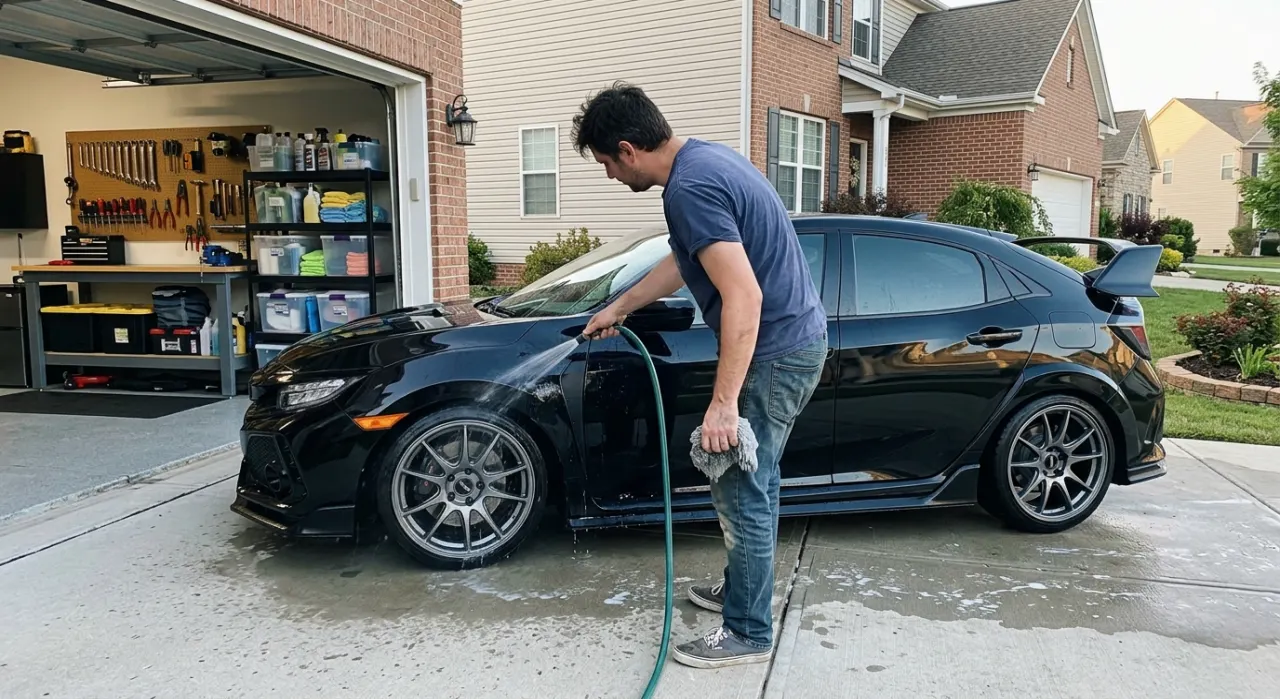
- Washing cars, trucks and motorcycles — electric wins decisively. Its lower pressure is safer on paint and trim, it is quiet enough to run early on a weekend, and paired with a foam cannon it handles the whole wash without ever threatening the clearcoat.
- Driveways, sidewalks and concrete — this is gas's home turf when the area is large. A surface cleaner attachment plus 2.4+ GPM sheets a two-car driveway fast. A small electric will do it, just slowly, and works fine for a single-car apron or short walkway.
- Wood decks and fences — favor electric, or a gas unit used carefully with a wide nozzle from a distance. Wood is soft; excess pressure furrows the grain and shreds fibers. Control matters more than raw output here.
- Siding and second-story soffits — gas is generally preferred for the flow to rinse a whole wall, though vinyl still demands a gentle wide nozzle and careful angle to avoid driving water behind it.
- Farm equipment, trailers, heavy mud — gas, without much debate. The output and cordless range are exactly what these jobs need.
For a car-care–focused owner whose list is mostly vehicles plus the occasional patio or deck, the honest recommendation is an electric unit in the 1,600–2,300 PSI range. The buyer who also cleans a big concrete driveway, long fence line, or full house exterior every season is the one who genuinely benefits from stepping up to gas.
Noise, fumes and where you can run it
This is the practical difference owners underestimate until they own one. An electric unit runs around 70–78 dB — loud, but you can hold a conversation nearby and run it at 8 a.m. without a neighbor complaint. A gas engine commonly hits 85–100+ dB, firmly in ear-protection territory and genuinely antisocial in a tight suburban lot.
Fumes are the bigger safety line. A gas engine produces carbon monoxide and must never be run in a garage, carport, or any enclosed space — every reputable manufacturer prints this warning, and CO poisoning cases from indoor small-engine use are well documented. An electric unit has no exhaust at all, so it can run in a closed garage on a rainy day, which for a lot of home detailers is the deciding factor by itself.
The electric trade-off is the tether. Higher-output units draw enough current that a long or thin extension cord causes voltage drop, starving the motor and tripping the breaker or GFCI. The fix is a short, heavy-gauge cord (12-gauge for longer runs) on a dedicated circuit — not one shared with a fridge or freezer.
Maintenance and the real cost of ownership
The sticker price understates the gap. An electric unit is close to maintenance-free: no oil, no fuel, no spark plug. You store it somewhere it won't freeze, pull the trigger to relieve pressure before disconnecting, and that is roughly the whole routine. Over five years the running cost is essentially electricity and the occasional replacement O-ring or nozzle.
A gas unit is a small engine, and it wants the care any small engine does — scheduled oil changes, a periodic spark plug and air filter, and above all fuel management. Ethanol-blended pump gas left sitting gums up the carburetor, the single most common reason a gas washer won't start in spring. Owners who add fuel stabilizer and run the carb dry before storage rarely have trouble; those who don't spend a Saturday cleaning a carburetor.
Pump quality drives longevity on both sides. Cheap electrics with brushed motors and plastic-headed pumps are effectively disposable — fine for light seasonal use, not for hours a week. Prosumer electrics with induction motors and metal pump heads last far longer, and a triplex-pump gas unit will outlast several cheaper machines if you actually work it.
Common myths and mistakes
"More PSI always cleans better." No — flow (GPM) does at least as much of the work, and on cars and wood excess PSI is a liability that etches, strips and gouges. Cleaning speed is PSI times GPM, and control often beats brute force.
"Gas is overkill, so electric is always the smart choice." Not for everyone. If you clean large concrete, siding, or work far from an outlet, an underpowered electric turns a 30-minute job into a two-hour slog and wears out its lighter-duty pump doing it.
"I can run my gas washer in the garage if the door is open." Dangerous and wrong. Carbon monoxide accumulates even with the door up. Gas units are outdoor-only, full stop — this is the mistake most likely to actually hurt someone.
"Any extension cord will do." A thin or overly long cord causes voltage drop that starves the motor, trips breakers, and can overheat the cord. Use a short, heavy-gauge cord on a dedicated circuit, or skip the cord entirely by choosing gas.
"A pressure washer is safe to point anywhere." Both types can inject water under the skin at close range — a genuine medical emergency — and can shatter windows, lift paint, and drive water behind siding. Nozzle choice and standoff distance matter more than which power source you bought.
Which should you buy — and how to decide
For most people reading a car-care site, the answer is electric. If your regular jobs are washing vehicles plus the occasional driveway apron, patio, deck or outdoor furniture, an electric unit in the 1,600–2,300 PSI range is quieter, safe to run in the garage, maintenance-free, cheaper, and gentle enough not to damage the surfaces you care about most. Pair it with a foam cannon and a couple of quality nozzles and it covers the overwhelming majority of home and vehicle cleaning.
You should buy gas if your list genuinely includes large concrete, full house siding, long fence lines, farm or trailer duty, or any regular work far from a power outlet. The extra 2,500–3,300 PSI and higher flow turn those big jobs from an all-afternoon chore into a quick pass — and the cordless range is worth the noise and upkeep when you actually need it. Buy a triplex-pump model if you will run it hard.
Whichever you choose, prioritize GPM alongside PSI, buy a reputable pump over a big number on the box, and add a surface cleaner attachment if flat concrete is on your list — it does more for driveway speed than another 500 PSI ever will. Get the surface-to-machine match right first, and the electric-vs-gas question mostly answers itself.
Recommended Products
Our top picks in this category, ranked on aggregated owner reviews.
Best for Beginners who want one box that does everything well
- 14 matched pieces covering wash, protect and interior
- Includes shampoo, spray sealant and interior cleaner
- Comes with microfiber towels and applicators
- Products are designed to work together as a system
Why buy it: It is the closest thing to a complete detail in a single box, which is exactly what a first-timer needs — no guesswork about whether the pieces play nicely together.
Best for Enthusiasts who want top-shelf formulas from the start
- Premium formulas with a genuinely slick finish
- Excellent spray sealant and glass cleaner
- High-quality plush microfiber included
- Strong resale-grade presentation and packaging
Why buy it: You pay more, but the products themselves are a noticeable step up in slickness and gloss — the kit you buy when you know you are hooked.
Best for Getting proven, forgiving products for a fair price
- Trusted formulas that are hard to get wrong
- Covers wash, wax and interior basics
- Widely reviewed and consistently reliable
- Great balance of price and performance
Why buy it: Meguiar's has been dialing in beginner-friendly products for decades, and this kit is the safe, sensible middle — nothing flashy, nothing you will regret.

Best for The cheapest way to cover the basics in one buy
- Lowest entry price of the group
- Covers wash, wheels, glass and interior
- Available almost everywhere
- Simple products that are easy to use
Why buy it: If you just want to stop washing your car with dish soap and a bath towel, this gets you a real detailing setup for pocket change.

Best for People who want maximum product and a storage bucket
- Large bundle with a bucket and grit guard included
- Full-size bottles of core products
- Foam and wash gear bundled in
- Everything stores neatly in the bucket
Why buy it: The bucket doubles as storage and a two-bucket wash setup, and the full-size bottles mean you are not restocking after two washes.

Best for Buying local at any auto parts store today
- Stocked at nearly every parts store
- Reliable wax and cleaner formulas
- Easy to top up individual bottles later
- Long-standing reputation with hobbyists
Why buy it: When you want to start today and not wait on shipping, Mothers is on a shelf near you — and the products genuinely hold up.
Prices are pulled from Amazon and were accurate as of Aug 22, 2026, 6:54 PM EDT. Product prices and availability are subject to change — the live price is shown on Amazon.