
Affiliate Disclosure
Some links on this page are affiliate links. As an Amazon Associate, we earn from qualifying purchases — at no extra cost to you. We do not buy, test, or physically handle the products we cover; our rankings come from aggregated owner reviews, ratings and expert consensus. Commissions never change our verdicts. How we rank & full disclosure.
Floor Jack
A wheeled hydraulic jack you roll under the car and raise with a long pump handle. It lifts fast, sits low, and is the tool most home mechanics reach for when they actually want to work on a vehicle.
Best for: Home garage work, oil changes, brake jobs and anyone lifting a car more than twice a year
Typically $60–$180 for steel; $150–$400+ for aluminum or low-profile racing jacks
- Lifts quickly with far less effort — a few handle strokes instead of dozens of crank turns
- Wide, wheeled base is dramatically more stable than a narrow scissor foot
- Rolls as it lifts, so the pad tracks the car's natural arc instead of fighting it
- Handles heavy trucks and SUVs; 3-ton units are common and affordable
- Rated saddle and lift range make it easy to pair with jack stands for safe work
- Heavy and bulky — a steel 3-ton jack can weigh 60–90 lbs and won't live in your trunk
- Costs money the scissor jack in your kit already covered for free
- Hydraulic seals can weep or fail over years, letting the jack sink under load
- Overkill for a single roadside tire change
Scissor Jack
The compact folding jack that ships in your spare-tire kit. A screw thread pulls two hinged arms together to raise a single corner just high enough to swap a flat.
Best for: Emergency roadside tire changes and drivers who need a jack that fits in the trunk
Typically $20–$45 aftermarket; usually $0 because one came with the car
- Tiny and light — folds flat and lives permanently in the trunk with the spare
- Free with virtually every car, so most drivers already own one
- Mechanically simple screw drive with no hydraulic fluid to leak
- Fine for its designed job: lifting one corner to change a tire on level ground
- Slow and tiring — swapping a tire can mean dozens of stiff crank turns
- Narrow footprint is far tippier, especially on soft or uneven ground
- Low weight rating and short lift; not meant for repeated shop work
- Never safe to crawl under — it offers no margin if it folds or slips
How they score, side by side
Scores reflect aggregated owner reviews and expert consensus — not our own bench testing.
- Lifting speed93
- Stability under load94
- Portability210
- Value for the money79
- Suited to garage work102
- Suited to roadside use39
Spec-by-spec comparison chart
| Factor | Floor Jack | Scissor Jack |
|---|---|---|
| Mechanism | Hydraulic pump + wheeled base | Screw thread + folding arms |
| Lifting speed | Fast — a few pump strokes | Slow — dozens of crank turns |
| Stability | High — wide, wheeled footprint | Low — narrow single foot |
| Typical capacity | 2–3+ tons (heavier units available) | Roughly 1–1.5 tons |
| Max lift height | ~13–20+ in. | ~11–15 in. |
| Weight of the tool | ~30–90 lbs | ~5–9 lbs |
| Portability | Poor — stays in the garage | Excellent — lives in the trunk |
| Cost | $60–$400+ | $0–$45 (often free with the car) |
| Best use | Garage / DIY maintenance | Roadside tire change |
| Safe to work under? | Only with jack stands — never on the jack alone | No — emergency lift only |
Our Top 3 Picks
The three highest-rated options in this category, if you'd rather skip straight to a proven pick.

Best for the best mix of brand pedigree, warranty and price
- 72-tooth ratchets for a 5° swing arc
- Polished chrome-vanadium, anti-slip sockets
- DEWALT full lifetime warranty
- Compact SAE + metric set in a blow-mould case
Why buy it: a name-brand kit that owners rate at the very top of the budget class — the lifetime warranty and fine-tooth ratchets punch well above the price, which is why it keeps getting recommended to first-time wrenchers.
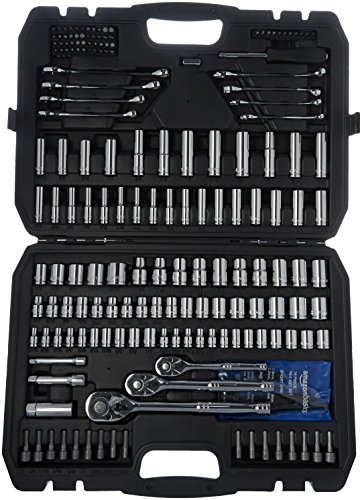
Best for the most sockets and bits per dollar
- 201 pieces across 1/4", 3/8" and 1/2" drives
- Chrome-vanadium forged, polished-chrome finish
- Full SAE + metric coverage
- Molded case keeps every socket in its slot
Why buy it: a socket-heavy kit that owners repeatedly call the best money-for-metal buy on Amazon — if your jobs are mostly nuts and bolts, nothing here gives you more drive tools for the outlay.

Best for trusted-brand tools with a lifetime guarantee
- 72-tooth reversible ratchets
- Alloy-steel sockets, off-corner loading grip
- Crescent lifetime warranty
- Closed, latching blow-mould case
Why buy it: an Apex Tool Group set that owners rate for genuine fit and finish — the off-corner grip protects rounded fasteners, and the lifetime backing means a cracked socket is a free swap.
Prices are pulled from Amazon and were accurate as of Aug 22, 2026, 6:54 PM EDT. Product prices and availability are subject to change — the live price is shown on Amazon.
What actually separates the two jacks
Both tools do the same headline job — lift a car off the ground — so it's easy to assume they're interchangeable. They aren't. They use different mechanics, target different situations, and carry very different margins of safety. Understanding how each one lifts is the fastest way to see why one belongs in your garage and the other belongs in your trunk.
A scissor jack is a purely mechanical device. Turning a bolt at one end draws two pairs of hinged arms together, and as they close, the diamond-shaped linkage rises. It's compact, cheap to make, and has no fluid inside, which is exactly why automakers stash one next to every spare tire. But that same simplicity means it lifts slowly, on a narrow single foot, with only enough capacity and height to raise one corner for a tire swap.
A floor jack is a hydraulic tool on wheels. Pumping the handle drives fluid into a cylinder, and a lever arm swings a saddle upward with far more force than your arm could apply directly. Because it rolls on casters, the lift point tracks the arc the car's chassis naturally follows as it rises, instead of dragging against it. The wide steel frame plants the load over a big footprint, and 2- and 3-ton ratings are the norm — enough for most trucks and SUVs, not just compact cars.
The clean way to remember the split: the scissor jack is emergency equipment engineered for one flat tire, while the floor jack is a workshop tool engineered for repeated, deliberate lifting. They overlap only in the single act of raising a wheel off the ground; everything about how safely and quickly they do it is different.
Why stability is the whole argument
If there's one factor that decides this comparison, it's stability — and it's not close. The consensus among mechanics and the pattern in owner reports both point the same direction: the wide, wheeled base of a floor jack is dramatically harder to tip than the narrow foot of a scissor jack.
A scissor jack contacts the ground on a small pad, sometimes just a few square inches. On a perfectly level, hard surface that's adequate for a quick tire change. But driveways slope, roadside shoulders are soft, and gravel shifts. As the car rises on a scissor jack, its center of gravity climbs over that tiny footprint, and any side load — a gust, a bump against the car, an uneven surface — can walk the jack out from under the pinch weld. This is precisely why scissor-jack failures are a known roadside hazard and why manufacturers warn never to put any part of your body under a car it's holding.
A floor jack spreads the same load across a long steel frame and rolls as it lifts, so it stays planted and follows the chassis rather than fighting it. That stability is what makes it safe to raise a corner, slide a rated jack stand under a solid lift point, and lower the car onto the stand before you work. You physically can't do that reliably with a scissor jack, which is the real reason it never graduates from emergency duty to garage duty.

When a scissor jack is genuinely the right tool
None of this makes the scissor jack useless — it makes it specialized. There are real situations where it's the better choice, and pretending otherwise would be dishonest:
- A roadside flat, miles from home. Your floor jack is a 60-pound lump in the garage. The scissor jack is already in the trunk with the spare and the lug wrench. For the one corner, on level ground, that it was designed to lift, it works.
- Cars with no room to spare. A folded scissor jack takes almost no space, so it can live permanently in the trunk well of even a small hatchback without you ever thinking about it.
- Drivers who rarely turn a wrench. If you're not doing your own oil changes or brakes, buying and storing a heavy floor jack you'd use once a year makes little sense. The free jack that came with the car covers the emergency it was built for.
- A backup when the hydraulics fail. Even committed DIYers keep the scissor jack around, because a mechanical screw jack has nothing to leak and will still lift when a neglected floor jack's seals finally weep.
The honest framing is that these two tools aren't really competing for the same job. Owners who treat the scissor jack as their only jack for driveway work are misusing it; owners who throw it out because they bought a floor jack have discarded a perfectly good emergency backup.
The safety rule that applies to both
This is the single most important point on the page, and it's identical for both tools: a jack lifts a car, it does not hold a car. Neither a scissor jack nor a floor jack is a safe support to work under. Both can fail — a scissor jack can tip or the thread can strip, and a floor jack's hydraulic seals can lose pressure and let the saddle sink over minutes or hours.
Once a corner is raised for anything more than a tire change, the rule is to lower it onto a pair of rated jack stands placed at the manufacturer's designated lift points, then shake the car to confirm it's solid before any part of you goes underneath. Chock the wheels that stay on the ground, and leave the floor jack in place as a redundant backup, snug but not carrying the full load. This is why the floor jack is the tool that enables real work: it lifts cleanly and stably so you can get the stands in. The scissor jack simply isn't stable or tall enough to make that handoff reliable, which is another reason it stays in the emergency lane.
Real cost and what to actually buy
The price gap looks large until you account for what each tool is for. A scissor jack is effectively free — one shipped with your car — and aftermarket replacements run only $20–$45. A floor jack is a genuine purchase: $60–$180 gets a solid 2–3 ton steel unit, while $150–$400+ buys aluminum or low-profile "racing" jacks that are lighter to haul out and slide under lowered cars.
For most home mechanics the sweet spot is a steel 2- or 3-ton floor jack in the $80–$150 range. Two tons handles the majority of cars comfortably; step up to three tons if you own a truck or a full-size SUV, since you want the rating to exceed the corner weight you're lifting with margin to spare. Aluminum jacks cost more and carry less, but if you haul the jack to the curb or a friend's place, the weight savings are worth it. Whatever you buy, pair it immediately with a set of jack stands rated for your vehicle — the jack and the stands are one purchase, not two, because using the jack without them is the unsafe part.
The scissor jack, meanwhile, costs you nothing to keep. It's already in the car. The only spending decision it demands is not throwing it away when you buy the floor jack, because its whole value is being in the trunk on the day you get a flat far from your garage.
Common myths and mistakes
"A floor jack is all I need — I can work under the car on it." No. A floor jack lifts far more safely than a scissor jack, but hydraulic seals can bleed down over time, and a jack that rolls can shift. Always transfer the load to jack stands before going underneath.
"The scissor jack is fine for my driveway oil changes." It's risky. The narrow foot on a sloped or soft driveway is exactly the setup where scissor jacks tip. For any repeated garage work, a floor jack plus stands is the right and far safer tool.
"Any jack will lift my truck." Not the scissor jack. The one in a light car's kit is rated for that car and lifts only to a modest height. A loaded truck or SUV needs a floor jack with the capacity and reach to match — check the rating against your vehicle's corner weight.
"I'll just leave the car on the jack overnight while I get parts." Don't. Both jacks can settle. Set the car on stands, or lower it fully to the ground until you're ready to work again.
Which should you buy — and how to decide
For garage work, buy the floor jack — it wins decisively. It lifts faster, stays far more stable, handles heavier vehicles, and lets you set the car safely on jack stands. If you change your own oil, do your own brakes, or lift a car more than a couple of times a year, a 2- or 3-ton floor jack is one of the highest-value tools you can own.
Keep the scissor jack anyway. This isn't really an either/or purchase. The floor jack earns its place in the garage; the free scissor jack earns its place in the trunk, where its light weight and compact fold make it the right tool for a roadside flat and a fine mechanical backup if your hydraulics ever fail.
So the practical answer for almost everyone is both: a floor jack and a matched set of jack stands for real work at home, and the factory scissor jack left exactly where it is for emergencies. Match the floor jack's rating to your heaviest vehicle, never work under a car supported by a jack alone, and you'll have the right tool for both the driveway and the shoulder of the highway.
Recommended Products
Our top picks in this category, ranked on aggregated owner reviews.
Best for the best mix of brand pedigree, warranty and price
- 72-tooth ratchets for a 5° swing arc
- Polished chrome-vanadium, anti-slip sockets
- DEWALT full lifetime warranty
- Compact SAE + metric set in a blow-mould case
Why buy it: a name-brand kit that owners rate at the very top of the budget class — the lifetime warranty and fine-tooth ratchets punch well above the price, which is why it keeps getting recommended to first-time wrenchers.
Best for the most sockets and bits per dollar
- 201 pieces across 1/4", 3/8" and 1/2" drives
- Chrome-vanadium forged, polished-chrome finish
- Full SAE + metric coverage
- Molded case keeps every socket in its slot
Why buy it: a socket-heavy kit that owners repeatedly call the best money-for-metal buy on Amazon — if your jobs are mostly nuts and bolts, nothing here gives you more drive tools for the outlay.
Best for trusted-brand tools with a lifetime guarantee
- 72-tooth reversible ratchets
- Alloy-steel sockets, off-corner loading grip
- Crescent lifetime warranty
- Closed, latching blow-mould case
Why buy it: an Apex Tool Group set that owners rate for genuine fit and finish — the off-corner grip protects rounded fasteners, and the lifetime backing means a cracked socket is a free swap.

Best for a first-ever kit that covers the whole garage and house
- Sockets, wrenches, screwdrivers, hammer, pliers
- Heat-treated carbon steel, rust-resistant
- Compact blow-mould carry case
- One of Amazon’s best-selling tool kits
Why buy it: the entry point owners recommend for a first toolbox — rated across tens of thousands of reviews, it handles light auto work and household jobs without asking much of your wallet.
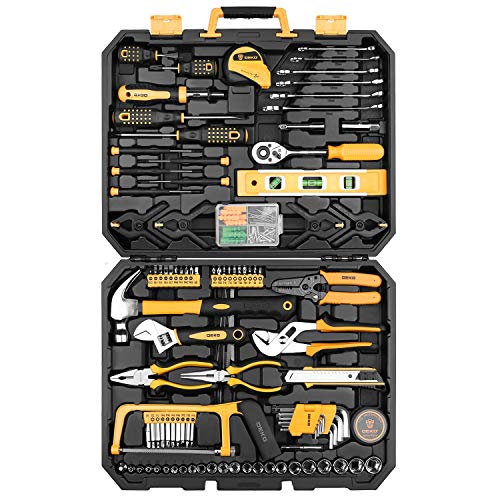
Best for a purpose-built car-repair combination
- 168-piece socket + wrench combination
- Ratchet handle, extension bars, spark-plug socket
- Chrome-vanadium and carbon-steel mix
- Deep plastic storage case
Why buy it: a combination set owners lean on for actual under-hood jobs — the spark-plug socket, extensions and combination wrenches mean fewer trips to buy the one tool you’re missing.

Best for the most complete kit before you leave the budget tier
- 201-piece mechanics set, SAE + metric
- 72-tooth quick-release ratchets
- Black-chrome sockets with laser-etched sizes
- Sturdy structural-foam case
Why buy it: the ceiling of the budget class — owners rate its ratchets and easy-read sockets highly, and the Stanley name carries a reputation that a no-name kit can’t match at the same money.
Prices are pulled from Amazon and were accurate as of Aug 22, 2026, 6:54 PM EDT. Product prices and availability are subject to change — the live price is shown on Amazon.