
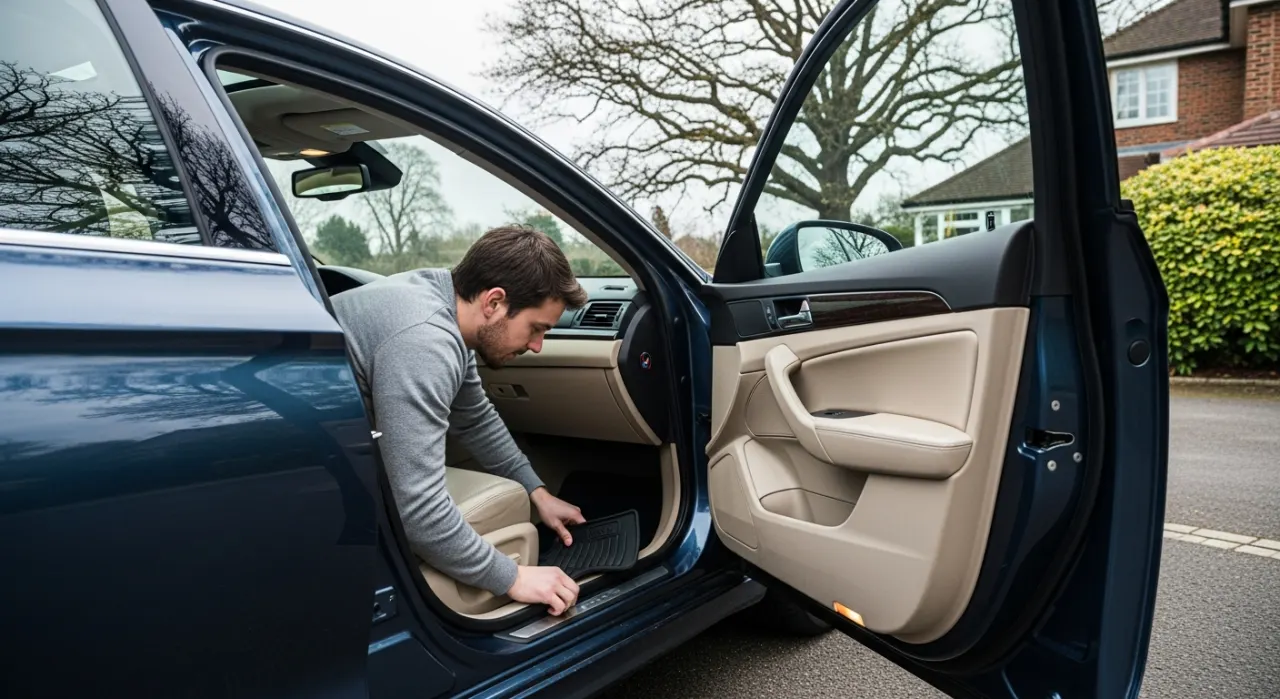
Affiliate Disclosure
Some links on this page are affiliate links. As an Amazon Associate, we earn from qualifying purchases — at no extra cost to you. We do not buy, test, or physically handle the products we cover; our rankings come from aggregated owner reviews, ratings and expert consensus. Commissions never change our verdicts. How we rank & full disclosure.
Floor Liners
Digitally laser-scanned, deep-dish trays molded to the exact contours of a specific make, model and year. Tall raised edges and a full footwell wrap are built to trap water, mud and slush and hold it away from the carpet.
Best for: Snow-belt, off-road, work-truck and pet-owner drivers who want maximum carpet protection
Typically $90–$180 per row front set; $170–$300+ for a full front-and-rear kit
- Vehicle-specific laser fit wraps up the sides and around the console, sealing the carpet
- Raised lips (often 3/4"–1.5") contain melting snow, spills and mud instead of letting them run onto carpet
- Rigid thermoplastic (TPE/TPO) construction resists cracking in cold and holds its shape
- Owners consistently report they protect resale value on trucks and SUVs used hard
- Textured reservoir surfaces channel liquid into low points for easy hose-out cleaning
- Two to three times the price of a universal mat set
- You must buy the exact liner for your year, trim and cab configuration — no cross-fitting
- Bulkier and heavier; the deep dish can crowd larger feet in tight footwells
- Rigid trays can look utilitarian and may squeak or shift if the retention post is missing
Floor Mats
Flatter, more universal floor covers — sold as trim-to-fit rubber, generic carpet sets, or lightly contoured semi-custom mats. They lie on top of the carpet and are held by a hook or clip.
Best for: Budget-minded drivers, mild climates, leased cars, and anyone who wants a low-profile factory look
Typically $15–$40 universal rubber set; $40–$90 for semi-custom or branded carpet mats
- Cheap — a universal rubber set costs a fraction of a molded liner
- Low profile keeps footwells roomy and preserves the factory carpeted look
- Trim-to-fit and universal sets fit almost any vehicle, so they carry between cars
- Lightweight and easy to pull, shake out and reinstall in seconds
- Flat edges let water, mud and spills run off the sides onto the carpet
- Universal mats can slide or bunch without a factory retention clip, a real pedal hazard
- Carpet mats absorb liquid and odor rather than containing it
- Thinner rubber can curl, crack in the cold, or wear through at the heel over a few winters
How they score, side by side
Scores reflect aggregated owner reviews and expert consensus — not our own bench testing.
- Carpet protection105
- Spill / snow containment104
- Exact fitment95
- Affordability59
- Low-profile / roominess58
- Ease of cleaning96
Spec-by-spec comparison chart
| Factor | Floor Liners | Floor Mats |
|---|---|---|
| Fitment | Vehicle-specific, laser-scanned | Universal, trim-to-fit, or semi-custom |
| Edge design | Raised lip ~3/4"–1.5", wraps up the sides | Flat or low edge, lies on carpet |
| Spill / snowmelt containment | Contains liquid in a reservoir | Runs off the sides onto carpet |
| Material | Rigid TPE / TPO thermoplastic | Rubber, thermoplastic, or carpet |
| Retention | Molded to floor + factory post | Hook, clip, or friction (can slide) |
| Carpet coverage | Full footwell incl. sides & console | Center flat area only |
| Price per front set | $90–$180 | $15–$90 |
| Cleaning | Hose out or wipe down | Shake out; carpet needs vacuum |
| Cold-weather durability | Excellent — stays flexible | Varies — thin rubber can crack |
| Footwell roominess | Tighter (deep dish) | Roomier (low profile) |
Our Top 3 Picks
The three highest-rated options in this category, if you'd rather skip straight to a proven pick.

Best for Beginners who want one box that does everything well
- 14 matched pieces covering wash, protect and interior
- Includes shampoo, spray sealant and interior cleaner
- Comes with microfiber towels and applicators
- Products are designed to work together as a system
Why buy it: It is the closest thing to a complete detail in a single box, which is exactly what a first-timer needs — no guesswork about whether the pieces play nicely together.

Best for Enthusiasts who want top-shelf formulas from the start
- Premium formulas with a genuinely slick finish
- Excellent spray sealant and glass cleaner
- High-quality plush microfiber included
- Strong resale-grade presentation and packaging
Why buy it: You pay more, but the products themselves are a noticeable step up in slickness and gloss — the kit you buy when you know you are hooked.

Best for Getting proven, forgiving products for a fair price
- Trusted formulas that are hard to get wrong
- Covers wash, wax and interior basics
- Widely reviewed and consistently reliable
- Great balance of price and performance
Why buy it: Meguiar's has been dialing in beginner-friendly products for decades, and this kit is the safe, sensible middle — nothing flashy, nothing you will regret.
Prices are pulled from Amazon and were accurate as of Aug 22, 2026, 6:54 PM EDT. Product prices and availability are subject to change — the live price is shown on Amazon.
What actually separates a liner from a mat
Both products sit in the same place and promise the same thing — a clean carpet — so the terms get used interchangeably in listings. But there is a real, physical difference in how they protect, and it comes down to two words: containment and fit.
A floor mat is fundamentally a flat cover. Whether it's a $20 universal rubber set, a trim-to-fit sheet you cut with scissors, or a branded semi-custom mat with a shallow lip, it lies on top of the carpet and relies on that carpet to be the backstop. Water, road salt and coffee that hit a flat mat run to the edge and spill off onto the very carpet you were trying to protect. Mats are cheaper, lighter and lower-profile, and for a dry commuter car that never sees mud, that's often all you need.
A floor liner is a molded tray. Manufacturers like WeatherTech, Husky and Weathertech's competitors laser-scan the exact footwell of a specific year, make, model and cab configuration, then thermoform a rigid TPE or TPO shell that wraps up the sides, around the transmission tunnel and often partway up the firewall. The raised perimeter lip — commonly three-quarters of an inch to an inch and a half tall — turns the footwell into a shallow bathtub. Melting snow, a knocked-over drink or a boot full of jobsite mud pools in the liner's reservoir instead of soaking into the carpet, and you hose or wipe it out later.
The cleanest way to remember it, and the framing detailers tend to use: a mat covers the carpet, a liner contains the mess. Everything else — the price gap, the fitment fuss, the bulk — flows from that single design decision.
Fitment, retention and the safety angle
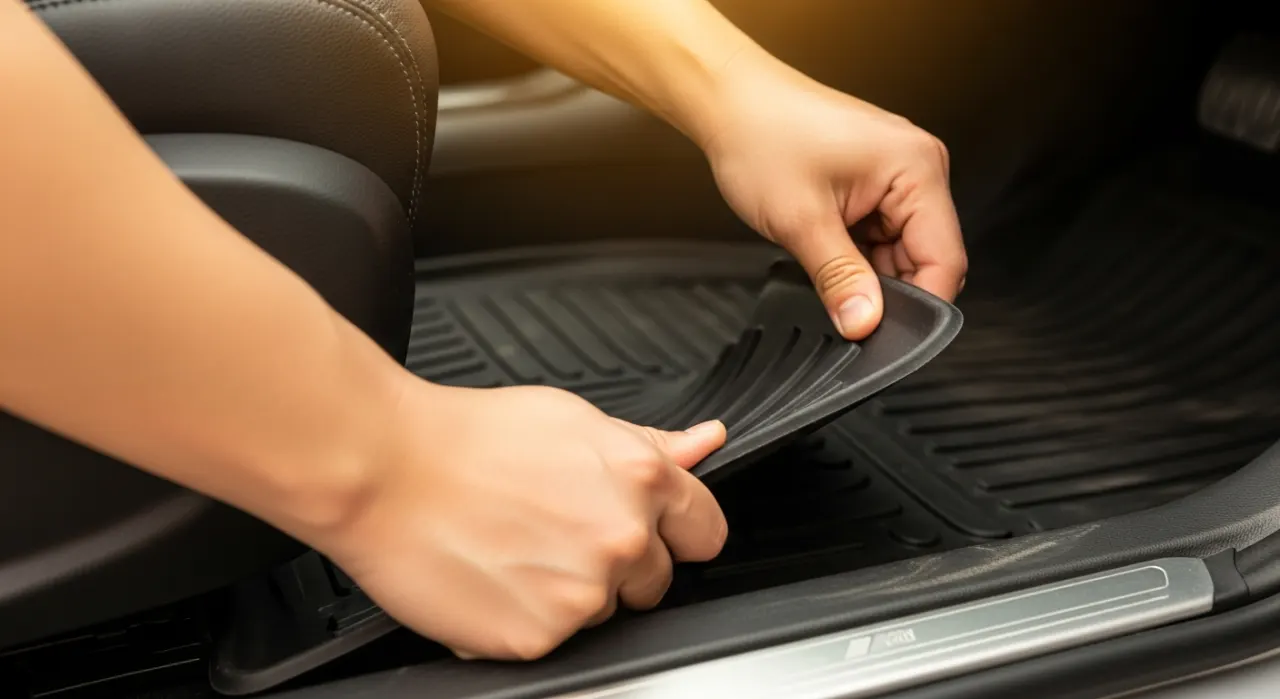
Fitment isn't just a cosmetic nicety here — it's the difference between a mat that protects and one that becomes a hazard. This is where liners earn a large part of their premium.
Because a liner is cut for one specific vehicle, it drops into the footwell and locks against the contours with almost no gap. Most also use the vehicle's factory retention post or a supplied anchor, so the liner physically cannot slide forward under the pedals. A universal mat, by contrast, is a compromise shape meant to fit dozens of cars, which means it's usually a little too big or too small and held only by a hook, a clip or plain friction.
That matters because a mat that creeps forward and stacks under the accelerator or brake is a genuine, documented safety problem — it's the exact failure behind several large automaker floor-mat recalls. The mechanic and safety consensus is firm on three rules for any mat:
- Never stack a new mat on top of the factory mat. Doubling up defeats the retention clip and lets the top mat migrate toward the pedals.
- Always use the vehicle's retention hooks or posts if it has them, and buy mats that are compatible with those anchors.
- Trim universal mats to fit so no edge can fold up under a pedal, and check periodically that the mat hasn't shifted.
Liners largely design this risk out because they're shaped to the floor and anchored by default. If you're going the cheaper mat route, the retention system is the one thing you should not skimp on.
Which one your climate and lifestyle need
The honest way to choose is to look at what actually lands in your footwell over a year, because that — not the price tag — is what separates a smart buy from a wasted one.
- Snow-belt and rain-heavy regions: a liner is the clear owner favorite. Boots carry in snow and de-icing salt that melts into a corrosive slurry; a flat mat lets that brine run straight onto the carpet and into the metal below. The liner's reservoir traps it for a hose-out.
- Off-road, jobsite and work trucks: liners, without much debate. Mud, gravel and spilled fluids are exactly the mess a deep tray is built to contain, and the resale protection on a hard-used truck usually justifies the cost.
- Pets and kids: liners again — the raised lip catches the drink, the muddy paw and the dropped snack instead of letting it seep into the carpet pad, where odor lives permanently.
- Mild, dry climates and mostly-highway commuters: a good rubber or semi-custom mat set is genuinely enough. If the worst your footwell sees is dry shoes and the occasional dropped fry, you're paying for containment you'll never use.
- Leased cars and short-term ownership: mats make sense. You want to hand the car back with clean carpet, not invest $250 in trays you'll leave behind.
The pattern owners describe over and over is simple: the messier and colder your real-world use, the more a liner pays for itself; the drier and more temporary your situation, the more a mat is the rational pick.
Materials, cleaning and durability
Material is where the two categories overlap and confuse people, because "rubber mat" and "rubber liner" can both exist — the shape is what defines the category, but the compound defines how it wears.
Premium liners are typically molded from TPE (thermoplastic elastomer) or TPO, engineered blends that stay flexible in deep cold, resist cracking, and don't off-gas the strong odor cheaper PVC can. They're also latex- and cadmium-free on the reputable brands. Cheaper universal mats are often basic rubber or PVC, which works fine in moderate temperatures but can stiffen and crack over a few hard winters, and thin sets may curl at the corners or wear through at the heel where your foot rests all day.
Cleaning strongly favors the liner. Because everything is contained, you pull the tray, tip out the debris, hose or wipe it down and drop it back — a two-minute job. A carpet mat is the opposite: it absorbs liquid and odor, needs vacuuming, and once salt or a spill soaks through, it's difficult to fully reset. Rubber mats sit in the middle — shake them out and they're clean, but any liquid that pooled has usually already run off the flat edge.
On lifespan, a quality liner commonly outlasts several sets of cheap mats and is often what owners keep through the life of the vehicle, which reshapes the value math below.
Real cost and value over the life of the car
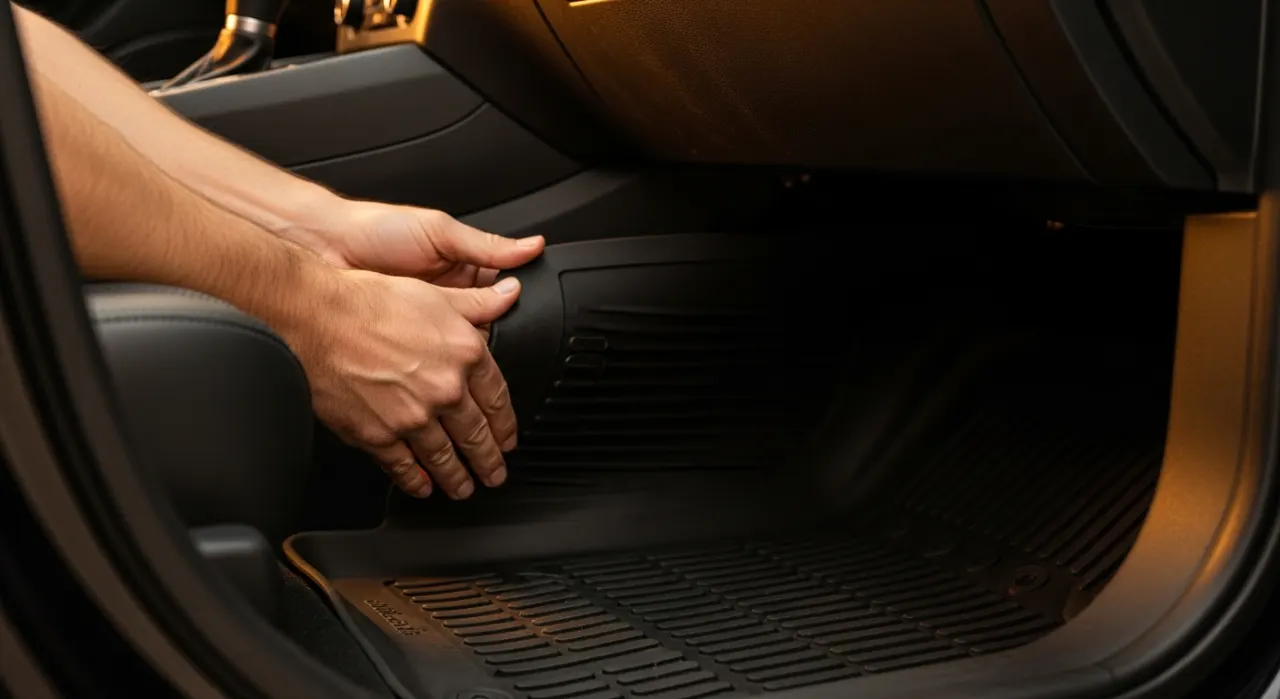
On the sticker the gap looks decisive — a universal rubber mat set can be $15–$40, while a molded front liner set runs $90–$180 and a full front-and-rear kit $170–$300+. But the honest comparison is protection-per-dollar over the years you own the car, and that narrows the gap considerably.
A liner is usually a one-time buy that stays with the vehicle. A cheap mat set is more likely to be replaced every couple of winters as corners curl and heels wear through, so two or three mat replacements can quietly approach the cost of a single good liner. Add the harder-to-see cost: carpet that's been repeatedly soaked in road salt stains, smells and can corrode the floor pan underneath, which dents resale — exactly the damage a liner is designed to prevent.
That said, the value case only holds if you actually need the containment. On a garage-kept commuter in a dry climate, the expensive liner protects against a mess that never arrives, and the mat is the smarter spend. The rule of thumb owners land on: buy the liner when your environment will punish the carpet, buy the mat when it won't. Paying for protection you'll use is value; paying for protection you won't is just a nicer-looking footwell.
Common myths and mistakes
"A liner and a mat are basically the same thing." They're not. A mat is a flat cover that lets spills run off its edges; a liner is a deep, vehicle-specific tray that contains them. In a wet or snowy climate that difference decides whether your carpet stays dry.
"I'll just lay a universal mat over the factory one." Don't. Stacking mats is the classic pedal-entrapment mistake behind real recalls — the top mat loses the retention clip and can slide under the accelerator. Use one properly anchored mat, or a fitted liner.
"Any 'custom fit' listing means it's molded for my car." Not necessarily. Sellers use "custom fit" loosely for lightly contoured semi-custom mats too. Genuine liners are sold by exact year, make, model and cab or trim — if the listing fits a dozen vehicles, it's a universal mat, not a scanned liner.
"Carpet mats look nicer, so they're the upgrade." They look more factory, but they absorb rather than contain. For appearance in a dry car they're fine; for protection they're the weakest option because liquid and salt soak straight in.
"A liner is overkill if I'm careful." Careful drivers still track in snow, salt and rain they can't control. The liner isn't about spills you cause — it's about the weather and the road you drive through.
Which should you buy — and how to decide
There's no universal winner, because these solve the same problem at two different intensities. The right call is dictated by your climate, your cargo (kids, pets, tools) and how long you'll keep the car — not by which one is "better" in the abstract.
Buy floor liners if you live with snow, salt, rain, mud, pets or kids, or you drive a truck or SUV you use hard and want to protect its resale. Buy the exact liner for your year, make, model and cab configuration, prefer TPE/TPO over cheap PVC, and make sure it uses your vehicle's retention post. It's the one-time buy that keeps the carpet original.
Buy floor mats if you're in a mild, dry climate, on a tight budget, driving a leased or short-term car, or you simply want a low-profile factory look with roomy footwells. Choose a set that's compatible with your factory retention hooks, trim universal mats so nothing folds under a pedal, and never stack them on top of the OEM mat.
Whichever you pick, the fitment-and-retention rule is the non-negotiable: a mat that slides toward the pedals is more dangerous than a dirty carpet. Match the protection level to the mess your life actually generates, secure it properly, and the "liner vs mat" question answers itself.
Recommended Products
Our top picks in this category, ranked on aggregated owner reviews.
Best for Beginners who want one box that does everything well
- 14 matched pieces covering wash, protect and interior
- Includes shampoo, spray sealant and interior cleaner
- Comes with microfiber towels and applicators
- Products are designed to work together as a system
Why buy it: It is the closest thing to a complete detail in a single box, which is exactly what a first-timer needs — no guesswork about whether the pieces play nicely together.
Best for Enthusiasts who want top-shelf formulas from the start
- Premium formulas with a genuinely slick finish
- Excellent spray sealant and glass cleaner
- High-quality plush microfiber included
- Strong resale-grade presentation and packaging
Why buy it: You pay more, but the products themselves are a noticeable step up in slickness and gloss — the kit you buy when you know you are hooked.
Best for Getting proven, forgiving products for a fair price
- Trusted formulas that are hard to get wrong
- Covers wash, wax and interior basics
- Widely reviewed and consistently reliable
- Great balance of price and performance
Why buy it: Meguiar's has been dialing in beginner-friendly products for decades, and this kit is the safe, sensible middle — nothing flashy, nothing you will regret.

Best for The cheapest way to cover the basics in one buy
- Lowest entry price of the group
- Covers wash, wheels, glass and interior
- Available almost everywhere
- Simple products that are easy to use
Why buy it: If you just want to stop washing your car with dish soap and a bath towel, this gets you a real detailing setup for pocket change.

Best for People who want maximum product and a storage bucket
- Large bundle with a bucket and grit guard included
- Full-size bottles of core products
- Foam and wash gear bundled in
- Everything stores neatly in the bucket
Why buy it: The bucket doubles as storage and a two-bucket wash setup, and the full-size bottles mean you are not restocking after two washes.

Best for Buying local at any auto parts store today
- Stocked at nearly every parts store
- Reliable wax and cleaner formulas
- Easy to top up individual bottles later
- Long-standing reputation with hobbyists
Why buy it: When you want to start today and not wait on shipping, Mothers is on a shelf near you — and the products genuinely hold up.
Prices are pulled from Amazon and were accurate as of Aug 22, 2026, 6:54 PM EDT. Product prices and availability are subject to change — the live price is shown on Amazon.