
Affiliate Disclosure
Some links on this page are affiliate links. As an Amazon Associate, we earn from qualifying purchases — at no extra cost to you. We do not buy, test, or physically handle the products we cover; our rankings come from aggregated owner reviews, ratings and expert consensus. Commissions never change our verdicts. How we rank & full disclosure.
LED Work Lights
Solid-state lights that turn nearly all their power into light and very little into heat. Modern LED work lights run cool, survive drops, and pull a fraction of the amps a halogen does for the same brightness.
Best for: Almost every garage, driveway and jobsite task today — from under-hood work to roadside repairs and cordless portable use
Typically $15–$60 for a portable/rechargeable unit; $25–$120 for a corded or dual-power shop light
- Draws far less power — often 8–15W to match a 500W halogen's usable output
- Runs cool to the touch, so no burns and no fire risk near fuel, plastics or rags
- Effectively instant-on at full brightness, even in the cold
- Solid-state with no filament, so it shrugs off drops and vibration
- Rated for 25,000–50,000 hours — realistically the last work light you buy
- Cheaper units can have poor color rendering (low CRI) that hides true paint and fluid colors
- A failed driver or fixed LED array usually means replacing the whole light, not a bulb
- Very bright budget models can produce harsh glare without a good diffuser
Halogen Work Lights
The old-school corded worklight with a glowing tungsten filament inside a quartz envelope. It throws a warm, familiar flood of light but turns most of its wattage into heat, not brightness.
Best for: Occasional corded use where you already own the fixtures, or as a doubling-as-a-space-heater light in a cold shop
Typically $12–$35 for a stand or clamp fixture; replacement bulbs roughly $4–$10 each
- Cheap to buy up front and widely available at any hardware store
- Excellent color rendering (CRI near 100) — colors look completely natural
- A blown bulb is a cheap, quick swap rather than a whole-fixture replacement
- Warm light some people simply prefer for detailing and paint inspection
- Runs dangerously hot — the lens and housing can exceed 400–500°F and cause burns or fires
- Guzzles power: a 500W halogen pulls ~4A where an equivalent LED pulls a fraction of that
- Fragile filament and quartz envelope fail easily from drops, vibration or a splash of water
- Short life — often 1,000–2,000 hours versus tens of thousands for LED
How they score, side by side
Scores reflect aggregated owner reviews and expert consensus — not our own bench testing.
- Brightness per watt103
- Running cost / efficiency103
- Safety (heat & fire)103
- Durability94
- Color accuracy (CRI)810
- Upfront affordability79
- Portability / cordless use102
Spec-by-spec comparison chart
| Factor | LED Work Lights | Halogen Work Lights |
|---|---|---|
| Power for ~500W-halogen brightness | ~8–15W | 500W |
| Efficiency (lumens per watt) | 80–130+ lm/W | 15–25 lm/W |
| Housing / lens temperature | Warm at most — safe to handle | 400–500°F+ — burns on contact |
| Rated lifespan | 25,000–50,000 hours | 1,000–2,000 hours |
| Color rendering (CRI) | 70–95 (varies by quality) | ~100 (excellent) |
| Durability | Solid-state, drop & vibration resistant | Fragile filament & quartz bulb |
| Cordless / rechargeable option | Common and practical | Effectively none (too power-hungry) |
| Instant full brightness | Yes, even when cold | Yes, but bulb runs hot fast |
| Typical upfront price | $15–$120 | $12–$35 (bulbs $4–$10) |
| Fire / burn risk near fuel & rags | Low | High |
| Replaceable bulb | Usually no (whole unit) | Yes (cheap swap) |
Our Top 3 Picks
The three highest-rated options in this category, if you'd rather skip straight to a proven pick.

Best for the best mix of brand pedigree, warranty and price
- 72-tooth ratchets for a 5° swing arc
- Polished chrome-vanadium, anti-slip sockets
- DEWALT full lifetime warranty
- Compact SAE + metric set in a blow-mould case
Why buy it: a name-brand kit that owners rate at the very top of the budget class — the lifetime warranty and fine-tooth ratchets punch well above the price, which is why it keeps getting recommended to first-time wrenchers.
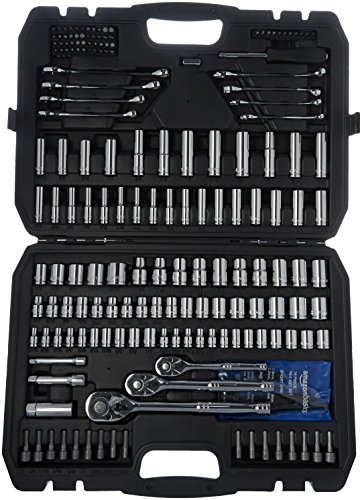
Best for the most sockets and bits per dollar
- 201 pieces across 1/4", 3/8" and 1/2" drives
- Chrome-vanadium forged, polished-chrome finish
- Full SAE + metric coverage
- Molded case keeps every socket in its slot
Why buy it: a socket-heavy kit that owners repeatedly call the best money-for-metal buy on Amazon — if your jobs are mostly nuts and bolts, nothing here gives you more drive tools for the outlay.

Best for trusted-brand tools with a lifetime guarantee
- 72-tooth reversible ratchets
- Alloy-steel sockets, off-corner loading grip
- Crescent lifetime warranty
- Closed, latching blow-mould case
Why buy it: an Apex Tool Group set that owners rate for genuine fit and finish — the off-corner grip protects rounded fasteners, and the lifetime backing means a cracked socket is a free swap.
Prices are pulled from Amazon and were accurate as of Aug 22, 2026, 6:54 PM EDT. Product prices and availability are subject to change — the live price is shown on Amazon.
What actually separates LED from halogen
Both of these are just work lights — you point them at whatever you're wrenching on and they light it up. But how they make that light could not be more different, and that single difference drives every trade-off below.
A halogen work light is an incandescent bulb. Electricity heats a tungsten filament until it glows white-hot inside a quartz envelope filled with halogen gas. It's the same 130-year-old principle as a household incandescent, just hotter and brighter. The catch is efficiency: roughly 90% of the energy a halogen burns comes out as heat, not light. That's why a 500W halogen can double as a space heater — and why it will scorch anything it touches.
An LED work light makes light electronically. Current passes through a semiconductor and photons come out directly, with very little wasted as heat. That's why an LED putting out the same usable brightness as that 500W halogen might only sip 8–15 watts. The consensus among electricians and shop owners is blunt: LED made halogen work lights obsolete for almost every purpose, in the same way it replaced them in flashlights and headlamps years ago.
The cleanest way to hold the difference in your head: halogen spends most of its power making heat and a little making light; LED spends almost all of it making light. Everything else — the cost, the safety, the lifespan, whether you can run it off a battery — flows from that one fact.
Brightness, lumens and reading the numbers
The biggest source of confusion when people shop is the mismatch between watts and lumens. Watts measure power the light consumes; lumens measure the actual light it produces. Halogen packaging historically leaned on wattage because that number sounds impressive, but wattage tells you how much electricity you're burning, not how much you can see.
Lumens per watt is the honest yardstick, and it isn't close:
- Halogen: roughly 15–25 lumens per watt. A 500W halogen produces somewhere around 8,000–10,000 lumens, but pays for it with a huge power bill and a lot of heat.
- LED: commonly 80–130+ lumens per watt. That's why a modern LED shop light can match or beat that halogen's brightness on a tiny fraction of the wattage.
When you compare, ignore the wattage headline and find the lumen rating. For general garage work, aggregated buyer feedback suggests 2,000–4,000 lumens is plenty for a portable light and 5,000–10,000+ for a big shop flood. Also watch the beam pattern: a wide flood covers a workbench evenly, while a tighter spot throws farther down a driveway. A high lumen number aimed badly still leaves you working in your own shadow.
Heat and safety — the deciding factor
If there's one section that settles this comparison for most people, it's this one. A halogen work light's lens and housing routinely reach 400–500°F or higher within minutes. Owner reports and shop-safety guidance are full of the predictable consequences: fingertip burns from grabbing the fixture, melted extension-cord jackets left leaning against the lens, singed carpet and upholstery, and — the serious one — fires started when a hot halogen tipped into fuel vapor, brake cleaner, oily rags or cardboard.
In a garage, that heat is not a minor annoyance. You are frequently working around gasoline, solvents, plastic trim and flammable shop rags. A light that can ignite any of them on contact is a genuine hazard, which is why many professional shops phased halogen work lights out on safety grounds alone.
An LED work light stays cool — warm at the heat sink under heavy use, but nowhere near ignition or burn temperatures. You can clamp it to a painted fender, set it on a plastic bumper cover, or hand it to a helper without a second thought. For anyone working in tight spaces, under a hood, or near fuel, that alone is worth the switch. It also means LED is the only realistic choice for a sealed, cordless, or hand-held light, because you can't safely hold a 500°F halogen anyway.
Color rendering: halogen's last real edge
Here's where honesty matters, because halogen isn't beaten on everything. Color Rendering Index (CRI) measures how accurately a light shows true colors, on a 0–100 scale. Halogen, like sunlight and other incandescents, sits at essentially 100 CRI — colors under it look exactly as they should.
This is why some detailers, painters and bodywork specialists still keep a halogen or a very high-CRI light around. When you're matching paint, spotting swirl marks in clear coat, or judging whether a fluid is amber or brown, accurate color genuinely matters, and a cheap low-CRI LED can wash those distinctions out or throw a bluish cast that hides them.
The important nuance is that LED color quality is a spec you choose, not a limitation of the technology. Budget LED work lights often land around 70–75 CRI, which is fine for general wrenching but poor for color-critical work. Better LED lights are rated 90–95+ CRI and rival halogen for accuracy while keeping every other LED advantage. If color fidelity matters to you, the fix isn't buying halogen — it's buying a high-CRI (90+) LED and checking that number before you order.
Real cost of ownership over time
On the shelf, halogen looks cheaper — a basic clamp or stand fixture can be $12–$35, well under many LED units. But the sticker price is the least honest way to compare these two.
Power. A 500W halogen run a few hours a day adds up on the electric bill, while an equivalent LED at 10–15W costs almost nothing to run. Over a year of regular garage use that gap alone can exceed the price difference of the light.
Lifespan. Halogen bulbs are typically rated 1,000–2,000 hours and are fragile — a drop, a splash of water on a hot bulb, or ordinary vibration can end one early. LED lights are rated 25,000–50,000 hours. In practical terms, a halogen is something you'll be re-bulbing periodically, while a decent LED work light is realistically the last one you'll buy for that job.
The one place halogen keeps a small edge is repairability: a blown halogen bulb is a $4–$10 swap, whereas most LED work lights integrate the emitters and driver, so a failure usually means replacing the unit. But given how rarely quality LEDs fail inside their rated life, the consensus is that the total cost of ownership still favors LED comfortably — lower running cost, far fewer replacements, and no bulbs to keep on the shelf.
Common myths and buying mistakes
"More watts means brighter." Not with LED in the picture. Watts measure power draw, not light output. A 15W LED can outshine a 500W halogen. Shop by lumens, not wattage.
"LED light is harsh and blue." That's a symptom of cheap LEDs, not LED itself. Color temperature (measured in Kelvin) and CRI are both specs you pick. Choose around 4000–5000K with 90+ CRI and you get a clean, natural, easy-on-the-eyes light.
"Halogen is cheaper." Only at the register. Factor in the power it burns, the bulbs you'll replace, and the fixtures that don't survive a drop, and halogen typically costs more over any real span of use.
"I need the heat in my cold shop." A work light is a terrible, and dangerous, space heater. If your shop is cold, buy a proper heater and a cool, safe LED to see by — don't rely on a 500°F lens near your fuel and solvents.
"Any bright LED will do." The most common regret in buyer reviews is glare and poor color from a bargain floodlight. Look for a diffused lens, a sensible beam pattern for your space, and a stated CRI. Raw lumens with no diffuser just blinds you and casts hard shadows.
Which should you buy — and how to decide
For almost everyone, buy the LED. The efficiency, the cool safe operation, the durability and the option to go cordless make it the right work light for the overwhelming majority of garage, driveway and jobsite tasks. The technology that won in flashlights and headlights won here too, for the same reasons.
Buy an LED work light if you want low running cost, a light you can handle and place anywhere without burning something, something that survives being dropped, or any battery-powered or portable option at all. Prioritize a real lumen rating for your space, a 4000–5000K color temperature, a diffused lens to tame glare, and — if color accuracy matters — a CRI of 90 or higher.
Consider halogen only if you already own the fixtures and use them rarely, you're on the tightest possible upfront budget, or you specifically need reference-grade color rendering and don't want to pay for a high-CRI LED. Even then, respect the heat: keep it clear of fuel, solvents, rags and anything meltable, and never leave it unattended.
Put simply: match the light to how you actually work. If you spend real time in the garage, a good LED work light pays for itself in power, safety and longevity — and you'll wonder why you ever squinted around a scorching-hot halogen.
Recommended Products
Our top picks in this category, ranked on aggregated owner reviews.
Best for the best mix of brand pedigree, warranty and price
- 72-tooth ratchets for a 5° swing arc
- Polished chrome-vanadium, anti-slip sockets
- DEWALT full lifetime warranty
- Compact SAE + metric set in a blow-mould case
Why buy it: a name-brand kit that owners rate at the very top of the budget class — the lifetime warranty and fine-tooth ratchets punch well above the price, which is why it keeps getting recommended to first-time wrenchers.
Best for the most sockets and bits per dollar
- 201 pieces across 1/4", 3/8" and 1/2" drives
- Chrome-vanadium forged, polished-chrome finish
- Full SAE + metric coverage
- Molded case keeps every socket in its slot
Why buy it: a socket-heavy kit that owners repeatedly call the best money-for-metal buy on Amazon — if your jobs are mostly nuts and bolts, nothing here gives you more drive tools for the outlay.
Best for trusted-brand tools with a lifetime guarantee
- 72-tooth reversible ratchets
- Alloy-steel sockets, off-corner loading grip
- Crescent lifetime warranty
- Closed, latching blow-mould case
Why buy it: an Apex Tool Group set that owners rate for genuine fit and finish — the off-corner grip protects rounded fasteners, and the lifetime backing means a cracked socket is a free swap.

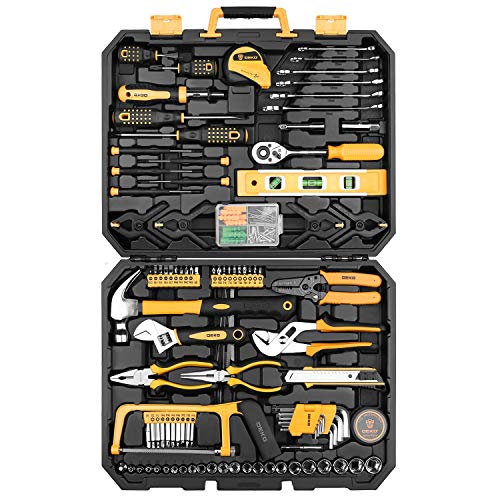
Best for a first-ever kit that covers the whole garage and house
- Sockets, wrenches, screwdrivers, hammer, pliers
- Heat-treated carbon steel, rust-resistant
- Compact blow-mould carry case
- One of Amazon’s best-selling tool kits
Why buy it: the entry point owners recommend for a first toolbox — rated across tens of thousands of reviews, it handles light auto work and household jobs without asking much of your wallet.
Best for a purpose-built car-repair combination
- 168-piece socket + wrench combination
- Ratchet handle, extension bars, spark-plug socket
- Chrome-vanadium and carbon-steel mix
- Deep plastic storage case
Why buy it: a combination set owners lean on for actual under-hood jobs — the spark-plug socket, extensions and combination wrenches mean fewer trips to buy the one tool you’re missing.

Best for the most complete kit before you leave the budget tier
- 201-piece mechanics set, SAE + metric
- 72-tooth quick-release ratchets
- Black-chrome sockets with laser-etched sizes
- Sturdy structural-foam case
Why buy it: the ceiling of the budget class — owners rate its ratchets and easy-read sockets highly, and the Stanley name carries a reputation that a no-name kit can’t match at the same money.
Prices are pulled from Amazon and were accurate as of Aug 22, 2026, 6:54 PM EDT. Product prices and availability are subject to change — the live price is shown on Amazon.