
Affiliate Disclosure
Some links on this page are affiliate links. As an Amazon Associate, we earn from qualifying purchases — at no extra cost to you. We do not buy, test, or physically handle the products we cover; our rankings come from aggregated owner reviews, ratings and expert consensus. Commissions never change our verdicts. How we rank & full disclosure.
Load Range E
A 10-ply-rated tire built to run at up to 80 psi, giving it the highest carrying capacity of the two. It is the standard choice on 3/4-ton and 1-ton trucks that tow and haul heavy.
Best for: Heavy towing, one-ton trucks, dual-rear-wheel rigs, and anyone regularly near their payload ceiling
Typically $190–$350 per tire in common 3/4- and 1-ton sizes
- Highest load capacity — rated to ~80 psi for the biggest reserve of the two
- Stiffer sidewall resists squirm and sway under a loaded bed or heavy trailer
- Less prone to heat buildup at high load, the main cause of blowouts
- The correct match for most 250/2500 and 350/3500 trucks from the factory
- Extra sidewall protection off-road when aired down within reason
- Stiffer, firmer ride when the bed is empty — more noticeable on the street
- Heavier, which very slightly hurts fuel economy and adds unsprung weight
- Overkill for a half-ton — you pay for capacity you may never use
- Requires higher inflation to hit its rating, so pressure management matters
Load Range D
An 8-ply-rated tire built to run at up to 65 psi. It carries less than an E but rides softer and is a common factory fitment on half-ton trucks and many trailers.
Best for: Half-ton trucks, lighter trailers, and daily drivers that rarely run near max payload
Typically $160–$300 per tire in comparable sizes
- Softer, more compliant ride, especially when the truck is running empty
- Lighter than an equivalent E, marginally better for economy and handling feel
- Usually a few dollars cheaper per tire in the same size
- Plenty of capacity for half-ton payloads and light-to-moderate trailers
- Lower max load and pressure (~65 psi) than an E — less reserve when heavy
- Sidewall flexes more under a heavy load, allowing more sway and heat
- Can be under-tired for a 3/4-ton or a heavy fifth-wheel setup
- Getting harder to find in some larger truck sizes as E becomes the default
How they score, side by side
Scores reflect aggregated owner reviews and expert consensus — not our own bench testing.
- Load capacity107
- Empty ride comfort69
- Heavy-tow stability107
- Value for light use69
- Availability (truck sizes)97
- Fuel economy78
Spec-by-spec comparison chart
| Factor | Load Range E | Load Range D |
|---|---|---|
| Ply rating (equivalent) | 10-ply rated | 8-ply rated |
| Max inflation pressure | ~80 psi | ~65 psi |
| Load capacity | Highest of the two | Lower — one step down |
| Ride quality (empty) | Firmer, stiffer | Softer, more compliant |
| Sidewall stiffness | Stiffer — resists sway & heat | More flex under heavy load |
| Typical vehicle | 3/4- & 1-ton trucks, heavy trailers | Half-ton trucks, lighter trailers |
| Weight per tire | Heavier | Lighter |
| Price each (same size) | $190–$350 | $160–$300 |
| Best towing use | Heavy / near-max payloads | Light-to-moderate loads |
| Fuel economy effect | Slightly worse (weight) | Slightly better |
Our Top 3 Picks
The three highest-rated options in this category, if you'd rather skip straight to a proven pick.
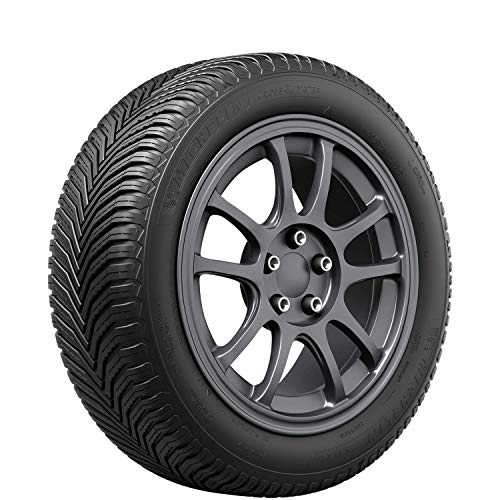
Best for the best all-round grip, wear and light-snow ability
- V-shaped tread with 3-peak-mountain-snowflake rating
- Class-leading wet and dry braking
- 60,000-mile treadwear warranty
- Real light-snow traction for an all-season
Why buy it: the tire owners and experts keep crowning as the best all-rounder — it brakes shorter in the wet than most rivals and genuinely handles snow, so it fits almost any driver in a four-season climate.

Best for the longest tread life on a sedan or minivan
- Up to 80,000-mile treadwear warranty
- Quiet, comfortable highway ride
- Strong wet grip and even wear
- Michelin’s longest-lasting all-season
Why buy it: the set-and-forget touring tire owners rate for outlasting everything else — fit it once and forget about tires for years.

Best for premium wet braking at a mid-range price
- Up to 80,000-mile treadwear warranty
- EcoPlus compound for shorter wet stops
- Fuel-efficient, low rolling resistance
- Wear indicators built into the tread
Why buy it: a hugely popular touring tire that delivers premium-brand wet performance and an 80k warranty for less than the flagships.
Prices are pulled from Amazon and were accurate as of Aug 22, 2026, 6:54 PM EDT. Product prices and availability are subject to change — the live price is shown on Amazon.
What Load Range E and D actually mean
Load range is a letter code stamped on the sidewall that tells you how much air pressure a tire is built to hold and, by extension, how much weight it can safely carry. It replaced the old "ply rating" system — modern tires almost never contain the literal number of fabric plies the rating implies — but the equivalence stuck, so people still talk in plies. Load Range D is 8-ply rated; Load Range E is 10-ply rated. The higher the letter, the stronger the casing and the higher the maximum inflation.
In concrete numbers, a Load Range D tire is typically built for a maximum of around 65 psi, while a Load Range E is built for around 80 psi. That extra pressure capacity is the whole story: more air at higher pressure means the tire can support more weight without the sidewall overheating or deflecting past its design limit. The exact pound rating varies by size and brand and is printed right on the sidewall next to the load range, so the letter is a shorthand, not the final word.
Crucially, D and E are not different kinds of tire — many models are sold in both, same tread pattern, same compound, just a heavier casing for the E. The consensus among truck owners and tire shops is simple: pick the load range your vehicle's door placard or trailer's rating calls for, then decide whether to go up a step based on how you actually use it. Going below the required range is a safety problem; going up is usually a comfort-versus-capacity trade.
Which load range does your rig need?
This is the decision that matters, and it is dictated by the vehicle far more than by preference. The starting point is the door-jamb placard on a truck or the certification label and axle rating on a trailer — those numbers are the manufacturer's minimum, not a suggestion.
- Half-ton trucks (F-150, Silverado 1500, Ram 1500): These usually come from the factory on Load Range C or D. A D is a common, sensible fit — it carries a half-ton's payload comfortably and rides better than an E when the bed is empty, which is most of the time for these trucks.
- Three-quarter- and one-ton trucks (250/2500, 350/3500): These are the E's home turf. The higher gross weight ratings, heavier beds, and towing duty demand the extra capacity, and most ship on E from the factory. Dropping one of these to a D is under-tiring the truck.
- Trailers: Match the tire load range to the trailer's axle rating and loaded weight. Heavier travel trailers, car haulers, and fifth-wheels frequently spec E (or higher, like F/G on big rigs); lighter utility and boat trailers may be fine on D.
- Dedicated off-road builds: Many overlanders choose E for the tougher sidewall and puncture resistance, accepting the firmer street ride as the cost of durability.
The practical rule owners repeat is: never go below the load range the placard or trailer label requires. You can almost always go up — a D-required application will happily run an E — but you cannot safely go down. If your placard says D and you want a bit more reserve for occasional heavy hauling, an E is a legitimate upgrade. If it says E, a D is not an option.
Ride quality, air pressure and the empty-truck problem
The most-reported real-world difference between the two is ride, and it shows up most on an empty truck. Because an E has a stiffer casing and is designed to run at higher pressure, an unloaded truck riding on E tires inflated toward their max can feel harsh — owners describe more bounce over expansion joints and a busier ride on rough pavement. A D, with its softer sidewall and lower pressure ceiling, deflects more and soaks up small impacts better when there's no load pushing down on it.
The fix that experienced owners rely on is pressure management rather than a different load range. The pressure stamped on the sidewall is the maximum, not a target. On a light or empty truck, running an E at 80 psi is far more air than the axle weight needs, which is exactly why it rides hard. Airing down to the pressure that matches your actual loaded (or unloaded) axle weight — found via a load-and-inflation table or the door placard — recovers much of the comfort while keeping the tire safely within spec. A D masks the problem by having a lower ceiling to begin with; an E gives you the range to run soft when empty and firm when loaded, if you're willing to adjust.
This is the honest trade at the heart of D versus E: the D is the more forgiving "set it and forget it" tire for light duty, while the E rewards an owner who actually manages pressure to match the load.
Towing, heat and why capacity matters most under load
When weight goes up, the calculus flips entirely in the E's favor. The single most common way a load-rated tire fails is heat: a sidewall flexing under more weight than it's designed for builds internal temperature, and heat is what degrades the rubber and separates belts, leading to a blowout. A stiffer, higher-capacity casing flexes less under the same load, runs cooler, and holds its shape — which is why the consensus for heavy towing is unambiguous.
Under a loaded bed or a heavy trailer, an E also simply sways and squirms less. The stiffer sidewall resists the side-to-side deflection that makes a heavily loaded truck feel vague or "tail-waggy," so the truck tracks straighter and responds more predictably to steering and crosswinds. Owners who tow near their limits on D tires frequently report exactly this vagueness, and moving up to E is one of the most common fixes shops recommend.
The margin matters even if you rarely max out. Running a tire near its capacity limit all the time leaves little reserve for a hot day, a fast highway, or an overloaded axle — and it's the reserve that keeps you out of trouble. If you're regularly within, say, 80–90% of a D's rating, that's precisely the situation where stepping up to E buys real safety margin rather than just capability you'll never touch.
Cost, weight and fuel economy over the life of a set
The price gap is real but modest. In the same size, an E typically runs a bit more than a D — often on the order of $20–$60 per tire, though it varies widely by brand and size. Across a set of four (or six on a dually) that adds up, but it's rarely the deciding factor next to the safety and capability difference.
The E's heavier casing carries two small downsides. First, the added weight is unsprung and rotational, so an E costs a little fuel economy and can very slightly dull steering feel compared to a D of the same size — most owners describe the difference as minor and hard to notice day to day. Second, that weight is precisely what buys the extra capacity, so it isn't waste; you're paying for casing strength, not dead weight.
Availability is quietly shifting the math too. As trucks have gotten heavier and towing capacities have climbed, E has become the default in many popular truck sizes, and some sizes are simply easier to find in E than D. If you're replacing tires on a 3/4-ton, you may find the E selection is broader anyway, which further tilts a heavy-duty buyer toward the range the truck wanted in the first place.
Common myths and mistakes
"Load Range E always rides worse." Only when it's over-inflated for the load. An E run at 80 psi on an empty half-ton rides hard, but aired down to match the actual axle weight it can ride nearly as well as a D. The harshness people blame on the tire is usually a pressure mistake.
"Higher load range means more grip or a higher speed rating." No. Load range is about carrying capacity and inflation, not traction or top speed. A D and an E of the same model grip the same; the E just carries more weight. Speed rating is a separate marking entirely.
"I can save money by dropping from E to D on my 3/4-ton." Don't. If the door placard calls for E, a D is under-rated for the truck's gross weight — that's a safety downgrade, not a smart saving, and it can void warranty and insurance considerations after an incident.
"Load range and ply rating are different things." They're the same measurement in two dialects. "10-ply" is just the old name for Load Range E, and "8-ply" for D. Modern tires don't actually contain that many plies — the rating describes strength, not literal layers.
Which should you buy — and how to decide
Start with the placard, then the load, then comfort. The manufacturer's required load range is your floor — never go under it. From there the choice between D and E comes down to how heavy you actually run.
Buy Load Range E if you own a 3/4- or 1-ton truck, tow near your limits, run a heavy trailer or fifth-wheel, build for off-road durability, or simply want the biggest safety reserve under load. Accept a firmer empty ride, or manage it with proper inflation, and enjoy the cooler-running, more stable behavior when the weight is on.
Buy Load Range D if your half-ton or lighter trailer calls for it, you rarely run near max payload, and you value the softer everyday ride and slightly lower cost. A properly rated D is the better daily tire for light-duty use — there's no prize for buying more capacity than you'll ever load.
Whichever you choose, verify the exact pound rating stamped on the sidewall against your loaded axle weights, buy a full matched set, and set your pressures from a load-and-inflation chart rather than defaulting to the max on the sidewall. Get the load range right for the job and the ride mostly takes care of itself.
Recommended Products
Our top picks in this category, ranked on aggregated owner reviews.
Best for the best all-round grip, wear and light-snow ability
- V-shaped tread with 3-peak-mountain-snowflake rating
- Class-leading wet and dry braking
- 60,000-mile treadwear warranty
- Real light-snow traction for an all-season
Why buy it: the tire owners and experts keep crowning as the best all-rounder — it brakes shorter in the wet than most rivals and genuinely handles snow, so it fits almost any driver in a four-season climate.
Best for the longest tread life on a sedan or minivan
- Up to 80,000-mile treadwear warranty
- Quiet, comfortable highway ride
- Strong wet grip and even wear
- Michelin’s longest-lasting all-season
Why buy it: the set-and-forget touring tire owners rate for outlasting everything else — fit it once and forget about tires for years.
Best for premium wet braking at a mid-range price
- Up to 80,000-mile treadwear warranty
- EcoPlus compound for shorter wet stops
- Fuel-efficient, low rolling resistance
- Wear indicators built into the tread
Why buy it: a hugely popular touring tire that delivers premium-brand wet performance and an 80k warranty for less than the flagships.

Best for the most tire for the money
- Up to 75,000-mile treadwear warranty
- "Replace Tire" wear indicator in the tread
- Reliable wet braking and light-snow grip
- Backed by Continental’s parent company
Why buy it: the value pick owners rate again and again — a genuinely good touring tire with a 75k warranty at a bargain price.

Best for confidence in rain and winter slush
- 3-peak-mountain-snowflake certified
- Evolving Traction Grooves for wet grip
- 60,000-mile treadwear warranty
- Strong all-weather safety focus
Why buy it: the pick for drivers who see a lot of rain and the occasional storm — a true all-weather tire that carries the winter certification most all-seasons lack.

Best for sporty cars that still need year-round use
- Ultra-high-performance all-season design
- Excellent dry, wet and light-snow grip
- Tread wear indicators (DWS letters)
- A perennial enthusiast favorite
Why buy it: the enthusiast’s all-season — near-summer-tire dry grip with real wet and light-snow ability, so a sports sedan can run one set all year.
Prices are pulled from Amazon and were accurate as of Aug 22, 2026, 6:54 PM EDT. Product prices and availability are subject to change — the live price is shown on Amazon.