
Affiliate Disclosure
Some links on this page are affiliate links. As an Amazon Associate, we earn from qualifying purchases — at no extra cost to you. We do not buy, test, or physically handle the products we cover; our rankings come from aggregated owner reviews, ratings and expert consensus. Commissions never change our verdicts. How we rank & full disclosure.
Buffing (Compounding)
The aggressive cutting stage of paint correction. A cutting compound with coarse abrasives shaves off a thin layer of clear coat to level out deep scratches, heavy swirls and oxidation that a polish can't touch.
Best for: Neglected, oxidized or heavily swirled paint that needs real defect removal before it will shine
Compound $15–$30 a bottle; rotary buffer $60–$200 or a DA machine $100–$400; a pro compounding step runs ~$150–$400
- Removes defects a polish physically cannot — deep swirls, sanding marks, oxidation
- Fast on badly neglected or single-stage paint that needs to be cut back
- The only way to level clear coat down to the bottom of a scratch
- Restores a flat, uniform surface for the polishing stage to refine
- A single aggressive pass can transform a chalky, dead finish
- Almost always leaves haze or micro-marring that must be polished out afterward
- Removes measurable clear coat — you only have so much to give
- Highest burn-through risk, especially with a rotary on panel edges and ridges
- Overkill on paint that only has light swirls or needs a gloss boost
Polishing (Refining)
The refinement stage. A fine polish with gentler abrasives removes light swirls and the haze left by compounding, restoring clarity and gloss with barely any material loss.
Best for: Restoring shine, clearing light swirls and holograms, and finishing paint after a compound step or before a coating
Polish $15–$30 a bottle; a DA polisher $100–$400; a pro single-stage polish (no compounding) runs ~$150–$350
- Restores deep gloss and clarity — the visible "wet" look most people want
- Removes very little clear coat, so it is far safer to run
- The essential final step after any compounding to erase haze and holograms
- Forgiving enough for a first-timer on a dual-action machine
- Cannot remove deep scratches, heavy oxidation or sanding marks on its own
- On badly neglected paint a polish alone barely moves the needle
- Skipping a needed compound step means the defects simply stay
- Results look dramatic but are limited by whatever the paint started with
How they score, side by side
Scores reflect aggregated owner reviews and expert consensus — not our own bench testing.
- Defect removal / cutting power94
- Gloss & clarity of finish59
- Safety for the clear coat48
- Beginner friendliness38
- Speed on heavy oxidation93
- Final show-car finish49
Spec-by-spec comparison chart
| Factor | Buffing (Compounding) | Polishing (Refining) |
|---|---|---|
| Primary job | Cut — remove defects & material | Refine — restore gloss & clarity |
| Abrasive aggression | High (cutting compound) | Low–moderate (fine polish) |
| Clear coat removed | More — a measurable layer | Minimal |
| Defects it fixes | Deep swirls, oxidation, sanding marks | Light swirls, haze, holograms |
| Usual tool | Rotary buffer or DA + cutting pad | DA polisher + polishing / finishing pad |
| Finish left behind | Often hazy — needs polishing after | Ready for wax, sealant or ceramic |
| Order in the process | First — the correction step | Second — the refinement step |
| Burn-through risk | Higher (esp. rotary on edges) | Low |
| Product cost each | $15–$30 compound | $15–$30 polish |
| DIY difficulty | Moderate–hard | Easy–moderate |
Our Top 3 Picks
The three highest-rated options in this category, if you'd rather skip straight to a proven pick.

Best for anyone who wants one do-it-all wax
- Synthetic hydrophobic polymer
- Deep, wet-look gloss
- 3–5 months of durability
- Kit includes pad + microfiber towel
Why buy it: the best balance of shine, months-long durability and beginner-easy application.

Best for maximum durability between coats
- 5–7 months of protection
- A little goes a long way
- Cheapest per use
Why buy it: nothing here survives weather longer — the durability champion.

Best for fast, cheap protection in minutes
- SiO₂ spray-on / wipe-off
- Fastest application here
- Strong water beading
Why buy it: the cheapest, fastest protection — spray on wet or dry and go.
Prices are pulled from Amazon and were accurate as of Aug 22, 2026, 6:54 PM EDT. Product prices and availability are subject to change — the live price is shown on Amazon.
What buffing and polishing actually mean
These two words get used interchangeably at the parts counter, which is exactly why so many people buy the wrong product and get a disappointing result. Among detailers the distinction is precise, and it comes down to one thing: how much abrasive is in the bottle and how much paint it removes.
Buffing — more accurately called compounding — is the aggressive cutting stage. A cutting compound is loaded with coarse abrasives that physically shave off a thin, uniform layer of clear coat. That is how it erases a defect: it doesn't fill or hide the scratch, it lowers the surrounding paint down to the bottom of it until the surface is flat again. Because it is removing real material, compounding is what tackles deep swirls, oxidation, water-spot etching and wet-sanding marks that nothing gentler can touch.
Polishing is the refinement stage. A polish uses much finer abrasives that remove only a whisper of clear coat. Its job is to clean up light swirls and, critically, to erase the fine haze and micro-marring that a compound almost always leaves behind. Polishing is where the deep, wet-looking gloss actually comes from — the clarity you see in a show-car finish is a polished surface, not a compounded one.
The consensus among professional detailers is the cleanest way to hold it in your head: compounding removes defects, polishing removes the compounding. One cuts, the other refines. They are not two roads to the same destination — they are the first and second halves of the same trip.
Why they are stages, not rivals
Framing this as "polishing versus buffing" is a little misleading, because on genuinely rough paint you don't choose between them — you do both, in sequence. Aggregated advice from detailing forums and pro shops lays the process out in stages of increasing gentleness:
- Stage 1 — Compound (buff): knock down the deep defects with an aggressive pad and cutting compound. This is where the correction happens, and it typically leaves the paint looking slightly hazy or dull under bright light.
- Stage 2 — Polish (refine): follow with a finer pad and polish to remove that haze and bring the gloss up. On lightly marked paint you can start — and finish — right here, skipping the compound entirely.
- Stage 3 — Protect: once the paint is corrected and refined, seal the work with a wax, sealant or ceramic coating. Protection is not correction; it locks in the finish you just created.
This is why detailers talk about a "one-step" versus a "two-step" (or "multi-stage") correction. A one-step uses an all-in-one product or a medium polish to split the difference — some cutting, some refining — and suits paint in decent shape. A two-step is a dedicated compound pass followed by a dedicated polish pass, and it is what neglected or heavily swirled paint actually needs. The single biggest DIY mistake is expecting a one-step polish to do a two-step job on a car that has never been corrected.
Machines: rotary buffer vs dual-action polisher
The tool matters as much as the bottle, and it is another place the "buffing" label causes confusion. "Buffing" often conjures the classic rotary buffer — a machine that spins the pad in a single direction on a fixed axis. A rotary generates real heat and cuts fast, which is why body shops reach for it on severe defects. It is also the tool most likely to burn through an edge or leave holograms (buffer trails), and it takes genuine practice to use safely.
Most enthusiasts today correct with a dual-action (DA) polisher instead. A DA spins and oscillates on an offset, so the pad's motion is randomized. That randomization dramatically reduces heat and burn-through risk and makes holograms almost impossible — which is why the consensus recommendation for a first-timer is a DA, not a rotary. The trade-off is that a DA cuts more slowly, so on truly severe defects you compensate with a more aggressive pad and compound rather than machine speed.
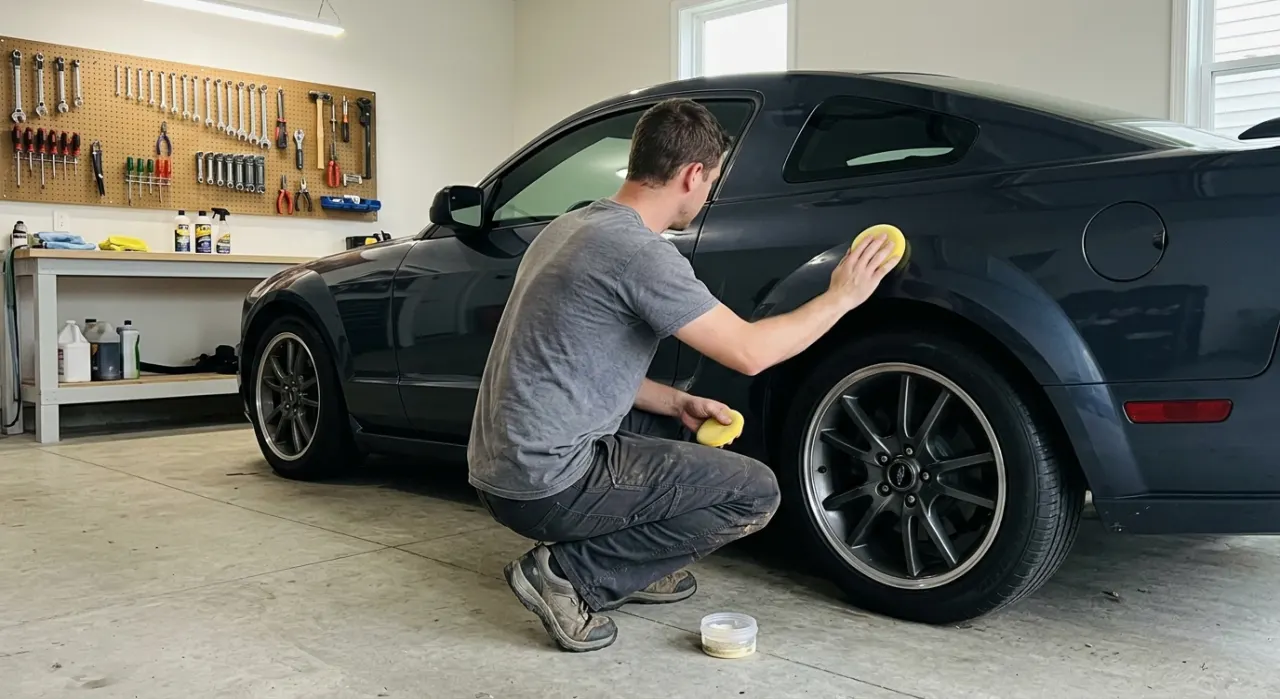
The key point: both compounding and polishing can be done on the same DA machine. You are not buying two tools — you are swapping the pad and the bottle. A cutting pad plus compound does the buffing stage; a softer polishing or finishing pad plus polish does the refining stage. Match the pad aggression to the product aggression, and let the machine do the work rather than leaning on it.
Clear coat is finite — how much you remove
Here is the honest constraint that should govern every correction decision: modern clear coat is only around 1.5 to 2.0 mils thick — roughly 40 to 50 microns — and every aggressive pass removes a slice of it that never comes back. Detailers who use a paint-depth gauge treat that number as a budget you are spending down over the life of the car.
This is precisely why the order matters. Compounding removes far more clear coat than polishing, so you use it only where a defect actually demands it, then refine with the gentler polish. Reaching for the most aggressive compound "to be safe" does the opposite — it burns through your paint's lifespan for defects a milder combination would have handled. The disciplined approach is to start with the least aggressive product and pad that will do the job, test a small section, and only step up if the defects don't clear.
Once you have compounded through a car's clear coat a few times over its life, there is no more to give and a respray becomes the only fix. That single fact is the strongest argument for treating buffing as a targeted correction, not a routine you run every spring. Polishing, which barely touches the clear, is the far safer habit for maintaining gloss between corrections.
Real cost: DIY kit vs professional correction
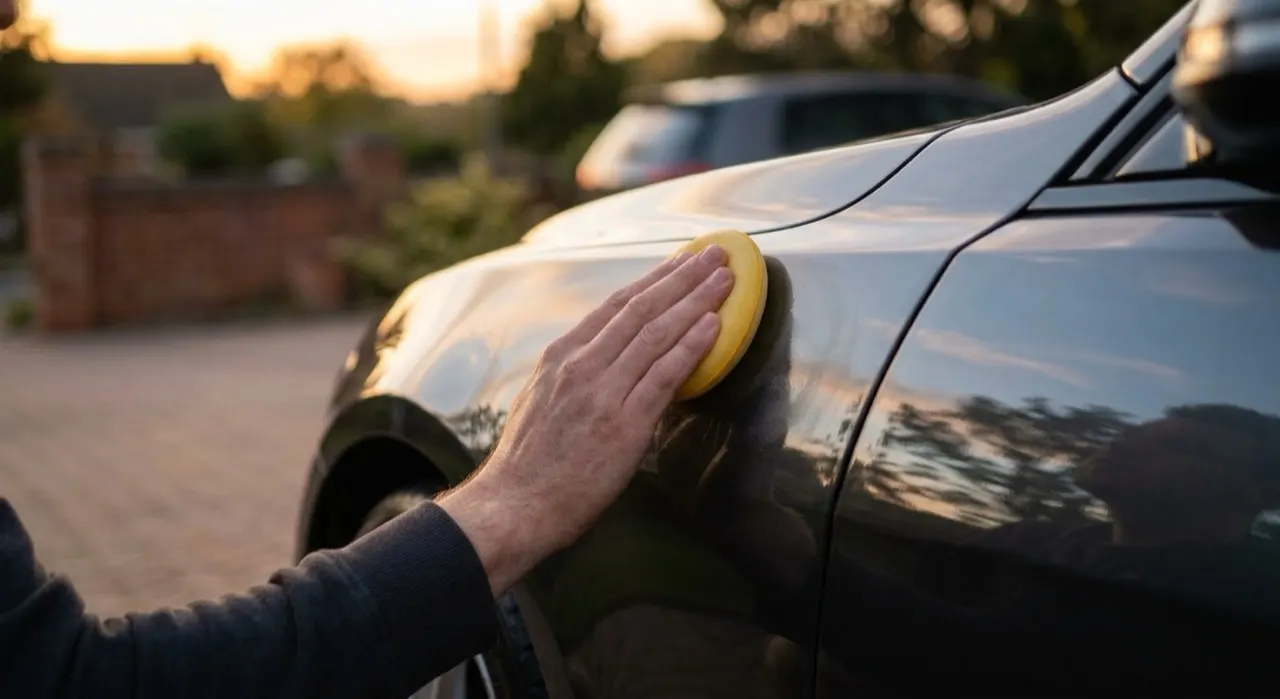
The product costs are almost identical — a bottle of compound and a bottle of polish each land around $15–$30, and you'll want a few pads of each aggression. The real spend is the machine. A capable dual-action polisher runs roughly $100–$400 depending on brand, and that one purchase covers both the buffing and the polishing stages. Budget rotary buffers can be found for $60–$200, but the added burn-through risk makes them a poor first machine for most people.
Going the professional route, the pricing tracks the number of stages exactly. A one-step polish — a single refining pass to boost gloss and clear light swirls — commonly runs $150–$350 on a typical car. A two-step correction — a dedicated compound pass followed by a polish pass — more often runs $400–$800+, because it is roughly double the labor and expertise. Multi-stage correction on badly neglected or dark, defect-prone paint can climb higher still.
The value math is straightforward. If your paint only looks dull, you are paying for polishing, and a one-step is the right ticket. If it is genuinely swirled and oxidized, paying for a polish-only service will disappoint you — the defects will still be there — and the compounding stage is what you are actually buying. Diagnose the paint honestly first, and the right service (and price) follows.
Common myths and mistakes
"Polishing will remove my scratches." Usually not. A fine polish clears light swirls and haze, but a scratch you can catch with a fingernail is too deep for polish alone — that needs compounding to level the clear, then polishing to refine. Expecting a polish to do a compound's job is the most common source of "it didn't work" frustration.
"Compound and be done." A compound pass on its own almost always leaves haze or micro-marring under bright light. The gloss you're after comes from the polishing step that follows. Stopping after the cut leaves you with a corrected but dull-looking finish.
"More aggressive is safer because it works faster." The opposite is true. Aggressive compound burns through your finite clear coat and raises burn-through risk. The pros start with the least aggressive combination that clears the defects and only step up when it doesn't — protecting the paint you can never get back.
"Waxing is the same as polishing." No. Wax and sealant are protection — they add a sacrificial layer and can mask imperfections temporarily, but they remove nothing and correct nothing. Polishing physically refines the paint itself. Protection goes on last, after any correction is finished.
"A rotary is the only way to get real results." Not anymore. A dual-action polisher with the right pad and compound will correct the vast majority of consumer paint safely, and it is far more forgiving for a beginner than a rotary.
Which do you actually need?
There is no universal winner here, because it isn't really a versus. The right answer is dictated by how bad your paint is, and most cars need one or the other — or both — depending on their condition.
You need buffing (compounding) if your paint has deep swirls, visible oxidation, water-spot etching or scratches you can feel with a fingernail. Compounding is the only stage that removes that kind of defect — but plan to follow it with a polish, use the least aggressive product that clears the marks, and respect how much clear coat you're spending.
You need polishing (refining) if your paint mostly looks dull or has only light swirls, or if you've just compounded and need to bring the gloss back and erase the haze. Polishing is the safer, more forgiving stage, and on paint in decent shape a one-step polish alone delivers the wet-looking finish most people are chasing.
For most neglected cars, the honest answer is both, in order — compound to correct, polish to refine, then protect. If you're buying tools, a single dual-action polisher plus a cutting pad, a polishing pad, a compound and a polish covers every stage. Diagnose the paint under strong light first, start gentle, and step up only when you have to. Get the diagnosis right and the "which one" question answers itself.
Recommended Products
Our top picks in this category, ranked on aggregated owner reviews.
Best for anyone who wants one do-it-all wax
- Synthetic hydrophobic polymer
- Deep, wet-look gloss
- 3–5 months of durability
- Kit includes pad + microfiber towel
Why buy it: the best balance of shine, months-long durability and beginner-easy application.
Best for maximum durability between coats
- 5–7 months of protection
- A little goes a long way
- Cheapest per use
Why buy it: nothing here survives weather longer — the durability champion.
Best for fast, cheap protection in minutes
- SiO₂ spray-on / wipe-off
- Fastest application here
- Strong water beading
Why buy it: the cheapest, fastest protection — spray on wet or dry and go.

Best for first-timers who want a foolproof shine
- Foolproof carnauba liquid
- Warm, wet look
- Wipes off clean even if it dries
Why buy it: almost impossible to mess up — the perfect first wax.

Best for show cars and dark paint
- Premium carnauba paste
- Concours-grade warm gloss
- Easy to apply for a paste
Why buy it: stunning depth on dark paint — a show finish you use for the ritual.

Best for detailing hobbyists chasing gloss
- Soft carnauba paste
- Excellent gloss
- Buffs off easily
Why buy it: a detailing-hobbyist favorite that finishes beautifully.
Prices are pulled from Amazon and were accurate as of Aug 22, 2026, 6:54 PM EDT. Product prices and availability are subject to change — the live price is shown on Amazon.