
Affiliate Disclosure
Some links on this page are affiliate links. As an Amazon Associate, we earn from qualifying purchases — at no extra cost to you. We do not buy, test, or physically handle the products we cover; our rankings come from aggregated owner reviews, ratings and expert consensus. Commissions never change our verdicts. How we rank & full disclosure.
PSI (Pounds per Square Inch)
The pressure rating — how hard the water hits the surface. PSI is the number that breaks the bond between dried-on grime and the material underneath it.
Best for: Cracking stubborn, stuck-on contamination: caked mud, flaking paint, dried mortar, ground-in oil stains
Higher PSI adds cost: ~1,800–2,000 PSI electric units start near $120; 3,000+ PSI gas units run $350–$600+
- Does the actual "breaking" work — lifts bonded grime the water film alone cannot
- Higher PSI reaches into pitted concrete, brick and mortar joints
- Lets you strip flaking paint, oxidation and stubborn stains
- The headline number brands market on, so high-PSI machines are easy to find
- Narrow-angle tips concentrate PSI for spot-blasting the worst spots
- Too much PSI etches concrete, gouges wood, and cracks car clear coat
- PSI without flow just blasts a tiny spot — it does not rinse an area
- Manufacturers inflate PSI ratings by quoting the max at zero flow
- High-PSI gas units are heavier, louder and need oil and gas maintenance
GPM (Gallons per Minute)
The flow rating — how much water moves through the wand each minute. GPM is what floats loosened dirt off the surface and carries it down the driveway.
Best for: Rinsing and covering ground fast: driveways, siding, fleets of cars, big flat areas where speed matters
Higher GPM usually means a bigger pump: 1.2 GPM electric units are cheap; 2.5+ GPM gas units cost $400–$700+
- Does the "flushing" work — carries away everything the PSI knocked loose
- Higher GPM dramatically cuts the time to clean a large area
- Gentler on surfaces than raw PSI, so it is the safer lever to increase
- More flow means wider fan tips still rinse effectively
- Critical for surface cleaners, which starve and streak on low flow
- Flow alone will not break a hard, bonded stain — you still need pressure
- High-GPM machines are almost always gas, with the weight and upkeep that brings
- Uses more water, which matters on a well or under drought restrictions
- The spec buyers overlook, so many people buy too little of it
How they score, side by side
Scores reflect aggregated owner reviews and expert consensus — not our own bench testing.
- Breaking bonded grime104
- Rinsing / flushing speed310
- Overall cleaning power88
- Surface safety (car/wood)48
- Large-area coverage310
- Water efficiency84
Spec-by-spec comparison chart
| Factor | PSI (Pounds per Square Inch) | GPM (Gallons per Minute) |
|---|---|---|
| What it measures | Force / pressure of the water | Volume / flow of the water |
| What it does on the surface | Breaks the bond of stuck-on grime | Flushes loosened grime away |
| Units | Pounds per square inch | Gallons per minute |
| Biggest impact on | Stubborn, bonded, dried-on stains | Speed and area coverage |
| Typical light-duty electric | 1,300–2,000 PSI | 1.2–1.6 GPM |
| Typical mid gas / prosumer | 2,700–3,200 PSI | 2.3–2.8 GPM |
| Typical heavy commercial | 3,300–4,200+ PSI | 3.5–5.0+ GPM |
| Surface-cleaner attachment | Helps, but not the limiter | Critical — starves on low flow |
| Risk if too high | Etches concrete, gouges wood, cuts paint | Mostly higher water use & cost |
| Combined metric | PSI × GPM ÷ 1,000 = cleaning units | PSI × GPM ÷ 1,000 = cleaning units |
Our Top 3 Picks
The three highest-rated options in this category, if you'd rather skip straight to a proven pick.

Best for Beginners who want one box that does everything well
- 14 matched pieces covering wash, protect and interior
- Includes shampoo, spray sealant and interior cleaner
- Comes with microfiber towels and applicators
- Products are designed to work together as a system
Why buy it: It is the closest thing to a complete detail in a single box, which is exactly what a first-timer needs — no guesswork about whether the pieces play nicely together.

Best for Enthusiasts who want top-shelf formulas from the start
- Premium formulas with a genuinely slick finish
- Excellent spray sealant and glass cleaner
- High-quality plush microfiber included
- Strong resale-grade presentation and packaging
Why buy it: You pay more, but the products themselves are a noticeable step up in slickness and gloss — the kit you buy when you know you are hooked.

Best for Getting proven, forgiving products for a fair price
- Trusted formulas that are hard to get wrong
- Covers wash, wax and interior basics
- Widely reviewed and consistently reliable
- Great balance of price and performance
Why buy it: Meguiar's has been dialing in beginner-friendly products for decades, and this kit is the safe, sensible middle — nothing flashy, nothing you will regret.
Prices are pulled from Amazon and were accurate as of Aug 22, 2026, 6:54 PM EDT. Product prices and availability are subject to change — the live price is shown on Amazon.
What PSI and GPM actually measure
Almost every pressure-washer argument online comes from treating PSI and GPM as if they were competing for the same trophy. They are not. They describe two different physical things a machine does at the same time, and a good clean needs both working together.
PSI (pounds per square inch) is pressure — how hard the stream of water strikes the surface. This is the force that breaks the mechanical and chemical bond holding dirt, algae, oxidation or dried mud to the material underneath. Think of PSI as the chisel: it is what pries stuck-on contamination loose. When a stain is baked on, caked, or ground into a porous surface, PSI is what actually attacks it.
GPM (gallons per minute) is flow — how much water passes through the wand every minute. Once the PSI has broken grime free, GPM is what floats it off the surface and carries it away. Flow is also what lets you cover ground quickly, because a wider, higher-volume sheet of water rinses a bigger strip with every pass. Think of GPM as the broom that sweeps away everything the chisel knocked loose.
The detailer and pressure-washing consensus is blunt about it: PSI breaks, GPM flushes. A machine with big pressure but tiny flow blasts a pinpoint clean spot and leaves you scrubbing for hours because nothing gets rinsed. A machine with big flow but weak pressure gently floods a surface without ever cracking the tough stains. You want the two matched to the job, not one maxed out and the other ignored.
Cleaning units: the number that combines both
Because neither number tells the whole story alone, the industry uses a single combined figure to compare real-world cleaning ability: cleaning units (CU) = PSI × GPM. It is usually divided by 1,000 to keep it readable. This is the honest way to rank machines, and it exposes why the spec sheet's headline PSI can be misleading.
Consider two machines owners frequently cross-shop:
- Machine A: 3,100 PSI × 1.2 GPM = 3,720 cleaning units (a common high-PSI electric spec).
- Machine B: 2,800 PSI × 2.5 GPM = 7,000 cleaning units (a typical mid gas unit).
On paper Machine A looks stronger because 3,100 beats 2,800. In practice Machine B does close to twice the cleaning work per minute, cleans a driveway far faster, and runs a surface cleaner without stalling — all because it moves more water. That gap is invisible if you only read the PSI on the box, which is exactly why so many buyers end up disappointed with a "3,000 PSI" bargain unit that crawls through real jobs.
Use cleaning units to compare overall grunt, then sanity-check each number on its own: a machine can have great CU but still be wrong for your task if, say, the PSI is high enough to damage what you are cleaning.
Which one matters for your job
The right balance shifts with the surface and the size of the job. Aggregated owner reviews and pro pressure-washing guidance point to a few clear patterns:
- Cars, boats, RVs and painted surfaces — keep PSI moderate (roughly 1,200–1,900 at the surface) and lean on flow. Too much pressure lifts clear coat and forces water past seals; decent GPM rinses soap and grit gently and quickly.
- Concrete, brick and driveways — this is where high GPM earns its keep. You want pressure to break the ground-in dirt (2,500–3,200 PSI is common) but flow is what makes a surface cleaner actually work and stops you leaving streaky "clean lines." Low flow here is the classic reason a job looks patchy.
- Wood decks and fences — moderate PSI (a wide tip, often under 1,500 PSI at the wood) to avoid furring and gouging, with flow doing the rinsing. Excess pressure destroys soft wood fast.
- Siding, soffits and house washing — this is largely a soft wash job: low pressure, high flow, and the right detergent do the work. Blasting siding with high PSI drives water behind it and cracks stucco.
- Heavy equipment, farm gear and paint stripping — here you genuinely want both numbers high, because you are breaking severe contamination and flushing a lot of it.
The general rule owners settle on: when in doubt, buy more GPM than you think you need and be conservative with PSI. Flow is the safer lever to increase — it speeds the job without adding damage risk — while excess pressure is what wrecks surfaces.
PSI, GPM and washing a car safely
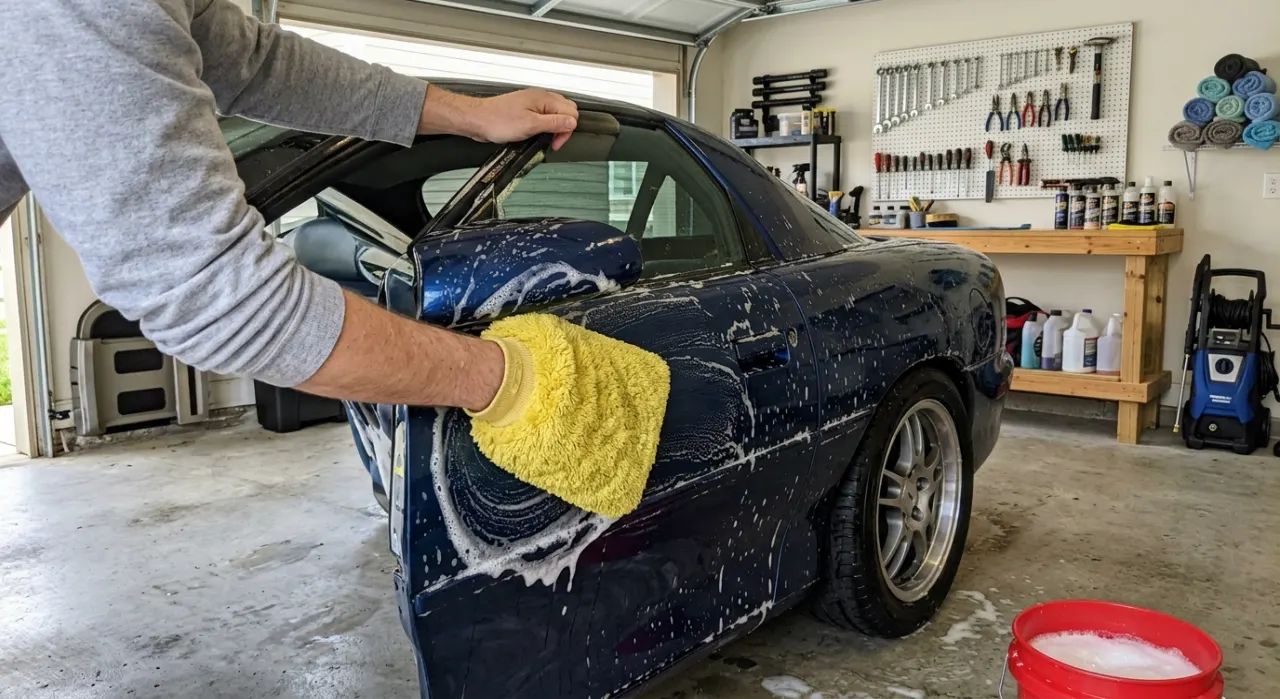
Because Redline Garage readers wash a lot of cars, this deserves its own note. Detailing consensus is that car paint is where high PSI stops being an asset and becomes a liability. Most detailers keep pressure at the paint in the neighborhood of 1,200–1,900 PSI, often using a wider 25- or 40-degree tip or a dedicated foam cannon setup rather than a narrow, high-pressure nozzle.
What actually makes a car wash fast and safe is flow, not force. Good GPM lets a foam cannon lay down a thick, clinging layer of snow foam and then rinse it — along with loosened road film and grit — cleanly off the panels. Try the same wash with a high-PSI, low-GPM electric unit and you get thin foam and a slow, streaky rinse, because the cannon is starved for water.
A common mistake is buying the biggest-PSI gas unit for the driveway and then using it on the family car with the wrong tip. At close range a narrow tip on a 3,000+ PSI machine will chip paint, blast off badges and trim, and drive water into door and window seals. If one machine has to do both duty cars and concrete, the fix is tip selection and standoff distance, not buying a gentler washer: use a wide fan and keep your distance on paint, switch to a narrower tip for the driveway.
Common myths and buying mistakes
"Higher PSI always means a better clean." No. Past the point that breaks a given stain, extra PSI adds damage risk, not cleaning speed. Once grime is loose, only flow (GPM) speeds up the job. This is the single most common reason people overpay for pressure they cannot use safely.
"GPM does not really matter." It matters enormously, especially for large areas and surface cleaners. Flow is what carries dirt away and what covers ground. Ignoring GPM is why a "high-PSI" bargain machine feels gutless on a real driveway.
"The PSI on the box is what I'll get." Ratings are often quoted at maximum pressure with zero flow — a condition that never exists while you are actually cleaning. Real working pressure at the surface, especially through a longer hose and a wider tip, is lower. Treat headline PSI as a marketing ceiling, not a promise.
"More power is always safer to buy — I can just dial it down." Only partly. You can drop effective pressure with a wider tip and more standoff distance, so a strong machine is versatile. But a high-flow gas unit also uses far more water and is heavier and noisier, so "just buy the biggest" has real trade-offs on a well, under water restrictions, or for a small patio.
"PSI and GPM are basically the same thing." They are opposites in what they do: one applies force, the other moves volume. A machine can be strong in one and weak in the other, which is exactly why the combined cleaning-units figure exists.
How to choose the right numbers
There is no winner here, because PSI and GPM are not alternatives — they are a pair. The goal is to pick a machine whose two numbers suit the jobs you actually do, then compare candidates on cleaning units to judge overall grunt.
Prioritize PSI (with moderate flow) if your headaches are stubborn, bonded messes on tough materials — dried mortar, flaking paint, ground-in oil, caked farm mud. You need the force to break those bonds, and the surfaces can take it.
Prioritize GPM (with sensible pressure) if you mostly rinse large areas or wash vehicles — driveways, siding, patios, cars, a small fleet. Flow is what makes those jobs fast and safe, and it is what feeds surface cleaners and foam cannons.
For a typical homeowner who wants one machine to wash cars and clean concrete, the sweet spot most owners land on is roughly 2,500–3,000 PSI paired with at least 2.2–2.5 GPM — enough pressure for the driveway, enough flow to rinse fast and run a surface cleaner, and gentle enough on paint with the right wide tip. Then let tip selection, not a second machine, handle the difference between blasting concrete and rinsing a fender. Match the numbers to the work, and the "PSI vs GPM" question dissolves into "how much of each do I need."
Recommended Products
Our top picks in this category, ranked on aggregated owner reviews.
Best for Beginners who want one box that does everything well
- 14 matched pieces covering wash, protect and interior
- Includes shampoo, spray sealant and interior cleaner
- Comes with microfiber towels and applicators
- Products are designed to work together as a system
Why buy it: It is the closest thing to a complete detail in a single box, which is exactly what a first-timer needs — no guesswork about whether the pieces play nicely together.
Best for Enthusiasts who want top-shelf formulas from the start
- Premium formulas with a genuinely slick finish
- Excellent spray sealant and glass cleaner
- High-quality plush microfiber included
- Strong resale-grade presentation and packaging
Why buy it: You pay more, but the products themselves are a noticeable step up in slickness and gloss — the kit you buy when you know you are hooked.
Best for Getting proven, forgiving products for a fair price
- Trusted formulas that are hard to get wrong
- Covers wash, wax and interior basics
- Widely reviewed and consistently reliable
- Great balance of price and performance
Why buy it: Meguiar's has been dialing in beginner-friendly products for decades, and this kit is the safe, sensible middle — nothing flashy, nothing you will regret.

Best for The cheapest way to cover the basics in one buy
- Lowest entry price of the group
- Covers wash, wheels, glass and interior
- Available almost everywhere
- Simple products that are easy to use
Why buy it: If you just want to stop washing your car with dish soap and a bath towel, this gets you a real detailing setup for pocket change.

Best for People who want maximum product and a storage bucket
- Large bundle with a bucket and grit guard included
- Full-size bottles of core products
- Foam and wash gear bundled in
- Everything stores neatly in the bucket
Why buy it: The bucket doubles as storage and a two-bucket wash setup, and the full-size bottles mean you are not restocking after two washes.

Best for Buying local at any auto parts store today
- Stocked at nearly every parts store
- Reliable wax and cleaner formulas
- Easy to top up individual bottles later
- Long-standing reputation with hobbyists
Why buy it: When you want to start today and not wait on shipping, Mothers is on a shelf near you — and the products genuinely hold up.
Prices are pulled from Amazon and were accurate as of Aug 22, 2026, 6:54 PM EDT. Product prices and availability are subject to change — the live price is shown on Amazon.