
Affiliate Disclosure
Some links on this page are affiliate links. As an Amazon Associate, we earn from qualifying purchases — at no extra cost to you. We do not buy, test, or physically handle the products we cover; our rankings come from aggregated owner reviews, ratings and expert consensus. Commissions never change our verdicts. How we rank & full disclosure.
Rinseless Wash
A concentrated polymer-and-surfactant solution you dilute in a bucket of water, then wash the whole car panel by panel — no hose, no rinse afterward. Think of it as a full contact wash that skips the pre-rinse and final rinse.
Best for: A normally dirty daily driver when you have no hose access but can still fill a bucket or two
Typically $15–$25 for a 32 oz concentrate (Optimum No Rinse, ONR) that makes 30–50+ buckets
- Handles genuinely dirty cars — light mud, road film and normal dust, not just dust
- Polymers encapsulate and lubricate grit so it slides off instead of grinding
- A single concentrate bottle makes dozens of washes, so cost per wash is pennies
- No hose, driveway runoff or standing water — apartment- and drought-friendly
- Doubles as a clay lubricant, wheel cleaner and glass cleaner at different dilutions
- Still needs a few gallons of water and multiple wash mitts or towels
- Not for a caked, off-road-filthy car — that still wants a proper pre-rinse
- More setup than waterless: buckets, dilution, mitts and drying towels
- Technique matters — cheap towels or one mitt for the whole car invites swirls
Waterless Wash
A ready-to-use spray (or heavy-dilution concentrate) loaded with lubricating polymers. You mist a panel, wipe with one towel, then buff dry with a second — no bucket and no rinsing at all.
Best for: A lightly dusty or already-fairly-clean car, or a quick touch-up between real washes
Typically $10–$20 for a 16–24 oz ready-to-use spray, or a concentrate that makes several gallons
- Fastest possible wash — mist, wipe, flip, buff, done in minutes
- Zero buckets and almost zero water; ideal for balconies, garages and events
- Leaves a light polymer gloss and some slickness behind, like a spray sealant lite
- Great for spot-cleaning bird droppings, pollen or a single dirty panel
- Only safe on light dust — real dirt drags across the paint and mars it
- Highest swirl risk of any method if you rush or reuse a loaded towel
- Ready-to-use bottles cost more per wash than diluting a concentrate
- Goes through microfiber fast — you need a fresh face for every panel
How they score, side by side
Scores reflect aggregated owner reviews and expert consensus — not our own bench testing.
- Cleaning power on real dirt84
- Paint safety on a dirty car83
- Speed / convenience69
- Water savings810
- Cost per wash96
- Beginner-friendliness65
Spec-by-spec comparison chart
| Factor | Rinseless Wash | Waterless Wash |
|---|---|---|
| How it is applied | Diluted in a bucket, washed panel by panel | Sprayed straight onto the panel, wiped off |
| Water needed | ~2–4 gallons per wash (buckets) | Almost none — just the product itself |
| Rinse step | None — that is the point | None |
| Dirt level it handles | Light mud & normal road film | Light dust only |
| Polymer strength | Higher — built to encapsulate real grit | Lubricating, but lighter dirt load |
| Typical form | 32 oz concentrate (highly diluted) | Ready-to-use spray or heavy-dilution concentrate |
| Cost per wash | Pennies (a bottle makes 30–50+ washes) | Higher (RTU sprays) to low (concentrate) |
| Swirl risk if rushed | Low–moderate with good technique | Moderate–high — least forgiving method |
| Speed | 20–40 min for a full car | 10–20 min for a full car |
| Leaves protection behind | Slight gloss; some versions add a bit | Light polymer gloss / slickness |
| Best home | Apartments, drought areas, garages | Touch-ups, shows, balconies, offices |
Our Top 3 Picks
The three highest-rated options in this category, if you'd rather skip straight to a proven pick.

Best for Beginners who want one box that does everything well
- 14 matched pieces covering wash, protect and interior
- Includes shampoo, spray sealant and interior cleaner
- Comes with microfiber towels and applicators
- Products are designed to work together as a system
Why buy it: It is the closest thing to a complete detail in a single box, which is exactly what a first-timer needs — no guesswork about whether the pieces play nicely together.

Best for Enthusiasts who want top-shelf formulas from the start
- Premium formulas with a genuinely slick finish
- Excellent spray sealant and glass cleaner
- High-quality plush microfiber included
- Strong resale-grade presentation and packaging
Why buy it: You pay more, but the products themselves are a noticeable step up in slickness and gloss — the kit you buy when you know you are hooked.

Best for Getting proven, forgiving products for a fair price
- Trusted formulas that are hard to get wrong
- Covers wash, wax and interior basics
- Widely reviewed and consistently reliable
- Great balance of price and performance
Why buy it: Meguiar's has been dialing in beginner-friendly products for decades, and this kit is the safe, sensible middle — nothing flashy, nothing you will regret.
Prices are pulled from Amazon and were accurate as of Aug 22, 2026, 6:54 PM EDT. Product prices and availability are subject to change — the live price is shown on Amazon.
What actually separates rinseless from waterless
On the shelf these two look almost identical — both are polymer-based products that let you wash a car without a hose, and both promise "no rinse." That shared marketing is exactly why owners buy the wrong one and then complain about swirls. The real difference is not the name; it is how much dirt each is engineered to lift and carry away safely.
A rinseless wash is a super-concentrate you dilute heavily in a bucket — a capful or two of something like Optimum No Rinse (ONR) into two or three gallons of water. That solution is loaded with surfactants and polymers that encapsulate dirt: they wrap each grit particle in a slick, lubricated shell so it releases from the paint and stays suspended in the mitt instead of grinding across the clear coat. You wash the car panel by panel, wipe or blot dry, and never rinse. Because there is actual water volume and stronger cleaning chemistry, rinseless can tackle a genuinely dirty daily driver.
A waterless wash flips the ratio. It is a ready-to-use (or lightly diluted) spray you mist straight onto the panel, then wipe off with a plush microfiber and buff dry with a second towel. There is no bucket and essentially no water beyond the product itself. The lubricating polymers are still there, but with almost no water volume to float dirt away, the method only has the capacity to handle light dust. Ask it to move real road grime and that grit has nowhere to go but across your paint.
The cleanest way to remember it, and the consensus among detailers: rinseless is a real wash without a hose; waterless is a spray-and-wipe for a car that is already nearly clean. They overlap in packaging and marketing, but they sit at different points on the dirt scale, and that single fact drives every other trade-off below.
The dirt line: which one your car needs today
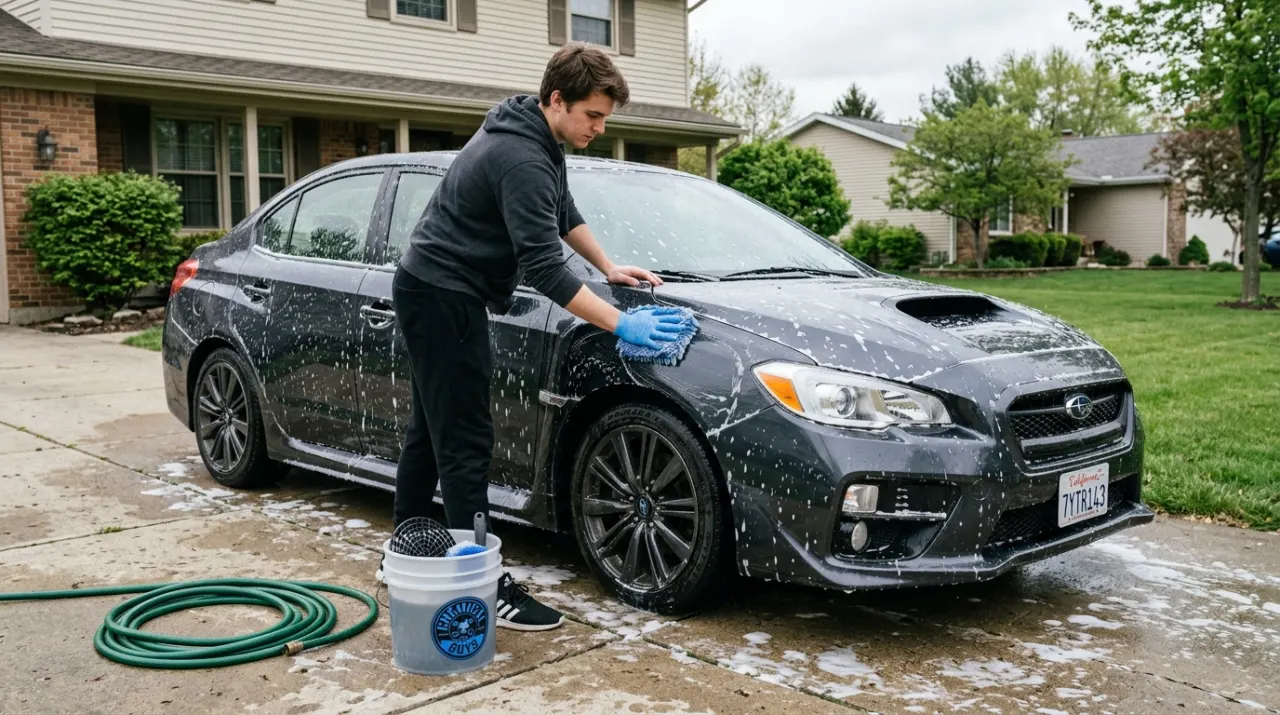
Because both skip the rinse, the deciding question is never brand or price — it is how dirty the car is right now. Detailers describe an informal "dirt line," and picking the wrong side of it is where paint damage happens:
- Dusty but not dirty — a light film of pollen, garage dust or a few days of settled grime with no gritty texture. This is waterless territory. A quick mist-and-wipe clears it and leaves a light gloss.
- Normal daily-driver dirty — visible road film, light mud spatter, bug residue, general grime you can feel. This is rinseless territory. The bucket and stronger polymers give the dirt somewhere to go.
- Genuinely filthy — caked mud, heavy salt, off-road grime, a winter's worth of buildup. Neither product is the right call. That car wants a proper pre-rinse or a foam-and-rinse contact wash first; forcing rinseless or waterless onto it just multiplies the scratching risk.
The practical test owners use is the finger drag: wipe a clean finger across a hidden panel. If it comes away lightly dusty, waterless is fine. If it comes away with real dirt on it, step up to rinseless. If the panel has visible chunks or a gritty crust, stop — hose it first. Aggregated owner reviews are remarkably consistent that the people who are unhappy with waterless almost always used it on a car that needed rinseless.
Technique and why it decides paint safety
Neither product is inherently a "swirl machine" or inherently safe — the technique carries more weight than the bottle. Both methods work by keeping grit lubricated and lifted, and both fail the moment you drag a loaded towel back across the paint.
For a rinseless wash, the consensus best practice is a two-bucket or multi-towel approach. Some detailers pre-soak plush microfiber towels in the solution and use a fresh face for each panel; others use a wash mitt with a rinse bucket to release grit between panels. Work top-down, one section at a time, blot rather than scrub, and dry with a clean waffle-weave or drying towel. Done this way, rinseless is remarkably safe — the encapsulating polymers do the heavy lifting and the grit ends up in the towel, not on the paint.
For a waterless wash, technique is even less forgiving because there is no bucket to dump contaminated grit into. The rules detailers repeat: mist generously so you are never wiping a dry or barely-damp panel, use a fresh, high-nap microfiber face for every section, wipe in straight lines with almost no pressure, and immediately flip to a dry side to buff. The instant a towel face looks dirty, it is retired. Reusing one loaded towel over an entire car is the classic mistake that turns a "waterless wash" into a "swirl application session."
The takeaway is that both methods reward good microfiber and patience. If you only own one thin cheap towel, neither product will be kind to your clear coat. Buy a stack of quality plush microfiber and the paint-safety gap between the two methods narrows considerably.
Real cost per wash and water savings
On the shelf the prices look similar — roughly $10–$25 for either — but cost per wash tells a very different story because of dilution. A 32 oz bottle of rinseless concentrate is diluted so heavily that it yields 30 to 50-plus buckets, which pushes the cost per wash down to pennies. That is the strongest value case of any wash method, hose or no hose.
Waterless splits into two camps. A ready-to-use spray is convenient but you are paying to ship water and using far more product per car, so the cost per wash is meaningfully higher. A waterless concentrate that you mix into gallons narrows the gap, but even then rinseless usually wins on pure economy because it is diluted more aggressively. If you wash weekly, a bottle of rinseless concentrate is the cheapest long-run choice by a wide margin.
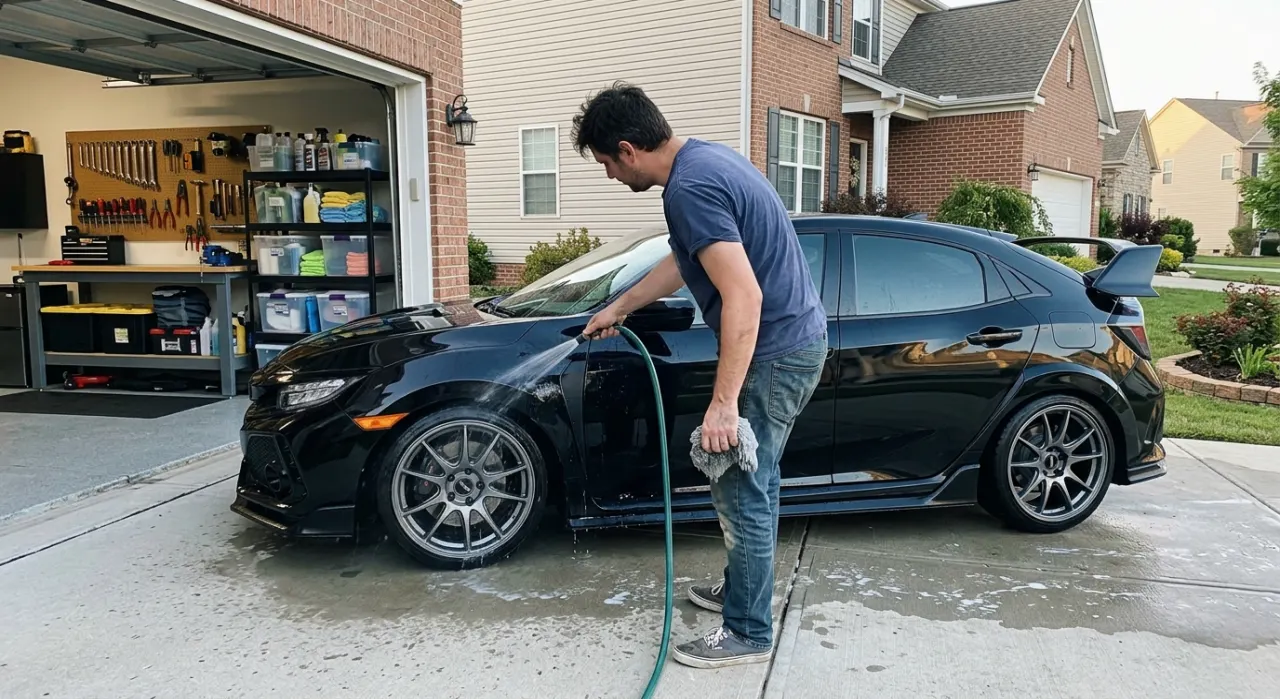
On water, both crush a traditional hose wash. A conventional wash can run 40 to 140 gallons; a rinseless wash uses roughly 2 to 4 gallons total, and waterless uses almost none beyond the product itself. For anyone in an apartment, under water restrictions, or without driveway drainage, that is often the entire reason to switch — and it is a real advantage both products share, with waterless edging ahead on raw water savings and rinseless winning on how dirty a car it can handle for those few gallons.
Common myths and mistakes
"Rinseless and waterless are basically the same thing." No. They share the no-rinse idea, but rinseless uses a bucket and stronger encapsulating chemistry to handle real dirt, while waterless is a spray-and-wipe for light dust only. Treating them as interchangeable is how paint gets marred.
"Waterless wash can replace all my hose washes." Only if your car never gets more than dusty. The moment there is gritty road film, waterless is the wrong tool — reach for rinseless, or a proper contact wash. Waterless shines as a touch-up and light-dust solution, not a do-everything replacement.
"No rinse means no scratching." The opposite risk is true — because you are wiping dirt off with a towel instead of blasting it away with water, technique and clean microfiber matter more, not less. A careless waterless wipe on a dirty panel scratches more than a sloppy hose wash would.
"One towel is enough." This is the single most common cause of swirls with either method. Grit loads into the towel fast; reusing a dirty face just sands the paint. The consensus is a stack of plush microfiber and a fresh face for every panel — non-negotiable with waterless, strongly advised with rinseless.
"Rinseless is only for pros." Not at all. With a bucket, a few good towels and a top-down routine, rinseless is beginner-friendly and forgiving, and many owners find it their default wash even when a hose is available.
Which should you buy — and how to decide
There is no universal winner here, because it is not really a versus — it is a matter of matching the product to the mess. The honest answer is that most serious no-hose washers end up owning both: rinseless for the real washes and a waterless spray for quick touch-ups.
Buy rinseless if your car gets normally dirty — road film, light mud, bugs — and you want a genuine, paint-safe wash without a hose. It is the more capable, more economical, more forgiving choice, and for most people it is the better single bottle to own. Optimum No Rinse (ONR) is the long-standing owner favorite for good reason.
Buy waterless if your car mostly gets dusty rather than dirty, or you need a fast touch-up between real washes — clearing pollen off the hood, wiping a single dirty panel, or prepping a mostly-clean car for a show. It is quicker and needs no setup, as long as you respect its light-dust limit.
Whichever you choose, the microfiber decides your results as much as the chemistry does. Buy a stack of quality plush towels, use a fresh face per panel, never wipe a genuinely gritty car, and both methods will keep your paint clean and swirl-free. Identify how dirty the car actually is first, and the "which one" question answers itself.
Recommended Products
Our top picks in this category, ranked on aggregated owner reviews.
Best for Beginners who want one box that does everything well
- 14 matched pieces covering wash, protect and interior
- Includes shampoo, spray sealant and interior cleaner
- Comes with microfiber towels and applicators
- Products are designed to work together as a system
Why buy it: It is the closest thing to a complete detail in a single box, which is exactly what a first-timer needs — no guesswork about whether the pieces play nicely together.
Best for Enthusiasts who want top-shelf formulas from the start
- Premium formulas with a genuinely slick finish
- Excellent spray sealant and glass cleaner
- High-quality plush microfiber included
- Strong resale-grade presentation and packaging
Why buy it: You pay more, but the products themselves are a noticeable step up in slickness and gloss — the kit you buy when you know you are hooked.
Best for Getting proven, forgiving products for a fair price
- Trusted formulas that are hard to get wrong
- Covers wash, wax and interior basics
- Widely reviewed and consistently reliable
- Great balance of price and performance
Why buy it: Meguiar's has been dialing in beginner-friendly products for decades, and this kit is the safe, sensible middle — nothing flashy, nothing you will regret.

Best for The cheapest way to cover the basics in one buy
- Lowest entry price of the group
- Covers wash, wheels, glass and interior
- Available almost everywhere
- Simple products that are easy to use
Why buy it: If you just want to stop washing your car with dish soap and a bath towel, this gets you a real detailing setup for pocket change.

Best for People who want maximum product and a storage bucket
- Large bundle with a bucket and grit guard included
- Full-size bottles of core products
- Foam and wash gear bundled in
- Everything stores neatly in the bucket
Why buy it: The bucket doubles as storage and a two-bucket wash setup, and the full-size bottles mean you are not restocking after two washes.

Best for Buying local at any auto parts store today
- Stocked at nearly every parts store
- Reliable wax and cleaner formulas
- Easy to top up individual bottles later
- Long-standing reputation with hobbyists
Why buy it: When you want to start today and not wait on shipping, Mothers is on a shelf near you — and the products genuinely hold up.
Prices are pulled from Amazon and were accurate as of Aug 22, 2026, 6:54 PM EDT. Product prices and availability are subject to change — the live price is shown on Amazon.