
Affiliate Disclosure
Some links on this page are affiliate links. As an Amazon Associate, we earn from qualifying purchases — at no extra cost to you. We do not buy, test, or physically handle the products we cover; our rankings come from aggregated owner reviews, ratings and expert consensus. Commissions never change our verdicts. How we rank & full disclosure.
Tire Rotation
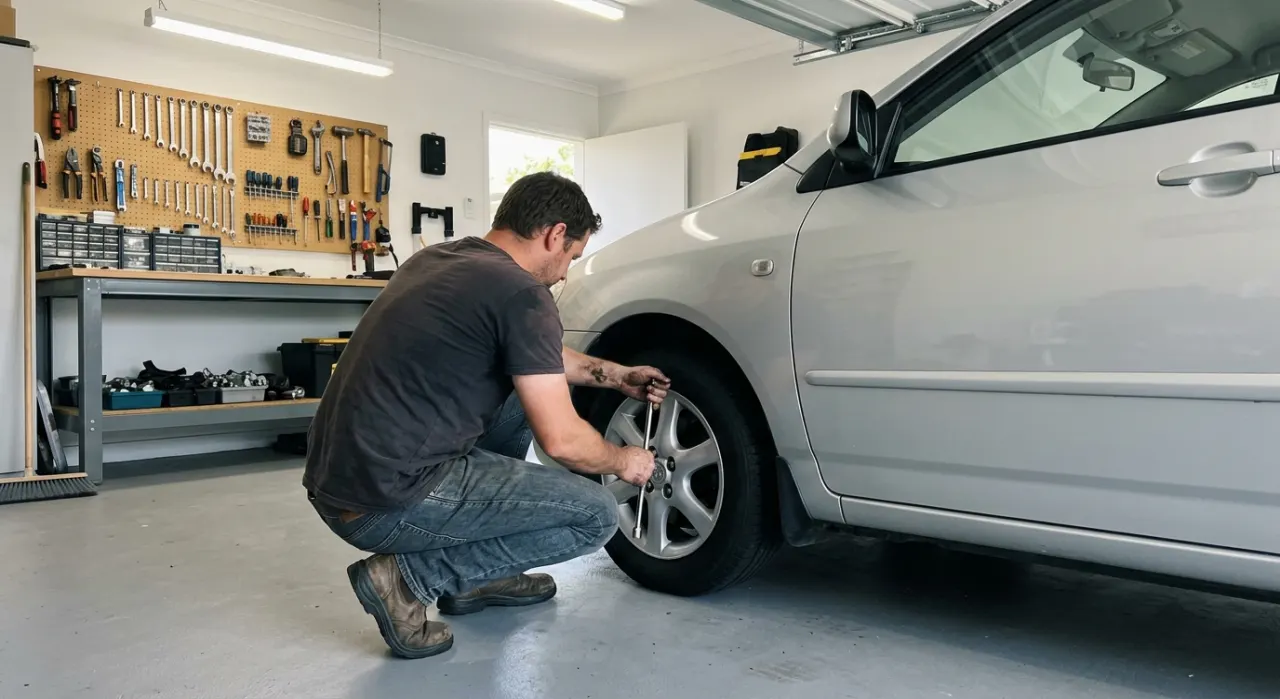
Moving each tire to a different position on the car so the set wears evenly. It is a scheduled maintenance job that changes nothing about the suspension — it just swaps where each tire lives.
Best for: Every car, on a mileage schedule, to make a set of tires last as long as it was designed to
Typically $20–$50, and often free with an oil change or tire purchase
- Cheap or free, and the single biggest lever on how long a tire set lasts
- Evens out the front-vs-rear wear difference that every drivetrain creates
- Required by most tire warranties — skip it and you can void the mileage coverage
- Fast — usually 15–30 minutes, no special calibration equipment needed
- A natural moment to inspect brakes, tread depth and uneven wear patterns
- Does nothing to correct suspension angles — a misaligned car still wears tires wrong
- Cannot fix a pull, a crooked steering wheel or feathered tread
- Needs to be done repeatedly (every 5,000–8,000 miles) to matter
- Wrong rotation pattern on directional or staggered tires can do more harm than good
Wheel Alignment
Adjusting the suspension angles — camber, toe and caster — so the tires meet the road at the geometry the manufacturer specified. It corrects how the car tracks, not where the tires sit.
Best for: Cars that pull, wear tires unevenly, or have hit a pothole/curb or had suspension work done
Typically $80–$150 for a four-wheel alignment; front-only around $50–$90
- Fixes the root cause of uneven wear, pulling and a off-center steering wheel
- Restores straight-line tracking and predictable, centered steering
- Protects a fresh set of tires from being ruined by bad geometry
- Can recover a little fuel economy lost to tires scrubbing sideways
- More expensive and needs a calibrated alignment rack — not a DIY job for most
- Does not redistribute existing wear — evening out tire wear is rotation's job
- Cannot save tires that are already cupped or feathered from prior neglect
- Only needed occasionally, so it is easy to forget until damage shows
How they score, side by side
Scores reflect aggregated owner reviews and expert consensus — not our own bench testing.
- Extends tire life87
- Fixes a pull / crooked wheel110
- Cost friendliness105
- How often you need it94
- DIY-ability82
- Corrects root cause of wear310
Spec-by-spec comparison chart
| Factor | Tire Rotation | Wheel Alignment |
|---|---|---|
| What it actually does | Swaps tire positions for even wear | Adjusts suspension angles (camber/toe/caster) |
| Touches the suspension | No — tires only | Yes — that is the whole job |
| Recommended interval | Every 5,000–8,000 miles | As needed; many shops suggest a yearly check |
| Typical cost | $20–$50 (often free) | $80–$150 (four-wheel) |
| Time in the shop | ~15–30 minutes | ~45–90 minutes |
| Fixes a steering pull | No | Yes |
| Fixes a crooked steering wheel | No | Yes |
| Evens out existing wear | Yes | No |
| Prevents future uneven wear | Partly (balances the wear rate) | Yes (corrects the cause) |
| Needs special equipment | No — just a jack/lift | Yes — a calibrated alignment rack |
| Required by tire warranty | Usually yes | No, but recommended |
Our Top 3 Picks
The three highest-rated options in this category, if you'd rather skip straight to a proven pick.
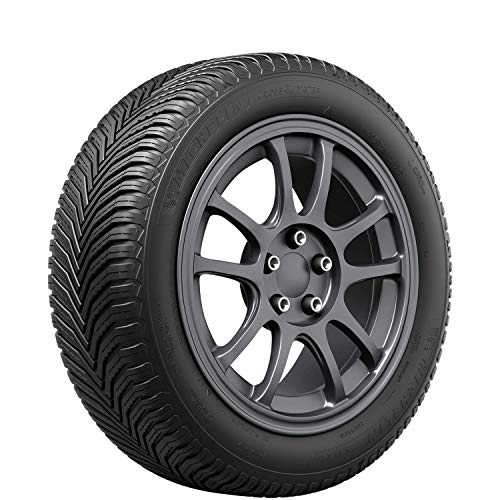
Best for the best all-round grip, wear and light-snow ability
- V-shaped tread with 3-peak-mountain-snowflake rating
- Class-leading wet and dry braking
- 60,000-mile treadwear warranty
- Real light-snow traction for an all-season
Why buy it: the tire owners and experts keep crowning as the best all-rounder — it brakes shorter in the wet than most rivals and genuinely handles snow, so it fits almost any driver in a four-season climate.

Best for the longest tread life on a sedan or minivan
- Up to 80,000-mile treadwear warranty
- Quiet, comfortable highway ride
- Strong wet grip and even wear
- Michelin’s longest-lasting all-season
Why buy it: the set-and-forget touring tire owners rate for outlasting everything else — fit it once and forget about tires for years.

Best for premium wet braking at a mid-range price
- Up to 80,000-mile treadwear warranty
- EcoPlus compound for shorter wet stops
- Fuel-efficient, low rolling resistance
- Wear indicators built into the tread
Why buy it: a hugely popular touring tire that delivers premium-brand wet performance and an 80k warranty for less than the flagships.
Prices are pulled from Amazon and were accurate as of Aug 22, 2026, 6:54 PM EDT. Product prices and availability are subject to change — the live price is shown on Amazon.
What rotation and alignment each actually do
These two services get lumped together at the tire shop, so it is easy to assume they are versions of the same thing or that one includes the other. They don't, and they aren't. One moves your tires; the other adjusts your suspension. Understanding that split is the whole game, because it tells you which one your car actually needs and stops you from paying for the wrong fix.
A tire rotation is pure position-swapping. The technician lifts the car, takes all four tires off, and puts them back on in a different pattern — typically front tires move to the rear and rear tires cross to the opposite front, though the exact pattern depends on whether the tires are directional and whether the car is front-, rear- or all-wheel drive. Nothing is adjusted, calibrated or bent. The tires themselves are identical when the job is done; they just live in new spots. The point is even wear: because the driven axle and the steering axle wear tires at different rates, rotating them shares that wear around the set so all four reach the end of their life together.
A wheel alignment never moves a tire from one corner to another. Instead the car goes on a calibrated rack, sensors read the suspension angles, and the technician adjusts them back to the manufacturer's spec. Three angles matter: camber (how far the top of the tire tilts in or out when viewed from the front), toe (whether the tires point slightly inward or outward from above), and caster (the steering-axis tilt that affects straight-line stability and return). When any of these drifts out of spec, the tire scrubs against the road at a slight angle and wears unevenly no matter how often you rotate it.
The cleanest way to remember the difference: rotation deals with where the tires are, alignment deals with how the tires meet the road. A car can badly need one and not the other, which is exactly why treating them as interchangeable costs people money and tires.
Why this is not really a versus
Search "tire rotation vs alignment" and the framing suggests you're choosing between them. In reality a properly maintained car gets both, on completely different schedules, because they cover for each other's blind spots. Rotation cannot correct bad geometry, and alignment cannot redistribute wear that has already happened. Skip either one and your tires pay for it.
Here is how they work together. Say your car's alignment is slightly off — the left front toe is out of spec. Alignment fixes the angle so that tire stops scrubbing. But rotation is what makes sure the front tires, which always wear faster because they steer and (on most cars) drive and brake harder, don't outpace the rears by the time the tread is gone. You need the angle corrected and the positions rotated to get full life out of the set. The consensus among tire techs is blunt: rotation without alignment lets a hidden geometry problem chew through evenly-rotated tires, and alignment without rotation leaves the front-rear wear imbalance untouched.
The one time it genuinely becomes an either/or is a tight budget. If money is short this month, the deciding question is simple — does the car track straight and steer centered, or does it pull and wear unevenly? A straight-tracking car benefits most from the cheap, overdue rotation. A pulling, tire-eating car needs the alignment first, because rotating tires onto a misaligned car just spreads the damage around.
When you need a rotation
Rotation is the easy one to schedule because it runs on mileage, not symptoms. Aggregated owner guidance and most manufacturer manuals land in the same window:
- Every 5,000–8,000 miles is the standard interval, which conveniently lines up with a lot of oil-change schedules — the easiest way to never forget it.
- Whenever you buy new tires, note the mileage and start the clock. Many retailers include free lifetime rotations with a set, so there's rarely a reason to skip it.
- If you notice the fronts wearing faster than the rears (or vice versa), you're overdue — that growing gap is exactly what rotation exists to prevent.
- All-wheel-drive owners should be stricter, not looser. AWD systems are sensitive to mismatched tire diameters, and uneven wear from skipped rotations can stress the differential and transfer case. Many AWD manuals call for rotation as often as every 5,000 miles.
The important thing rotation will not do is fix a car that pulls or a steering wheel that sits crooked. Those are geometry symptoms, and no amount of position-swapping touches geometry. If your only complaint is that the tread is wearing a touch faster up front, rotation is your answer. If the car is fighting you in a straight line, keep reading.
When you need an alignment
Alignment is symptom-driven and event-driven rather than strictly scheduled. The consensus among mechanics is to get one checked whenever any of these show up:
- The car pulls to one side on a flat, straight road when you loosen your grip — the classic sign toe or camber has drifted.
- The steering wheel is off-center when you're driving straight, sitting a few degrees to one side. That's a toe issue and it won't fix itself.
- Uneven or unusual tire wear — feathering (tread edges sharp on one side, rounded on the other), or one shoulder wearing far faster than the rest. Inside-edge wear in particular points to a camber or toe problem.
- You hit a big pothole, curb or road debris. A hard impact can knock the suspension out of spec instantly, even with no visible damage.
- After suspension work — replacing struts, control arms, tie rods, or lowering the car all change the geometry, so an alignment is standard practice afterward.
- On fresh tires. A pre-emptive alignment check is cheap insurance so a hidden angle problem doesn't quietly ruin a brand-new set.
Note that a "four-wheel" alignment adjusts what's adjustable at all four corners and squares the rear to the front; a "front-only" (or two-wheel) alignment is cheaper but only sets the front axle. Most modern cars with independent rear suspension benefit from the four-wheel job. What alignment will not do is rescue tires that are already cupped or feathered from months of neglect — it stops the damage going forward, but the worn rubber stays worn.
Real cost and value over the life of a tire set
On price the two aren't close, and that's the point — they're doing different amounts of work. A rotation is $20–$50, and frequently free if you bought the tires there or bundle it with an oil change. An alignment is $80–$150 for a four-wheel job, or roughly $50–$90 front-only, because it ties up a calibrated rack and a trained tech for the better part of an hour.
But the honest way to judge value is against a set of tires, which commonly runs $600–$1,000+ installed. Skipping rotations lets the driven axle wear out while the other axle still has tread, and once the wear is uneven enough you can be shopping for tires thousands of miles early — the difference between one set lasting 60,000 miles and 45,000 miles pays for a decade of rotations several times over. Skipping alignment is worse per dollar: a car that's meaningfully out of toe can scrub a tire's usable life down dramatically, turning a $100 alignment you skipped into a $700 tire replacement. Both services are cheap insurance against a big, avoidable bill.
The math that matters: rotation protects the evenness of wear across the set, and alignment protects the rate of wear on each tire. Neglect the first and your tires die out of sync; neglect the second and they die fast. Spending a little on both on schedule is close to the highest-return maintenance you can do, because tires are one of the most expensive consumables on the car.
Common myths and mistakes
"Rotating my tires will fix the pull." It won't. A pull is a geometry problem, and rotation changes zero geometry. At most, swapping tires can move a pull caused by a single conical tire, but a true alignment pull follows the car, not the tire. You need the rack.
"An alignment includes a rotation." Usually not. They're separate line items with separate equipment and separate purposes. Some shops will bundle them or rotate while the wheels are off, but never assume — ask, because a rotation is often free-or-cheap to add and worth confirming.
"If the car drives straight, I don't need an alignment." Mostly true, but not always. A car can track straight and still be slightly out of toe, quietly feathering the tread. If you're seeing uneven wear with no pull, get it checked anyway — the geometry can be off without an obvious steering symptom.
"I got new tires, so I'm set for a while." New tires are exactly when a rotation schedule and an alignment check matter most, because you have the most rubber to protect. Fitting a fresh set to a misaligned car is the fastest way to waste money on tires.
"Rotation direction doesn't matter." On directional tires and staggered (different-size front/rear) setups it very much does — a wrong pattern can put a directional tire on backwards or move a tire to an axle it doesn't fit. Follow the correct pattern for your tire and drivetrain, or let the shop handle it.
Which should you buy — and how to decide
There is no universal winner here, because it isn't a real versus — a healthy car gets both, on different schedules. The decision is only ever "which does my car need right now," and your car tells you.
You need a rotation if it's simply been 5,000–8,000 miles (or you can't remember the last one), the car tracks straight, and the only thing you notice is the front tires wearing a bit faster than the rears. It's cheap, fast, often free, and required to keep most tire warranties valid — there's no reason to skip it.
You need an alignment if the car pulls to one side, the steering wheel sits crooked when you're going straight, the tread is wearing unevenly, or you've recently hit a pothole or had suspension work done. That's a geometry problem, and only the rack fixes it.
If both apply — and after enough miles they often do — do both, and ask the shop to rotate while the alignment has the wheels off, since it's cheap to combine. If your budget forces a choice, a straight-tracking car should get the overdue rotation, and a pulling or tire-eating car should get the alignment first. Match the service to the symptom and you'll get the full designed life out of every set of tires you buy.
Recommended Products
Our top picks in this category, ranked on aggregated owner reviews.
Best for the best all-round grip, wear and light-snow ability
- V-shaped tread with 3-peak-mountain-snowflake rating
- Class-leading wet and dry braking
- 60,000-mile treadwear warranty
- Real light-snow traction for an all-season
Why buy it: the tire owners and experts keep crowning as the best all-rounder — it brakes shorter in the wet than most rivals and genuinely handles snow, so it fits almost any driver in a four-season climate.
Best for the longest tread life on a sedan or minivan
- Up to 80,000-mile treadwear warranty
- Quiet, comfortable highway ride
- Strong wet grip and even wear
- Michelin’s longest-lasting all-season
Why buy it: the set-and-forget touring tire owners rate for outlasting everything else — fit it once and forget about tires for years.
Best for premium wet braking at a mid-range price
- Up to 80,000-mile treadwear warranty
- EcoPlus compound for shorter wet stops
- Fuel-efficient, low rolling resistance
- Wear indicators built into the tread
Why buy it: a hugely popular touring tire that delivers premium-brand wet performance and an 80k warranty for less than the flagships.

Best for the most tire for the money
- Up to 75,000-mile treadwear warranty
- "Replace Tire" wear indicator in the tread
- Reliable wet braking and light-snow grip
- Backed by Continental’s parent company
Why buy it: the value pick owners rate again and again — a genuinely good touring tire with a 75k warranty at a bargain price.

Best for confidence in rain and winter slush
- 3-peak-mountain-snowflake certified
- Evolving Traction Grooves for wet grip
- 60,000-mile treadwear warranty
- Strong all-weather safety focus
Why buy it: the pick for drivers who see a lot of rain and the occasional storm — a true all-weather tire that carries the winter certification most all-seasons lack.

Best for sporty cars that still need year-round use
- Ultra-high-performance all-season design
- Excellent dry, wet and light-snow grip
- Tread wear indicators (DWS letters)
- A perennial enthusiast favorite
Why buy it: the enthusiast’s all-season — near-summer-tire dry grip with real wet and light-snow ability, so a sports sedan can run one set all year.
Prices are pulled from Amazon and were accurate as of Aug 22, 2026, 6:54 PM EDT. Product prices and availability are subject to change — the live price is shown on Amazon.