
Affiliate Disclosure
Some links on this page are affiliate links. As an Amazon Associate, we earn from qualifying purchases — at no extra cost to you. We do not buy, test, or physically handle the products we cover; our rankings come from aggregated owner reviews, ratings and expert consensus. Commissions never change our verdicts. How we rank & full disclosure.
Winter Tires
A full set of tires built from a soft, silica-rich rubber compound that stays pliable below 45°F, with deep tread blocks and thousands of tiny sipes that bite into snow and ice. You run them all winter, then swap back in spring.
Best for: Anyone who drives regularly through a genuine winter — daily commuters, all-wheel-drive owners, and drivers who want everyday grip rather than a get-out-of-a-ditch tool
Typically $120–$250 per tire ($480–$1,000 per set), plus $60–$150 to mount and balance, or ~$120–$250 for a spare set of steel wheels
- Compound stays soft below 45°F, so grip improves the moment temperatures drop — not just in snow
- Dramatically shorter braking distances on cold, wet and icy pavement, the biggest real-world safety gain
- No speed limit — drive normally on dry highway, unlike chains
- Sipes and biting edges work on packed snow, slush and black ice, not only deep snow
- Legal everywhere and never damage the road, wheels or drivetrain
- High up-front cost for a full set plus mounting, or a second set of wheels
- Need storage space and a seasonal swap twice a year
- On deep unplowed snow or sheet ice on a steep grade, even good winter tires can run out of grip
- Wear faster if you forget to switch them off in warm weather
Snow Chains
Steel link or cable devices that wrap around the drive tires to claw into deep snow and ice. They are an emergency traction aid you fit only when conditions or the law demand it, then remove once the road clears.
Best for: Occasional mountain-pass drivers, anyone facing "chains required" road signs, and drivers who need maximum bite in deep snow for short, low-speed stretches
Typically $40–$100 per pair for cable/link chains; $70–$200 for premium diamond-pattern or self-tensioning sets
- Unbeatable bite in deep, unplowed snow and on steep icy grades — the reason many mountain passes legally require them
- Cheap to buy and packs into the trunk until you actually need it
- Meets "chains required" legal mandates that winter tires alone may not satisfy
- Works on any tire you already own, no second set to buy
- Strict low speed limit, usually 30 mph or less — driving faster damages the chain, tire and vehicle
- Must be fitted and removed by hand, often kneeling in snow and cold
- Useless and destructive on bare pavement; you must stop and take them off when the road clears
- Can damage tires, wheel wells, brake lines or suspension if loose or wrong-sized
How they score, side by side
Scores reflect aggregated owner reviews and expert consensus — not our own bench testing.
- Everyday cold grip93
- Deep-snow bite710
- Braking on cold/wet/ice94
- Convenience83
- Up-front affordability49
- Legal mountain-pass compliance510
Spec-by-spec comparison chart
| Factor | Winter Tires | Snow Chains |
|---|---|---|
| Primary job | Everyday cold-weather grip & braking | Emergency deep-snow / ice traction |
| When they work | All winter, any cold surface (dry, wet, snow, ice) | Only when fitted — deep snow & ice |
| Speed limit | None — drive at normal highway speeds | Usually 30 mph or lower |
| Cold-pavement braking | Greatly improved vs all-seasons | No benefit on bare/cold pavement |
| Deep unplowed snow | Good | Excellent — best available bite |
| Legal for "chains required" signs | Often no — chains still mandated | Yes — this is what they satisfy |
| Install effort | Seasonal shop swap (twice a year) | Hands-on, roadside, each time you need them |
| Up-front cost | $480–$1,000+ per set | $40–$200 per pair |
| Road / vehicle damage risk | None | Real if misused or over speed |
| Typical service life | 4–6 winter seasons | Years of occasional use |
Our Top 3 Picks
The three highest-rated options in this category, if you'd rather skip straight to a proven pick.
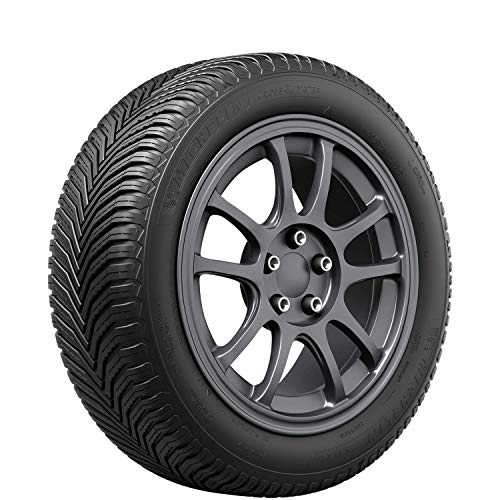
Best for the best all-round grip, wear and light-snow ability
- V-shaped tread with 3-peak-mountain-snowflake rating
- Class-leading wet and dry braking
- 60,000-mile treadwear warranty
- Real light-snow traction for an all-season
Why buy it: the tire owners and experts keep crowning as the best all-rounder — it brakes shorter in the wet than most rivals and genuinely handles snow, so it fits almost any driver in a four-season climate.

Best for the longest tread life on a sedan or minivan
- Up to 80,000-mile treadwear warranty
- Quiet, comfortable highway ride
- Strong wet grip and even wear
- Michelin’s longest-lasting all-season
Why buy it: the set-and-forget touring tire owners rate for outlasting everything else — fit it once and forget about tires for years.

Best for premium wet braking at a mid-range price
- Up to 80,000-mile treadwear warranty
- EcoPlus compound for shorter wet stops
- Fuel-efficient, low rolling resistance
- Wear indicators built into the tread
Why buy it: a hugely popular touring tire that delivers premium-brand wet performance and an 80k warranty for less than the flagships.
Prices are pulled from Amazon and were accurate as of Aug 22, 2026, 6:54 PM EDT. Product prices and availability are subject to change — the live price is shown on Amazon.
What actually separates winter tires from chains
People treat this like a head-to-head purchase — winter tires or chains — but they are not really competing products. They are two different tools that happen to share a season. One is the surface you drive on all winter; the other is a device you strap on for a specific, brief, dangerous stretch of road.
A winter tire (often badged with the three-peak-mountain-snowflake, or 3PMSF, symbol) is engineered around one core idea: rubber that stays soft in the cold. Ordinary all-season and summer compounds turn hard and glassy below roughly 45°F, and a hard tire simply can't conform to the road, so it slides. Winter compounds use extra silica and natural rubber to stay pliable in freezing temperatures, and the tread is carved with deep blocks and thousands of tiny slits called sipes that open like little claws to bite snow and channel away water and slush. The result is more grip on every cold surface — dry, wet, packed snow, and ice — not just deep snow.
A snow chain does something much narrower. It wraps steel links or cables around the outside of your drive tires so that hardened metal, rather than rubber, digs into deep snow and ice. That gives phenomenal bite in conditions where any tire would struggle — but only at crawling speed, and only until the road clears. On bare pavement a chain has nothing to dig into; it just hammers itself, your tires and your fender liners to pieces.
The cleanest way to hold the difference in your head: a winter tire changes how your car behaves every mile of the winter, while a chain is an emergency measure you deploy for the worst few miles and then take off. One is a foundation; the other is a tool in the trunk.
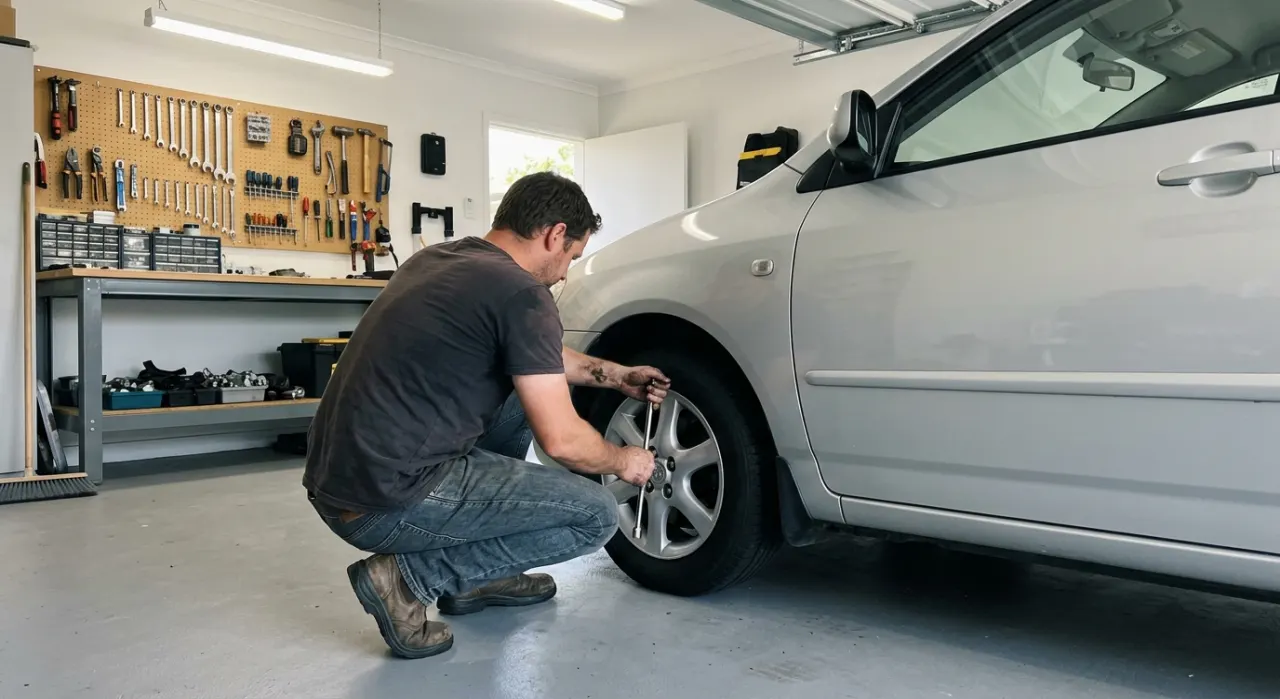
Everyday grip vs emergency traction
The most important real-world safety gain in winter driving isn't getting moving — it's stopping and steering. Anyone can get a car rolling on flat snow; the crashes happen when you can't stop at the light or hold a curve. This is exactly where the two tools diverge, and where owners most often buy the wrong one.
Winter tires shine on the ordinary cold mornings that make up most of the season. Aggregated owner reports and independent braking tests consistently show a winter tire stopping a car from around 30 mph on snow and ice in a fraction of the distance an all-season needs — often dozens of feet shorter, which is the difference between a near miss and a collision. Crucially, that benefit shows up even on cold, dry or merely wet pavement, because the compound is the thing doing the work, not the snow. If your winter is mostly cold roads with intermittent snow, that everyday braking edge is the whole game.
Chains do almost nothing for that scenario. At a 30-mph legal ceiling and useless on clear pavement, a chain won't help you brake on a cold, dry commute — it isn't fitted, and it shouldn't be. Where chains are unbeatable is the narrow, brutal case: deep, unplowed snow, or a steep icy grade where you need maximum mechanical bite to keep moving and under control at low speed. That's a mountain-pass problem, not a daily-commute problem.
- Daily cold-weather driving, occasional snow: winter tires are the answer; chains sit unused.
- Deep snow, steep grades, posted chain zones: chains earn their keep in a way tires can't fully match.
- Both at once: plenty of mountain drivers run winter tires as the baseline and keep chains for the days a sign orders them fitted.
What the law and road signs actually require
This is the detail that trips up drivers who assume good tires cover every situation. In many mountainous states — California, Colorado, Oregon, Washington and others — highway authorities post chain control levels during storms. At the strictest level, chains are legally required on drive wheels for most vehicles, and a "chains required" sign means exactly that: a metal traction device, physically fitted, regardless of how good your tires are.
There is nuance worth knowing. Some jurisdictions grant an exemption for vehicles that are all-wheel-drive and carrying 3PMSF-rated winter tires, or that have winter tires plus chains aboard. But the rules vary by state, by road, and by the storm-level in effect, and the exemption can disappear at the highest control level. The practical consensus among mountain-country drivers is blunt: winter tires are the everyday foundation, but if you're heading into a posted chain-control area, carry chains too and check the current requirement before you go. Relying on tires alone at a "chains required" checkpoint can get you turned around.
The reverse trap matters as well: chains are not a substitute for tires the other 95% of the season. You cannot legally or sanely run chains on a clear interstate at 65 mph, so they do nothing for the daily cold-road driving where most winter risk actually lives.
Real cost over the life of the car
On paper the gap looks enormous — a pair of chains can be $40–$100 while a set of four winter tires runs $480–$1,000 or more before mounting — but comparing the sticker prices misses what each one buys. They aren't doing the same job, so the "cheaper" option isn't automatically the smarter spend.
Winter tires carry real up-front cost, and the smartest way to own them is a dedicated second set of wheels. Buying inexpensive steel rims (roughly $60–$120 each) and leaving the winter tires permanently mounted turns the seasonal changeover into a quick, cheap swap and avoids the $60–$150 mount-and-balance charge every spring and fall. It also spares the beads and TPMS sensors the wear of repeated dismounting. Spread over the four-to-six winters a good set lasts — and remembering that your summer tires aren't wearing while the winters are on — the annualized cost is far lower than the sticker suggests. Owners consistently frame it as buying safety and stopping distance, not just tread.
Chains are cheap to buy and cheap to store, which is exactly their appeal as a backstop. But the honest cost of chains includes the ways they go wrong: a loose or wrong-sized chain can gouge a tire, whip a brake line or tear a fender liner, and driving over the speed limit shreds them fast. Bought correctly and used sparingly at proper speed, a set lasts years. As a value proposition they are unbeatable for what they do — occasional deep-snow rescue — and a poor value if you buy them hoping to skip winter tires entirely.
Common myths and mistakes
"I have all-wheel drive, so I don't need either." The single most expensive winter myth. AWD helps you accelerate; it does nothing for braking or cornering, which is where winter crashes happen. An AWD vehicle on hard all-season rubber still slides at a red light. Traction devices act at the contact patch, where AWD can't help.
"Winter tires and chains are interchangeable." They're not. A winter tire improves grip every cold mile at any speed; a chain is a low-speed emergency device for deep snow that's harmful on clear roads. Buying one doesn't cancel the case for the other.
"All-season tires are basically winter tires." No. "All-season" is really a three-season compound that hardens in the cold. The 3PMSF snowflake symbol — not the "M+S" marking, which is far weaker — is the meaningful indicator of true cold-weather capability.
"I can leave the chains on until I'm off the mountain." Only while there's snow or ice under them. The moment you hit bare, plowed pavement you must stop and remove them, or you'll destroy the chains and risk your tires and suspension. And keep to the posted chain speed limit — usually 30 mph — the entire time.
"Two winter tires on the drive wheels is enough." A mismatched set makes handling worse and can spin the untreated end out under braking. The consensus is unambiguous: fit winter tires in sets of four, and chains on the drive axle as directed.
Which should you buy — and how to decide
There is no single winner, because this was never really a versus. The right answer is set by where and how you drive, and for many people it's "the tires now, the chains too if the mountains call."
Buy winter tires if you drive regularly through real cold — anything with sustained temperatures below about 45°F and periodic snow or ice. This is the foundation, the thing that shortens every stop and steadies every curve all season. Fit a full set of four, ideally on a second set of steel wheels, and switch back in spring so you don't burn the soft compound off on warm roads.
Add chains if you'll face deep unplowed snow, steep icy grades, or posted "chains required" chain-control zones. Keep a correctly sized set in the trunk, practice fitting them once in your driveway before you need them in a blizzard, and respect the low speed limit. In mountain country, chains aren't an alternative to winter tires — they're the legal, last-resort layer on top.
If you must pick only one and you live somewhere with genuine winters, choose the winter tires: they help you every single cold day, not just the worst one. Save chains for the specific case — the mountain pass, the chain-control sign, the deep-snow driveway — where nothing else will get you through. Match the tool to the road, and the "which one" question answers itself.
Recommended Products
Our top picks in this category, ranked on aggregated owner reviews.
Best for the best all-round grip, wear and light-snow ability
- V-shaped tread with 3-peak-mountain-snowflake rating
- Class-leading wet and dry braking
- 60,000-mile treadwear warranty
- Real light-snow traction for an all-season
Why buy it: the tire owners and experts keep crowning as the best all-rounder — it brakes shorter in the wet than most rivals and genuinely handles snow, so it fits almost any driver in a four-season climate.
Best for the longest tread life on a sedan or minivan
- Up to 80,000-mile treadwear warranty
- Quiet, comfortable highway ride
- Strong wet grip and even wear
- Michelin’s longest-lasting all-season
Why buy it: the set-and-forget touring tire owners rate for outlasting everything else — fit it once and forget about tires for years.
Best for premium wet braking at a mid-range price
- Up to 80,000-mile treadwear warranty
- EcoPlus compound for shorter wet stops
- Fuel-efficient, low rolling resistance
- Wear indicators built into the tread
Why buy it: a hugely popular touring tire that delivers premium-brand wet performance and an 80k warranty for less than the flagships.

Best for the most tire for the money
- Up to 75,000-mile treadwear warranty
- "Replace Tire" wear indicator in the tread
- Reliable wet braking and light-snow grip
- Backed by Continental’s parent company
Why buy it: the value pick owners rate again and again — a genuinely good touring tire with a 75k warranty at a bargain price.

Best for confidence in rain and winter slush
- 3-peak-mountain-snowflake certified
- Evolving Traction Grooves for wet grip
- 60,000-mile treadwear warranty
- Strong all-weather safety focus
Why buy it: the pick for drivers who see a lot of rain and the occasional storm — a true all-weather tire that carries the winter certification most all-seasons lack.

Best for sporty cars that still need year-round use
- Ultra-high-performance all-season design
- Excellent dry, wet and light-snow grip
- Tread wear indicators (DWS letters)
- A perennial enthusiast favorite
Why buy it: the enthusiast’s all-season — near-summer-tire dry grip with real wet and light-snow ability, so a sports sedan can run one set all year.
Prices are pulled from Amazon and were accurate as of Aug 22, 2026, 6:54 PM EDT. Product prices and availability are subject to change — the live price is shown on Amazon.