

Affiliate Disclosure
Some links on this page are affiliate links. As an Amazon Associate, we earn from qualifying purchases — at no extra cost to you. We do not buy, test, or physically handle the products we cover; our rankings come from aggregated owner reviews, ratings and expert consensus. Commissions never change our verdicts. How we rank & full disclosure.
The short version: a car audio capacitor steadies your electrical system for the split-second a bass note demands big current, so your headlights stop dimming — but it does not add power, and it will not cure constant voltage sag. Ranked across owner reviews, our #1 pick is the Rockville RFC50F: owners praise its big farad rating, clear voltage meter and proper protections. On a budget, the proven BOSS CAP8 is the value choice. Below is the full ranked field, how we rank, and the honest trade-offs.
A capacitor is one piece of an amplified system — pair it with the right amplifier and subwoofer. New to amps? Start with do you need an amp?. See the car audio hub for more.
Top Picks at a Glance
Our #1 Pick: Rockville RFC50F
The steady hand for a big amp. Owners rate it highly because the large farad rating stores enough energy to cover the current spike of a hard bass hit, the bright voltage meter lets you watch the rail, and the protections guard against reverse polarity and surges. Pros: big storage, clear readout, proper protections, heavy terminals. Cons: a cap steadies transients, not constant sag — if your voltage is always low, spend on wiring and an alternator instead.
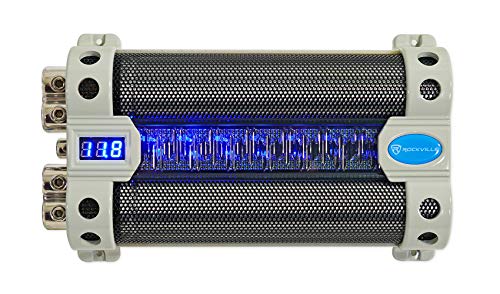
Best for a big-farad cap with a clear voltage readout
- Large farad rating for big amps
- 3-digit blue LED voltage display
- Reverse-polarity and surge warnings
- Heavy-duty terminals, auto sleep
Why buy it: the capacitor owners rate highest — a high-farad cap with a bright voltage meter and proper protections that steadies the rail so your headlights stop dimming on bass hits.

Best for a proven cap for a single amp on a budget
- 8 farad energy storage
- Digital voltage display
- Reverse-polarity and overload warnings
- Simple, reliable, huge review base
Why buy it: the value pick with a massive review base — enough storage for a single moderate amp, with warning tones, for the price of a set of speakers.

Best for a stiffening cap rated for 5000 watts
- 5 farad, rated to 5000 watts
- Digital LED voltage meter
- Screw terminals for heavy cable
- Stabilizes amplifier current draw
Why buy it: the pick for a hungry amp — five farads of fast-release storage sized for a big system to smooth the current spikes a hard bass note demands.

Best for a mid-range cap with headroom
- 20 farad energy storage
- LED voltage meter, warning tones
- Handles multi-amp setups
- Straightforward install
Why buy it: the pick for a growing system — twenty farads gives headroom for a second amp without jumping to a giant cap you may not need.

Best for a smaller cap for a modest amp
- 10 farad energy storage
- Digital voltage display
- Warning tones for polarity/overload
- Compact body for tight installs
Why buy it: the pick for a modest single amp — ten farads of stiffening in a compact body, enough to steady the voltage without the bulk of a big cap.

Best for a small, cheap voltage buffer
- 2.5 farad, rated to 2500 watts
- Digital LED display
- Compact and light
- Cheapest way to add stiffening
Why buy it: the budget pick for a small system — a compact 2.5-farad buffer that takes the edge off minor voltage sag without a big outlay.
What a Capacitor Actually Does (and Doesn't)
Let us be blunt, because this is where people waste money: a capacitor does not add power or volume. It stores a small charge and releases it very quickly to cover the instantaneous current spike when a bass note hits, which keeps the voltage from dipping and the lights from dimming. That is the whole job — smoothing brief demand peaks. If you bought a cap expecting the system to get louder, you bought the wrong part. Understanding this up front is the difference between a cap that solves your actual problem and one that disappoints because it was never going to do what you hoped.
Sizing: The 1 Farad Per 1000 Watts Rule
The common guideline is about 1 farad per 1000 watts of amplifier power — a loose rule of thumb, not physics, since more farads simply store more energy for the spike. Add up your amplifiers’ total power and size the cap to match or a little above. Do not over-buy, though: a giant cap on a small amp is wasted money, and no cap of any size cures chronic sag. Size it to your real amp power, and if you are unsure, lean slightly larger for headroom as the system grows. The bright voltage meter on the better caps lets you confirm it is doing its job.
When to Skip the Cap Entirely
Here is the honest alternative many enthusiasts choose. A capacitor treats the momentary spike of a bass note. If your lights dim continuously, your voltage reads low at idle, or a big system drains the battery, that is constant sag — a supply problem a cap will not fix. The real cures are a "big 3" wiring upgrade (heavier battery, ground and alternator cables), a higher-output alternator, or a second battery. Plenty of experienced installers skip the cap and put the money straight into the big 3 and a stronger alternator, because that fixes the cause rather than smoothing a symptom.
Installing It Safely
Two install rules matter most. First, charge the cap slowly on first install — connect it through a resistor or an inline test light so it charges gradually; wiring a fully discharged cap straight to power causes a big spark that can damage the cap or terminals. Second, wire it in parallel with the amp, right next to it, using cable at least as heavy as the amp’s power wire, and fuse the run. Mount it so it cannot move. The slow first charge is the step people skip and regret, so follow the included procedure exactly — a few minutes of patience protects the whole install.
Car Audio Capacitors: BOSS, Rockville and Other Brands
The capacitor market is smaller than the amp or stereo aisle, and a handful of brands own it. BOSS Audio and Rockville dominate the owner recommendations — for value and big-farad models respectively — with SoundBox and Planet Audio close behind. Stinger is the name enthusiasts reach for when they want a premium hybrid design, though you pay for it. The brand matters less than the farad rating and the honesty of the voltage meter: owners who have run several report the cheaper caps stiffen the rail just as well, so buy on size and protections rather than the badge.
Reading the Digital Voltage Display
Nearly every cap here carries a digital LED voltage readout, and it earns its keep. At rest it should show your charging voltage — around 14.4V with the engine running, near 12V key-on. Watch it on a hard bass hit: a small brief dip is normal; a large sustained drop is the symptom a cap cannot fix, meaning your supply is the real limit. The display also flags reverse polarity and overload with warning tones on the better units. Treat it as a live gauge of your electrical system, not a light show — it tells you honestly whether the cap, or a wiring upgrade, is what you actually need.
Wiring the Capacitor to Your Amp
A cap wires in parallel with the amplifier, mounted close to it, on cable at least as heavy as the amp's power wire. If you have any doubt, the wiring diagram included with most units shows the parallel tap off the same 12V positive and ground the amp already uses — the cap is not inline, it sits alongside. Fuse the run near the battery and keep the ground short and clean.
Matching Farads to Amplifier Power and Bass Demand
Size follows the amp: roughly a farad per 1000 watts, leaning larger if the bass is heavy or a second amp is coming. More farads simply hold more charge for the spike, so a growing system benefits from headroom — but no capacitor substitutes for the supply a truly power-hungry build demands.
How We Rank
A capacitor earns its place by steadying the rail and installing safely, so we rank by aggregated owner ratings, review volume, and the themes owners repeat. We weigh four things. Storage — farad rating matched to real amp power. Monitoring — a clear voltage meter. Protection — polarity and surge safeguards, heavy terminals. And honesty of fit — whether a cap is even the right fix versus wiring. Prices were current at the time of writing.
Quick Comparison
Rockville RFC50F Car Audio Capacitor (50 Farad)
Best for a big-farad cap with a clear voltage readout
Best Value
BOSS Audio CAP8 Car Capacitor (8 Farad)
Check Price on Amazon
Best for Big Systems
SoundBox SCAP5D Digital Capacitor (5 Farad)
Check Price on Amazon
Best Mid-Size
Planet Audio PC20F Car Capacitor (20 Farad)
Check Price on Amazon
Best Compact
Planet Audio PC10F Car Capacitor (10 Farad)
Check Price on Amazon
Best Budget
SoundBox SCAP2D Digital Capacitor (2.5 Farad)
Check Price on Amazon
The Verdict
For steadying a big amp, the Rockville RFC50F is the one owners rate above the rest, with the proven BOSS CAP8 the budget choice for a single moderate amp. But be honest about your problem: constant dimming means a big 3 and alternator upgrade, not a cap. Get the amp and sub right first — see the best amplifiers and do you need an amp?. Check Price on Amazon →