
Affiliate Disclosure
Some links on this page are affiliate links. As an Amazon Associate, we earn from qualifying purchases — at no extra cost to you. We do not buy, test, or physically handle the products we cover; our rankings come from aggregated owner reviews, ratings and expert consensus. Commissions never change our verdicts. How we rank & full disclosure.
The short version: a kayak rack gets your boat to the water securely and keeps it off the roof paint — as long as you have crossbars and tie it down properly, bow and stern included. Ranked across owner reviews, our #1 pick is the Yakima JayLow: a folding J-cradle owners praise for carrying one heavy boat upright or two on their sides, then folding flat. Prefer to carry the hull flat? The Malone SeaWing saddle is the quieter pick. Below is the full ranked field, how we rank, and the honest trade-offs.
A kayak rack is one way to carry gear — see the ski rack, bike rack and hitch bike rack guides for the rest. See the interior accessories hub for more.
Top Picks at a Glance
Our #1 Pick: Yakima JayLow
The flexible choice. Owners rate it highly because it carries a single heavy kayak upright in the J position, or folds to the side to hold two boats when you need to bring a friend’s — then folds flat and low when you are not carrying anything. Pros: one or two boats, folds away, universal bar fit, tie-downs included. Cons: like all kayak racks it needs crossbars, and an upright J-cradle catches more wind than a flat saddle.

Best for a folding J-cradle that carries one or two kayaks
- Folds flat when not carrying a boat
- Carries 1 kayak up to 100 lb, or 2 on the side
- Fits round, square, aero and factory bars
- Includes tie-down straps
Why buy it: the kayak rack owners rate highest — a J-cradle that folds down flat between trips and carries one heavy boat upright or two on their sides.

Best for carrying a kayak flat on its hull
- V-style saddle cradles the hull
- Low profile cuts wind noise and drag
- No-tool JAWZ mounting
- Includes bow and stern tie-downs
Why buy it: the pick for carrying a boat flat — a low-profile saddle that supports the hull, quieter and more aerodynamic than an upright J-cradle.

Best for a fixed-arm J-rack at the best price
- Fixed-arm steel J-cradles, 75 lb capacity
- SpeedLine tie-downs included
- Universal JAWZ hardware fits most bars
- Corrosion-resistant frame
Why buy it: the value pick that gets a boat up cheaply — sturdy fixed-arm J-cradles with tie-downs for well under the folding racks.

Best for one kayak with a quick, simple mount
- Carries 1 kayak in a J position
- Tool-free clamp mounting
- Padded to protect the hull
- Fits most crossbar types
Why buy it: the pick for a single boat — a straightforward J-hook that mounts fast and cradles one kayak securely on the side of the roof.
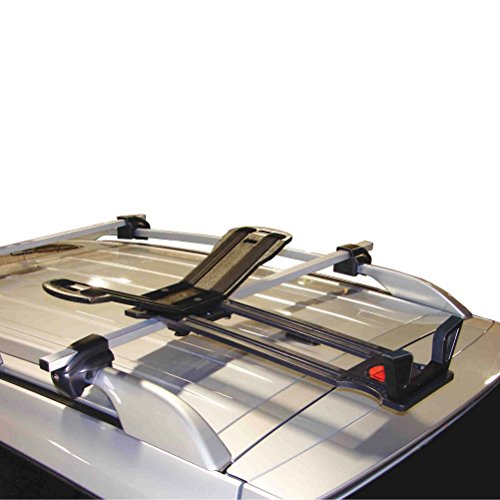
Best for loading a kayak solo without straining
- SeaWing saddle plus a Stinger load bar
- Rear bar extends to slide the boat up
- Padded to protect the vehicle
- Bow and stern lines included
Why buy it: the pick for loading alone — a rear load-assist bar lets you rest the boat and slide it up instead of hoisting the whole kayak overhead.

Best for a four-saddle set that cradles the whole hull
- Four saddles support the hull fully
- Articulating pads follow the hull shape
- Bow and stern lines included
- Universal crossbar mount
Why buy it: the pick for full hull support — four articulating saddles that cradle the boat evenly, ideal for longer or heavier kayaks carried flat.
Crossbars Are Non-Negotiable
A kayak is large and catches a lot of wind, so it mounts to roof crossbars rated for the load — there is no bare-roof or magnetic shortcut here. If your car has no bars, install a crossbar system first, sized for the combined weight of the rack plus your heaviest kayak. Once you have bars, most J-cradles and saddles clamp on with universal hardware that fits round, square, aero and factory shapes. Confirm your crossbars’ weight rating before loading — the boat, the rack and the wind load all ride on those two bars.
J-Cradle vs Saddle
The two styles carry the boat differently. A J-cradle holds the kayak on its side at an angle, which frees roof space so you can fit a second kayak or other gear beside it — the pick when space is tight or you carry two boats. A saddle carrier holds the boat flat on its hull: lower-profile, quieter, more aerodynamic, and gentler on the hull for long highway drives. J-cradles are easier to load one boat into; saddles support the hull more evenly. Two kayaks means J-cradles; one boat and quiet efficiency means saddles.
Tie It Down the Right Way — Bow and Stern
This is the safety section that matters most. Use two systems, always. First, strap the kayak to the cradles or saddles with cam straps — snug, not crushing. Second, and non-negotiable, run bow and stern lines from the ends of the boat to secure points on the car, front and back. The straps hold the boat to the rack; the bow and stern lines stop the whole assembly from lifting or pivoting at highway speed or in the gust from a passing truck. Every quality rack includes or expects these lines — skipping them is the most common and most dangerous kayak-hauling mistake.
Loading Solo Without Straining
If you paddle alone, the right rack saves your back and your paint. A load-assist system like the Malone Stinger adds a rear bar you rest the bow on, then slide the boat up and forward — no overhead hoist. Without it, you can lift one end onto the rear bar first and walk the boat up, or lay a towel on the rear glass to slide it. For heavier boats or frequent solo loading, a load-assist rack is worth the premium. However you load, protect the hull with the rack’s padding and confirm every strap and line before you drive.
Roof Rails, Bars and What Fits
Before the rack goes on, look at your roof. Raised side rails you can slip a hand under take a crossbar system easily; flush rails need a fit-specific foot pack; a bare roof needs clamp-on feet that grip the door frame. Only once crossbars are up do the kayak racks themselves clamp on. Factory or OEM bars are often rated lighter than aftermarket ones, so check the number before you load a heavy boat. Matching the carrier to your exact rail type is what keeps a good kayak rack from rattling loose.
Carrying Canoes and Two Kayaks
The load changes the gear. A canoe rides best flat and upside down on gunwale blocks or wide saddles rather than a J-cradle, and its length means bow and stern lines matter even more. To transport two kayaks, fold two J-cradles upright side by side — a double setup that frees the middle of the bar — or run a pair of saddles if the boats are narrow. Hauling both canoes and kayaks over a season? A modular bar with swappable carriers lets you reconfigure without buying a whole new rack.
Thule, Yakima and Malone
Three names dominate. Yakima and Malone anchor most of our picks for value and simple mounting; Thule sits at the premium end, and its Hullavator lift-assist arm is the gold standard for loading a heavy boat solo — it lowers to waist height, you set the kayak in, and gas struts help lift it up. All three make cradles that fit standard crossbars, so the choice is less about brand and more about load assist, price, and whether you carry one boat or two. Owners consistently recommend buying tie-down lines to match.
Carrying a Kayak on a Truck
A pickup changes the math. Instead of a roof rack, many truck owners drop the tailgate and slide the kayak into the bed, then flag the overhang — cheap and quick for one boat, though the stern hangs out the back. A bed extender bar raises the far end so a long kayak rides level, and an over-cab truck rack carries boats up top like a car does, freeing the bed for gear. Owners consistently report that even in a bed, bow-and-stern-style tie-downs still matter — a boat that shifts at highway speed is a hazard whether it rides on a roof or in a truck.
Protecting Your Roof and Hull From Scratches
Loading is where paint and gelcoat get hurt. A boat dragged across the roof scratches both the car and the hull, so the padded cradles and felt-lined saddles on quality racks are not just for grip — they stop the kayak rubbing bare metal. When you load solo, lay a towel or a load pad on the rear glass and roof edge so the hull slides instead of scrapes. Owners report the most common damage is a scratch from a strap buckle flapping against the door, or a stern dragged over the tailgate — both avoidable with a pad and a slower, two-hand lift.
Budget Kayak Racks vs Premium Systems
You do not always need a $200 system. At the budget end, foam block sets and inflatable roof pads let you strap a single kayak to a bare roof through the doors for well under fifty dollars — fine for occasional trips at moderate speed. Fixed-arm J-cradles sit in the middle, offering a sturdier metal hold without the folding convenience. Premium systems add folding arms, load assist and slicker mounting. The honest guidance owners give: buy to your frequency. An annual paddler is well served by a budget carrier; someone hauling every weekend earns back the premium rack in ease and durability.
How We Rank
A kayak rack earns its place by carrying a boat securely at highway speed, so we rank by aggregated owner ratings, review volume, and the themes owners repeat. We weigh four things. Security — how well it holds the boat and whether it includes bow/stern lines. Capacity — one boat or two, and weight rating. Ease — loading, especially solo, and folding when empty. And fit — universal crossbar compatibility. Prices were current at the time of writing.
Quick Comparison
Yakima JayLow Folding J-Cradle Kayak Rack
Best for a folding J-cradle that carries one or two kayaks
Best Saddle Style
Malone SeaWing Saddle Kayak Carrier
Check Price on Amazon
Best Value
Malone J-Pro 2 J-Style Kayak Carrier (2-Pack)
Check Price on Amazon
Best Single J-Hook
Yakima JayHook Kayak Rack
Check Price on Amazon
Best with Load Assist
Malone SeaWing/Stinger Combo Kayak Carrier
Check Price on Amazon
Best Saddle Set
Malone Saddle Up Pro Kayak Carrier (Set of 4)
Check Price on Amazon
The Verdict
For a flexible folding J-cradle that carries one or two boats, the Yakima JayLow is the one owners rate above the rest. Prefer carrying the hull flat? The Malone SeaWing saddle is quieter and lower, and solo paddlers should look at the SeaWing/Stinger load-assist combo. Carrying bikes or skis too? See the bike rack and ski rack guides. Check Price on Amazon →