
Affiliate Disclosure
Some links on this page are affiliate links. As an Amazon Associate, we earn from qualifying purchases — at no extra cost to you. We do not buy, test, or physically handle the products we cover; our rankings come from aggregated owner reviews, ratings and expert consensus. Commissions never change our verdicts. How we rank & full disclosure.
Short answer: yes, absolutely, every single time. If you landed here because you were about to slide under your car supported only by a floor jack, stop. Read this first. It will take you four minutes and it might save your life.
This is not boilerplate legal cover. Cars fall off jacks and crush people. It happens to experienced mechanics, not just beginners. The reason is straightforward physics and hydraulics, and once you understand it, you will never work under an unsupported jack again.
A Hydraulic Jack Is a Lifting Device, Not a Holding Device
This distinction is the entire argument, and most DIYers have never heard it stated plainly.
A floor jack — whether it’s a cheap Harbor Freight trolley jack or a professional 3-ton unit — is engineered to lift. It uses pressurized hydraulic fluid to extend a ram and raise a load. That is the one job it was designed to do.
Holding a load statically for an extended period while a human being works beneath it is a fundamentally different mechanical task, and hydraulic jacks are not rated or designed for it.
Here is why that matters: hydraulic systems rely on seals. Those seals are rubber and polymer components subject to age, temperature cycling, contamination, and wear. A seal can develop a slow weep that drops the car over twenty minutes. A seal can fail catastrophically and drop the car in under a second. There is no warning creak, no settling sound, no grace period. The ram collapses and the car comes down instantly.
This is not a theoretical failure mode. It is a documented, recurring cause of serious injury and death in home garages. The National Highway Traffic Safety Administration (NHTSA) and emergency departments see these cases regularly. A 3,080 lb family sedan landing on a human torso is not survivable.
The “I’ll Just Be Quick” Myth
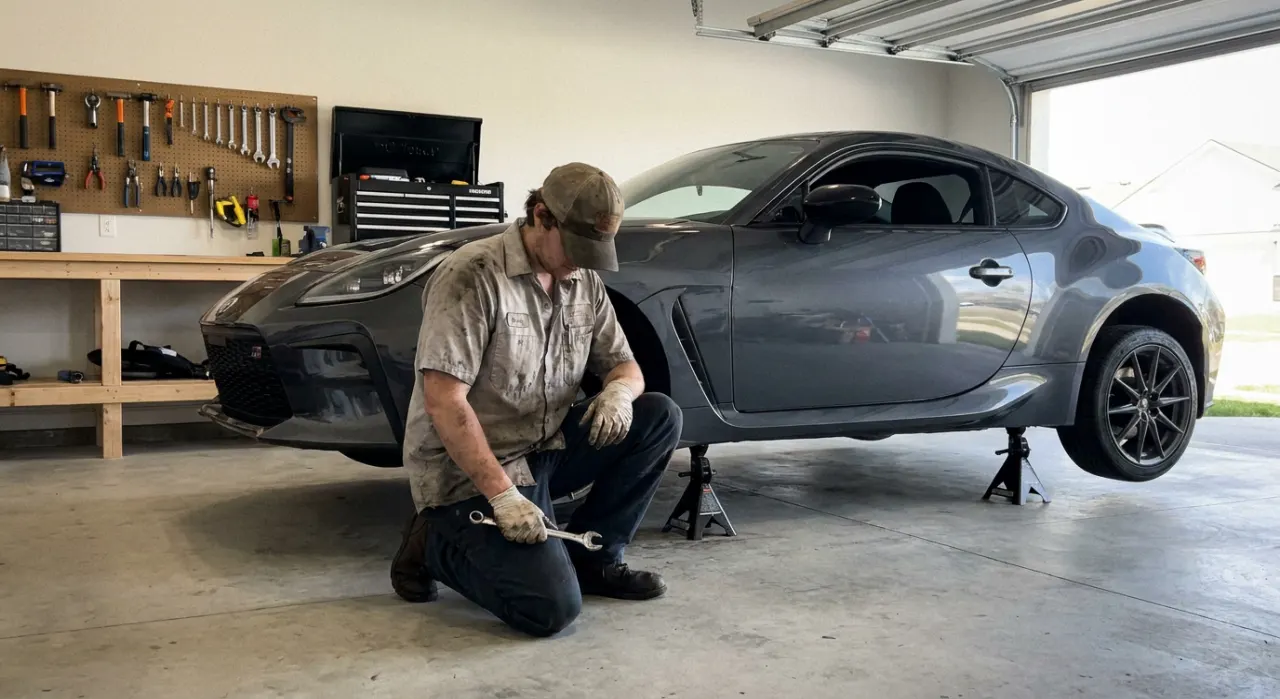
This is the most dangerous piece of reasoning in DIY automotive culture, and it deserves a direct rebuttal.
“I just need to pull the drain plug.”
“I’m only checking the exhaust hanger.”
“It’ll take thirty seconds.”
None of those statements change the physics. A hydraulic seal does not check your schedule before failing. The car does not wait until you are clear. Thirty seconds is plenty of time to be crushed.
Beyond seal failure, consider these additional failure modes that occur while you are “just being quick”:
- The jack saddle slips off a curved sill or subframe rail
- The jack sits on an uneven garage floor surface and rolls
- A wheel is still on the ground and you accelerate all of the above by brushing it
Every one of these takes less time to happen than it takes to read this sentence. Being quick under an unsupported jack is not a calculated risk. It is a gamble where the downside is death and the upside is saving ninety seconds of setup time.
Working Load Limit: What It Means and Why It Matters
Every jack stand has a Working Load Limit (WLL) stamped on it. This is the maximum load the stand is rated to support safely in normal use. It is not a peak crush rating. It is the figure below which the manufacturer can guarantee safe, stable performance.
Here is how to apply it correctly:
Know your vehicle’s curb weight. This is listed in the owner’s manual and on the driver’s door jamb sticker. A typical JDM sports car sits between 2,420 lb and 3,080 lb. A pickup truck or SUV can exceed 5,500 lb.
Divide that weight between the stands actually supporting the car. When you lift the front of the car and place two stands under the front jack points, each stand is carrying roughly half the front axle weight — not half the total vehicle weight, because the rear wheels are still on the ground. However, when you have all four corners in the air (recommended for a full service), each stand carries approximately one quarter of the total curb weight.
Always choose stands rated above the load they will carry. A 2-ton per-stand capacity is a reasonable minimum for most passenger cars. For trucks, SUVs, and modified vehicles with heavy components, step up to 3-ton rated stands. Do not mix stand heights or models under the same vehicle. Our guide to the best jack stands covers specific ratings for common vehicle categories.
The Law of Two: Why One Stand Is Never Enough
“Is one jack stand enough?” is a question that comes up frequently, and the answer is no — not because one stand cannot technically hold a corner of the car, but because of what happens if it fails, shifts, or is placed incorrectly.
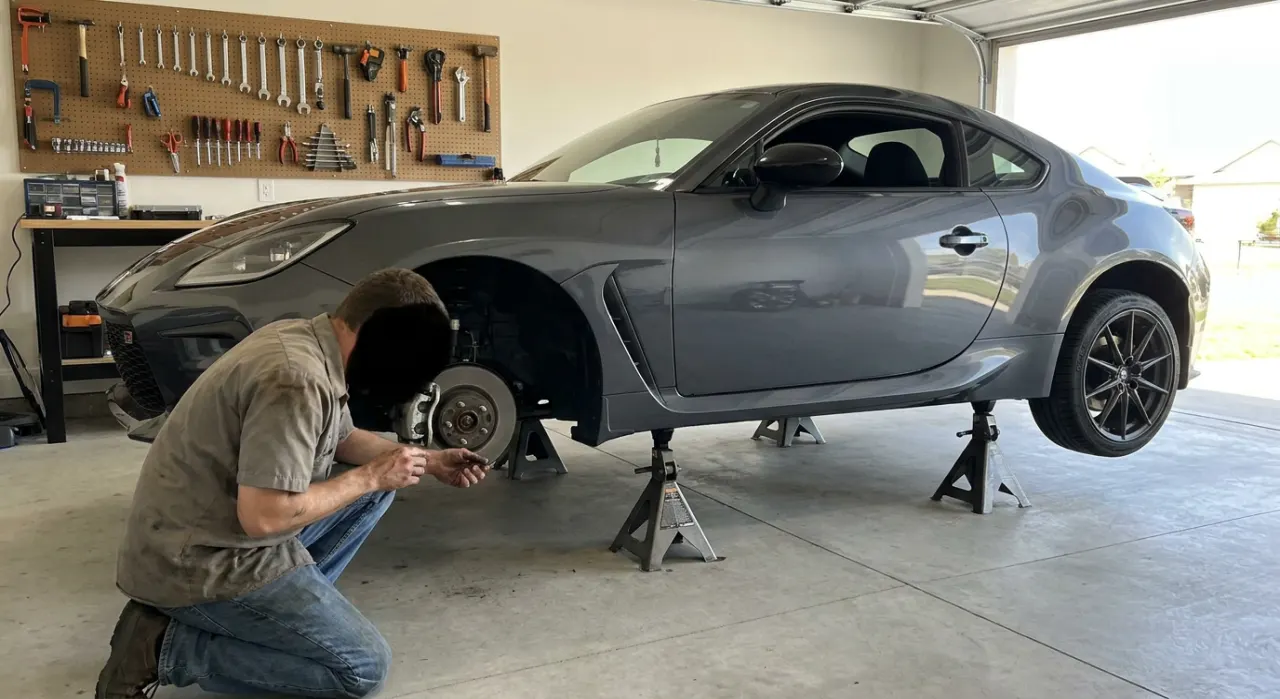
A vehicle supported on a single stand at one end and the floor jack at the other is in a mechanically unstable triangle. If the stand tips, if the jack shifts, or if you accidentally apply lateral force while working underneath, the car pivots around the remaining support point and falls on you.
The Law of Two is simple: every lift requires a minimum of two jack stands, placed at the rated jack points on the same axle or at all four corners for whole-car lifts. This provides a stable, level platform that does not depend on any single point of contact remaining perfect.
The jack itself is removed from the equation entirely once the stands are in place. Some experienced mechanics leave the jack in position as a third contact point for added security. That is fine. What is not fine is using the jack as a substitute for even one of the stands.
Where to Place Jack Stands (The Short Version)
Jack stands must go on rated jack points — the reinforced sections of the subframe or chassis designed to bear vertical load. These are different from the pinch welds used for emergency roadside jacking with a scissors jack.
Placing a stand on sheet metal, on suspension components, or on any unrated point risks crushing the bodywork and introducing a dangerous instability. The vehicle’s owner manual and service manual both identify the correct jack points. Use them every time.
Always work on a flat, solid, level surface. Concrete is preferred. Never use jack stands on gravel, grass, asphalt in summer heat, or any surface that can shift or compress under load. Pair every lift with wheel chocks on the wheels remaining on the ground — our wheel chocks and safety guide covers the right technique.
The Full Safe Sequence
- Chock the wheels that will remain on the ground before you release the parking brake
- Lift using the floor jack at the vehicle’s rated central or axle jack point
- Place both jack stands at the rated chassis jack points for that end of the vehicle
- Lower the jack slowly until the vehicle’s weight transfers fully onto the stands
- Apply lateral pressure to the vehicle with both hands to confirm stability before going underneath
- Leave the floor jack in contact with the vehicle or reposition it as a backup point
That sequence adds approximately ninety seconds to your job. It is the only acceptable way to work under a vehicle at home. The full walkthrough is in our Jacking Up a Car hub.
The Definitive Answer
Do you really need jack stands? Yes. No exceptions, no shortcuts, no “just this once.” A hydraulic jack is a lifting device. A jack stand is a holding device. They are not interchangeable. They are not optional together. They are both required, rated for the load, placed at the correct points, on every single occasion you put your body beneath a vehicle.
Buy the stands before you buy anything else in your garage tool kit. A decent pair of 2-ton rated stands costs less than a single tire change. They cost nothing compared to what happens without them.
Recommended Jack Stands

Best for most passenger cars and a first set for any garage
- 3-ton per-stand rating — comfortable margin for most cars
- Ratcheting height adjustment with a locking pin
- Wide cast base for stability on concrete
- The most-owned budget stand, by a wide margin
Why buy it: the safe default — a rating well above what most cars need, from the pair that more home garages own than any other.

Best for a dependable pair at the lowest sensible price
- 3-ton rating per stand
- Self-locking ratchet with a safety pin
- Compact and easy to store
- Strong owner rating across thousands of reviews
Why buy it: the budget buy — the same 3-ton safety margin as pricier stands, so cost is never a reason to skip them.
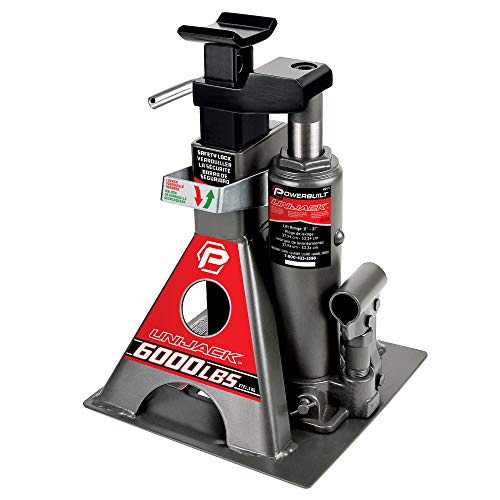
Best for lifting and supporting in one unit for tight spaces
- Combines a bottle jack and a locking stand
- Cradles the pinch weld and locks mechanically
- Great for a single-corner job
- Still use a second support — never rely on one
Why buy it: the clever pick — lifts and then locks in place, though the Law of Two still applies: pair it, never trust a single point.

Best for the cheapest properly-rated stands to buy today
- 3-ton per-stand rating
- Ratcheting bar with a locking pawl
- Simple, sturdy, widely available
- Very high owner rating for the price
Why buy it: the no-excuses pick — cheaper than a single tire change, and rated for the load, so there is no reason to work without them.
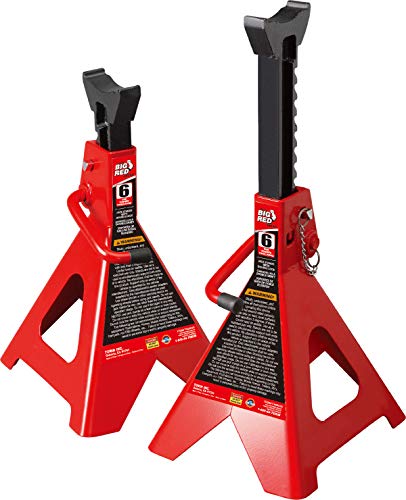
Best for trucks, SUVs and heavier modified vehicles
- 6-ton per-stand rating for heavy vehicles
- Taller lift range for high-clearance trucks
- Heavy cast base for stability under load
- The step up when a car exceeds 5,500 lb
Why buy it: the truck pick — the extra capacity to keep a full-size pickup or SUV comfortably within its rated load.
Prices are pulled from Amazon and were accurate as of Aug 22, 2026, 6:54 PM EDT. Product prices and availability are subject to change — the live price is shown on Amazon.