
Affiliate Disclosure
Some links on this page are affiliate links. As an Amazon Associate, we earn from qualifying purchases — at no extra cost to you. We do not buy, test, or physically handle the products we cover; our rankings come from aggregated owner reviews, ratings and expert consensus. Commissions never change our verdicts. How we rank & full disclosure.
Short version: a portable jump starter is only useful if it is charged, and keeping it charged is simple — top it up every two to three months even when unused, recharge it immediately after every jump, and never let it sit fully dead. Modern lithium packs charge from USB or a wall adapter in a few hours and manage their own charging, so the real skill is the schedule, not the technique. Here is exactly how to keep yours ready for the roadside morning you cannot predict.
A jump starter is like the spare fuel can a rally team keeps strapped in the back — it does nothing on the good days and saves the whole run on the bad one. But an empty can saves no one, and the same is true here. The single job that matters is keeping the pack charged.
How modern jump starters charge
Almost every current portable jump starter is a lithium pack that recharges through a USB-C or micro-USB input from a wall adapter, a computer, or a car's USB port. Gone are the days of the bulky lead-acid boosters that needed their own dedicated charger. The pack has onboard electronics that regulate the charge and stop when full, so your part is straightforward: plug it into an appropriate source and let it fill. If you are still comparing chemistries, the lithium vs lead-acid guide explains why lithium won.
Step 1: Charge it before you ever need it
The most common jump-starter failure is not a broken unit — it is a flat one. Right out of the box, top it to full before you stash it in the trunk. A pack that ships half-charged and then sits for months can be too weak to crank an engine when the moment comes. Treat the first charge as part of setup, not an afterthought. From there, the maintenance schedule keeps it ready.
Step 2: Read the charge indicator
Most packs show state of charge with a row of LEDs or a small display. Plug it in, and the indicator will typically pulse or count up while charging and go solid or read 100 percent when done. Do not eyeball it and pull the plug early — leave it until the indicator confirms a full charge, because a partial charge means a partial reserve, and a marginal battery in the cold may need every bit of the pack's output. Check your specific model's manual, as the light patterns vary by brand.
Step 3: Keep it on a top-up schedule
This is the habit that separates a jump starter that works from one that lets you down. Lithium packs slowly self-discharge on the shelf, so set a reminder to top it up every two to three months whether or not you have used it. It only takes a few hours, and it guarantees the pack is ready on the freezing morning your car battery finally gives up. Owners consistently name this the single most important jump-starter habit — and the one most people forget until the day it is too late.
Step 4: Recharge immediately after a jump
Starting an engine draws a big slug of energy from the pack, so after you have used it to jump a car, recharge it as soon as you get home. Do not toss it back in the trunk half-empty "for now" — that is how it ends up dead the next time you reach for it. A used-and-not-recharged jump starter is the second-most-common way these fail their owner. Make the recharge part of the same job as the jump itself. If you have to jump a car, follow the safe procedure in how to jump-start a car safely first.
Avoid the deep-discharge trap
The one thing that genuinely harms a lithium jump pack is letting it sit fully drained for a long time. A deeply discharged, long-ignored cell can lose capacity or refuse to charge at all. The top-up schedule is your protection against exactly this. If yours has gone flat, put it on the charger immediately — many recover fine — but do not make a habit of running it to empty and walking away. Prevention is far easier than trying to revive a neglected pack.
Storage and temperature
Store the pack somewhere with a moderate temperature. Extreme heat is hard on lithium cells over time, and deep cold temporarily saps their output — ironic, since cold mornings are when you most need cranking power, so bring the pack inside overnight in harsh winters and keep it near full. A glovebox or trunk is fine in mild climates; just keep it out of direct summer sun. Pair it with a battery maintainer on the car itself and you attack dead-battery problems from both ends.
Where to go next
Keep it charged and a portable jump starter is one of the most reassuring things in your trunk. If you are still choosing one, start with the best portable jump starter roundup, learn the signs your battery is on the way out with signs of a dying car battery, and head back to the jump starters and battery care hub for the full picture.
Recommended Products
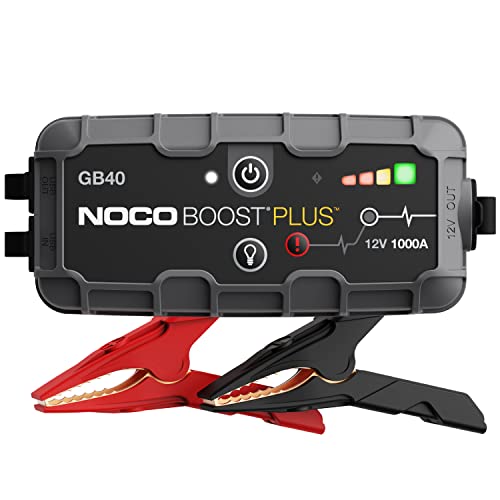
Best for most cars, SUVs and small trucks
- 1000A — cranks up to 6.0L gas / 3.0L diesel
- Spark-proof, reverse-polarity protected clamps
- Doubles as a USB power bank + 100-lumen light
- Up to 20 jump starts per charge
Why buy it: the pack owners rate highest overall — and one that holds a charge well between uses, so it is ready when you need it.

Best for big V8s, trucks, RVs and diesels
- 2000A — cranks up to 8.0L gas / 6.0L diesel
- IP65 rugged, water- and dust-sealed casing
- 400-lumen flashlight, up to 40 jumps per charge
- Same UltraSafe clamp protection as the GB40
Why buy it: the step-up pack for bigger engines — twice the cranking power of the GB40, with a bigger reserve to recharge between jobs.

Best for the most cranking power per dollar
- 6000A peak — all gas, up to 12L diesel
- Smart clamps with 8-layer safety protection
- Big built-in LED light + USB Quick Charge power bank
- Huge capacity for the price
Why buy it: a hugely reviewed budget pack that undercuts the premium brands while owners rate its raw power and value highly.

Best for fast recharge and high capacity
- 4000A peak — all gas, up to 10L diesel
- USB-C fast charge in and out
- SuperSafe clamps with error-tone warnings
- Owners praise the recharge speed
Why buy it: a well-rated high-output pack that recharges quickly over USB-C — ideal if you hate waiting for a pack to top back up.
Prices are pulled from Amazon and were accurate as of Aug 22, 2026, 7:14 PM EDT. Product prices and availability are subject to change — the live price is shown on Amazon.