
Affiliate Disclosure
Some links on this page are affiliate links. As an Amazon Associate, we earn from qualifying purchases — at no extra cost to you. We do not buy, test, or physically handle the products we cover; our rankings come from aggregated owner reviews, ratings and expert consensus. Commissions never change our verdicts. How we rank & full disclosure.
The short version: same trusted NOCO DNA, two different jobs. The GB40 is the compact 1000-amp unit that starts most cars, costs about half as much, and hides in a glovebox — the pick the reviews back for ordinary drivers. The GB70 is the 2000-amp heavy-hitter with roughly double the internal battery, and owners reach for it when the GB40 runs out of grunt: big diesels, V8 trucks, and households juggling several vehicles. There's no "better" here, only the right amount of power for your engine.
This is a straight head-to-head. For the wider field, our best portable jump starter roundup ranks more options, the NOCO GB40 review goes deep on the smaller unit, and the jump starters hub covers chargers and maintainers too.
GB40 vs GB70 at a Glance
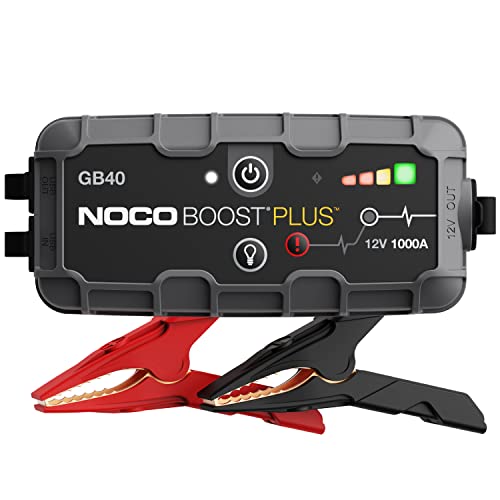
NOCO Boost Plus GB40 (1000A)
Best for daily drivers, sedans and most V6 gas engines
Prices are pulled from Amazon and were accurate as of Aug 22, 2026, 7:14 PM EDT. Product prices and availability are subject to change — the live price is shown on Amazon.
How We Compare Them
We don't drain batteries in a lab and clock restarts — we read the crowd. For each unit we pull together the aggregated Amazon rating, the volume of reviews behind it, and the themes owners raise again and again: whether it actually cranked their engine, how many jumps it managed per charge, how it held up in the cold, and whether the size suited how they carry it. Where thousands of reviewers say the same thing — "started my truck on the first try," "not enough for my diesel" — that consensus is the signal. Specs set the ceiling; owner reports tell you where each NOCO really lands.
Cranking Power: The GB70 Pulls Ahead
This is the clearest split. The GB70's 2000 peak amps is exactly double the GB40's 1000, and the rated reach jumps with it — from 6L gas and 3L diesel on the GB40 to 8L gas and 6.5L diesel on the GB70. Owners feel that gap in the real world: GB40 reviews are full of dead sedans and crossovers firing instantly, but the occasional big-diesel or flat-V8 owner reports it straining. Cross to the GB70 and those same heavy engines get cleared without drama. If your car is ordinary, the GB40's power is plenty; if it's a work truck, the GB70 is the one with headroom to spare.
Battery Capacity: More Jumps Before the Recharge
Power gets you the start; capacity gets you the next one. The GB70 carries roughly twice the internal battery of the GB40, and reviewers who keep a unit for multiple vehicles consistently prefer it for exactly that reason — more starts between recharges, and more reserve on a brutal cold morning when a single jump pulls hard. The GB40 still delivers a healthy string of restarts per charge on an average engine; it's just the one you'll top up more often if you're leaning on it hard. For a single commuter car, that rarely matters. For a fleet in the driveway, it does.
Portability: Where the GB40 Shines
Everything the GB70 gains in muscle, it pays back in bulk. The GB40 is genuinely pocketable — owners love that it vanishes into a glovebox or door pocket and rides along unnoticed. The GB70 is noticeably heavier and chunkier; still portable, but it announces itself in a bag. This is the quiet reason so many drivers land on the GB40: it's the one they'll actually keep in the car, and a jump starter left at home starts nothing. Match the size to how you carry it, not just to the spec sheet.
The Verdict: Match the Amps to the Engine
There's no loser here — both wear NOCO's strong safety record and easygoing clamps. Pick by what you drive.
- Pick the NOCO GB40 if your daily driver is an ordinary car, SUV or small truck, you want something pocket-sized you'll actually keep on board, and you'd rather not pay for power you won't use. It's the high-consensus choice for most drivers, and our pick for the average garage.
- Pick the NOCO GB70 if you run a big diesel, a V8 truck, an RV, or several vehicles at once — anything where the GB40 might grunt and stall. The extra amps and near-double battery are exactly the headroom heavy-engine owners say they're glad to have.
The instinct to over-buy "just in case" is strong, but the reviews are clear: the GB40 covers most drivers completely, and the GB70 earns its premium only when the engine truly demands it.
Both NOCO Units, Side by Side
Best for daily drivers, sedans and most V6 gas engines
- 1000 peak amps — gas up to 6L, diesel up to 3L
- Pocket-sized; lives in a glovebox easily
- Owners report the price-to-capability sweet spot
- USB charging + 100-lumen work light
Why buy it: the unit most owners say is "enough" — it starts the overwhelming majority of cars, costs half as much as the GB70, and disappears into a door pocket.

Best for trucks, big diesels, V8s and multi-vehicle households
- 2000 peak amps — gas up to 8L, diesel up to 6.5L
- Roughly double the internal battery — more jumps per charge
- Owners praise cranking dead trucks and diesels
- Noticeably heavier and bulkier than the GB40
Why buy it: the one reviewers reach for when the GB40 grunts and stalls — big diesels, work trucks, and packs of vehicles it clears without drama.
Prices are pulled from Amazon and were accurate as of Aug 22, 2026, 7:14 PM EDT. Product prices and availability are subject to change — the live price is shown on Amazon.
Still weighing the technology itself? Our lithium vs lead-acid breakdown and the jump starter brands compared guide both help, and the full ranked field lives in our best portable jump starter roundup.