
Affiliate Disclosure
Some links on this page are affiliate links. As an Amazon Associate, we earn from qualifying purchases — at no extra cost to you. We do not buy, test, or physically handle the products we cover; our rankings come from aggregated owner reviews, ratings and expert consensus. Commissions never change our verdicts. How we rank & full disclosure.
The short version: transmission fluid is the ultimate "match the spec" purchase. Your transmission was engineered around a specific fluid — GM Dexron-VI, Ford Mercon LV, Chrysler ATF+4, Toyota WS, Honda DW-1, or a model-specific CVT fluid — and the single most important thing you can do is confirm that spec in your owner’s manual and buy a fluid licensed to it. Our overall pick, Valvoline MaxLife Multi-Vehicle ATF, covers a wide range of conventional automatics, but it is only correct if your spec is on its list. For late-model GM and Ford automatics, buy the genuine Dexron-VI or Mercon LV fluid. And never put regular ATF in a CVT.
Top Picks at a Glance
Our #1 Pick: Valvoline MaxLife Multi-Vehicle ATF
Valvoline MaxLife tops the list because it does the most useful thing a multi-vehicle ATF can do: it meets a long list of conventional Dexron, Mercon and ATF+4-style specifications in one full-synthetic bottle, and it is also rated for many belt- and chain-driven CVTs. That makes it the convenient, credible choice for the majority of "regular" automatics on the road. But the ranking here comes with the biggest caveat on this site: a multi-vehicle fluid is only right if your transmission’s exact specification appears on the approval list. If your manual calls for Dexron-VI, Mercon LV, a specific import fluid or a CVT fluid, buy the fluid licensed to that spec instead — convenience never beats correctness with transmissions.
Best Transmission Fluids 2026: The Ranked Field

Best for covering the widest range of "regular" ATF specs in one bottle
- Meets a long list of Dexron/Mercon/ATF+4-style specs
- Full synthetic, strong thermal stability
- Also rated for many belt/chain CVTs
- Best-selling multi-vehicle ATF
Why buy it: the multi-vehicle ATF owners trust to cover the majority of conventional automatics — but only after you confirm your transmission’s exact spec is on its approval list.

Best for late-model GM (Dexron-VI) and Ford (Mercon LV) automatics
- Licensed Dexron-VI and Mercon LV
- Full synthetic, smooth-shift additive
- Correct low-viscosity for modern 6/8-speeds
- GM/Ford factory-fill equivalent
Why buy it: the right call when your manual specifies Dexron-VI or Mercon LV — a licensed fluid that matches the exact modern spec instead of a generic "works in everything" claim.

Best for a premium multi-vehicle synthetic for Dexron/Mercon applications
- Full synthetic, excellent shear stability
- Covers many Dexron III/Mercon-style specs
- Strong high-temperature protection
- Trusted premium formula
Why buy it: owners who want a premium synthetic for older Dexron/Mercon automatics rate its shift feel and heat resistance highly — check your spec is listed before you pour.
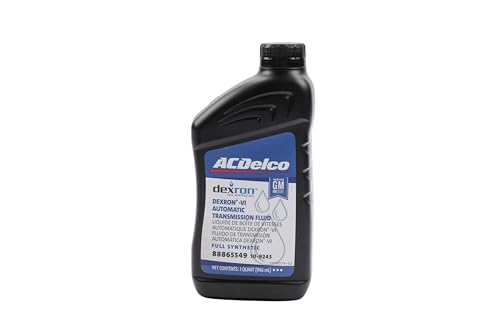
Best for GM vehicles that must have genuine Dexron-VI
- GM Original Equipment Dexron-VI
- Full synthetic factory fluid
- The licensed GM spec, not a substitute
- Backward-compatible with older Dexron
Why buy it: the genuine GM Dexron-VI fluid — for a late-model GM automatic, matching the OEM spec exactly is the safest money you can spend on a service.

Best for a full Dexron-VI drain-and-fill at the best price per quart
- GM Original Equipment Dexron-VI, gallon size
- Cheapest way to buy genuine OEM fluid
- Ideal for multi-quart fills
- Same licensed spec as the quart
Why buy it: the smart buy when a GM transmission needs several quarts — genuine Dexron-VI by the gallon costs less per quart and keeps the whole job on-spec.

Best for a low-cost licensed multi-vehicle synthetic
- Dexron-VI licensed, full synthetic
- Covers a broad multi-vehicle spec list
- Value-priced by the gallon
- Good thermal and oxidation stability
Why buy it: a budget-friendly, licensed multi-vehicle synthetic — a sensible choice when your transmission’s spec is on its list and you want to save without going off-spec.
Match the OEM Spec — This Is the Whole Job
Unlike engine oil, where a single grade covers most cars, ATF specifications are tightly tied to individual transmission designs. The families you will see include GM Dexron (older Dexron III vs modern low-viscosity Dexron-VI — not interchangeable in the wrong direction), Ford Mercon (older Mercon V vs modern Mercon LV), Chrysler ATF+4, and import specs like Toyota WS, Honda DW-1/Z1, Nissan Matic-S and Hyundai/Kia SP-IV. Each was chosen for a specific friction profile and viscosity. Put the wrong one in and you can get harsh or slipping shifts, shudder, or long-term wear. The rule is simple: find your spec in the manual, then buy a fluid that is licensed to that spec — a genuine OEM fluid or an aftermarket fluid that explicitly lists it.
CVT and Dual-Clutch: Use the Exact Fluid
If your car has a continuously variable transmission (CVT), treat its fluid as non-negotiable. A CVT works by a steel belt or chain gripping variable pulleys, and it depends on a fluid with a precise friction characteristic. Ordinary ATF changes that friction and can cause the belt to slip, shudder and fail — an expensive lesson. Use the CVT fluid your manufacturer specifies (or a CVT fluid explicitly approved for your model). The same discipline applies to dual-clutch (DCT) transmissions, which use their own DCT fluids. When it comes to CVTs and DCTs, "multi-vehicle" and "universal" are not words you want to gamble on.
When to Change It — and Drain-and-Fill vs Flush
Check your manual for the interval; many transmissions want fresh fluid somewhere in the 30,000–60,000-mile range under severe service, and towing or heavy traffic shortens that. Fluid that is dark and smells burnt is overdue. A drain-and-fill — dropping the pan or pulling the drain plug and replacing what comes out — is a manageable DIY that refreshes a good portion of the fluid; repeating it a couple of times over a few thousand miles dilutes the old fluid nicely. A full machine flush is best left to a shop, and on a neglected high-mileage transmission some mechanics advise a series of drain-and-fills rather than an aggressive flush. Whatever the method, refill with the correct spec and check the level exactly as the manufacturer describes.
Related Maintenance
Fresh fluid is one piece of drivetrain health. If you also service differentials or a manual gearbox, see our best gear oil guide (and mind GL-4 vs GL-5). For the wider service picture, start at the oil change hub, and if a transmission-related warning light is on, read the code first with a scanner from our OBD2 hub. Doing your own fluid work? The garage tools hub covers the drain pans, jacks and stands you will want.
How We Rank
Transmission fluid is a high-stakes, spec-driven category, so we rank on aggregated owner ratings, review volume and — above everything — specification compliance, not brand cachet. We weigh four things. Spec accuracy — whether the fluid is licensed to real, named specifications (Dexron-VI, Mercon LV, ATF+4, CVT fluids) rather than making vague "works in all" claims. Owner-reported shift quality — smooth engagement and no shudder across large review bases. Fit for application — genuine OEM fluids for the transmissions that demand them, credible multi-vehicle fluids where the spec is listed. And value for the correct spec, where gallon sizes and store brands earn their place. We do not bench-test transmissions; we verify specs and read owner consensus. Prices were current at the time of writing — always confirm the required fluid against your own vehicle’s manual.
Quick Comparison
Valvoline MaxLife Multi-Vehicle ATF Full Synthetic (1 gal)
Best for covering the widest range of "regular" ATF specs in one bottle
Best for GM & Ford
Castrol Transmax Full Synthetic Dexron-VI / Mercon LV
Check Price on Amazon
Best Premium
Mobil 1 Synthetic ATF (1 qt)
Check Price on Amazon
Best OEM Dexron-VI
ACDelco Dexron VI Full Synthetic ATF (10-9243, 1 qt)
Check Price on Amazon
Best Value (Bulk)
ACDelco Dexron VI ATF (10-9395, 1 gal)
Check Price on Amazon
Best Budget Multi-Vehicle
ULTRA1PLUS Dexron-VI Full Synthetic Multi-Vehicle ATF
Check Price on Amazon
The Verdict
Find your transmission’s fluid spec in the manual before you buy anything. For a conventional automatic whose spec is listed, Valvoline MaxLife Multi-Vehicle ATF is our convenient overall pick; for a late-model GM, the genuine ACDelco Dexron-VI is the safe OEM answer, with the gallon size the value play for multi-quart fills. And if you drive a CVT, buy only the CVT fluid your manufacturer approves. Check Price on Amazon →