
Affiliate Disclosure
Some links on this page are affiliate links. As an Amazon Associate, we earn from qualifying purchases — at no extra cost to you. We do not buy, test, or physically handle the products we cover; our rankings come from aggregated owner reviews, ratings and expert consensus. Commissions never change our verdicts. How we rank & full disclosure.
You're standing in the auto-parts aisle staring at a shelf that looks like a chemistry exam, and you just want to know: what oil does my car take? 0W-20, 5W-30, 5W-40, 10W-40. API SP. ACEA C3. dexos1. VW 504.00. It's a lot. Run the wrong grade and you risk cold-start wear, sludge, blocked emissions hardware or a voided warranty. This page is part of our DIY oil change hub and decodes every number on the bottle. Ground rule: every spec here is a teaching example — always verify against your own owner's manual or the filler cap. Your manual wins.
What Viscosity Actually Means
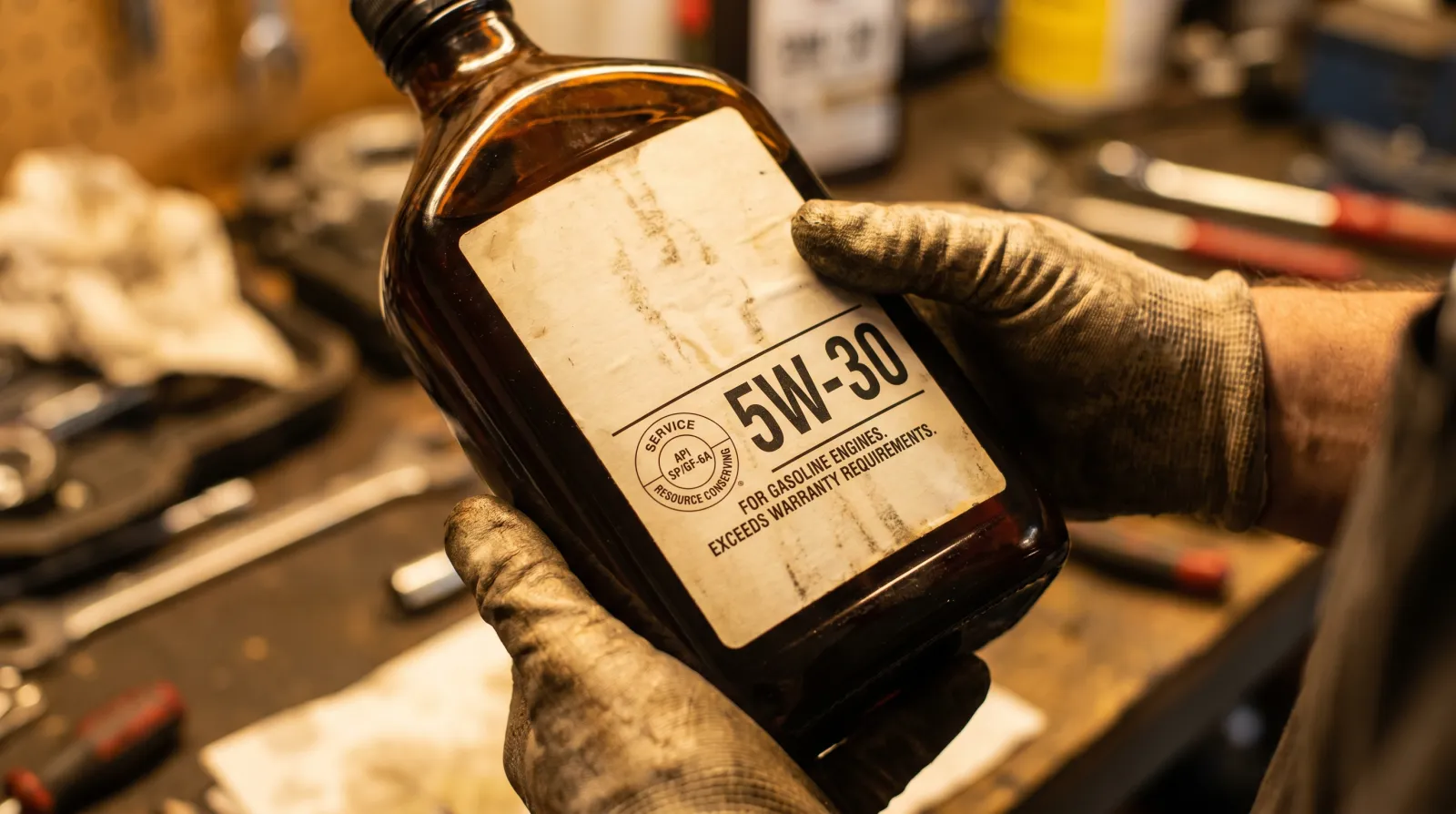
Viscosity is an oil's resistance to flow — how thick or thin it is at a given temperature. Too thick and it won't circulate fast enough on a cold start; too thin and it won't hold a protective film when the engine is hot. Modern oils are multi-grade, behaving differently cold versus hot — that's the two numbers either side of the W.
| Part of "5W-30" | What it means | In plain English |
|---|---|---|
| 5 | Cold (winter) viscosity | How easily it flows when the engine is stone cold |
| W | Winter | Confirms the first number is the cold-start rating |
| 30 | Hot viscosity (at 100°C) | How thick it stays once fully warmed up |
The W stands for Winter, not weight. A lower W number means the oil stays fluid at lower temperatures and reaches components faster on startup — and the first few seconds of a cold start account for a disproportionate share of lifetime engine wear.
The Four Common Grades
0W-20 — ultra-low viscosity, full synthetic; modern fuel-efficient gas engines (recent Toyota, Honda, Subaru, Mazda). Don't substitute a thicker grade thinking it protects better — the tolerances are designed around that thin film. 5W-30 — the workhorse across Japanese, Korean and European cars from the late '90s to mid-2010s. 5W-40 — common on European gas and diesel (BMW, Mercedes, VW/Audi); the thicker hot film suits tighter tolerances and turbo loads. 10W-40 — an older multi-grade, still suitable for some older or high-mileage engines; thicker cold-start behavior means slower circulation in very cold weather. Which oil type to pair with your grade is covered in synthetic vs conventional.
Quality Standards: API, ACEA, dexos & OEM Approvals
Viscosity tells you the grade; quality standards tell you what the oil does chemically. API uses a two-letter code — S for gas, C for diesel — with later letters being newer and higher: API SP (2020) is current, adding LSPI protection for turbo direct-injection engines, and is backward-compatible. ACEA is the European set: A3/B4 is full-SAPS for high-performance gas/diesel; C3 is mid-SAPS, designed for cars with a diesel particulate filter (DPF) — using full-SAPS A3/B4 where C3 is specified can clog the DPF, an expensive outcome. dexos1 Gen 3 is GM's licensed spec (mandatory on most GM gas engines from ~2011); look for the official license mark, not just a "meets" claim. Beyond these, manufacturers publish their own approvals — VW 504.00/507.00, BMW Longlife-04, MB 229.5x — and if your manual specifies an OEM code, that code is the minimum requirement, not a suggestion.
How to Find Your Car's Spec
Three places, in order of authority: the owner's manual (the definitive source — grade, API/ACEA tier, OEM approvals, and both dry-fill and oil-change capacities); the oil filler cap (often stamps the grade); and an under-hood sticker on some cars. The cap and sticker are quick checks — the manual is the full picture.
How Many Quarts Does My Car Need?
Capacity varies widely — a small four-cylinder might take 3.5 quarts, a turbo six 6.5 quarts, a large V8 over 8 quarts. Use the oil-change capacity in your manual (not the dry-fill number), buy slightly more than stated, fill to about 80%, run the engine 30 seconds to prime the filter, wait, then top up to the dipstick's upper mark. Never overfill — oil above MAX gets aerated by the crankshaft and can damage seals.
What Happens If You Use the Wrong Oil
Too thick: slower cold circulation, more startup wear, and erratic behavior from variable-valve-timing systems that rely on precise oil pressure. Too thin: the hot film may not fully separate metal under load — wear accumulates, and in a hard-loaded turbo it can fail fast. Wrong quality standard: often invisible until it causes a problem — an A3/B4 oil in a DPF car requiring C3 can progressively block the filter. When in doubt, match the manual exactly. For oil type, see synthetic vs conventional; for the right filter, our oil filter guide; and the full process is in the DIY oil change hub.
Recommended Products

Best for the widest OEM approval list and long drain intervals
- API SP / ILSAC GF-6 rated
- Meets GM dexos1 Gen 3 and many OEM approvals
- Rated for extended (up to 20k-mile) intervals
- Strong LSPI and timing-chain-wear protection
Why buy it: the synthetic with a huge approval list — the right pick for most modern engines, provided the grade on the bottle matches the one in your manual.

Best for a fully-approved synthetic for the lowest price per quart
- API SN Plus / dexos1 licensed
- Genuine full synthetic base
- Lowest cost-per-quart of the group
- Same spec compliance as name brands
Why buy it: proof that spec beats badge: a licensed, fully-approved synthetic that meets the same standards as the premium jugs for less — check the dexos/API code against your manual.

Best for turbocharged and hard-driven engines needing API SP
- Fluid Titanium film-strength additives
- API SP / dexos1 Gen 3
- Holds up under high heat and load
- LSPI protection for turbo DI engines
Why buy it: the film-strength pick for turbo and performance engines that call for API SP — only if 5W-30 is the grade your engine actually specifies.
Best for pairing a high-efficiency filter with synthetic oil
- Dual-layer synthetic media, 99%+ efficient
- Wire-backed media, silicone anti-drainback valve
- Rated up to 20,000 miles
- SureGrip textured shell
Why buy it: the synthetic-media filter to match a long-interval synthetic oil — always confirm the exact part number for your specific vehicle before you buy.
Prices are pulled from Amazon and were accurate as of Aug 22, 2026, 6:54 PM EDT. Product prices and availability are subject to change — the live price is shown on Amazon.