

Affiliate Disclosure
Some links on this page are affiliate links. As an Amazon Associate, we earn from qualifying purchases — at no extra cost to you. We do not buy, test, or physically handle the products we cover; our rankings come from aggregated owner reviews, ratings and expert consensus. Commissions never change our verdicts. How we rank & full disclosure.
The short version: a multimeter is the tool that turns "the scanner says a sensor is bad" into proof — but for modern cars, three specs matter: high input impedance (10 MegOhm) so you don’t damage sensitive ECU circuits, auto-ranging for ease of use, and the right CAT safety rating for whatever you probe. Our overall pick is the Fluke 117 for lifetime accuracy and safety; for a car-specific tool, the INNOVA 3340 is purpose-built with ECU-safe impedance and automotive functions. Pair it with a scanner from our OBD2 hub and you can actually confirm what a code means.
Top Picks at a Glance
Our #1 Pick: Fluke 117
The Fluke 117 earns the top spot as the meter you buy once. It combines true-RMS accuracy, a genuine CAT III 600V safety rating, auto-ranging, and high input impedance that is safe on electronic circuits — in the legendarily durable Fluke package that professionals trust for a lifetime. It is not the cheapest, and for pure 12V car work a purpose-built automotive meter is enough, but if you want one meter that handles automotive and household electrical safely and accurately for decades, this is it. If your budget is tighter, the Klein MM600 delivers a higher CAT IV rating for far less, and the INNOVA 3340 is the car-specific specialist.
Best Automotive Multimeters 2026: The Ranked Field

Best for professional accuracy and safety that lasts a lifetime
- True-RMS for accurate AC readings
- CAT III 600V safety rating
- Auto-ranging, high input impedance
- Legendary Fluke reliability
Why buy it: the meter pros trust for a lifetime — true-RMS accuracy, a real CAT III safety rating, and the build quality that makes it the last multimeter you buy.

Best for a high safety rating at a fair price
- CAT IV 600V / CAT III 1000V rated
- Auto-ranging, 1000V capability
- Rugged build, measures temp & more
- Trusted electrician brand
Why buy it: the meter owners choose for a top-tier CAT IV safety rating without Fluke money — rugged, auto-ranging, and safe on higher-energy circuits.
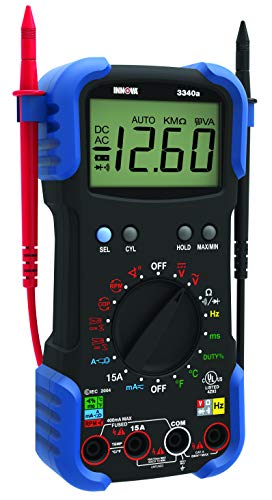
Best for car-specific tests with ECU-safe impedance
- 10 MegOhm impedance protects the ECU
- Auto-ranging, RPM & dwell functions
- Temperature and duty-cycle tests
- Built for automotive diagnostics
Why buy it: the multimeter built for cars — the high 10 MegOhm impedance won’t damage sensitive ECU circuits, and it reads RPM and dwell most meters can’t.

Best for true-RMS features at a mid-range price
- True-RMS, 6000 counts
- Measures temp, capacitance, frequency
- Auto-ranging, safety-rated
- Great features per dollar
Why buy it: the feature-packed mid-range meter owners love — true-RMS accuracy and a full function set for far less than a pro-brand meter.
Best for a cheap, reliable meter for basic checks
- Measures DC/AC voltage, current, resistance
- Continuity & diode test
- Simple and dependable
- Cheap enough for the glovebox
Why buy it: the value meter that does the everyday jobs — voltage, continuity, resistance — reliably, for the price of lunch. A great first multimeter.

Best for a few more functions for tinkering
- Adds capacitance measurement
- AC/DC voltage & current
- Continuity and diode test
- Beginner-friendly
Why buy it: the hobbyist’s budget pick — adds capacitance testing for electronics tinkering while staying cheap and easy to use.
Input Impedance: Protect the ECU
This is the automotive-specific spec that matters most. Modern vehicles are full of sensitive, low-current electronic circuits and computer (ECU) inputs, and a low-impedance meter can draw enough current to skew a reading or even damage the circuit. A high-impedance meter — 10 MegOhm is the automotive standard — draws almost no current, so it reads true voltage without loading the circuit or risking the ECU. That is exactly why automotive meters like the INNOVA 3340 advertise 10 MegOhm impedance. If you probe sensor signals, reference voltages or ECU circuits, high impedance is essential — an old low-impedance meter on those circuits is a genuine risk.
CAT Safety Rating and Accuracy Class
Two more specs to understand. The CAT rating (I–IV, paired with a voltage) tells you how much transient energy the meter can safely handle: CAT II for outlets, CAT III for building distribution and motors, CAT IV for the utility supply. Automotive 12V is low-energy, but if you also touch household 120/240V wiring, buy at least CAT III (ideally CAT IV) at that voltage — safety is not where to economize. The accuracy class (the meter’s stated tolerance, e.g. ±0.5%) and counts (resolution) describe how precise and fine the readings are; more counts and tighter accuracy mean better measurements. And true-RMS gives accurate readings on non-sinusoidal AC — worth having on a quality meter.
Auto-Ranging and Automotive Functions
Auto-ranging means the meter picks the correct measurement range for you — far easier than manually selecting ranges, and standard on all our picks. For car work specifically, look for automotive functions: RPM and dwell (on meters like the INNOVA 3340), temperature, duty cycle, and a good continuity beeper. These turn a general meter into a diagnostic tool that can check a charging system, trace a parasitic battery drain, verify a ground, or test a sensor circuit. A multimeter is the perfect partner to a scanner — the scanner points to the system, the meter proves the fault.
Build Your Diagnostic Kit
A multimeter is one pillar of home diagnostics. Start with a scanner from our best OBD2 scanners guide to read the code, use the meter to confirm the electrical fault, and add a circuit tester and battery load tester for power and charging problems. For battery and charging issues, our battery chargers hub helps, and the rest of your tools live in the garage tools hub.
Professional and Deluxe Meters (Fluke 88V, Snap-On)
Above the picks ranked here sits a professional tier built for daily shop use. The Fluke 88V is the deluxe automotive standard — it adds RPM, a min/max recorder and a dedicated automotive function set to Fluke's legendary accuracy, and many techs recommend it as the last meter they will buy. Snap-On and other tool-truck brands sell comparable deluxe meters, usually at a premium. For a home garage these are more meter than you need, but if you diagnose cars for a living the extra durability, warranty and automotive features earn their keep.
Digital Multimeters and Car Diagnostics
Every meter worth buying today is digital — a clear numeric display is easier to read and more precise than an old analog needle for the fine voltages cars run on. Where a meter shines is diagnostics: check battery voltage (about 12.6V at rest, 13.7–14.7V running), test alternator output, trace a parasitic drain, verify grounds and fuses, and probe sensor reference voltages. Paired with a scanner that names the faulty system, a digital meter proves whether the wiring, power or sensor is actually the problem — turning a guess into a confirmed fix.
Built for the Garage: Leads and Probes
A meter that lives in a garage needs to be built for abuse. Look for a rugged, drop-resistant case and a holster, silicone test leads that stay flexible in the cold, and sharp, well-insulated probes. The accessories matter as much as the meter: back-probe pins let you read a connector without piercing the wire, alligator clips free your hands, and a magnetic hanger holds the meter while you work under the hood. These small tools are what make a meter genuinely usable on a real car rather than just on a bench.
The Fluke Lineup: 87V, 88V and Which to Own
Fluke makes several meters and it is easy to get lost, so here is the short version of the range one might actually own. The Fluke 87V is the industrial gold standard — a rugged, ultra-accurate true-RMS meter that electricians and hard-core DIYers treasure for a lifetime. The 88V adds automotive-specific functions like RPM and a min/max recorder, making it the deluxe choice for car work. The 115 and 117 are the more affordable general-purpose Fluke multimeters, with the 117 our overall pick. For most home mechanics a 117 is plenty; step up to an 87V or 88V only if you want the last meter you will ever buy.
Choosing a Regular Meter for Occasional Use
Not everyone needs a professional instrument. If you just want a regular meter for the odd battery check, a blown-fuse hunt or a continuity test, a $15–$40 auto-ranging meter is all you need — the AstroAI value pick or the KAIWEETS mid-range cover it comfortably. The one non-negotiable even at this price is high (10 MegOhm) input impedance if you will probe anything beyond the battery, so you do not risk a sensor circuit. Buy cheap, keep it in the glovebox, and upgrade later only if you find yourself reaching for it constantly. A modest meter used often beats an expensive one that intimidates you.
Clamp Meters for Measuring Current Draw
A standard multimeter measures current by breaking the circuit and routing it through the meter — awkward and limited to a few amps. A clamp meter reads current by clamping its jaws around a wire, no disconnection needed, and handles much higher amperage. For automotive work that makes it the right tool for hunting a parasitic battery drain or checking alternator output current without unbolting anything. Many clamp meters also do the usual voltage and resistance functions, so one can serve as both. If you regularly chase electrical gremlins, a clamp meter is a worthwhile companion to your bench multimeter.
How We Rank
Automotive multimeters are a tool category, so we rank on aggregated owner ratings, review volume and the qualities owners report. We weigh four things. Automotive suitability — high (10 MegOhm) impedance and car-specific functions. Safety and accuracy — an appropriate CAT rating, true-RMS where it matters, and a tight accuracy class. Usability — auto-ranging, clear display, good probes and continuity beeper. And value for the tier. We do not run a calibration-lab test; we read owner consensus and published specs. Prices were current at the time of writing.
Quick Comparison
Fluke 117 Electrician’s True-RMS Multimeter
Best for professional accuracy and safety that lasts a lifetime
Best Premium
Klein Tools MM600 Auto-Ranging Multimeter
Check Price on Amazon
Best for Automotive
INNOVA 3340 Professional Automotive Multimeter
Check Price on Amazon
Best Mid-Range
KAIWEETS HT118A True-RMS Digital Multimeter
Check Price on Amazon
Best Value
AstroAI Digital Multimeter (2000 Counts)
Check Price on Amazon
Best Budget (Hobbyist)
AstroAI Digital Multimeter with Capacitance
Check Price on Amazon
The Verdict
For a lifetime meter that does everything safely, the Fluke 117 is our overall pick; for a car-specific tool with ECU-safe impedance, the INNOVA 3340; and for a high safety rating on a budget, the Klein MM600. Insist on 10 MegOhm impedance for modern cars, and pair the meter with a scanner to turn codes into confirmed diagnoses. Check Price on Amazon →