
Affiliate Disclosure
Some links on this page are affiliate links. As an Amazon Associate, we earn from qualifying purchases — at no extra cost to you. We do not buy, test, or physically handle the products we cover; our rankings come from aggregated owner reviews, ratings and expert consensus. Commissions never change our verdicts. How we rank & full disclosure.
Short version: checking tire pressure correctly comes down to four things — use the PSI on your driver's-door-jamb sticker (not the tire sidewall), check when the tires are cold, use an accurate gauge pressed straight onto the valve, and do it monthly plus before long trips. Correct pressure gives you the best grip, the longest tire life, and the best fuel economy; low pressure costs you all three and runs hot. It is a two-minute habit, and here is exactly how to do it right.
Grip starts at the contact patch, and the contact patch is set by pressure. Run a tire soft and it squirms, heats up, wears its edges and drinks fuel; run it right and the car turns in cleanly and the rubber lasts. This is the cheapest performance-and-safety habit there is, and it takes two minutes.
Step 1: Find your correct PSI
The number you want is on a sticker in the driver's door jamb (also in the owner's manual) — the vehicle maker's recommended cold pressure for your car. It is typically around 30 to 35 PSI for passenger vehicles, and the front and rear specs sometimes differ, so read both. Do not use the big number molded into the tire sidewall — that is the tire's maximum pressure, not your target, and setting to it will overinflate. The door jamb is the source of truth. For the full explanation, see the correct tire pressure guide.
Step 2: Check them cold
Air expands as it heats, so a tire warmed by driving reads several PSI higher than its true set pressure. "Cold" means the car has sat at least three hours, or been driven less than about a mile. Check first thing in the morning before you head out, and the reading will match the cold door-jamb spec directly. If you can only check after driving, do not let the higher warm reading fool you into bleeding air out — you will end up underinflated once the tire cools.
Step 3: Use an accurate gauge
Unscrew the valve cap, press the gauge firmly and squarely onto the valve stem in one motion, and read the number. A brief hiss when you seat or remove the gauge is normal; a continuous hiss means it is not seated straight, so reseat it. Take the reading, then replace the valve cap — it keeps grit out of the valve. The built-in gauges on gas-station air pumps are famously unreliable, so use your own quality tire pressure gauge for the actual number. Repeat on all four tires, and check the spare while you are at it.
Step 4: Adjust to spec
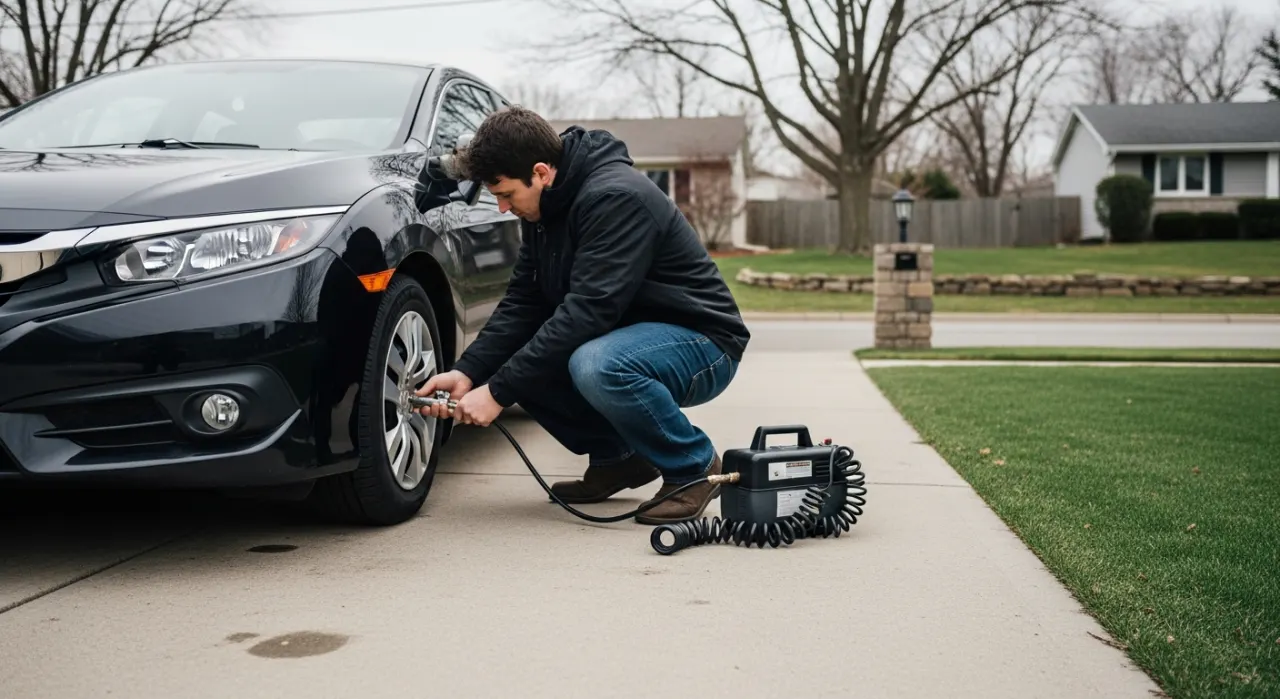
If a tire is low, add air in small bursts and re-check with your gauge each time — sneaking up on the number beats overshooting and having to bleed it back. If a tire is over the spec (common if it was filled warm or overfilled), press the little pin in the valve to release air, then re-check. A portable inflator makes this a driveway job instead of a gas-station chore; the best portable tire inflator roundup covers the options, and how to use a portable tire inflator walks through the technique.
How often to check
Tires lose roughly a PSI a month on their own, and more as the weather cools — pressure drops about a PSI for every ten-degree fall in temperature, which is why lights often pop on the first cold morning of autumn. Check at least monthly, and always before a long road trip or a heavy load. Tying it to a routine — a fuel stop, the first of the month — keeps it from slipping. A slow leak shows up as one tire that keeps needing air; that is your cue to have it inspected.
Don't rely on the dashboard light
The TPMS warning light is a backstop, not a substitute for checking. On most cars it only lights up once a tire is around 25 percent below spec — well past the point where you are already losing grip, wearing the tire unevenly and burning extra fuel. Treat the light as "fix immediately," and use a gauge to catch the small drops long before it ever triggers. Underinflation is also a leading cause of tire failure at speed, which is the safety half of why the monthly check earns its two minutes.
Why it is worth the habit
Correct pressure is quietly one of the best-value habits in car care. It gives you the grip and braking the tire was designed for, spreads wear evenly so the tire lasts its full mileage, and improves fuel economy — underinflated tires have more rolling resistance and cost you at the pump. Overinflation trades ride comfort and center-tread wear for a marginal economy gain and is not the goal either. The sweet spot is simply the door-jamb number, checked cold, once a month.
Where to go next
Two minutes a month is all it takes to protect your tires and your safety. Grab an accurate tire pressure gauge, keep a portable inflator in the trunk for top-ups, and head back to the tire inflators and tire tools hub for the full kit.
Recommended Products
An accurate gauge is the whole job — here are the ones we'd trust, plus a top-up inflator. We rank on aggregated owner reviews rather than our own testing, and prices are indicative — check the live listing.
Best for accurate, cheap, and impossible to overthink
- Backlit digital readout for clear numbers
- Lighted nozzle for night checks
- The default recommendation for most drivers
Why buy it: the gauge to beat — accurate, lit, and cheap enough that there’s no excuse not to own a proper one.

Best for lab-grade accuracy and a tougher build
- Calibrated for high accuracy
- Rubberised, drop-resistant housing
- Bleed valve to fine-tune pressure
Why buy it: the step-up for people who want a precise, durable gauge they’ll keep for years.

Best for a proven, no-frills point-and-read gauge
- One-button digital reading
- Angled head reaches valves easily
- Long-standing, hugely reviewed favourite
Why buy it: the dependable classic — nothing fancy, just a clear reading every time.

Best for high-pressure truck, RV and trailer tires
- Reads up to 230 PSI for big tires
- Dual-chuck head for inner/outer duals
- Steel body and braided hose
Why buy it: the pick if your tires run past a car gauge’s range — built for trucks, RVs and trailers.

Best for topping tires to spec in the driveway
- Plugs into the 12V socket
- Built-in gauge and auto-shutoff
- Compact enough for the trunk
Why buy it: once you’ve checked, this lets you add air at home instead of hunting for a working gas-station pump.
Prices are pulled from Amazon and were accurate as of Aug 22, 2026, 7:14 PM EDT. Product prices and availability are subject to change — the live price is shown on Amazon.