

Affiliate Disclosure
Some links on this page are affiliate links. As an Amazon Associate, we earn from qualifying purchases — at no extra cost to you. We do not buy, test, or physically handle the products we cover; our rankings come from aggregated owner reviews, ratings and expert consensus. Commissions never change our verdicts. How we rank & full disclosure.
Short version: a portable tire inflator is worth it for almost every driver — it is cheap, it lives in the trunk, and it lets you fix a low tire on the spot instead of limping to a gas station on an underinflated tire. It is not a flat-tire cure-all, and a cordless one is only useful if you keep it charged. So the honest answer is a confident yes for the low price, with a couple of realistic caveats. Here is the straight case, minus the hype.
Tire inflator marketing loves big PSI and inflation-speed claims. We would rather tell you what owners actually report living with one, so you can decide with clear eyes. Here are the real benefits, the honest limits, and who can happily skip it.
The big one: right pressure, all the time
The core reason a portable inflator is worth it is that correct tire pressure quietly affects almost everything about how your car drives and costs to run. Underinflated tires waste fuel, wear out faster and unevenly, and handle worse — and pressure naturally drops with cold weather and time, so the slow drift toward low is constant. Having an inflator in the trunk means the moment your tire-pressure light comes on, or you notice a tire looking soft, you top it up in your own driveway in a couple of minutes. Owners consistently describe this convenience as the real payoff: no special trip, no gas-station machine that is broken or out of order, no coins. Nail down what your numbers should be with our correct tire pressure guide.
The safety case: roadside and slow leaks
Beyond routine top-ups, an inflator earns its place in a genuine emergency. A slow leak that would leave you stranded becomes manageable — you reinflate and drive to a shop. And if you carry a tire repair kit, the inflator is the tool that pumps the tire back up after you plug the puncture, turning a tow-truck situation into a fifteen-minute roadside fix. Owners who have used it this way rate it as one of the most reassuring things in the trunk. It does not replace a spare or a shop for serious damage, but for the common small puncture or slow leak, it is exactly the tool you want to have with you.
Cordless vs 12V: the honest trade-off
Not all inflators are worth it in the same way, and the choice matters. A 12V plug-in unit is cheaper and never runs out of power while the engine runs, but it tethers you to the cigarette-lighter socket by a cord — fine as a cheap trunk backup. A cordless inflator costs more but is far more convenient: you can grab it, walk to any tire, do bikes and sports equipment, and never fight a cord — as long as you kept it charged. That last part is the honest catch with cordless, the same as any battery tool. Owners who inflate often prefer cordless freedom; those who want a set-and-forget emergency tool prefer 12V reliability. We lay it all out in cordless vs 12V inflators.
The honest limit: gauge accuracy
Here is what the marketing skips. The built-in gauges on portable inflators are good enough to set pressure, but they are not precision instruments — owners consistently find they can read a few PSI off from a quality standalone gauge. That is not a dealbreaker, because getting to roughly the right pressure matters far more than the final single PSI, and the fix is cheap: use the inflator to add air, then confirm with a dedicated tire pressure gauge. The inflator-plus-gauge combo costs very little together and covers you completely. Just do not treat the built-in readout as gospel for anything critical.
Who a portable inflator is (and isn't) worth it for
It is worth it for the vast majority of drivers. If you own a car, tires lose pressure, lights come on at inconvenient times, and the ability to fix it yourself in the driveway or on the roadside is worth far more than the modest price. It pairs perfectly with a plug kit for the common small puncture, and it makes staying on top of pressure — and therefore fuel economy and tire life — effortless. For most people this is an easy, low-regret buy.
It is not worth it for a small group: someone whose car already includes a factory compressor kit, who passes a reliable gas-station machine daily and actually uses it, or who drives so little that pressure is never an issue — and who honestly will not keep a cordless one charged or a 12V one in the trunk. If it would sit ignored, the money is better spent elsewhere. We will not pretend everyone needs one equally, but for most drivers, it is a clear yes.
The verdict
Is a portable tire inflator worth it? For nearly every driver — yes, and it is one of the cheapest, most useful tools you can keep in the trunk. Set expectations honestly: it keeps your pressures right, it partners with a plug kit for small punctures, and it is not a cure for serious tire damage. Confirm final pressure with a real gauge and keep a cordless one charged. When you are ready to choose, start with our best portable tire inflator ranking, decide between formats in cordless vs 12V inflators, and head back to the tire inflators hub for the full picture.
Recommended Products
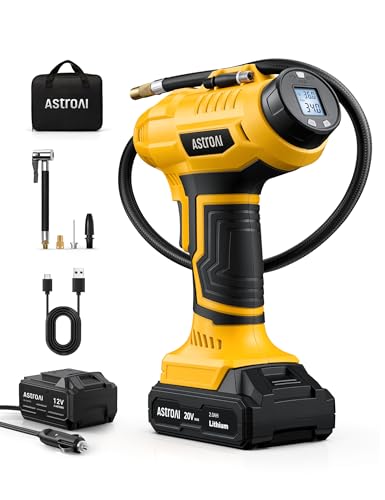
Best for cordless convenience with the runtime to back it up
- 20V rechargeable battery + 12V DC backup
- Airs a car tire ~30→36 PSI in under 40 sec
- Auto shut-off at your preset pressure
- Digital gauge + LED work light
Why buy it: the best all-round pick — cordless freedom for driveway top-ups plus a 12V fallback, so the "only works if charged" caveat never strands you.
Best for the most proven protection per dollar
- 12V plug-in — unlimited runtime
- Preset pressure with auto shut-off
- Bright LED light for night fixes
- One of the most-reviewed inflators online
Why buy it: a hugely reviewed 12V unit that does everything a car owner needs for a fraction of the cordless price — the easiest way to justify the buy.

Best for the fastest, most polished cordless experience
- 150 PSI, ~2x faster inflation
- Dual LED screen, one-handed operation
- High-capacity battery, low-noise motor
- Presets for car, bike, ball and more
Why buy it: the premium cordless owners praise for speed and a genuinely effortless one-handed workflow — worth it if you inflate often.
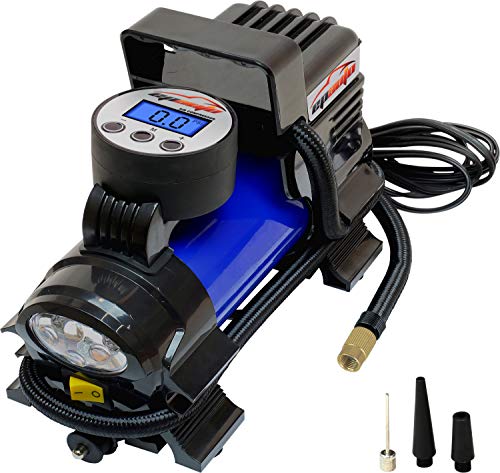
Best for a set-and-forget trunk backup
- 12V plug-in with digital preset gauge
- Auto shut-off, four measurement units
- Long power cord + air hose
- Among the best-reviewed inflators on Amazon
Why buy it: the near-universal safe pick — the no-drama 12V that lives in the trunk for years and pairs perfectly with a plug kit for small punctures.
Prices are pulled from Amazon and were accurate as of Aug 22, 2026, 7:14 PM EDT. Product prices and availability are subject to change — the live price is shown on Amazon.