

Affiliate Disclosure
Some links on this page are affiliate links. As an Amazon Associate, we earn from qualifying purchases — at no extra cost to you. We do not buy, test, or physically handle the products we cover; our rankings come from aggregated owner reviews, ratings and expert consensus. Commissions never change our verdicts. How we rank & full disclosure.
The honest short version: a 12V plug-in car heater will not warm your cabin — the cigarette-lighter socket only supplies about 150 watts, a fraction of a household space heater. What these units genuinely do is help clear a patch of windshield fog or frost while your engine-powered heater does the real warming. Buy one understanding that, and it is a handy little defrost helper; expect a space heater and you will be let down. Ranked across aggregated owner reviews by how well they do their real job, our #1 pick is a 150W ceramic defroster. Below is the full field and, more importantly, how to actually stay warm.
The tools that really warm a winter car are the engine heater plus preparation. Pair a remote starter to warm it before you get in, an engine block heater for faster warm-up in deep cold, and a windshield cover to skip the scraping. The full tires & wheel buying hub has more.
Top Picks at a Glance
Our #1 Pick: 12V 150W Ceramic Defroster
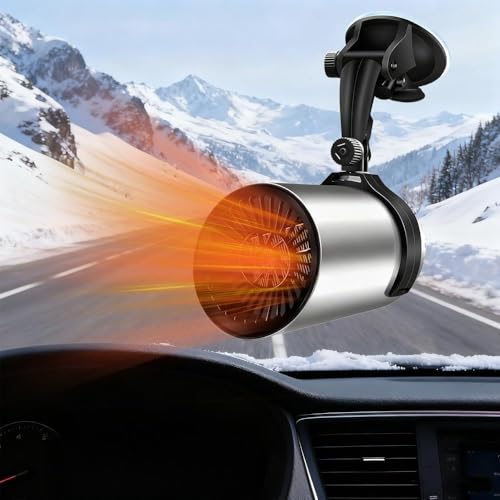
Our top pick is a 150W ceramic 12V defroster with a suction/holder mount. Within the honest limits of the category, it does its one useful job well: plugged into the accessory socket with the engine running, it warms quickly and pushes a small stream of warm air at the windshield to help clear fog and light frost from a patch of glass while your car real heater comes up to temperature. The ceramic (PTC) element self-regulates and feels safer than a bare coil. Owners rate it at the top for exactly this. Just remember what it is — a defrost helper, not a cabin heater — and run it with the engine on so it does not drain your battery.
Best Portable Car Heaters 2026: The Ranked Field
Best for clearing fog and frost from a patch of glass
- Plugs into the 12V accessory socket
- 150W heat + cool fan modes
- Suction/holder aims at the glass
- Fast to warm up its small element
Why buy it: the pick owners rate highest in a limited category — at 150W it will not heat the cabin, but it does clear a patch of windshield fog or frost while the engine warms the real heater.
Best for the cheapest defrost helper
- 12V cigarette-lighter plug
- 360° rotating base to aim heat
- Heat and fan modes
- Compact, stows in the door pocket
Why buy it: the value pick — a rotating base lets you aim the small airflow at the windshield or a side window, and it costs little as a backup for foggy, frosty mornings.

Best for a bit more output and 24V compatibility
- 12V and 24V compatible
- Higher 300W output
- Heat and cool modes
- Fits cars and trucks
Why buy it: the higher-output pick — 300W and dual 12V/24V support give a little more defrosting punch than the common 150W units, and it works in trucks as well as cars.

Best for fast windshield defrosting help
- 12V plug-in, 150W
- Aimed at the windshield
- Heats quickly for its size
- Simple one-switch operation
Why buy it: the quick-defrost pick — it heats fast and points at the glass, so owners use it to speed up clearing a foggy or lightly frosted windshield alongside the car heater.

Best for 24V trucks, buses and RVs
- 24V system for trucks/buses
- Ceramic (PTC) heating element
- 280W output, heat and cool
- Cigarette-lighter plug
Why buy it: the 24V pick — a ceramic-element heater sized for 24-volt trucks and RVs, so big-rig and commercial owners get the same defrost help car drivers do.

Best for a ceramic element that runs cooler-bodied
- Ceramic PTC heating element
- 12V plug-in, 150W
- Heat and fan modes
- Fits car, SUV, truck, RV
Why buy it: the ceramic pick — a PTC ceramic element heats efficiently and self-regulates temperature, a slightly safer-feeling design than bare-coil units in the same small-output class.
The Honest Truth About 12V Heaters
We rank by what the reviews back up, so here is the reality: a device plugged into the 12V socket can draw only about 120–180 watts, because that is all the socket and its fuse allow. A household space heater uses 1,500 watts — nearly ten times more — to warm a room. So no plug-in car heater will heat your cabin; the claims implying otherwise do not match the physics. Your car actual heater is far more powerful because it uses waste heat from the engine coolant, which is why it blows cold until the engine warms and then produces abundant heat for free. Buy a 12V heater as a spot-defrost helper, not a cabin warmer, and you will be happy with it.
How to Choose a Portable Car Heater
Because the whole category is limited, choose on the details. Favor a ceramic (PTC) element, which self-regulates temperature and is safer than a bare coil. Pick a unit with a mount or rotating base so you can aim the airflow at the glass. Match the voltage — 12V for cars, 24V for big trucks and RVs. A slightly higher wattage (300W dual-voltage) defrosts a touch faster but still will not heat the cabin. And keep expectations realistic: you are buying a defog/defrost assistant. If you want genuine winter comfort, spend the money on a remote starter and, in cold climates, an engine block heater instead.
Using It Safely and Effectively
Get the most from one without the risks. Run it only with the engine on so the alternator powers it and your battery does not drain; unplug it when you shut off. Aim it at the windshield or side glass to clear fog and light frost, and let the car own heater handle cabin warmth once the coolant is hot. Keep the heater away from anything flammable and mount it so it cannot fall onto the carpet. Do not leave it unattended or expect it to melt heavy ice — for that, use a scraper and the defrost setting on your car climate control. Treat it as the small helper it is and it earns its keep on foggy mornings.
Heat and Cool: Fan Modes and Airflow
Most of these units are really a small heating element behind a fan, and nearly all offer two modes. The hot setting warms the airflow to defog and defrost a patch of glass; a cool fan-only mode pushes unheated air, which some owners use to move air on a mild day. Neither mode moves much volume — the element is tiny and the fan is small — so aim it directly at the windshield for the best effect. Think of it as a targeted hot-air nozzle for the glass, not a climate system for the cabin.
12-Volt vs 24-Volt Fitment
Match the heater to your electrical system. Cars and light trucks run 12-volt, and the common 150W units plug into the 12V accessory socket. Big trucks, buses and many RVs run 24-volt, and they need a 24V heater or a dual-volt unit — plugging a 12V-only heater into a 24V socket, or vice versa, will not work properly and can damage it. A few models support both 12V and 24V for exactly this reason. Check your vehicle's system voltage before buying, because a mismatched heater is the most common avoidable return in this category.
Common Issues and Owner Recommendations
The complaints owners report are consistent, and they trace back to the physics. The main issues are weak heat output (expected — it is 150W), a blown accessory-socket fuse from a higher-draw unit, and a battery drained by running it with the engine off. Owner recommendations are simple: run it only with the engine on, treat it as a defroster rather than a heater, and pick a ceramic element for safety. Most who recommend these do so with that caveat firmly attached. Buy with realistic expectations and the little unit does its narrow job without drama.
Why Not a Dyson or Home Space Heater in the Car?
People reasonably ask why they cannot just run a proper heater — even a Dyson fan heater — in the car. Honestly, it comes down to power. A household heater needs about 1,500 watts of hot-air output, and the 12V socket supplies barely a tenth of that, so a home unit cannot run from the lighter socket at all. Powering one through an inverter would demand a large, hard-wired inverter and heavy cabling straight off the battery, and it would flatten the battery in minutes with the engine off. That is why the market is limited to small 150W defrosters — the physics simply will not allow a cabin-warming heater on 12 volts.
Heaters for a Jeep, Truck or 12-Volt Setup
Vehicle type shapes what little these can do. A soft-top Jeep leaks heat badly, so a small unit barely dents the cold — it is still only a glass defroster there, not cabin warmth. In any car the common 12V heater plugs into the accessory socket and clears a fogged patch while the engine warms; a portable volt heater rated for 24V suits big trucks and RVs instead. Budget brands such as TikScience sell the same small 150W element under many names. Whatever the vehicle, the job is the same: aim it at the glass, run it with the engine on, and lean on the engine's own heater for real warmth.
How We Rank
Portable car heaters are a limited category, so we rank by aggregated owner ratings, review volume, and — crucially — how honestly a unit performs its real job rather than its marketing claims. We weigh four things. Defrost usefulness — how well it clears a patch of glass, which is what these actually do. Safety — a self-regulating ceramic element and stable mounting. Fit — the right voltage and a way to aim the airflow. And value — modest price for a modest tool. Prices were current at the time of writing.
Quick Comparison
Portable 12V 150W Car Heater & Defroster with Suction Mount
Best for clearing fog and frost from a patch of glass
Best Value
2-in-1 Portable 12V Car Heater & Cooling Fan (360° Base)
Check Price on Amazon
Best Premium
FAMYNGL 12V/24V 300W Portable Car Heater & Defroster
Check Price on Amazon
Best for Quick Defrost
MASO Portable 12V 150W Windshield Heater & Defroster
Check Price on Amazon
Best for Trucks
24V Portable Ceramic Car Heater & Defroster (280W)
Check Price on Amazon
Best Ceramic Element
Portable 12V 150W Ceramic Car Heater & Defroster
Check Price on Amazon
The Verdict
If you want a cheap helper to clear a foggy or frosty patch of windshield, the 150W ceramic 12V defroster is the one owners rate highest — just know it is a defrost aid, not a cabin heater. For real winter comfort, spend your money on a remote starter and an engine block heater instead. If a small defroster is what you want, Check Price on Amazon →