
Affiliate Disclosure
Some links on this page are affiliate links. As an Amazon Associate, we earn from qualifying purchases — at no extra cost to you. We do not buy, test, or physically handle the products we cover; our rankings come from aggregated owner reviews, ratings and expert consensus. Commissions never change our verdicts. How we rank & full disclosure.
The short version: a fifth-wheel hitch is a safety-critical part, so the rule that overrides everything is capacity — the hitch must be rated above your trailer GVWR and pin weight, and you never buy under-rated to save money. After that, decide on the base (rails, a Turnoverball gooseneck mount, or a gooseneck ball) and how easily you need to remove it. Ranked across aggregated owner reviews, our #1 pick is the B&W Companion RVK3500: a 20K hitch that mounts to the Turnoverball base for a famously rattle-free tow. Below is the full field and how to choose — safely.
Fifth-wheel and gooseneck setups often share a base — see our best gooseneck hitch guide, and if you want to keep bed storage, the toolbox-clearing options here pair with a truck tool box. The full tonneau & truck bed covers hub has more.
Top Picks at a Glance
Our #1 Pick: B&W Companion RVK3500
Our top pick is the B&W Companion RVK3500, a 20,000 lb hitch that mounts to the B&W Turnoverball under-bed gooseneck base. That base is the key: it gives a rock-solid, rattle-free connection owners consistently praise, and it means the same truck can pull a gooseneck trailer too. The head fully articulates for smooth towing over rough ground, the polyurethane bushings kill chucking, and the cam-action handle releases even when parked on unlevel sites. It is rated for a 5,000 lb pin weight. As always, confirm your trailer GVWR and pin weight sit under the hitch rating and that your truck is rated for the load before buying.
Best Fifth Wheel Hitches 2026: The Ranked Field

Best for a rattle-free 20K hitch on the Turnoverball system
- 20,000 lb GTW / 5,000 lb pin weight
- Mounts to B&W Turnoverball gooseneck base
- Fully articulating head, polyurethane bushings
- Cam-action handle releases on unlevel ground
Why buy it: the hitch owners rate highest — it drops into a B&W Turnoverball gooseneck base for a rock-solid, rattle-free connection, and the fully articulating head tows smoothly over rough ground.
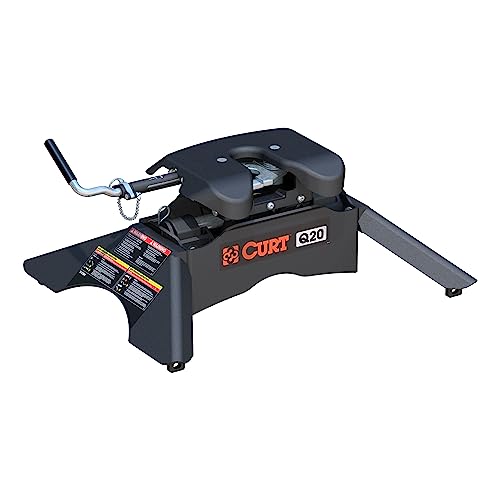
Best for a 20K rail-mount hitch for less
- 20,000 lb GTW / 6,000 lb pin
- Dual-jaw wrap-around locking
- Spherical bearing head tilts any direction
- Mounts on standard 5th wheel rails
Why buy it: the value pick — a full 20K dual-jaw hitch with a smooth-tilting head at a noticeably lower price, for owners who already run or will install standard fifth-wheel rails.

Best for a lightweight high-capacity double-pivot head
- 21,000 lb GTW / 4,000 lb vertical
- Lightweight geometric design
- Double-pivot head for uneven ground
- Separates into two pieces to remove
Why buy it: the premium pick — a 21K double-pivot head that tows exceptionally smoothly on rough terrain, yet splits into two liftable pieces so one person can remove it from the bed.

Best for the lightest hitch that mounts on a gooseneck ball
- 24,000 lb GTWR / 4,500 lb tongue
- Aluminum — only about 37 lb
- Mounts on a 2-5/16" gooseneck ball
- Funnel makes hitching easy, quiet ride
Why buy it: the lightweight pick owners love — at around 37 lb of aluminum it lifts in and out one-handed, mounts on an existing gooseneck ball, and its funnel-and-coupler design tows quietly.

Best for short beds needing extra turning clearance
- 20,000 lb GTW / 5,000 lb pin
- 12" slide for cab clearance
- Turnoverball gooseneck mount
- Fully articulating, rattle-free head
Why buy it: the short-bed answer — the 12-inch slider gives the cab clearance a short bed needs in tight turns, on the same solid Turnoverball mount as our top pick.
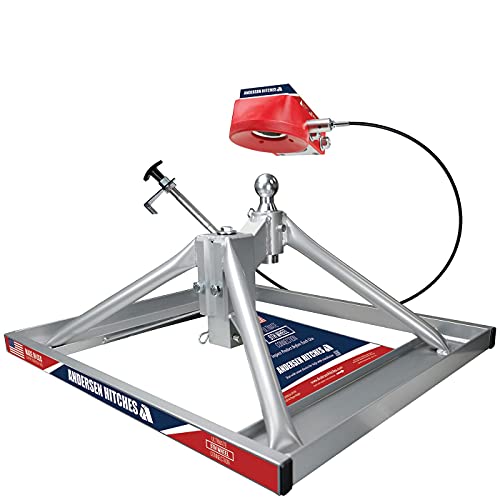
Best for clearing a crossover tool box in the bed
- 13" tall base clears a toolbox
- 24,000 lb GTWR / 4,500 lb tongue
- Lightweight aluminum, gooseneck mount
- Remote-release coupler
Why buy it: the toolbox-friendly Andersen — the taller 13-inch base clears a crossover tool box in the bed, so owners keep their storage while still running a fifth-wheel connection.
Capacity Is Safety-Critical — Match GVWR and Pin Weight
This is the one rule you do not bend. Every hitch has a gross trailer weight (GTW) rating and a pin (vertical) weight rating, and both must sit above your trailer numbers. Find your fifth-wheel trailer GVWR (its maximum loaded weight) and its pin weight (typically 15–25% of trailer weight), and choose a hitch rated comfortably above both — a 20K hitch for most setups, more for heavy fifth-wheels. Never recommend or buy across classes to save money: an under-rated hitch is the kind of failure that ends badly with a heavy trailer at speed. Confirm your truck is rated to tow and carry the pin weight too — the weakest link governs.
How to Choose a Fifth Wheel Hitch
With capacity settled, choose the base to match your truck: rails (CURT), a Turnoverball gooseneck mount (B&W), or a gooseneck ball adapter (Andersen). Decide how important easy removal is — a heavy steel head needs two people, while a lightweight aluminum (Andersen, ~37 lb) or two-piece (Demco Recon) design lifts out solo to free the bed. Consider short-bed clearance — a slider (B&W RVK3405) prevents the trailer contacting the cab in tight turns. And if you want to keep a tool box in the bed, a taller-base design (Andersen TBX) clears it. Buy the head and base as a matched, compatible system.
Installation and Safe Towing
Fifth-wheel installation centers on the base: rails or a Turnoverball are bolted to the frame, ideally by someone experienced, because it is structural. Once the base is in, the head drops in and pins. When hitching, verify the jaws fully wrap and lock the kingpin and that the safety pin is set before towing — a partial connection is dangerous. Do a walkaround, check the coupler is seated, and confirm your pin weight keeps the truck within its axle and payload ratings. Recheck the connection at your first stop. If you ever feel excessive chucking, stop and inspect the jaws and mounting rather than driving on.
Puck System vs Rail Mounts
How the hitch attaches to the truck comes down to two systems. Many late-model trucks — Ram, GM/GMC and Ford — offer a factory puck system: pre-installed under-bed pucks that a compatible hitch drops into and locks, no rails needed. Older trucks and universal setups use bolt-in rails (CURT and others sell rail kits) that mount to the frame. A puck-system hitch is quicker to remove and leaves a cleaner bed, but you need the matching brand puck kit. Confirm whether your truck has factory pucks before choosing between a puck-mount and a rail-mount hitch.
Sliding Hitches for Short-Bed Trucks
A short-bed truck cannot make a tight turn with a fixed fifth-wheel hitch — the trailer nose swings into the cab. A sliding hitch solves it by letting the head slide rearward for turns and lock forward for towing. Auto-sliding models like the PullRite SuperGlide move on their own as you turn, while manual sliders you unlock by hand. If you run a 6.5-foot or shorter bed, a sliding hitch is close to mandatory for safe low-speed maneuvering. Full-size long beds usually clear fine with a fixed hitch.
5th Wheel Hitch Brands and Owner Advice
The 5th wheel hitch market is dominated by a handful of brands, each with a following. B&W, CURT, Demco, Andersen (sometimes spelled Anderson) and PullRite cover most setups, and Forest River and similar RV makers spec particular heads. RV forums are full of advice on chucking, removal weight and puck compatibility, and owners who have towed for years consistently point newcomers toward matching the head to their truck and trailer rather than chasing the cheapest listing. Cross-check Amazon sellers against the maker’s fitment guide, and read the capacity on the box before you buy.
How We Rank
Fifth-wheel hitches are safety hardware, so we rank by aggregated owner ratings, review volume, and the towing experiences owners repeat rather than a bench test. We weigh four things. Capacity and security — a properly rated head with tight, positively-locking jaws. Ride quality — articulation and anti-chucking design owners report as smooth and rattle-free. Usability — weight and mounting that suit how often you remove it, plus short-bed and toolbox options. And value — what you pay for that capability. Prices were current at the time of writing.
Quick Comparison
B&W Companion RVK3500 Fifth Wheel Hitch (20,000 lb, Turnoverball Mount)
Best for a rattle-free 20K hitch on the Turnoverball system
Best Value
CURT 16130 Q20 Fifth Wheel Hitch (20,000 lb, Dual-Jaw, Rails)
Check Price on Amazon
Best Premium
Demco 8550043 Recon 21K Fifth Wheel Hitch (Double Pivot)
Check Price on Amazon
Best Lightweight
Andersen 3220 Ultimate Fifth Wheel Connection (Gooseneck Mount, 24K)
Check Price on Amazon
Best for Short-Bed Trucks
B&W Companion RVK3405 Slider Fifth Wheel Hitch (20,000 lb)
Check Price on Amazon
Best Toolbox Fit
Andersen 3220-TBX Ultimate Fifth Wheel Connection (Toolbox Model, 24K)
Check Price on Amazon
The Verdict
For most setups, the B&W Companion RVK3500 is the fifth-wheel hitch owners rate highest — a solid 20K connection that tows rattle-free on the Turnoverball base. On a budget, the rail-mount CURT Q20 delivers the same 20K capacity for less, and for one-person removal the Andersen Ultimate aluminum hitch is unbeatable. Match your trailer GVWR and pin weight first — never across classes — then Check Price on Amazon →