
Affiliate Disclosure
Some links on this page are affiliate links. As an Amazon Associate, we earn from qualifying purchases — at no extra cost to you. We do not buy, test, or physically handle the products we cover; our rankings come from aggregated owner reviews, ratings and expert consensus. Commissions never change our verdicts. How we rank & full disclosure.
The short version: a dead TPMS sensor is why your low-pressure light will not clear, and replacing one has exactly two paths. Buy a direct-fit OE sensor that arrives pre-programmed for your car and needs no tool, or buy a programmable universal sensor that one part number covers almost everything — but which needs a TPMS tool to clone or program. The frequency (315 vs 433 MHz) has to match your vehicle either way. Ranked across aggregated owner reviews, our #1 pick is the dual-frequency Autel MX-Sensor for coverage, with Denso direct-fit sensors as the no-tool route. Below is the full field and how to choose.
A new sensor is only half the job — you still need to hit the right pressure. Pair this with a portable inflator and a good pressure gauge, and see the full wheels & tires hub.
Top Picks at a Glance
Our #1 Pick: Autel MX-Sensor (2-in-1 315/433)
Our top pick is the Autel MX-Sensor, a dual-frequency programmable sensor that transmits on both 315MHz and 433MHz. That is why a single part number covers nearly every TPMS-equipped vehicle: you program it (or clone your old sensor ID) with an Autel or compatible tool, and it adopts the correct protocol. Owners like the metal valve stem and the broad OE coverage. The one catch is the tool — you cannot use a programmable sensor without a TPMS programmer. If you do not own one and do not want to buy one, jump to the Denso direct-fit sensors below, which need no programming at all.
Best TPMS Sensors 2026: The Ranked Field

Best for covering almost any vehicle with one dual-frequency sensor
- Dual 315MHz + 433MHz in one sensor
- Programmable and ID clone-able (no relearn)
- Metal valve stem, 99% OE coverage
- Needs an Autel or compatible programmer
Why buy it: the programmable sensor owners reach for because one part number fits nearly everything — clone the old ID and there is often no relearn, but you do need a programming tool.
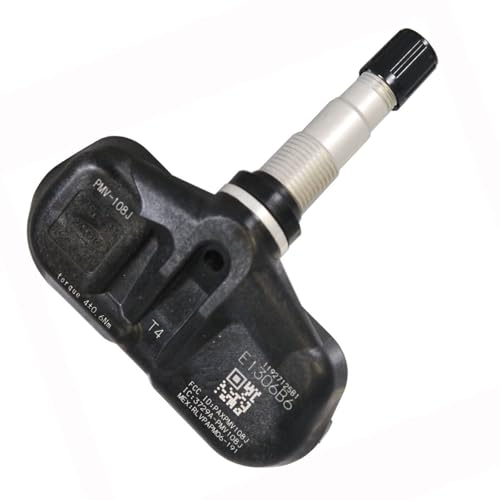
Best for a plug-and-play OE sensor for Toyota/Lexus
- OE-manufacturer sensor, direct fit
- No cloning or programming required
- Correct frequency for the application
- Fits many 2006-2015 Toyota/Lexus
Why buy it: the no-tool pick — a genuine OE-maker sensor that installs and pairs like the factory part, so DIYers without a programmer can still fix a bad TPMS.

Best for later-model applications needing an exact OE match
- OE-quality DENSO build
- Direct fit, no programming
- Application-specific frequency
- Reliable long-life battery
Why buy it: the choice when you want the factory sensor without dealer pricing — application-specific and ready to pair, with no programming step to get wrong.

Best for a specific OE fit on older applications
- Direct-fit OE-maker sensor
- No cloning needed
- Snap-in rubber valve
- Correct MHz for the listing
Why buy it: a straight OE replacement for the applications it lists — owners like that it behaves exactly like the sensor that came off, with no relearn drama.

Best for a listed domestic/import direct-fit
- OE-manufacturer sensor
- No programming required
- Application-specific
- Factory-style pairing
Why buy it: another direct-fit Denso for its listed applications — the simplest path for a home mechanic who does not own a TPMS tool.

Best for a specific late-model OE replacement
- DENSO OE-quality
- Direct fit, no clone/program
- Correct frequency per application
- Sealed against moisture
Why buy it: rounds out the OE-fit options for owners who would rather buy the exact application sensor than program a universal one.
315 vs 433 MHz, and Clone vs Program
Two decisions define TPMS fitment. First, frequency: most North American cars use 315MHz and many European/newer cars use 433MHz, but exceptions exist — match your specific vehicle, because a sensor on the wrong frequency is invisible to your car. Dual-frequency programmable sensors avoid the guess. Second, clone vs program: a programmable sensor is blank until a tool configures it. Cloning copies your old sensor ID so the car needs no relearn; programming a new ID means you then run the vehicle relearn. Direct-fit OE sensors skip all of this — they come pre-set for their listed applications and just need the tire mounted.
How to Choose TPMS Sensors
Start with whether you own a TPMS tool. If yes, a programmable dual-frequency sensor (Autel) is the most flexible and future-proof choice. If no, buy a direct-fit OE sensor for your exact vehicle (Denso) so there is nothing to program. Either way, confirm the frequency and protocol for your make, model and year. Consider replacing all four at once if the others are the same age, since the batteries wear together. And choose the right valve stem — rubber snap-in is simple and cheap; aluminum clamp-in looks cleaner but can corrode and seize, so use a fresh service kit (grommet, nut, core, cap) each time you mount a tire.
Installing and Relearning
The sensor lives inside the tire, so the wheel must come off the bead — most people have a tire shop mount the tire and torque the valve nut to spec (over-tightening cracks the sensor). After fitting, complete the relearn so the car binds each sensor ID to its wheel position: some vehicles relearn automatically after a short drive, others need a TPMS tool or a specific key/drive sequence from the owner manual. If you cloned the old IDs, no relearn is needed. Confirm all four sensors report a pressure before you trust the system.
How the Tire Pressure Monitoring System Works
TPMS stands for tire pressure monitoring system, and understanding it makes replacement straightforward. In a direct system, a battery-powered sensor inside each tire measures the air pressure (and often temperature) and radios the reading to the car, which lights the low-pressure warning when a tire drops. A few vehicles use an indirect system instead, inferring pressure from wheel-speed data with no sensors at all. The sensors here are for direct monitoring systems — the kind that sit on the valve stem inside the tire. Knowing which of the two systems your car uses tells you whether you even need a sensor.
OEM vs Aftermarket Sensors and Brands
You have two sourcing routes. OEM sensors are the exact factory part — Denso and Pacific Industrial supply some Toyota and Lexus systems, for example — and they pair like the original with no fuss. Aftermarket brands offer universal programmable sensors and OE-equivalent replacements: Schrader (which pioneered TPMS), Autel and others cover almost any car for less than dealer pricing. You can source either from a parts supplier like RockAuto. For a straight replacement, an OEM or OE-equivalent sensor from a trusted brand is the safe pick; a programmable universal sensor wins if you service several different vehicles.
Matching 433MHz and 315MHz to Any Vehicle
Frequency is the one spec you cannot get wrong. Most North American cars broadcast at 315MHz, while many European and newer models use 433MHz — and a sensor on the wrong band is simply invisible to any vehicle it is fitted to. A dual-frequency universal sensor covers both, so one part fits almost any car you have. Trailers and RVs are a separate case: aftermarket monitoring systems like TireMinder add external cap sensors and their own display rather than talking to the car. Whatever you drive, confirm the exact frequency and protocol for your make, model and year before buying.
How We Rank
TPMS sensors are a fit-and-forget part, so we rank by aggregated owner ratings, review volume, and the install experiences owners repeat. We weigh four things. Coverage and correctness — whether the sensor genuinely matches the vehicle frequency and protocol, judged by how consistently owners report the light clearing. Ease of fit — programmable-with-tool versus true no-tool direct-fit. Build and battery — a sealed, long-life sensor with a sound valve stem. And value versus dealer pricing. Prices were current at the time of writing.
Quick Comparison
Autel MX-Sensor 2-in-1 315MHz & 433MHz Programmable TPMS Sensor (4-Pack, Metal Stem)
Best for covering almost any vehicle with one dual-frequency sensor
Best Value
Denso 550-0104 TPMS Sensor (Direct-Fit, No Programming)
Check Price on Amazon
Best Premium
Denso 550-2404 TPMS Sensor (Direct-Fit OE)
Check Price on Amazon
Best for Older Toyotas
Denso 550-0204 TPMS Sensor (Direct-Fit)
Check Price on Amazon
Best for Domestic Fit
Denso 550-0304 TPMS Sensor (Direct-Fit)
Check Price on Amazon
Best OE Alternative
Denso 550-2904 TPMS Sensor (Direct-Fit OE)
Check Price on Amazon
The Verdict
If you own or will buy a TPMS tool, the dual-frequency Autel MX-Sensor is the sensor owners rate highest for covering almost anything. If you do not want to program anything, a Denso direct-fit sensor for your exact vehicle is the plug-and-play route. Confirm your frequency and protocol first, then Check Price on Amazon →