
Affiliate Disclosure
Some links on this page are affiliate links. As an Amazon Associate, we earn from qualifying purchases — at no extra cost to you. We do not buy, test, or physically handle the products we cover; our rankings come from aggregated owner reviews, ratings and expert consensus. Commissions never change our verdicts. How we rank & full disclosure.
Clay Bar
A pliable resin bar that shears bonded contamination off the paint mechanically as you glide it across a lubricated panel. It grabs anything sitting proud of the clear coat, regardless of what that contamination is made of.
Best for: Overspray, tree sap, road tar residue and the gritty texture you feel through a plastic bag
Roughly $15–$30 for a two-bar kit with lubricant; $20–$35 for a reusable clay mitt or towel
- Removes every kind of bonded contaminant, not just ferrous particles
- Immediate, verifiable result — the paint goes from gritty to glass-smooth as you work
- Cheap per use, and one 100 g bar covers several full cars if kept clean
- No dwell time, no fumes, and no temperature window to work around
- Reusable mitt and towel formats cut the per-car cost further and survive being dropped
- Induces light marring on soft paint, so a polish step afterward is often required
- A dropped bar picks up grit and will scratch the panel badly — it must be discarded
- Physically slow: 45–90 minutes of active work for a full car
- Cannot dissolve iron particles that are embedded below the surface, only shear the tops off
Iron Remover
A spray-on chemical decontaminant that dissolves embedded ferrous particles — brake dust, rail dust, industrial fallout — and bleeds a distinctive purple as it reacts. Nothing touches the paint but liquid.
Best for: Brake dust in wheel faces, rail dust on white paint, and any car that has never been decontaminated
Roughly $15–$30 for a 32 oz spray; concentrates run $25–$45 and dilute much further
- Zero marring risk — no physical contact with the clear coat at all
- Reaches iron particles that have embedded below the surface where clay cannot
- Visually self-reporting: the purple bleed shows exactly how contaminated the panel was
- Covers a full car in 10–15 minutes of spraying plus a short dwell
- Safest option on wheels, where clay is awkward and brake dust is worst
- Only works on ferrous contamination — sap, tar and overspray are untouched
- Sulfur odor is genuinely unpleasant and needs ventilation
- Must not dry on the paint, which rules out hot panels and direct sun
- Costs more per car than a clay bar once you are decontaminating regularly
How they score, side by side
Scores reflect aggregated owner reviews and expert consensus — not our own bench testing.
- Ferrous contamination removal510
- Non-ferrous contamination removal101
- Paint safety / no marring510
- Speed on a full car49
- Cost per use96
- Beginner friendliness69
- Coating-safe maintenance use38
Spec-by-spec comparison chart
| Factor | Clay Bar | Iron Remover |
|---|---|---|
| Removal method | Mechanical — shears contamination off | Chemical — dissolves ferrous particles |
| Removes iron / brake dust | Partially (surface only) | Yes — this is its whole job |
| Removes sap, tar, overspray | Yes | No |
| Marring risk | Moderate on soft paint | None |
| Time for a full car | 45–90 minutes of active work | 10–15 minutes plus 3–5 min dwell |
| Lubricant required | Yes — always, and generously | No |
| Works in direct sun | Yes, if lube stays wet | No — must not dry on paint |
| Follow-up polish usually needed | Often, on soft or dark paint | No |
| Typical price | $15–$30 kit / $20–$35 mitt | $15–$30 per 32 oz |
| Safe on ceramic coatings | Not recommended — abrades the coating | Yes, if pH-neutral and rinsed promptly |
| Beginner difficulty | Moderate — technique matters | Easy — spray, wait, rinse |
Our Top 3 Picks
The three highest-rated options in this category, if you'd rather skip straight to a proven pick.

Best for Beginners who want one box that does everything well
- 14 matched pieces covering wash, protect and interior
- Includes shampoo, spray sealant and interior cleaner
- Comes with microfiber towels and applicators
- Products are designed to work together as a system
Why buy it: It is the closest thing to a complete detail in a single box, which is exactly what a first-timer needs — no guesswork about whether the pieces play nicely together.

Best for Enthusiasts who want top-shelf formulas from the start
- Premium formulas with a genuinely slick finish
- Excellent spray sealant and glass cleaner
- High-quality plush microfiber included
- Strong resale-grade presentation and packaging
Why buy it: You pay more, but the products themselves are a noticeable step up in slickness and gloss — the kit you buy when you know you are hooked.

Best for Getting proven, forgiving products for a fair price
- Trusted formulas that are hard to get wrong
- Covers wash, wax and interior basics
- Widely reviewed and consistently reliable
- Great balance of price and performance
Why buy it: Meguiar's has been dialing in beginner-friendly products for decades, and this kit is the safe, sensible middle — nothing flashy, nothing you will regret.
Prices are pulled from Amazon and were accurate as of Aug 22, 2026, 6:54 PM EDT. Product prices and availability are subject to change — the live price is shown on Amazon.
What each one actually removes
The plastic-bag test is where most people first meet this problem. Wash the car, slide a hand inside a sandwich bag across the hood, and if it feels like fine sandpaper instead of glass, the paint is contaminated. What that test cannot tell you is what the contamination is — and that is precisely the question that decides which product you need.
Paint picks up two broadly different kinds of bonded contamination. The first is ferrous: microscopic iron particles from brake pads, from railway and industrial fallout, and from any nearby machining or welding. Those particles land hot, embed themselves in the clear coat, and then rust in place, expanding as they oxidize. On white and silver paint the result is the familiar rash of tiny orange-brown specks.
The second is everything else: tree sap, road tar, paint overspray, bug residue, mineral deposits and industrial fallout that is not iron-based. These sit proud of the surface and are held on by adhesion rather than embedded by heat.
An iron remover only addresses the first category. Clay addresses both, but only the portion sitting above the clear coat — it physically cannot reach an iron particle that has worked its way down into the paint. That is why the consensus among detailers is not "pick one" but "use the chemical first, then the mechanical for what is left." Our decontamination guide covers the full workflow including tar removers, which are a third category again.
How an iron remover dissolves fallout
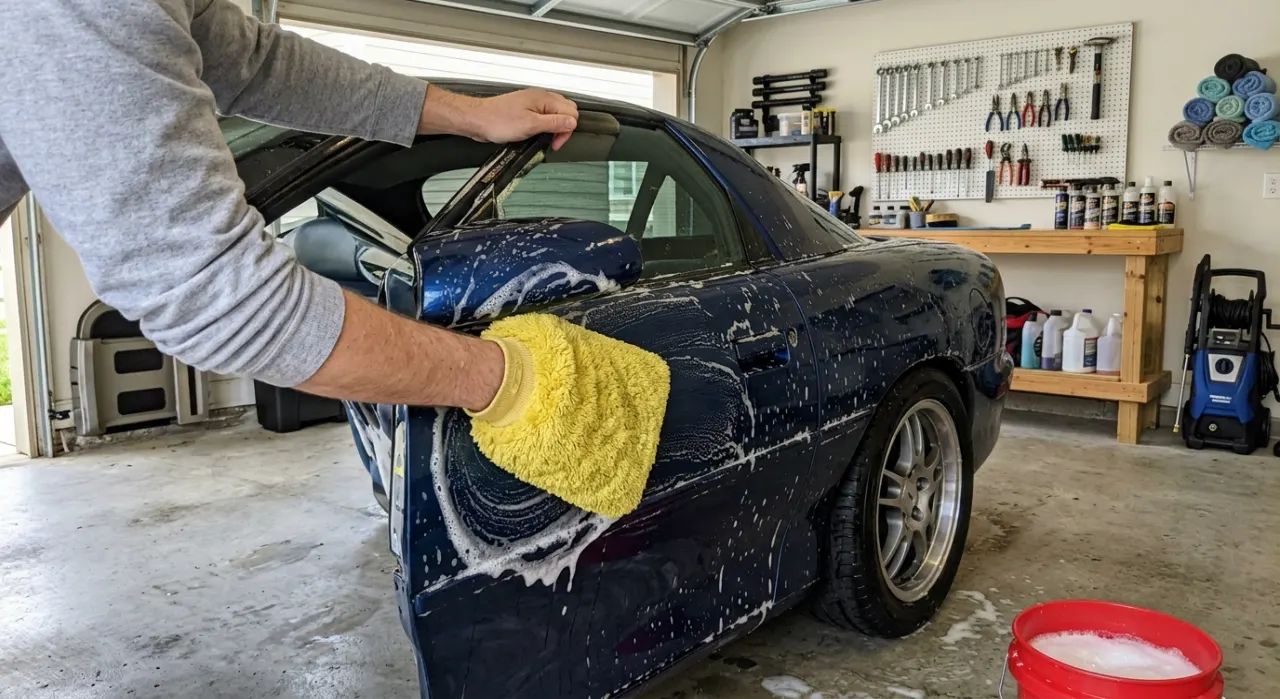
Iron removers are built around thioglycolate chemistry — usually ammonium or sodium thioglycolate. The active compound reacts with iron oxide, chelating it into a water-soluble complex that simply rinses away. The dramatic purple-red bleed you see running down the panel is that reaction happening in real time, and it is a genuinely useful diagnostic: heavy bleeding means heavy contamination, and a panel that barely changes color was already clean.
Most modern formulas are pH-neutral, which is what makes them safe on clear coat, ceramic coatings and factory wheel finishes. Application is straightforward but has two hard rules. First, the product must never dry on the paint — work on a cool car, out of direct sun, panel by panel, and rinse thoroughly after a three to five minute dwell. Second, ventilate. The sulfur smell that owners universally complain about is inherent to the chemistry, and in an enclosed garage it is genuinely unpleasant.
Where iron removers earn their keep most obviously is wheels. Brake dust is almost entirely ferrous, wheel faces have barrels and spokes that clay cannot reach, and a chemical that dissolves the contamination and rinses off solves a problem that no mechanical method addresses well. Owners consistently report that the first iron-remover application on a neglected set of wheels produces the most dramatic bleed they have ever seen.
How clay shears contamination off the paint
Detailing clay is an engineered resin — not natural clay — with a controlled tackiness and abrasive grade. Lubricated with a dedicated clay lube or a slick soap solution, it glides across the paint, and anything protruding above the surface catches in the resin and is pulled free. Fold the bar to expose a clean face, keep going, and the panel goes from gritty to glass-smooth in a few passes.
Clay is graded by aggressiveness. Fine or light grade is the right default for maintenance work and soft paint; medium handles a neglected car; heavy or aggressive grades exist for overspray removal and will absolutely mar the paint enough to require correction afterward. The strong recommendation from detailers is to start with the least aggressive grade that works, because you cannot un-mar a panel without polishing it.
Format matters too. Traditional bars, synthetic clay mitts and clay towels all work on the same principle, but reusable formats can be rinsed clean when you drop them while a dropped bar must be thrown away — it will have picked up grit that turns it into sandpaper. That single practical difference is why many owners have moved to mitts, and it is covered in detail in our clay bar vs clay mitt comparison.
The correct order — and why it saves you an hour
Do the chemical step first. Always. The sequence that produces the best result with the least paint disturbance is:
- Wash thoroughly — a foam pre-wash and a two-bucket contact wash to remove loose dirt, so nothing gets dragged around later.
- Spray the iron remover panel by panel on cool paint and wheels, dwell three to five minutes, and rinse before it dries.
- Re-test with the bag. This is the step people skip, and it is the one that saves the time. A significant share of what felt rough was ferrous and is now gone.
- Clay only the areas that still feel rough, with plenty of lubricant and light pressure.
- Polish if needed, then seal or coat — bare, decontaminated paint has no protection on it.
Doing it the other way round is not dangerous, it is just wasteful: you spend 45 minutes claying contamination that a five-minute chemical dwell would have dissolved, and you rack up marring you did not need to. Owners who adopt the chemical-first order consistently report their claying time drops by half or more.
Marring, safety and when clay is the wrong call
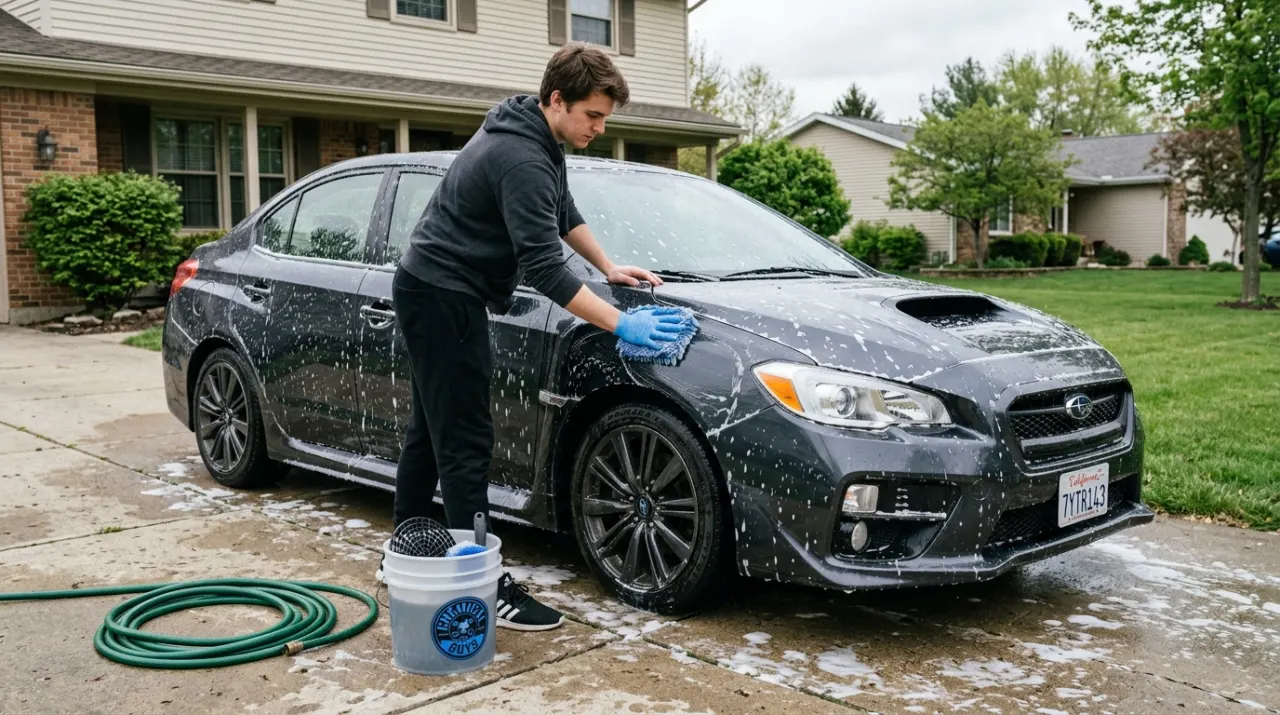
Clay marring is real and widely misunderstood. Because clay works by dragging a semi-rigid medium across the clear coat with contamination trapped in it, it leaves very fine directional scratches — most visible on soft Japanese paints and on black. On a hard German clear you may see nothing at all. The professional workflow simply assumes it: decontaminate, then polish. If you were planning to polish the car anyway, clay marring is a non-issue.
Where clay becomes the wrong choice is on a ceramic-coated car. The coating is a sacrificial layer measured in microns, and dragging clay across it abrades it — you will shorten the life of a coating you paid real money for. On coated paint, iron remover is the correct maintenance decontaminant precisely because it never touches the surface. That distinction is one of the practical advantages covered in our ceramic coating guide.
Iron remover has its own boundaries. It does nothing for sap or overspray, it should not be left to dry, and while pH-neutral formulas are safe on most finishes, bare polished aluminum and some aftermarket wheel coatings warrant a test spot first. Neither product is risk-free — they just carry different risks.
Cost per car and per year
A clay kit at $15 to $30 typically includes two 50–100 g bars and a lubricant, which is realistically three to six full cars if you keep the bar clean and do not drop it. That works out to roughly $5 per decontamination, which is about as cheap as detailing gets. A reusable clay mitt at $20 to $35 stretches further still — owners routinely report dozens of uses before the surface wears out — and it survives the drops that destroy bars.
Iron remover costs more per application. A 32 oz ready-to-use spray at $15 to $30 covers roughly two to four full cars including wheels, so call it $8 to $12 a car. Concentrates change that math significantly: a $30 concentrate diluting at 1:4 or better brings the effective cost down near clay territory, and is the sensible buy for anyone decontaminating more than a couple of cars a year.
For a typical owner doing one or two full decontaminations annually plus wheel cleaning in between, budgeting around $40 to $60 a year covers both products comfortably. That is a small line item against the paint correction you avoid by keeping contamination out of the clear coat in the first place.
Which should you buy — and how to decide
Neither wins outright, because they are two halves of one job. If you can only buy one this month, let the contamination decide.
Buy the iron remover first if your car is white, silver or light-colored and showing orange specks; if your wheels are caked with brake dust; if the paint is ceramic-coated and you need a decontamination method that does not abrade the coating; or if you are new to detailing and want the highest-impact result with zero risk of marring.
Buy the clay first if the paint feels rough but shows no rust specks, if you have overspray, sap or tar to deal with, or if you are already committed to polishing the car afterward and want the most thorough mechanical clean you can get before you start.
Buy both if you are doing a full correction. Chemical first, mechanical second, then polish and protect — that is the sequence professional detailers run on every serious job, and it is also the fastest route to paint that actually feels like glass.
Recommended Products
Our top picks in this category, ranked on aggregated owner reviews.
Best for Beginners who want one box that does everything well
- 14 matched pieces covering wash, protect and interior
- Includes shampoo, spray sealant and interior cleaner
- Comes with microfiber towels and applicators
- Products are designed to work together as a system
Why buy it: It is the closest thing to a complete detail in a single box, which is exactly what a first-timer needs — no guesswork about whether the pieces play nicely together.
Best for Enthusiasts who want top-shelf formulas from the start
- Premium formulas with a genuinely slick finish
- Excellent spray sealant and glass cleaner
- High-quality plush microfiber included
- Strong resale-grade presentation and packaging
Why buy it: You pay more, but the products themselves are a noticeable step up in slickness and gloss — the kit you buy when you know you are hooked.
Best for Getting proven, forgiving products for a fair price
- Trusted formulas that are hard to get wrong
- Covers wash, wax and interior basics
- Widely reviewed and consistently reliable
- Great balance of price and performance
Why buy it: Meguiar's has been dialing in beginner-friendly products for decades, and this kit is the safe, sensible middle — nothing flashy, nothing you will regret.

Best for The cheapest way to cover the basics in one buy
- Lowest entry price of the group
- Covers wash, wheels, glass and interior
- Available almost everywhere
- Simple products that are easy to use
Why buy it: If you just want to stop washing your car with dish soap and a bath towel, this gets you a real detailing setup for pocket change.

Best for People who want maximum product and a storage bucket
- Large bundle with a bucket and grit guard included
- Full-size bottles of core products
- Foam and wash gear bundled in
- Everything stores neatly in the bucket
Why buy it: The bucket doubles as storage and a two-bucket wash setup, and the full-size bottles mean you are not restocking after two washes.

Best for Buying local at any auto parts store today
- Stocked at nearly every parts store
- Reliable wax and cleaner formulas
- Easy to top up individual bottles later
- Long-standing reputation with hobbyists
Why buy it: When you want to start today and not wait on shipping, Mothers is on a shelf near you — and the products genuinely hold up.
Prices are pulled from Amazon and were accurate as of Aug 22, 2026, 6:54 PM EDT. Product prices and availability are subject to change — the live price is shown on Amazon.