

Affiliate Disclosure
Some links on this page are affiliate links. As an Amazon Associate, we earn from qualifying purchases — at no extra cost to you. We do not buy, test, or physically handle the products we cover; our rankings come from aggregated owner reviews, ratings and expert consensus. Commissions never change our verdicts. How we rank & full disclosure.
Digital Multimeter
A measuring instrument that reads actual voltage, resistance and current in numbers. It tells you not just whether power is present, but how much — which is the difference between guessing and diagnosing.
Best for: Anyone who wants to actually find an electrical fault rather than confirm a fuse has power
Typically $25–$60 for a solid auto-ranging DMM, $80–$200 for a CAT III automotive model
- Reads exact voltage, so you can run a voltage-drop test — the single most useful electrical diagnosis there is
- Measures resistance and continuity, which finds broken grounds, open switches and bad sensors
- High input impedance (10 megohms) means it draws almost no current and cannot overload a control module
- Doubles as a battery, alternator, parasitic-draw and sensor tester, so one tool covers most of the electrical system
- Better models add duty cycle, frequency, temperature and min/max capture for intermittent faults
- Two hands and two leads to manage while you are half under a dash
- Cheap meters have slow refresh rates and can miss a flickering or intermittent signal
- You have to know which setting to use — a meter on the wrong range tells you nothing useful
- Not as fast as a test light when all you want is a yes/no on a fuse
Test Light (12V Circuit Tester)
A probe with a bulb or LED and a ground clip that lights up when it finds power. It answers one question fast: is there voltage here or not?
Best for: Quick power-present checks, tracing fuses and probing while your other hand is busy
Typically $8–$20 for a basic incandescent tester, $20–$40 for an LED or computer-safe model
- One-handed and instant — clip the ground, poke the probe, look at the bulb
- Nearly unbreakable, cheap enough to keep one in the trunk and one on the bench
- A traditional bulb tester loads the circuit, so it can reveal a corroded connection that a meter still reads as 12 volts
- Nothing to set, no range to select, no battery to go flat in an LED-free design
- Gives you presence, not value — a dim glow could be 12 volts or 8 volts and you cannot tell which
- Old-style incandescent testers draw real current and can damage airbag, ECU and body-module circuits
- Cannot measure resistance or continuity, so it is useless for checking a sensor or a broken ground path
- No help at all on low-voltage signal, CAN bus or PWM circuits found all over modern cars
How they score, side by side
Scores reflect aggregated owner reviews and expert consensus — not our own bench testing.
- Diagnostic depth103
- Speed for a simple check510
- Safety on modern modules105
- Durability / abuse tolerance69
- Value for the money89
- Beginner friendliness69
Spec-by-spec comparison chart
| Factor | Digital Multimeter | Test Light (12V Circuit Tester) |
|---|---|---|
| What it tells you | Exact value — volts, ohms, amps | Presence only — power or no power |
| Voltage-drop testing | Yes — the core diagnostic use | No |
| Resistance / continuity | Yes | No |
| Safe on ECU & airbag circuits | Yes — 10 megohm input draws almost nothing | LED type yes; incandescent type risky |
| Loads the circuit | No (which can hide a weak connection) | Yes on bulb types (which can expose one) |
| Speed of a simple fuse check | Slower — set range, two leads | Instant — one hand |
| Reads low-voltage sensor signals | Yes (0.5–4.5 V sensors, 5 V references) | No |
| Typical price | $25–$60 basic, $80–$200 automotive-grade | $8–$20 basic, $20–$40 computer-safe LED |
| Learning curve | Moderate — you must pick the right function | Effectively none |
| Battery required | Yes (9 V or AA) | No — powered by the circuit |
| Best single use | Finding why a circuit is weak | Finding where power stops |
Our Top 3 Picks
The three highest-rated options in this category, if you'd rather skip straight to a proven pick.

Best for the best mix of brand pedigree, warranty and price
- 72-tooth ratchets for a 5° swing arc
- Polished chrome-vanadium, anti-slip sockets
- DEWALT full lifetime warranty
- Compact SAE + metric set in a blow-mould case
Why buy it: a name-brand kit that owners rate at the very top of the budget class — the lifetime warranty and fine-tooth ratchets punch well above the price, which is why it keeps getting recommended to first-time wrenchers.
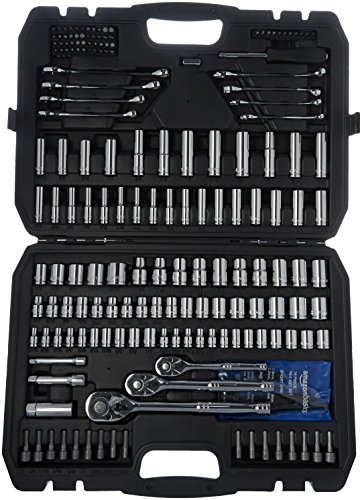
Best for the most sockets and bits per dollar
- 201 pieces across 1/4", 3/8" and 1/2" drives
- Chrome-vanadium forged, polished-chrome finish
- Full SAE + metric coverage
- Molded case keeps every socket in its slot
Why buy it: a socket-heavy kit that owners repeatedly call the best money-for-metal buy on Amazon — if your jobs are mostly nuts and bolts, nothing here gives you more drive tools for the outlay.

Best for trusted-brand tools with a lifetime guarantee
- 72-tooth reversible ratchets
- Alloy-steel sockets, off-corner loading grip
- Crescent lifetime warranty
- Closed, latching blow-mould case
Why buy it: an Apex Tool Group set that owners rate for genuine fit and finish — the off-corner grip protects rounded fasteners, and the lifetime backing means a cracked socket is a free swap.
Prices are pulled from Amazon and were accurate as of Aug 22, 2026, 6:54 PM EDT. Product prices and availability are subject to change — the live price is shown on Amazon.
What each tool actually tells you
These two tools get lumped together because both end up clipped to a ground and poked into a connector. But they answer fundamentally different questions, and understanding that difference is most of the value of this comparison.
A test light answers a binary question: is there voltage at this point? A bulb or LED sits between your probe tip and a ground clip. Complete the circuit and it glows. That is the whole design. It is fast, it needs no setup, and you can use it one-handed while your other arm is jammed behind a kick panel. What it cannot do is tell you how much voltage. A circuit sagging to 8 volts under load — enough to make a fuel pump run weakly or a relay chatter — will still light the bulb, and you will happily conclude the circuit is fine.
A digital multimeter answers the question with a number. Twelve-point-four volts. Zero-point-three volts. Forty-seven ohms. Open circuit. That number is what lets you decide whether a connection is good, marginal or dead, and it is the only way to check the components — sensors, grounds, coils, solenoids — that make up most of what actually fails on a modern vehicle. Owners consistently report the same progression: they buy a test light first because it is cheap, then buy a meter the first time a fault refuses to reveal itself to a glowing bulb.
The consensus among mechanics is blunt. A test light is a tracing tool; a multimeter is a diagnostic tool.

Voltage drop: the test only a multimeter can do
Here is the single most valuable thing a multimeter buys you, and the reason professional diagnostic training leans on it so heavily. Most automotive electrical faults are not clean breaks. They are high-resistance connections — corroded grounds, green pin terminals, a chafed wire down to two strands, a battery clamp with a film of oxide under it. The circuit still works, just badly.
A voltage-drop test finds those. You set the meter to DC volts, put one lead at each end of the section you suspect, and load the circuit — turn on the headlights, crank the starter, run the blower. The meter now reads the voltage being wasted across that section. On a healthy circuit the numbers are small and the accepted rules of thumb are widely published:
- Under 0.1 V across a single ground connection or a clean terminal.
- Under 0.2 V across a wire, switch or connector on a typical circuit.
- Under 0.5 V total on the whole positive side of a starter circuit, and under 0.2 V on the ground side.
Read 1.8 volts across a ground strap and you have just found the fault in about thirty seconds, without unwrapping a single harness. A test light cannot do this at all. It has no way to express "you are losing 1.8 volts here" — it will just glow, and you will keep looking. This one technique is why nearly every experienced tech would keep the meter and give up the light.
The same meter also handles battery state-of-charge (12.6 V rested, roughly 12.2 V at half charge), charging output (13.5–14.7 V at idle with the engine running), and parasitic draw on the milliamp range — the test that finds why a car goes flat over a weekend. If those checks sound useful, our jump starter buying guide covers the other half of that problem.

Why old test lights can damage modern modules
This is the part that gets glossed over on hardware-store packaging, and it matters more every model year. A classic incandescent test light works by passing real current through a filament bulb — commonly a quarter to half an amp. On a 1978 pickup that was harmless. On a 2026 vehicle it is not.
Modern cars are full of low-current circuits driven directly by control modules: body control modules, transmission controllers, airbag squib circuits, sensor reference feeds, LIN and CAN network lines. Many of these are designed to source only milliamps. Force a bulb's worth of current through a module's output driver and you can cook the driver, set permanent fault codes, or — on an airbag circuit — do something far worse. Service literature from most manufacturers now explicitly prohibits an incandescent test light on supplemental restraint and network circuits.
Two safe alternatives exist. A digital multimeter has roughly 10 megohms of input impedance, meaning it draws a few microamps and is effectively invisible to the circuit it is measuring — that is why meters are the default in factory diagnostic procedures. Or use an LED / computer-safe test light, which draws a tiny fraction of the current a bulb does. Owners consistently report LED testers as the sensible modern replacement for the old bulb style, and they cost about $20.
The one genuine advantage of the old bulb tester is the flip side of the same coin: because it loads the circuit, it will expose a connection so corroded it can supply voltage but not current. Keep it for high-current, module-free circuits like lighting and horn feeds.
What to look for when buying either one
Spec sheets vary wildly at these price points, and a few features do most of the work. For a multimeter:
- Auto-ranging. You will not have to guess whether a reading lives on the 2 V or 200 V scale. On a manual meter that guess is where beginners lose an afternoon.
- A CAT III 600 V safety rating with fused current inputs. Mandatory if you go anywhere near a hybrid or EV, and cheap insurance regardless.
- 10 A current range plus a milliamp range for parasitic-draw hunting.
- Min/Max capture, which catches the momentary dropout of an intermittent fault you would never see on a live display.
- Duty cycle and frequency if you plan to check injectors, idle-control valves or wheel-speed sensors, plus decent leads — a set of back-probe pins and small alligator clips transforms usability.
For a test light, keep it simple: buy the LED or "computer-safe" version, look for a sharp replaceable probe tip and a long lead with a real alligator clip, and prefer one that indicates both power and ground. A few models are dual-polarity, lighting one color for battery voltage and another for ground — genuinely handy when you are chasing a switched ground circuit. Both tools live comfortably in the same drawer as the rest of the kit in our garage tools guide.

Real cost and what each tool earns back
A capable auto-ranging multimeter is $25–$60. A CAT III automotive model with duty cycle and temperature runs $80–$200. A computer-safe LED test light is $20. The entire pairing costs less than a single hour of diagnostic labor at most shops, which now commonly runs $130–$200 per hour.
That is the real math. The most expensive electrical mistake is the parts-cannon approach — replacing a $220 alternator when the actual fault was 1.4 volts of drop across a corroded battery terminal, a problem a meter finds in a minute and a test light never finds at all.

Common myths and mistakes
"The test light lit up, so the circuit is good." This is the number-one error. A glowing bulb only proves some voltage is present. It proves nothing about whether the circuit can carry current under load, which is where most real faults live.
"12.6 volts at the battery means the battery is fine." Resting voltage is a state-of-charge reading, not a health reading. A battery can show 12.6 V and still collapse under a starter load. Voltage under crank, or a proper load test, is the real answer — the same logic that applies when picking between chemistries in our AGM vs flooded battery comparison.
"Any test light is fine on any circuit." Not on a modern car. Incandescent testers do not belong on airbag, network or module-driven circuits. Use an LED tester or the meter.
"A more expensive meter reads more accurately." Above the budget tier, extra money mostly buys safety rating, response speed and extra functions — not raw accuracy on a 12 V circuit. Spend the difference on better leads.
Which should you buy — and how to decide
Buy the multimeter first. It is the tool that can answer every question a test light can, plus the entire category of questions a test light cannot touch. If your electrical work extends past swapping fuses — sensors, grounds, charging problems, mystery battery drains, anything with a diagnostic trouble code attached — the meter is not optional. Pair it with a scan tool and our guide to reading OBD2 codes and you have a genuinely capable home diagnostic setup.
Add the test light second, because at $20 it is not really a competing purchase. It is faster than a meter for the specific job of walking a fuse box or confirming a feed while contorted under a dash, and it never needs a setting selected. Buy the LED or computer-safe version and it is safe on almost everything.
Buy only a test light if your work genuinely stops at lights, horns, fuses and trailer wiring on an older vehicle — and even then, expect to want a meter the first time something is intermittent.
The realistic answer for most enthusiasts is both, in that order, for well under $80 combined. Get the meter for the diagnosis and the light for the speed, and keep the incandescent one away from anything with a module behind it.
Recommended Products
Our top picks in this category, ranked on aggregated owner reviews.
Best for the best mix of brand pedigree, warranty and price
- 72-tooth ratchets for a 5° swing arc
- Polished chrome-vanadium, anti-slip sockets
- DEWALT full lifetime warranty
- Compact SAE + metric set in a blow-mould case
Why buy it: a name-brand kit that owners rate at the very top of the budget class — the lifetime warranty and fine-tooth ratchets punch well above the price, which is why it keeps getting recommended to first-time wrenchers.
Best for the most sockets and bits per dollar
- 201 pieces across 1/4", 3/8" and 1/2" drives
- Chrome-vanadium forged, polished-chrome finish
- Full SAE + metric coverage
- Molded case keeps every socket in its slot
Why buy it: a socket-heavy kit that owners repeatedly call the best money-for-metal buy on Amazon — if your jobs are mostly nuts and bolts, nothing here gives you more drive tools for the outlay.
Best for trusted-brand tools with a lifetime guarantee
- 72-tooth reversible ratchets
- Alloy-steel sockets, off-corner loading grip
- Crescent lifetime warranty
- Closed, latching blow-mould case
Why buy it: an Apex Tool Group set that owners rate for genuine fit and finish — the off-corner grip protects rounded fasteners, and the lifetime backing means a cracked socket is a free swap.

Best for a first-ever kit that covers the whole garage and house
- Sockets, wrenches, screwdrivers, hammer, pliers
- Heat-treated carbon steel, rust-resistant
- Compact blow-mould carry case
- One of Amazon’s best-selling tool kits
Why buy it: the entry point owners recommend for a first toolbox — rated across tens of thousands of reviews, it handles light auto work and household jobs without asking much of your wallet.
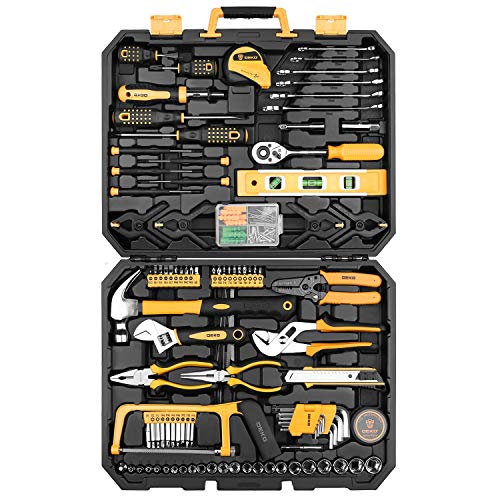
Best for a purpose-built car-repair combination
- 168-piece socket + wrench combination
- Ratchet handle, extension bars, spark-plug socket
- Chrome-vanadium and carbon-steel mix
- Deep plastic storage case
Why buy it: a combination set owners lean on for actual under-hood jobs — the spark-plug socket, extensions and combination wrenches mean fewer trips to buy the one tool you’re missing.

Best for the most complete kit before you leave the budget tier
- 201-piece mechanics set, SAE + metric
- 72-tooth quick-release ratchets
- Black-chrome sockets with laser-etched sizes
- Sturdy structural-foam case
Why buy it: the ceiling of the budget class — owners rate its ratchets and easy-read sockets highly, and the Stanley name carries a reputation that a no-name kit can’t match at the same money.
Prices are pulled from Amazon and were accurate as of Aug 22, 2026, 6:54 PM EDT. Product prices and availability are subject to change — the live price is shown on Amazon.