
Affiliate Disclosure
Some links on this page are affiliate links. As an Amazon Associate, we earn from qualifying purchases — at no extra cost to you. We do not buy, test, or physically handle the products we cover; our rankings come from aggregated owner reviews, ratings and expert consensus. Commissions never change our verdicts. How we rank & full disclosure.
Polish
An abrasive liquid that levels a few microns of clear coat to physically remove swirls, haze and light scratches. The correction it makes is permanent because the damaged layer is gone, not covered.
Best for: Anyone who wants defects genuinely removed before applying a sealant, coating or wax
Roughly $15–$30 for a 16 oz bottle; $25–$45 for premium German abrasive lines
- Permanently removes swirls, oxidation and light scratches instead of masking them
- Leaves bare, honest paint — exactly what a ceramic coating needs to bond to
- Modern diminishing abrasives finish down to a gloss that needs no follow-up refinement
- One correction can last years if the car is washed properly afterward
- Works by machine or by hand, so the same bottle covers a full correction or a spot fix
- Consumes clear coat — a finite resource of roughly 1.5–2.0 mils on most modern cars
- Slow: a full car by dual-action polisher realistically takes four to eight hours
- Needs a machine, pads and good lighting to reach its potential
- Careless use on edges and thin panels can burn through to primer
Glaze
A non-abrasive, oil- and polymer-rich product that fills and optically hides fine swirls while adding a deep, wet-looking shine. Nothing is removed — the defects are temporarily disguised.
Best for: Fast gloss before a car show, sale photos, or dark paint you do not want to correct yet
Roughly $12–$25 for a 16 oz bottle; body-shop-safe formulas at the upper end
- Adds noticeable depth and wetness on dark paint in under an hour
- Zero clear-coat consumption, so it is safe on thin or repainted panels
- Body-shop-safe formulas are silicone-free and let fresh paint continue to cure
- Very forgiving — hand application produces near-identical results to machine
- Purely cosmetic; every swirl returns as the fillers wash away
- Typically survives only one to three washes, or a few weeks of weather
- Must be topped with a wax or sealant or it offers almost no protection
- The oils it leaves behind will stop a ceramic coating from bonding
How they score, side by side
Scores reflect aggregated owner reviews and expert consensus — not our own bench testing.
- Real defect removal102
- Instant gloss and depth79
- How long the result lasts93
- Beginner friendliness510
- Coating and sealant prep101
- Safety on thin paint510
- Cost per finished car88
Spec-by-spec comparison chart
| Factor | Polish | Glaze |
|---|---|---|
| What it does | Removes clear coat to level defects | Fills and optically hides defects |
| Contains abrasives | Yes — diminishing or non-diminishing | No (or negligible) |
| Result on swirls | Permanently gone | Hidden until the fillers wash out |
| How long the look lasts | Years, if washing is careful | 1–3 washes / a few weeks |
| Clear coat consumed | ~0.1–0.5 microns per machine pass | None |
| Safe on repainted panels | With care — measure film thickness first | Yes — body-shop-safe formulas are common |
| Ceramic coating compatible | Yes — the correct prep step | No — oils block bonding |
| Time for a full car | 4–8 hours by dual-action machine | 45–90 minutes by hand |
| Typical bottle price | $15–$30 (16 oz) | $12–$25 (16 oz) |
| Skill required | Moderate — pad, speed and lighting matter | Beginner-friendly |
Our Top 3 Picks
The three highest-rated options in this category, if you'd rather skip straight to a proven pick.

Best for anyone who wants one do-it-all wax
- Synthetic hydrophobic polymer
- Deep, wet-look gloss
- 3–5 months of durability
- Kit includes pad + microfiber towel
Why buy it: the best balance of shine, months-long durability and beginner-easy application.

Best for maximum durability between coats
- 5–7 months of protection
- A little goes a long way
- Cheapest per use
Why buy it: nothing here survives weather longer — the durability champion.

Best for fast, cheap protection in minutes
- SiO₂ spray-on / wipe-off
- Fastest application here
- Strong water beading
Why buy it: the cheapest, fastest protection — spray on wet or dry and go.
Prices are pulled from Amazon and were accurate as of Aug 22, 2026, 6:54 PM EDT. Product prices and availability are subject to change — the live price is shown on Amazon.
What actually separates a polish from a glaze
Both bottles promise shine, both look like the same white liquid, and both get wiped on with a foam pad. That is where the similarity ends. A polish is an abrasive. A glaze is a filler. Understanding that single distinction resolves almost every question detailers argue about on forums.
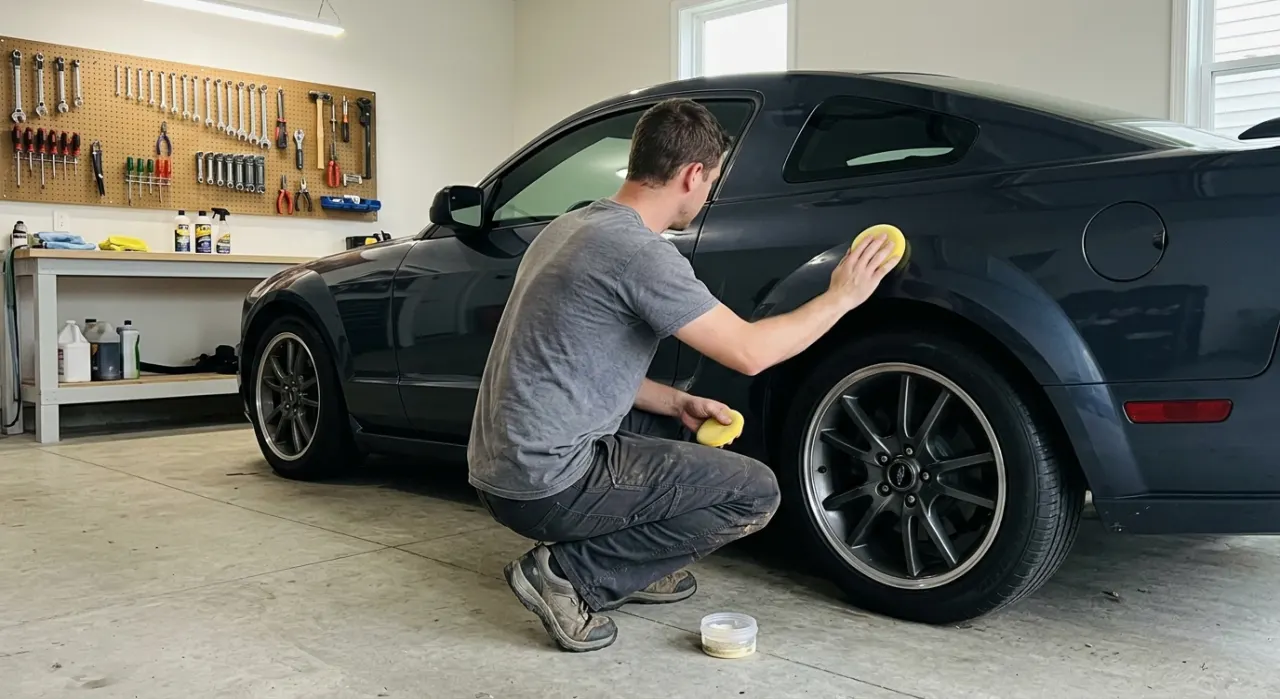
When you polish, microscopic abrasive particles suspended in a lubricating carrier shear away an extremely thin layer of clear coat — on the order of a few tenths of a micron per machine pass. The swirl marks and light scratches in your paint are trenches; polishing lowers the surrounding surface until the trenches are gone. The paint is now flat, light reflects evenly, and the gloss you see is the paint itself, not an additive. That correction is permanent. Wash the car a hundred times and those specific swirls will not come back.
A glaze does none of that. It is a blend of oils, polymers and often kaolin clay or similar fine minerals that flow into the trenches and level them optically. The refractive index of the filler is close enough to the clear coat that your eye stops seeing the scratch. Dark paint in particular takes on a wet, liquid depth that is genuinely hard to match with correction alone. But nothing has been repaired — you have applied a very good disguise, and disguises wash off.
The consensus among detailers is blunt about it: a glaze buys you an afternoon of looks, a polish buys you a year of them. Neither is a criticism — they are different tools, and most serious detailers own both.
How abrasive polish actually corrects paint
Polishes are graded by how aggressively they cut. At the mild end sit finishing polishes designed to refine an already-corrected surface; at the aggressive end sit compounds that remove sanding marks and deep defects. A true "polish" sits in the middle — enough cut for swirls and light oxidation, fine enough to leave a finish that needs no follow-up. If your defects are deeper than a polish can reach, you have crossed into compound territory, which is a genuinely different product class.
Two abrasive technologies dominate. Diminishing abrasives start coarse and break down as you work them, so a single product cuts hard early in the pass and finishes fine at the end — the classic German approach. Non-diminishing (SMAT) abrasives stay a uniform size for the whole pass, giving consistent, predictable results and a much shorter learning curve for beginners. Owner reviews consistently favor non-diminishing formulas for first-time machine polishers, simply because there is no technique window to get wrong.
The number that should govern how often you polish is clear-coat thickness. Factory clear on most modern vehicles runs roughly 1.5 to 2.0 mils — about 38 to 50 microns — and the general guidance among paint-correction professionals is to never remove more than around 25 percent of it over the car's life. Since a dual-action pass removes only a fraction of a micron, a properly executed correction every few years is not a threat. Repeatedly attacking the same panel with a rotary and a wool pad absolutely is. Our car polish guide walks through pad and abrasive pairings in more detail.
What a glaze is really doing to your finish
A glaze is deliberately engineered to leave residue behind. The oils sit in the surface texture, the polymers add a slick optical layer, and the result on black, dark blue or dark red paint is a depth that photographs extremely well. Detailers who prep cars for shows and dealership listings lean on glazes for exactly this reason — the before-and-after photos are real, they just are not durable.
The other reason glazes exist is fresh paint. Newly sprayed panels continue to outgas solvents for 30 to 90 days, and sealing them prematurely can trap those solvents and cause defects. Body-shop-safe glazes are silicone-free and vapor-permeable, so a shop can hand a customer a glossy car that is still curing underneath. If you have had a panel repainted recently, this is the one product category that is unambiguously correct to use.
Understand the trade-off though. Because those fillers are surface residue, anything that dissolves them takes the illusion with it. A car wash with a strong alkaline soap, a couple of rain cycles, or a panel wipe with isopropyl alcohol will strip a glaze in minutes and reveal exactly the swirls that were there before. That is not a defect in the product — it is the product working as designed.
Where each one belongs in your detailing order
Order matters more than product choice here, and getting it wrong is the single most common mistake. The correct sequence for a full exterior detail is:
- Wash and decontaminate — iron remover and clay to pull embedded contamination out of the paint, because polishing over grit just drags it around. See our decontamination guide for the full process.
- Polish — correct the defects while the paint is bare and you can actually see what you are fixing.
- Glaze (optional) — only if you stopped short of full correction and want to hide what is left, or you want extra depth on dark paint.
- Seal it — wax or synthetic sealant over the glaze, since the glaze itself offers essentially no protection and needs something on top to hold it in place.
There is one hard rule: never glaze before a ceramic coating. Coatings bond to clean, bare clear coat, and the oils in a glaze prevent that bond from forming. Any coating instruction sheet will tell you to do an isopropyl alcohol panel wipe first — which strips the glaze anyway — so the step is wasted at best and a bonding failure at worst. If a coating is the plan, polish, wipe down, and coat. Our ceramic coating guide covers that prep sequence in full.
Cost and time over a year of detailing
On raw bottle price the two are nearly identical, so cost only becomes interesting once you count labor and repeat applications. A 16 oz bottle of quality polish runs $15 to $30 and, used by machine, is enough for four to eight full-car corrections. Spread over the three or so years a correction typically holds, the material cost is trivial — the real investment is the dual-action polisher and pads, usually $130 to $250 as a starter kit, plus four to eight hours of your weekend.
A glaze bottle costs about the same but gets consumed far faster because you are reapplying it every few washes. Someone glazing a dark car monthly will burn through two or three bottles a year and spend roughly an hour each time — more total labor than a single annual polish. The math flips hard in polish's favor for anyone keeping a car long-term.
Where a glaze genuinely wins on cost is the one-off scenario: you are photographing the car to sell it next weekend, or the paint is thin enough that correction is risky. Twenty dollars and an hour to make a tired finish look sharp is excellent value, and no amount of polishing gets you that result in that timeframe.
Common myths and mistakes
"A glaze will fix my swirls." It will hide them, convincingly, for a few weeks. Owners who believe otherwise are the ones surprised when the swirls "come back" after two washes. Nothing came back — nothing left.
"Polish adds protection." It does not. A pure polish leaves bare, unprotected clear coat that will oxidize if left that way. Correction and protection are two separate steps, which is why every proper detail ends with a wax, sealant or coating on top.
"All-in-one products make both obsolete." All-in-ones do combine light abrasives, fillers and a protectant, and they are legitimately useful for a quick refresh. But they compromise on all three jobs, and the fillers make them a poor choice under a coating. Dedicated products still win when the result matters.
"Polishing is dangerous, so I'll just glaze forever." A dual-action polisher with a soft finishing pad and a mild polish is remarkably difficult to damage paint with — the machine stalls before it burns. The genuine risk lives with rotary polishers, aggressive wool pads, and thin edges, not with a beginner working carefully on a flat panel.
Which should you buy — and how to decide
There is no single winner, because they are not competing. Match the product to the outcome you actually want.
Buy the polish if you want the paint genuinely improved, you are prepping for a sealant or ceramic coating, or your car has visible swirls under direct sunlight that bother you every time you walk up to it. This is the choice that compounds in value — correct it once, wash it properly, and you are maintaining a good finish rather than chasing one.
Buy the glaze if you have a dark car you are not ready to correct, a freshly repainted panel that is still curing, thin or previously-polished paint you would rather not thin further, or a deadline — a show, a sale listing, a photo shoot — where an hour of work needs to look like a day of it.
Buy both if you are building a real detailing kit. Polish in the spring, glaze before events, and seal whichever you finished with. That combination — correct, enhance, protect — is what the finish on a genuinely well-kept car is actually built from, and it is covered end to end in our exterior protection guide.
Recommended Products
Our top picks in this category, ranked on aggregated owner reviews.
Best for anyone who wants one do-it-all wax
- Synthetic hydrophobic polymer
- Deep, wet-look gloss
- 3–5 months of durability
- Kit includes pad + microfiber towel
Why buy it: the best balance of shine, months-long durability and beginner-easy application.
Best for maximum durability between coats
- 5–7 months of protection
- A little goes a long way
- Cheapest per use
Why buy it: nothing here survives weather longer — the durability champion.
Best for fast, cheap protection in minutes
- SiO₂ spray-on / wipe-off
- Fastest application here
- Strong water beading
Why buy it: the cheapest, fastest protection — spray on wet or dry and go.

Best for first-timers who want a foolproof shine
- Foolproof carnauba liquid
- Warm, wet look
- Wipes off clean even if it dries
Why buy it: almost impossible to mess up — the perfect first wax.

Best for show cars and dark paint
- Premium carnauba paste
- Concours-grade warm gloss
- Easy to apply for a paste
Why buy it: stunning depth on dark paint — a show finish you use for the ritual.

Best for detailing hobbyists chasing gloss
- Soft carnauba paste
- Excellent gloss
- Buffs off easily
Why buy it: a detailing-hobbyist favorite that finishes beautifully.
Prices are pulled from Amazon and were accurate as of Aug 22, 2026, 6:54 PM EDT. Product prices and availability are subject to change — the live price is shown on Amazon.