
Affiliate Disclosure
Some links on this page are affiliate links. As an Amazon Associate, we earn from qualifying purchases — at no extra cost to you. We do not buy, test, or physically handle the products we cover; our rankings come from aggregated owner reviews, ratings and expert consensus. Commissions never change our verdicts. How we rank & full disclosure.
Snow Foam
A touchless pre-wash. You spray a thick layer of high-cling foam through a foam cannon or foam gun, let it dwell for several minutes while the surfactants lift and encapsulate loose grit, then rinse it away before a mitt ever touches the paint.
Best for: Owners who want to cut swirl marks on dark paint, and anyone washing a genuinely filthy vehicle
About $20–$45 per gallon of dedicated foam, plus $30–$100 for a cannon and $120–$350 for a pressure washer
- Removes a large share of loose grit before any physical contact — the single biggest swirl-prevention step available
- Softens bonded road film and bug residue so the contact wash needs far less pressure
- Covers areas a mitt struggles to reach, including grilles, lower rockers and wheel arches
- pH-neutral formulas are safe over wax, sealant and ceramic coatings
- Alkaline traffic-film formulas like Bilt Hamber Auto-Foam clean aggressively on neglected vehicles
- Cannot replace a contact wash — it will not remove bonded road film on its own
- Requires equipment, and a pressure washer is the real cost barrier
- Higher cost per wash than shampoo, often two to five times as much
- Alkaline and traffic-film formulas will strip wax and shorten sealant life
Car Shampoo
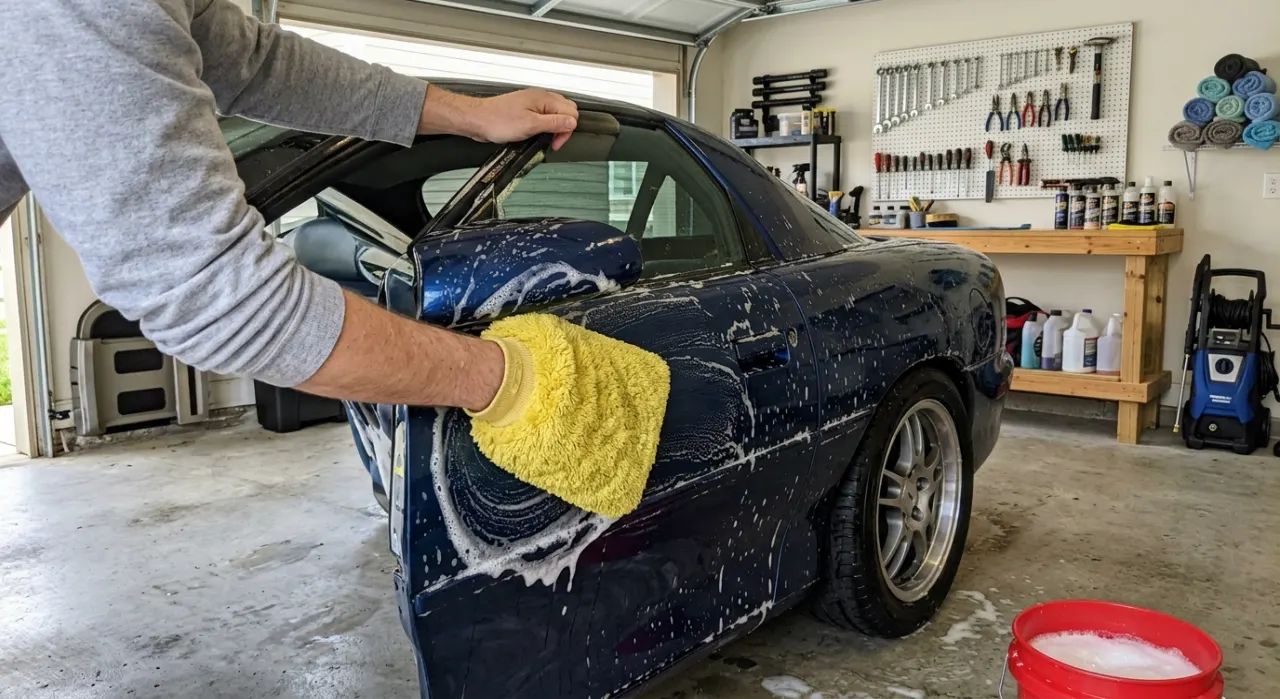
The contact-wash soap that goes in your bucket. Its main job is not cleaning power at all — it is lubrication, creating a slick barrier that lets a wash mitt glide over trapped particles instead of grinding them into the clearcoat.
Best for: Every car, every wash — this is the non-optional product in the entire washing process
About $15–$40 per gallon, working out to roughly $0.30–$0.75 per wash
- Provides the lubrication that actually prevents a mitt from scratching paint — nothing else does this job
- Genuinely removes bonded road film, which a touchless foam cannot
- Cheapest step in the process by a wide margin at well under a dollar per wash
- Needs no equipment beyond two buckets, a grit guard and a mitt
- pH-neutral formulas preserve wax, sealant and ceramic coatings indefinitely
- Involves physical contact, so poor technique still creates swirls
- Does little for heavy grit unless the car is thoroughly pre-rinsed first
- Foaming ability in a bucket is mostly cosmetic and tells you little about quality
- Cheap supermarket soaps often contain gloss enhancers or degreasers that strip protection
How they score, side by side
Scores reflect aggregated owner reviews and expert consensus — not our own bench testing.
- Swirl prevention96
- Cleaning power on bonded film59
- Cost per wash59
- Equipment required49
- Speed of a full wash68
- Safe on coated paint89
- Essential to own510
Spec-by-spec comparison chart
| Factor | Snow Foam | Car Shampoo |
|---|---|---|
| Role in the wash | Pre-wash — step one, touchless | Contact wash — step two, with a mitt |
| Primary job | Lift and encapsulate loose grit | Lubricate the mitt and remove bonded film |
| Equipment needed | Foam cannon or foam gun; pressure washer for best results | Two buckets, grit guard, wash mitt |
| Typical dwell time | 3–7 minutes, never allowed to dry | Panel by panel, rinsed as you go |
| Typical dilution | 100–200 ml of product in the cannon bottle | 1–2 oz per 4-gallon bucket |
| Cost per wash | Roughly $1–$3 | Roughly $0.30–$0.75 |
| Removes bonded road film | Partially — softens it, rarely removes it | Yes — this is what contact washing is for |
| Safe over wax and coatings | pH-neutral formulas yes; alkaline TFR no | pH-neutral formulas yes |
| Swirl-mark risk | Essentially zero — no contact | Real, and entirely dependent on technique |
| Can it replace the other | No — a foam-only wash leaves bonded film behind | Yes, if you pre-rinse thoroughly first |
| Entry cost to start | $150–$450 including a pressure washer | $25–$60 including buckets and a mitt |
Our Top 3 Picks
The three highest-rated options in this category, if you'd rather skip straight to a proven pick.

Best for Beginners who want one box that does everything well
- 14 matched pieces covering wash, protect and interior
- Includes shampoo, spray sealant and interior cleaner
- Comes with microfiber towels and applicators
- Products are designed to work together as a system
Why buy it: It is the closest thing to a complete detail in a single box, which is exactly what a first-timer needs — no guesswork about whether the pieces play nicely together.

Best for Enthusiasts who want top-shelf formulas from the start
- Premium formulas with a genuinely slick finish
- Excellent spray sealant and glass cleaner
- High-quality plush microfiber included
- Strong resale-grade presentation and packaging
Why buy it: You pay more, but the products themselves are a noticeable step up in slickness and gloss — the kit you buy when you know you are hooked.

Best for Getting proven, forgiving products for a fair price
- Trusted formulas that are hard to get wrong
- Covers wash, wax and interior basics
- Widely reviewed and consistently reliable
- Great balance of price and performance
Why buy it: Meguiar's has been dialing in beginner-friendly products for decades, and this kit is the safe, sensible middle — nothing flashy, nothing you will regret.
Prices are pulled from Amazon and were accurate as of Aug 22, 2026, 6:54 PM EDT. Product prices and availability are subject to change — the live price is shown on Amazon.
They do completely different jobs
This comparison exists because of a naming problem. Both products foam, both are labeled for washing cars, and both sit on the same shelf — so people reasonably assume they compete. They do not. They occupy different positions in the same process.
Snow foam is a pre-wash. Its entire purpose is to clean the car without touching it. High-cling surfactants blanket the panel, dwell for several minutes, chemically loosen and encapsulate loose dirt, then carry it off the paint when you rinse. Nothing physical goes near the clearcoat during this step, which is exactly the point.
Car shampoo is a lubricant first and a cleaner second. When you wipe a mitt across a panel, some particles will inevitably still be there. Shampoo builds a slick, cushioned film that lets those particles roll and float rather than being dragged. Its detergency matters too — bonded road film genuinely needs contact and surfactant to come off — but the lubrication is what protects your paint.
Put plainly: snow foam reduces how much grit reaches the mitt. Shampoo reduces the damage done by the grit that gets through. Skipping either one has a different consequence, which is why the consensus among detailers is to use both in sequence rather than pick a side.
The chemistry: cling, dwell and pH
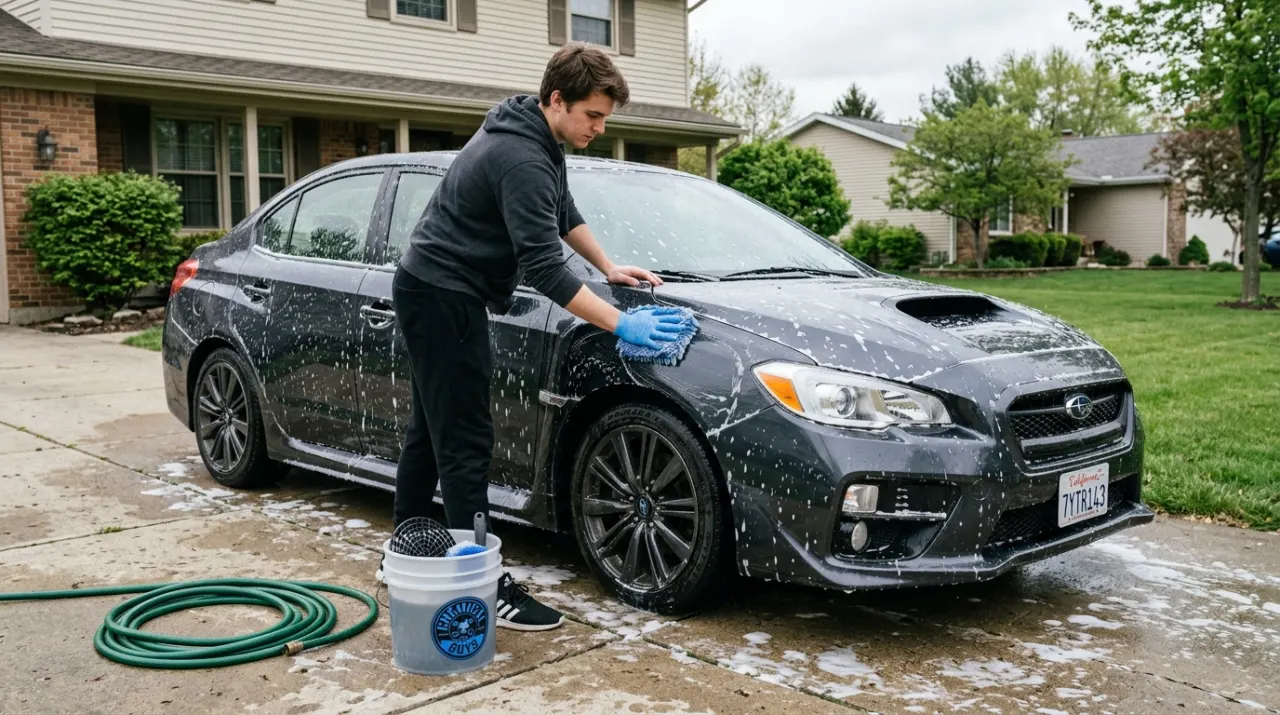
What separates a good snow foam from a mediocre one is not how thick the foam looks. It is how long the foam clings to a vertical panel while staying wet enough to keep working. A stiff, shaving-cream foam that slides off in ninety seconds is doing less than a slightly wetter foam that stays put for five minutes.
That dwell window is where the chemistry happens. Surfactants need time to wet the dirt, break its bond with the paint, and lift it into suspension. Rinse after one minute and you have wasted most of the product. The working range owners consistently report as effective is 3–7 minutes, and the hard rule is that the foam must never be allowed to dry on the paint — in direct sun or on a hot panel, cut the dwell short and rinse.
pH is the other axis, and it decides whether the product is safe over your protection:
- pH-neutral snow foams — Adam’s Mega Foam, Chemical Guys Honeydew, Gyeon Q²M Foam — are gentle enough to use weekly over wax, sealant or a ceramic coating without shortening its life.
- Alkaline foams and traffic-film removers — Bilt Hamber Auto-Foam is the best-known example — clean dramatically harder on neglected or work-truck grime, but they will strip wax and degrade a sealant. Use them on an uncoated car, or on a coated car occasionally and knowingly.
Shampoo chemistry runs on the same pH logic. A quality pH-neutral shampoo cleans without touching your last step protection, while cheap supermarket soaps strip wax because they contain degreasers or are deliberately alkaline. Dish soap is the worst offender and should never go near paint. We work through the options in our guide to the best car wash soap.
One more distinction: many shampoos advertise that they work in a foam cannon. They do produce foam. What they generally will not do is cling for five minutes, because shampoo is not formulated for vertical dwell. It is a workable stopgap, not an equivalent.
What a foam pre-wash really does for swirl marks
Here is the honest accounting, because snow foam gets both oversold and dismissed.
Virtually every swirl mark on a daily-driven car came from a wash — a hard particle trapped between a mitt and the clearcoat, dragged under pressure. Everything in a good wash process is aimed at that one failure mode.
A foam pre-wash attacks it at the source. Removing loose grit touchlessly means the mitt meets fewer particles on its first pass, which is the pass that does most of the damage. Owners with black and dark blue paint consistently report the clearest improvement, because those colors show marring most.
What snow foam does not do is make contact washing safe by itself. It will not remove bonded road film, brake dust keyed into the finish, or the gray haze that builds on lower panels. Those need mechanical contact with a lubricated mitt.
It also does not compensate for bad technique. If you use one bucket, a sponge and circular motions, foam will not save you. The two-bucket method with a grit guard, straight-line motions and separate mitts for upper and lower panels does far more than any product. Foam is the amplifier, not the foundation — our guide to preventing swirl marks puts the sequence in order.
The equipment question, honestly
Shampoo needs two buckets, a grit guard and a decent mitt — call it $25–$60 to be properly set up. There is no barrier here. Snow foam is a different conversation, because the product is the cheap part and the delivery system is not.
- A foam cannon attaches to a pressure washer and produces the thick, clinging foam the technique depends on. Cannons run roughly $30–$100 — the MTM Hydro PF22 and Chemical Guys TORQ are the two most-recommended. But it needs a pressure washer, realistically 1.2 GPM and 1,200 PSI or better, which is another $120–$350.
- A foam gun attaches to a garden hose and costs $25–$50 with no pressure washer required. Hose pressure produces a thinner, wetter foam with less cling and shorter dwell — meaningfully better than nothing, meaningfully worse than a cannon. Our foam cannon vs foam gun comparison covers where that line falls.
So the true entry cost for snow foam, if you do not already own a pressure washer, is roughly $150–$450 — that is the number to weigh, not the $25 jug of foam. If you do own one, the barrier collapses to the price of a cannon and you should almost certainly add the step.
Real cost per wash and over a year
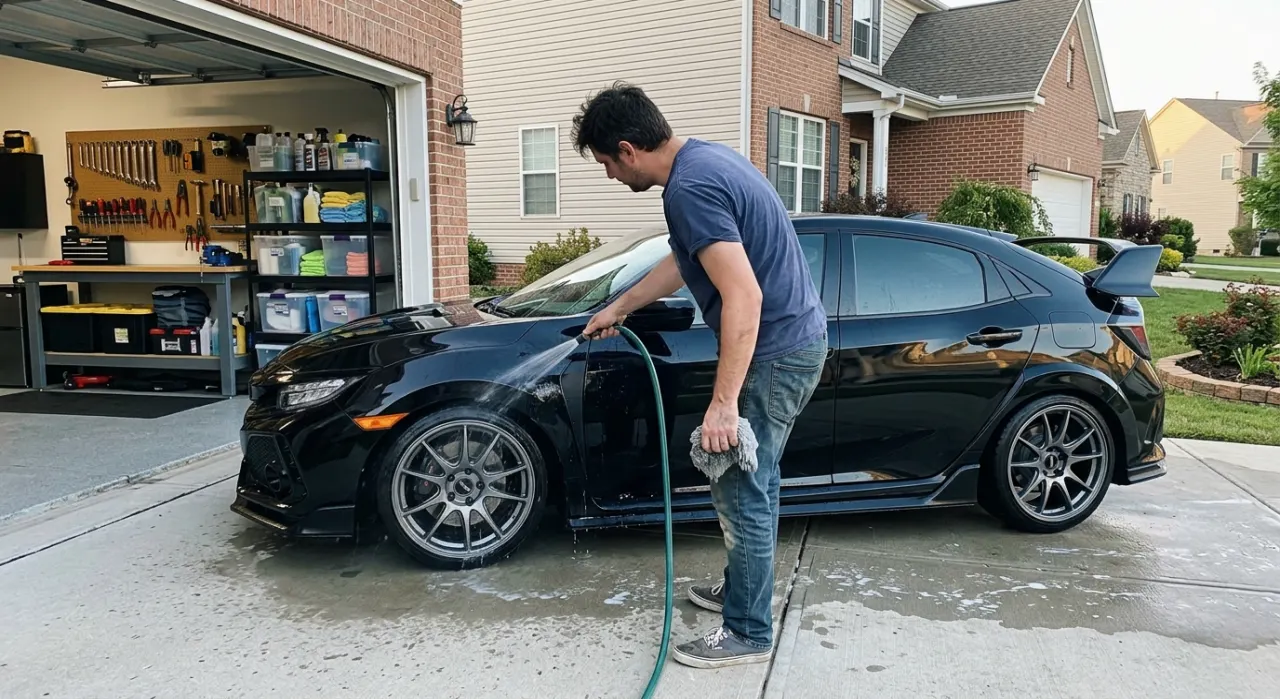
Shampoo is remarkably cheap in use. A gallon runs $15–$40, you use 1–2 ounces per bucket, and that works out to roughly $0.30–$0.75 per wash. A single gallon comfortably covers a year of weekly washing.
Snow foam costs more per use because you dispense 100–200 ml of concentrate into the cannon bottle each time. At $20–$45 per gallon, that lands around $1–$3 per wash — two to five times the shampoo cost. Over a year of weekly washing, shampoo alone might cost $25–$40, while adding a foam pre-wash pushes the consumables bill to roughly $80–$180. Neither figure is large; the equipment is what decides affordability.
Weigh that against the alternative. A single-stage machine polish to remove wash-induced swirls runs $300–$800 at a professional shop, and every correction removes a few microns of clearcoat you never get back. From that angle, $100 a year in foam is cheap insurance on a dark-colored car you plan to keep — and a harder case on a white commuter with 60,000 miles of existing marring. See our picks for the best foam cannon soap.
Common myths and mistakes
"Snow foam can replace washing the car." The most costly misunderstanding here. Foam is touchless and removes loose grit only. Bonded road film needs contact. A foam-only routine leaves a car that looks clean wet and dull dry, and the film builds week after week.
"Thicker foam means better cleaning." Cling and dwell matter far more than density. A wetter foam that stays on a vertical panel for five minutes outperforms a stiff foam that slides off in ninety seconds. Thickness photographs well; it does not clean well.
"Any car shampoo works fine in a foam cannon." It will foam, but most shampoos are not formulated for vertical cling and will run off before the surfactants have done their work. It is a reasonable stopgap, not a substitute for a dedicated foam.
"Dish soap is basically car shampoo." It is a degreaser. It strips wax, sealant and coating protection, dries out trim and rubber, and provides poor lubrication — the exact opposite of what a wash soap is designed to do.
"Longer dwell is always better." Only while it stays wet. Foam that dries on paint leaves residue and, on a hot panel, marks that need polishing. Work in shade and rinse before it dries.
Which should you buy — and how to decide
Buy car shampoo first, always. It is the non-negotiable product in the process, it costs almost nothing per wash, it needs no equipment, and no other product does the lubrication job it does. Choose a pH-neutral formula and pair it with two buckets and a grit guard.
Add snow foam when the math works for you. If you already own a pressure washer, buy a cannon and a pH-neutral foam — the upgrade is inexpensive and the swirl reduction is real. If you do not, be honest about the $150–$450 entry cost and decide whether your paint and climate justify it.
Choose a foam gun if you want the pre-wash benefit on a garden hose and can accept thinner foam with less cling. It beats a plain rinse, particularly on a moderately dirty car. Pick alkaline over pH-neutral only for uncoated vehicles, work trucks or seasonal deep cleans — on a waxed or coated car, a strong traffic-film remover shortens the life of the protection you paid for.
The realistic ideal for most enthusiasts is the full sequence: rinse, foam, dwell, rinse, two-bucket contact wash with a pH-neutral shampoo, then dry with a plush towel or blower. Every step is aimed at the same thing — keeping hard particles from being dragged across your clearcoat.
Recommended Products
Our top picks in this category, ranked on aggregated owner reviews.
Best for Beginners who want one box that does everything well
- 14 matched pieces covering wash, protect and interior
- Includes shampoo, spray sealant and interior cleaner
- Comes with microfiber towels and applicators
- Products are designed to work together as a system
Why buy it: It is the closest thing to a complete detail in a single box, which is exactly what a first-timer needs — no guesswork about whether the pieces play nicely together.
Best for Enthusiasts who want top-shelf formulas from the start
- Premium formulas with a genuinely slick finish
- Excellent spray sealant and glass cleaner
- High-quality plush microfiber included
- Strong resale-grade presentation and packaging
Why buy it: You pay more, but the products themselves are a noticeable step up in slickness and gloss — the kit you buy when you know you are hooked.
Best for Getting proven, forgiving products for a fair price
- Trusted formulas that are hard to get wrong
- Covers wash, wax and interior basics
- Widely reviewed and consistently reliable
- Great balance of price and performance
Why buy it: Meguiar's has been dialing in beginner-friendly products for decades, and this kit is the safe, sensible middle — nothing flashy, nothing you will regret.

Best for The cheapest way to cover the basics in one buy
- Lowest entry price of the group
- Covers wash, wheels, glass and interior
- Available almost everywhere
- Simple products that are easy to use
Why buy it: If you just want to stop washing your car with dish soap and a bath towel, this gets you a real detailing setup for pocket change.

Best for People who want maximum product and a storage bucket
- Large bundle with a bucket and grit guard included
- Full-size bottles of core products
- Foam and wash gear bundled in
- Everything stores neatly in the bucket
Why buy it: The bucket doubles as storage and a two-bucket wash setup, and the full-size bottles mean you are not restocking after two washes.

Best for Buying local at any auto parts store today
- Stocked at nearly every parts store
- Reliable wax and cleaner formulas
- Easy to top up individual bottles later
- Long-standing reputation with hobbyists
Why buy it: When you want to start today and not wait on shipping, Mothers is on a shelf near you — and the products genuinely hold up.
Prices are pulled from Amazon and were accurate as of Aug 22, 2026, 6:54 PM EDT. Product prices and availability are subject to change — the live price is shown on Amazon.