
Affiliate Disclosure
Some links on this page are affiliate links. As an Amazon Associate, we earn from qualifying purchases — at no extra cost to you. We do not buy, test, or physically handle the products we cover; our rankings come from aggregated owner reviews, ratings and expert consensus. Commissions never change our verdicts. How we rank & full disclosure.
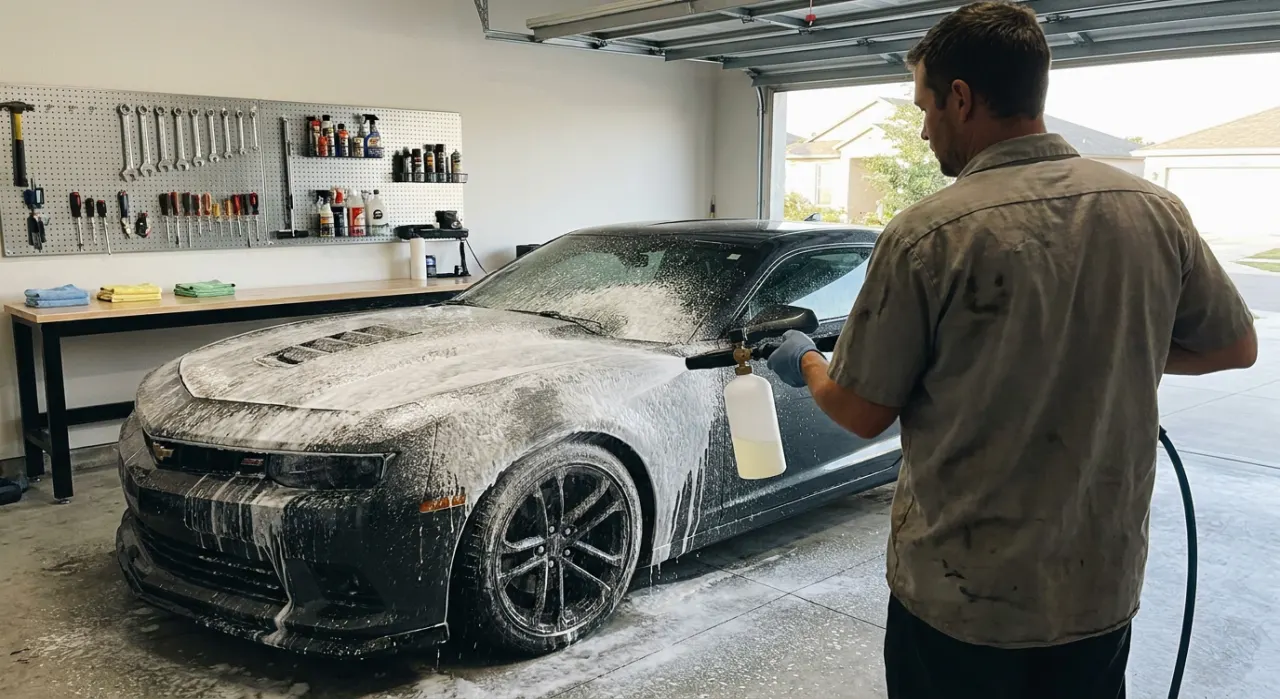
Short version: Mix a dedicated foam soap at roughly 1 to 3 oz per 32oz bottle, set your cannon's fan wide and the soap knob rich, blanket the car top to bottom, let it dwell 3 to 5 minutes out of direct sun, then rinse. Foam is a pre-wash that loosens grit so your wash mitt does less scrubbing and leaves fewer scratches.
What foam actually does (and does not do)
The first time I ran a foam cannon, I expected the car to come out clean just from the suds. It did not. What foam really does is buy you time and reduce risk. It clings to the panel, softens the bonded road film, and encapsulates loose grit so that when you rinse, a good chunk of the dirt sheets off before your mitt ever touches the paint. Every particle that rinses away in the foam stage is one that will not get dragged across your clear coat later.
Think of it like a warm-up lap before you push hard. You are not setting the fastest time on the foam pass. You are setting up the contact wash to go clean and controlled. That mindset shift is what separates a foam wash that protects paint from one that just looks dramatic on the driveway.
The gear and the mix
You need three things working together: a pressure washer with enough flow, a foam cannon matched to it, and a soap built for high foaming. If any one of those is weak, your foam will be thin no matter what you do. If you are still choosing hardware, start with our top picks in the best foam cannon roundup, and match it to your washer using the foam cannon vs foam gun breakdown so you buy the right tool for your setup.
For the mix, I start conservative and build up. Put 1 to 3 oz of soap into a 32oz cannon bottle and fill the rest with water. Warm water dissolves and foams a little better than cold. Give it a gentle swirl rather than a hard shake so you are not filling the bottle with air. The exact ratio depends heavily on your soap, which is why we keep a full dilution ratio cheat sheet you can reference for specific products.
- Too thin? Add more soap in half-ounce steps, or check your water pressure.
- Foaming but not clinging? Your soap may be a wash shampoo, not a snow-foam. Foam-specific soaps are formulated to hold on the panel.
- Runs out fast? A 32oz bottle covers a sedan in one fill if your mix is efficient. If you are refilling mid-car, you are over-dosing soap.
Dialing in the cannon
Most cannons have two adjustments: a soap ratio knob on top and a fan spray adjustment at the nozzle. The knob controls how much soap solution gets pulled into the stream. The nozzle controls the spray pattern, from a wide fan to a tight stream. For laying down a thick blanket, I run the soap knob rich and the fan open wide so the foam spreads across the panel instead of drilling into it.
If you are getting a watery spray instead of shaving-cream foam, the usual culprits are dilution, orifice size, or not enough pressure at the cannon. We wrote a whole troubleshooting guide for exactly this, so if your foam looks sad, jump to foam cannon not foaming and how to fix it before you blame the soap.
One thing worth knowing early: the thickest possible foam is not always the goal. Ultra-dense foam looks incredible but can sit on top of the dirt rather than flowing down and lifting it. A slightly wetter, self-sheeting foam often cleans better because it moves. Aim for foam that clings but still slowly runs off, carrying grime with it.
The technique, step by step
Here is the sequence I run every time. It is not complicated, but the order matters.
- Rinse first. Give the whole car a plain water rinse to knock off loose dust and grit. Foaming over dry, gritty paint is asking for scratches.
- Foam bottom to top for coverage, then top to bottom for dwell. I like to apply generously starting low so I can see coverage, making sure the dirtiest lower panels get the most product.
- Blanket the whole car. Roof, glass, hood, doors, lower rockers. The lower quarter of the car and behind the wheels is where the real grime lives, so hit it heavier there.
- Let it dwell 3 to 5 minutes. Do not let it dry. In heat, shorten this and stay in the shade.
- Rinse thoroughly, top down. Watch how much dirt sheets away in the foam. That is the whole point.
After the foam rinse, this is where you decide: is the car clean enough, or does it need a contact wash? On a garaged weekend car that only gets light dust, a foam-and-rinse can genuinely be enough. On a daily driver with weeks of highway film, foam is step one and you follow with a proper two-bucket mitt wash.
Dwell time, sun, and the mistakes I made early
The single biggest rookie error is foaming a hot car in direct sun. The foam flashes, the water evaporates, and you are left with soap residue drying onto warm paint, which can leave streaks and even light etching over time. Always work on a cool panel in shade. Early morning or a shaded garage bay is ideal. If you have no choice but to work in sun, cut dwell time hard and rinse in sections rather than doing the whole car at once.
The second mistake is treating dwell time like a competition. Longer is not better. Once the foam has done its softening job, extra minutes only increase the risk of it drying. Three to five minutes is plenty for a maintenance wash. If the car is filthy enough that you think it needs ten minutes of dwell, what it actually needs is a dedicated pre-soak product and a proper contact wash, not more foam sitting there.
Where foam fits in the whole wash
Foaming is one stage, not the entire job. A complete safe wash looks like this: pre-rinse, foam pre-wash, dwell, rinse, then a contact wash with the two-bucket method and a plush mitt, followed by drying with a clean towel. The foam stage exists to make the contact stage safer. Skip it and your mitt does all the grunt work, picking up and dragging more grit. Add it and you dramatically cut the odds of putting fresh swirls into your paint.
If you want to build the full picture around this, the Foam Cannon hub ties together technique, gear and troubleshooting, and once you have your process down and want to lock in soap choice, our best foam cannon soap guide covers the products that actually blanket a car instead of trickling off.
Quick recap
Use foam as a pre-wash, not a magic clean. Mix a foam-specific soap at 1 to 3 oz per bottle, run the cannon rich and the fan wide, blanket the car, dwell 3 to 5 minutes out of the sun, and rinse. Then decide whether to follow with a contact wash. Do that consistently and you will get cleaner paint with fewer scratches, which is the entire reason a foam cannon earns its spot in your kit. When you are ready to upgrade the hardware, see our top foam cannon picks.
Recommended Products
We aggregate owner reviews rather than test gear ourselves. Thick foam is a team effort — a cannon matched to your pressure washer plus a real snow-foam soap. These are the cannons and soaps owners rate for exactly that.

Best for most pressure-washer owners who want thick foam without overspending
- 1/4in quick connector fits most pressure washers
- Adjustable soap knob and fan spray
- Enormous, satisfied owner base
- Reliable thick foam once dialled in
Why buy it: the safe default — the settings this guide describes (rich knob, wide fan) work straight out of the box on this one.
Best for enthusiasts chasing the thickest, most consistent shaving-cream foam
- Wide-mouth bottle and premium build
- Renowned for dense, clinging foam
- Fully adjustable output
- A detailer favourite
Why buy it: the step-up cannon if foam thickness is the whole point for you — built to lay down a heavy blanket.

Best for buyers who want a well-engineered cannon with strong adjustability
- Thicker-foam nozzle technology
- Precise soap and pattern control
- Solid, refined build quality
- Popular in the detailing community
Why buy it: a refined, highly adjustable cannon for owners who like to fine-tune every wash.
Best for a dedicated snow-foam that clings instead of trickling off
- Formulated as a high-foaming pre-wash
- Clings to panels to soften grime
- Dilutes economically at 1-3oz per bottle
- A staple foam soap
Why buy it: the soap half of the equation — foam thickness depends far more on soap than on gas-vs-electric, and this is built for it.
Best for maximum dwell — foam that hangs on the panel to lift dirt
- Extra-clinging formula for longer dwell
- Thick, slow-running foam
- Pairs well with any quality cannon
- Good grime-softening pre-wash
Why buy it: the pick when you want the foam to sit and work rather than run straight off.

Best for buyers who want a recognised brand at an approachable price
- Adjustable foam and spray
- Widely available and supported
- Large owner base
- Solid entry into foam washing
Why buy it: a supported big-brand option if you would rather buy a familiar name to get started.
Prices are pulled from Amazon and were accurate as of Aug 22, 2026, 6:54 PM EDT. Product prices and availability are subject to change — the live price is shown on Amazon.