
Affiliate Disclosure
Some links on this page are affiliate links. As an Amazon Associate, we earn from qualifying purchases — at no extra cost to you. We do not buy, test, or physically handle the products we cover; our rankings come from aggregated owner reviews, ratings and expert consensus. Commissions never change our verdicts. How we rank & full disclosure.
Every year, people die working under cars that have fallen on them. Not because they were reckless. Not because they were idiots. Because they skipped one step, used the wrong gear, or trusted something that looked solid enough. This page exists to be blunt about what those mistakes are, because the consequences are permanent.
If you are planning to jack up your car for an oil change, brake job, or any reason at all, read this first. Then read our complete guide to jacking up a car safely before you touch a jack handle.
The Mistakes That Actually Kill and Injure People
Mistake 1: Going Under the Car Supported Only by a Jack
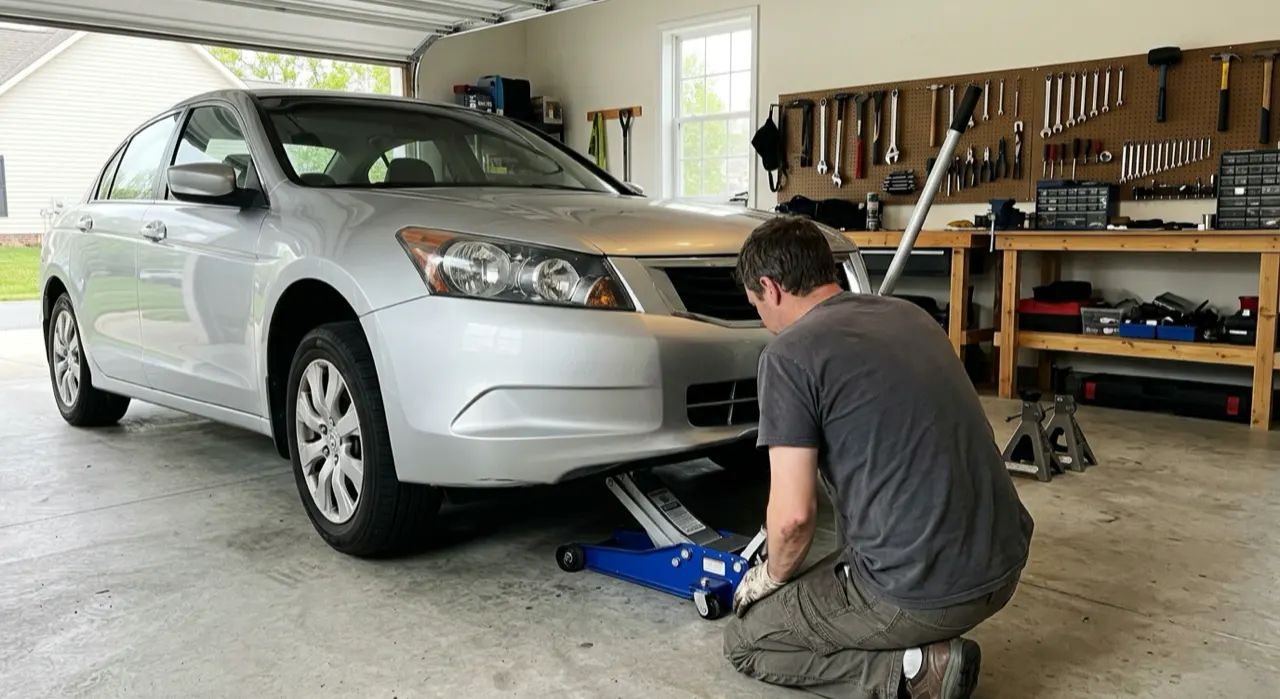
This is the one that puts people in the ground. A hydraulic floor jack, a scissor jack, a bottle jack — none of them are designed to hold a car stationary while you work under it. They are lifting devices. They fail. Seals leak. Hydraulic pressure bleeds off slowly. A bump, a vibration, the car shifting its weight — and the jack tips or drops.
People search “working under a car on a jack” constantly, which tells us this is extremely common. It is also extremely dangerous. If you do not have rated jack stands under the vehicle before you go under it, you do not go under it. Full stop. There is no shortcut here, no “just for a few minutes,” no exception.
Read more about why stands are non-negotiable in our article on whether you need jack stands.
Mistake 2: Using Bricks, Blocks, Concrete, or Timber as Stands
If you are asking “is it safe to use bricks instead of jack stands,” the answer is no. Not even close. Bricks fracture under load. Concrete blocks crack. Timber compresses, splits, and rolls. None of these materials are load-rated for dynamic vehicle weight, and none of them fail predictably — they fail suddenly.
People have died with a car resting on a brick stack that held perfectly for ten minutes and then gave way without warning. The car does not fall slowly. It drops. You have no time to react.
Rated metal jack stands cost between $40 and $120 for a quality pair. There is no financial justification for substituting bricks. Buy the stands.
Mistake 3: Using a Scissor Jack or Bottle Jack as a Stationary Support
Your scissor jack came with the car for roadside tire changes. It is built to lift the car long enough for you to swap a wheel on flat, stable ground, in good conditions. That is it. It is not designed for extended static load, it is not designed for use on uneven surfaces, and it is absolutely not designed for you to slide under and start wrenching.
The same goes for bottle jacks. They are excellent lifting tools. They are not jack stands. The geometry of a bottle jack makes it unstable under lateral load — any slight shift in the car’s weight can tip it. If you jack the car up with a scissor or bottle jack and then work underneath it, you are betting your life on a piece of equipment that was never rated for that purpose.
Mistake 4: Jacking on Grass, Gravel, or a Slope
A jack placed on soft or uneven ground can sink, tilt, or walk sideways as load increases. Grass compresses. Gravel rolls. Even a slight slope means the car wants to move the moment you lift one corner.
The consequences of jacking on poor surfaces compound quickly: the jack shifts, the car slides off the jack, the jack stands tip, and you have a ton or more of vehicle dropping without warning. Always work on flat, solid, paved concrete. If you do not have that available, sort it out before you start — borrow a driveway, use a workshop, or pay someone else to do the job.
Mistake 5: Lifting on the Wrong Point
This one causes expensive damage more often than injury, but it belongs on this list because a compromised lift point is also a safety failure. Every car has designated jacking points — reinforced sections of the chassis or subframe built to take the load of a jack. On most modern vehicles these are marked in the owner’s manual and physically indicated on the underside of the car.
Lift in the wrong spot and you will crush the pinch weld (the folded steel seam along the rocker) or push a floor jack saddle straight into an aluminum oil pan, transmission casing, or brake line. A crushed pinch weld is not just cosmetic damage — it weakens the structural point you are now planning to rest a stand on. A cracked oil pan or dented transmission case can destroy an engine or transmission.
Look up your specific vehicle’s jacking points before you lift. Do not guess. The owner’s manual will tell you, or a thirty-second search of your car’s make and model will confirm it.
Mistake 6: Ignoring the Jack and Stand Tonnage Rating
Every jack and every stand has a rated maximum load. That rating exists because the equipment has been tested to that limit, and beyond it the metal deforms, collapses, or tips. A 2-ton floor jack used under a 2.5-ton SUV is being asked to do something it was not designed to do.
A few things people get wrong here:
- Checking the jack rating but not the stand rating (the stands are often what gives out)
- Buying the cheapest no-brand stands without a legitimate load rating marked on them
- Forgetting that lifting one corner of a heavy vehicle places more than a quarter of the total weight on that single lift point, especially on larger vehicles
- Using stands that have been dropped, dented, or corroded, which reduces their effective rated capacity
For most passenger cars, 2-ton rated stands are adequate. For larger sedans, wagons, and 4WDs, go to 3-ton rated stands minimum. When in doubt, overspec rather than underspec.
Mistake 7: Using Only One Jack Stand
Some people lift one corner of the car and drop it onto a single stand, then work on whatever they need access to. If the job only requires access to one wheel or one corner, this can feel like it should be fine. It often is not.
A single stand under one corner leaves three other corners as potential pivot points. If the car rocks or shifts for any reason — a tool dropped under it, leaning on a component, weight transfer as you move — the stand can tip or the car can slide off it. Whenever you are doing work that requires you to be partially or fully under the vehicle, the car should be supported on at least two stands placed symmetrically at rated lift points.
Mistake 8: Not Chocking the Wheels
When you jack up one end of a car, the other end is still on the ground and can roll. Parking brakes and park settings on automatics are not infallible, and they only hold against a parked, level vehicle — not one that has been partially lifted and had its weight distribution shifted. A car that rolls off a jack is a car that falls.
Wheel chocks are cheap, they weigh almost nothing, and they take about ten seconds to place. Put them behind and in front of the tires on the end that stays on the ground before you jack anything. This is a non-negotiable step, not an optional one.
We cover the correct way to use them in detail in our wheel chocks and safety guide.
Why Cars Fall Off Jacks (The Real Answer)
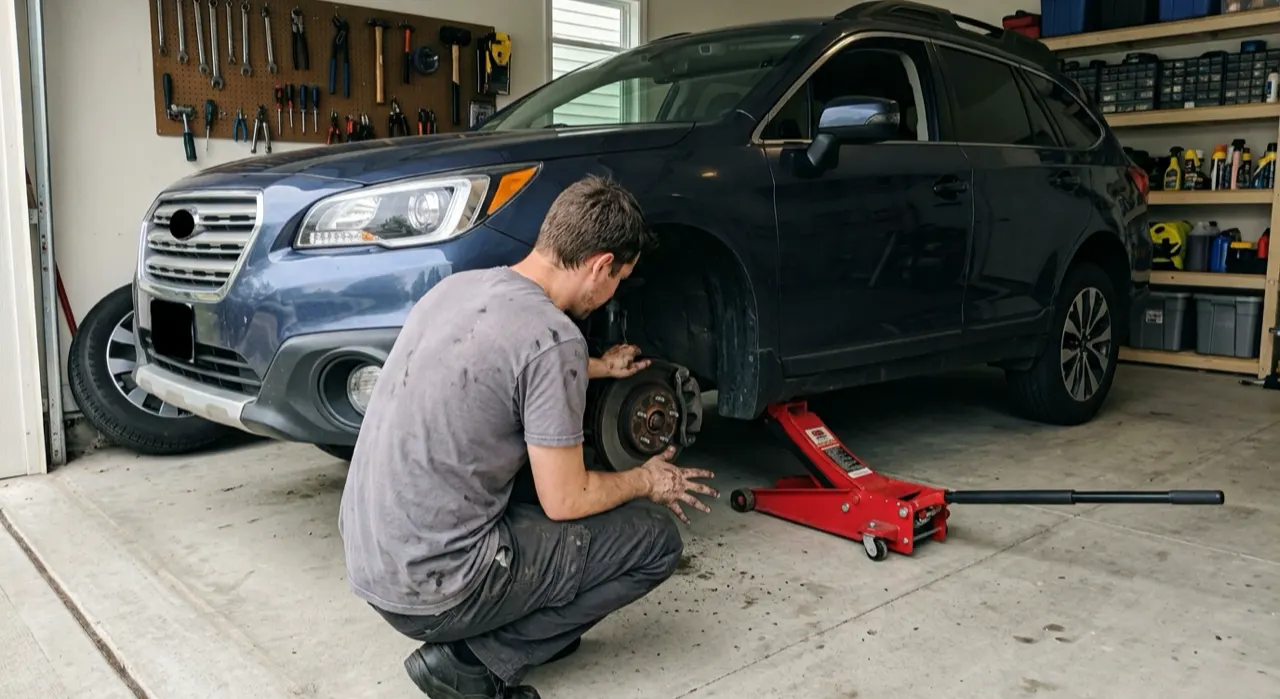
If you are searching “why did my car fall off the jack” because it happened to you or someone you know, the answer is almost always one of these eight mistakes — often in combination. A car on a hydraulic jack with no stands, on a slightly sloped driveway, with no wheel chocks, is being held up by one piece of equipment on an unstable surface with nothing backing it up. When any one of those factors gives way, the whole thing comes down.
The full chain of correct procedure is: solid flat surface, correct jack point, lift, place rated stands at designated support points, lower onto stands, chock wheels, confirm stable before you touch anything underneath. No shortcuts. Not one.
The Honest Summary
None of these mistakes are exotic. They are all things people do regularly, often because they have done them before and nothing went wrong. That is how this kind of hazard works — it tolerates repetition until it does not. The statistics on vehicle crush injuries and fatalities are not theoretical. People die doing exactly what is described on this page.
Proper jack stands, correct lift points, chocked wheels, flat solid ground, and rated equipment. That is the whole list. It is not complicated, and none of it is expensive relative to what it protects.
If you want the complete process from start to finish, our jacking up a car hub covers every step in order.
Recommended Products

Best for safe, cheap, everyday use
- Ratcheting 3-ton pair
- Wide, stable base
- Locking pawl safety
- Unbeatable value
Why buy it: the safe, dependable default pair for almost every home garage.

Best for the strongest, safest stands
- Pro-grade build
- Pin-lock (no ratchet slip)
- Extra-wide stance
Why buy it: the safest, most over-built stands money can buy.

Best for a reliable mid-price pair
- Double-locking pins
- Sturdy steel
- Good height range
Why buy it: a well-built pair with a double-locking safety pin.
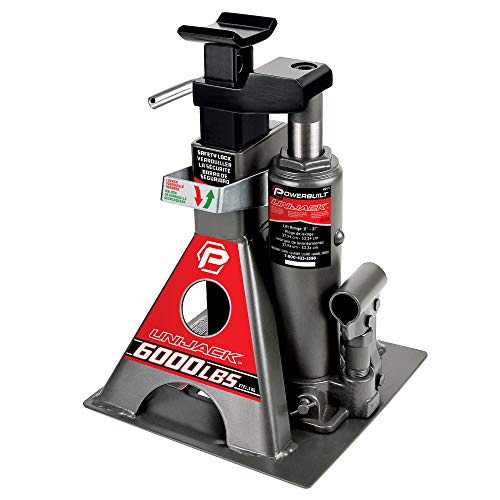
Best for tight or awkward lift points
- Bottle jack + stand in one
- Great for motorcycles too
- Self-contained lift
Why buy it: a jack and stand in one — ideal where a trolley jack won't fit.
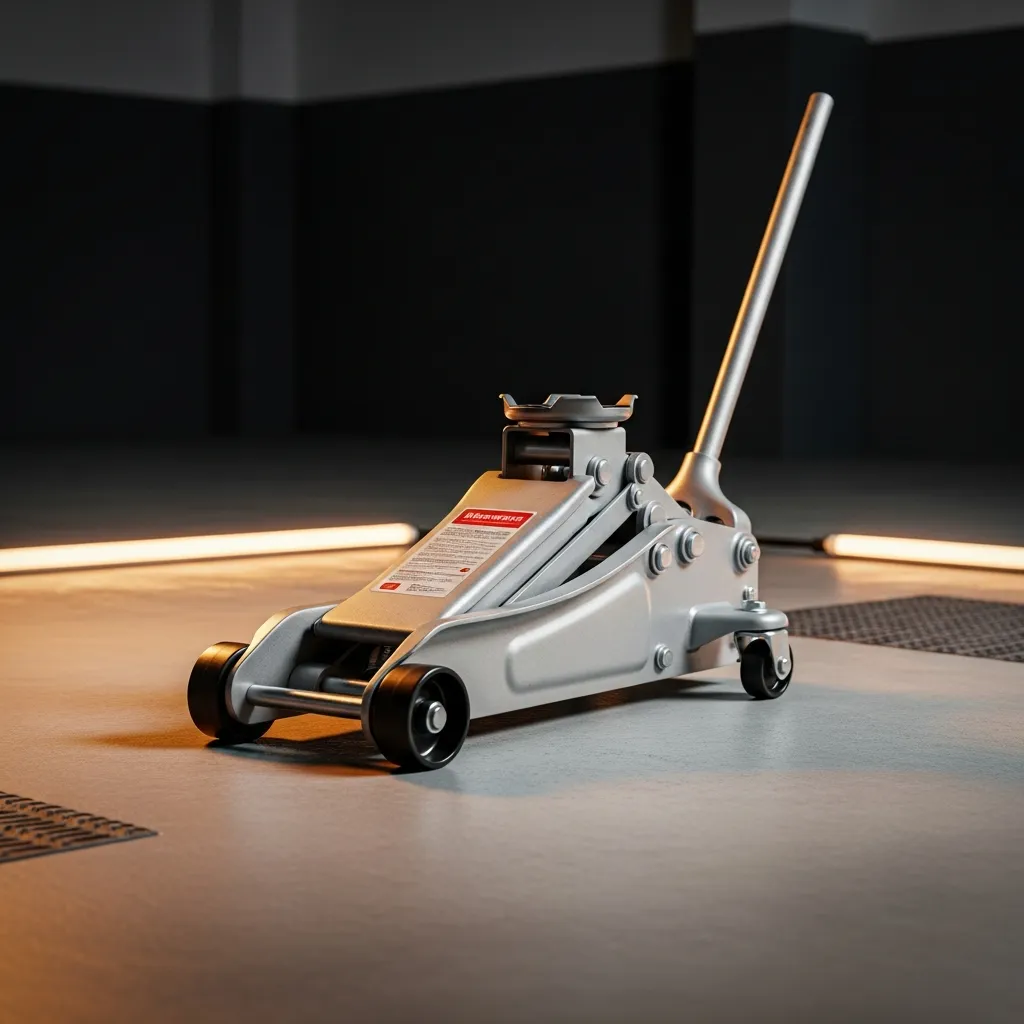
Best for a light, fast, reliable jack
- Lightweight aluminum
- Dual-piston fast lift
- Low 3.6" saddle
- Wide, stable stance
Why buy it: the best balance of light weight, speed and reliability.

Best for cheap, capable home use
- Cheap and dependable
- Compact and light
- Good for most cars
Why buy it: a proven budget jack that just works for home use.
Prices are pulled from Amazon and were accurate as of Aug 22, 2026, 6:54 PM EDT. Product prices and availability are subject to change — the live price is shown on Amazon.