

Affiliate Disclosure
Some links on this page are affiliate links. As an Amazon Associate, we earn from qualifying purchases — at no extra cost to you. We do not buy, test, or physically handle the products we cover; our rankings come from aggregated owner reviews, ratings and expert consensus. Commissions never change our verdicts. How we rank & full disclosure.
If you grew up watching the oil pan drained every 3,000 miles without fail, you're not alone — that number was gospel for decades. The problem is it hasn't been accurate for most modern cars since the early 2000s. Following it religiously doesn't hurt your engine, but it hurts your wallet and generates unnecessary waste oil. This guide covers how often you should really change it — by oil type, by how you actually drive, and what your oil-life monitor is really telling you. It's part of our DIY oil change hub. Always verify against your owner's manual — OEM specs override general guidelines.
The 3,000-Mile Myth
The interval originated from a real need: pre-1990s engines had looser tolerances, used simpler conventional oils, and ran on dirtier fuel. Modern engines have tighter tolerances (less blow-by), fuel injection burns cleaner, and full-synthetic chemistry has leapt forward. Today most new vehicles specify 6,000–9,000 miles on full synthetic, and some European long-life packages reach 15,000 miles. The sticker on your windshield is not your owner's manual.
Distance or Time — Whichever Comes First
Every interval is a dual spec: distance or elapsed time, whichever hits first — typically six to twelve months. This catches the low-mileage driver who needs an annual change because oil ages chemically even while the car sits: moisture from condensation, fuel dilution from short trips, and antioxidant depletion all happen without mechanical wear.
Interval Table by Oil Type & Driving Style
| Oil Type | Normal | Severe-Duty | Time Limit |
|---|---|---|---|
| Conventional mineral | 3,000–4,500 miles | 1,800–3,000 miles | 6 months |
| Synthetic blend | 4,500–6,000 miles | 3,000–4,500 miles | 6–9 months |
| Full synthetic (standard) | 6,000–9,000 miles | 4,500–6,000 miles | 12 months |
| Full synthetic (OEM long-life) | 9,000–15,000 miles | revert to standard | 12–24 months |
| High-mileage synthetic (45,000 miles+ engine) | 5,000–7,000 miles | 3,600–5,000 miles | 12 months |
Verify against your manual. For how the oil types differ, see synthetic vs conventional.
Severe-Duty — Do You Actually Qualify?
Most people get this wrong: "severe duty" doesn't mean racing a V8 — your daily commute might qualify. Manufacturers usually include: frequent short trips under 15 minutes (the engine never fully warms, so fuel and moisture accumulate — the most common qualifier), stop-and-go urban driving, towing/hauling, track or spirited mountain driving, dusty/off-road environments, and extreme cold or heat. If two or more describe your typical week, use the severe-duty column — many city commuters fit the profile through the short-trip issue alone.
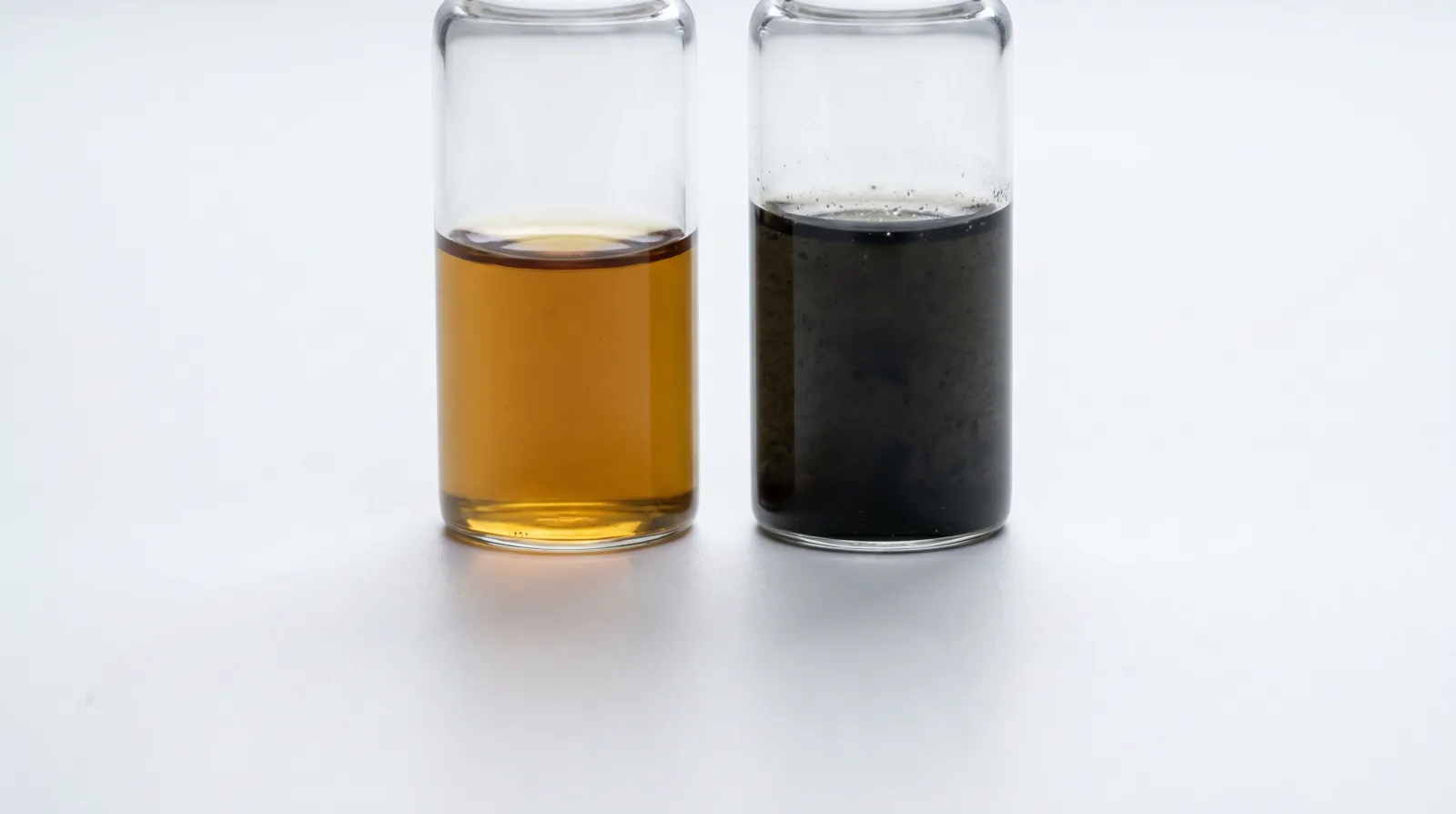
How Oil Actually Degrades
Three failure modes, often simultaneous. Viscosity shear: the long-chain viscosity-index-improver polymers that make a multi-grade work physically break apart under stress (valve train, turbo bearings), thinning the oil — full synthetic resists this far better. Chemical contamination: combustion produces water, sulfur compounds and unburnt fuel that accumulate in a cold engine rather than boiling off (why short trips are severe duty). Additive depletion: antioxidants, detergents, dispersants and anti-wear agents (ZDDP) are consumed as they work — once spent, the oil is chemically exhausted even if it still looks clean, which is why monitors model depletion rather than color.
Oil-Life Monitors — What They Measure
Algorithm-based systems (e.g. GM's Oil Life System) track starts, RPM, load and temperature cycles to model additive life — genuinely accurate and independently validated. Trust these. Simple countdown timers dressed up as "oil life monitors" just count down from a preset figure and know nothing about your conditions — treat them as a reminder and use the table above. Check your manual: "considers driving conditions" usually means algorithm-based.
Does Oil Expire Sitting in the Engine?
Yes — and it catches out low-mileage drivers. If you drive 3,000 miles a year or less, you'll hit the time limit (usually 12 months for full synthetic) before the distance limit. Oil that sits in a hot-then-cold engine absorbs moisture and its antioxidants deplete through oxidation. Change it at the time limit regardless of the odometer. The same applies to a car parked over a year — change the oil before regular use, however clean the dipstick looks.
Finding Your Real Interval
- Open your owner's manual — the spec and interval (not a lube-shop sticker).
- Identify your oil type — conventional, blend or full synthetic.
- Honestly assess your driving against the severe-duty criteria.
- Apply the correct column, using whichever limit (distance or time) you hit first.
- Factor in an algorithm-based oil-life monitor if you have one.
And once you've nailed the interval, the DIY vs shop cost breakdown shows what you're spending on labor annually. There's always a correct answer for your car, oil and driving style — it's almost never 3,000 miles on full synthetic. Find your scenario, pick the interval, stick to it, and head back to the oil change hub for the rest of the series.
Recommended Products

Best for the widest OEM approval list and long drain intervals
- API SP / ILSAC GF-6 rated
- Meets GM dexos1 Gen 3, many OEM approvals
- Rated for extended (up to 20k-mile) intervals
- Strong LSPI and timing-chain-wear protection
Why buy it: the synthetic owners reach for most because it carries a huge approval list — the right pick for the majority of modern engines, provided the grade matches your manual.

Best for a fully-approved synthetic for the lowest price per quart
- API SN Plus / dexos1 Gen 2 licensed
- Genuine full synthetic base
- Lowest cost-per-quart of the group
- Same spec compliance as name brands
Why buy it: proof that spec beats badge: a licensed, fully-approved synthetic that meets the same standards as the premium jugs for noticeably less money.

Best for engine cleanliness from a gas-to-liquid base oil
- PurePlus gas-to-liquid base oil
- API SP / ILSAC GF-6, dexos1 Gen 3
- Excellent for keeping pistons clean
- Backed by a mileage protection program
Why buy it: owners who care about keeping deposits off pistons like the ultra-clean GTL base — a genuinely premium synthetic that still meets mainstream specs.

Best for turbocharged and hard-driven engines
- Fluid Titanium film strength additives
- API SP / dexos1 Gen 3
- Holds up under high heat and load
- Strong wear protection at the film
Why buy it: the pick owners of turbo and performance engines lean on for film strength under heat — as always, only if 5W-30 is the grade your engine calls for.

Best for engines past 75,000 miles that seep or burn a little
- Added seal conditioners
- API SP / ILSAC GF-6
- Targets minor leaks and oil burn
- Full-synthetic protection for older engines
Why buy it: the high-mileage formula owners of older engines credit with quieting minor seepage — the seal conditioners are the reason to choose it over standard synthetic.

Best for a dependable, widely-stocked daily-driver synthetic
- API SP / ILSAC GF-6, dexos1 approved
- Strong wear and deposit protection
- Easy to find and refill
- Trusted mainstream formula
Why buy it: the no-drama daily-driver synthetic owners buy on repeat — fully approved, easy to source, and priced right for regular changes.
Prices are pulled from Amazon and were accurate as of Aug 22, 2026, 6:54 PM EDT. Product prices and availability are subject to change — the live price is shown on Amazon.