
Affiliate Disclosure
Some links on this page are affiliate links. As an Amazon Associate, we earn from qualifying purchases — at no extra cost to you. We do not buy, test, or physically handle the products we cover; our rankings come from aggregated owner reviews, ratings and expert consensus. Commissions never change our verdicts. How we rank & full disclosure.
The short version: long range means one specific thing in this category — how weak and distant a Ka band signal a detector can pull out of the noise, because Ka is where essentially all modern US enforcement operates. Ranked across aggregated owner ratings and the published comparison work of the enthusiast community, the Uniden R8 is the unit most consistently named when distance is the priority, with the older Uniden R7 close enough behind that many owners consider it the smarter buy, and the Escort Redline 360c the premium alternative with quieter default behavior.
Range does not change the law. Detectors are legal in passenger vehicles in almost every state, but not in Virginia and not in Washington, DC, and federal rules prohibit them in commercial vehicles over 10,000 lbs. Details in radar detector legal states. Flagship detectors are also physically large, which matters in the states that restrict windshield-mounted objects. The category overview is in the radar detectors hub.
Top Picks at a Glance
Why the Uniden R8 Is Our #1
The R8 takes the architecture that made the R7 the long-range benchmark — dual antennas, front and rear, with directional arrows — and improves the two things that matter most at distance: receiver sensitivity and filtering. Owners consistently report it hearing Ka earlier than the R7 on open road, and reporting fewer of the K-band false alerts that other cars generate. That combination is unusual, because most attempts to increase sensitivity also increase noise.
The arrows matter more at long range than anywhere else. When a detector alerts from a mile out, the single most useful piece of information is whether the source is ahead of you or behind you — one means slow down and pay attention, the other means it has already happened. A single-antenna detector cannot tell you which. On a long highway drive that distinction repeats dozens of times, and it is the reason experienced long-distance drivers rarely go back to a single-antenna unit.
The honest downsides: it is large, it hangs low on the glass, and in a car with a short raked windshield it can intrude into your view — a real practical problem, and a legal one in states that restrict windshield mounting. Updates run through a computer rather than Wi-Fi unless you step up to the R8W. Its review base is smaller than the R7's, so there is less aggregate owner evidence. And at around $600 the value argument gets thin: the R7 does most of this for roughly $200 less, which is why it sits second here rather than fourth.
Best Long-Range Radar Detectors 2026: The Ranked Field

Best for the longest reach with arrows, at a sane price
- Dual antennas, front and rear
- Directional arrows on a large color OLED
- Best-in-class K and Ka filtering per owner reports
- GPS lockouts and camera database
Why buy it: the detector owners and enthusiasts most often name when the question is pure distance — R7 architecture with a stronger receiver and better filtering.

Best for most of the R8 reach for meaningfully less
- Dual antennas with directional arrows
- Flagship Ka sensitivity
- Per-band sensitivity and filtering control
- GPS lockouts and camera alerts
Why buy it: the long-range benchmark for years and still close to the R8 in owner reports — the cheapest honest way into arrows plus flagship range.

Best for maximum range with the quietest cabin
- 360° directional arrows
- Built-in Wi-Fi for automatic updates
- Auto-learn GPS lockout system
- Drive Smarter app with shared alerts
Why buy it: Escort’s long-range flagship — it trades a little raw Ka reach against the Unidens for filtering that needs almost no setup from you.

Best for reading a whole radar environment at distance
- Front and rear antennas with arrow display
- Counts and tracks multiple simultaneous signals
- Magnesium case, made in the USA
- Deep configuration via the V1 Driver app
Why buy it: the multi-signal display is unique — at long range it tells you how many sources are out there and where each one sits, not just the loudest.
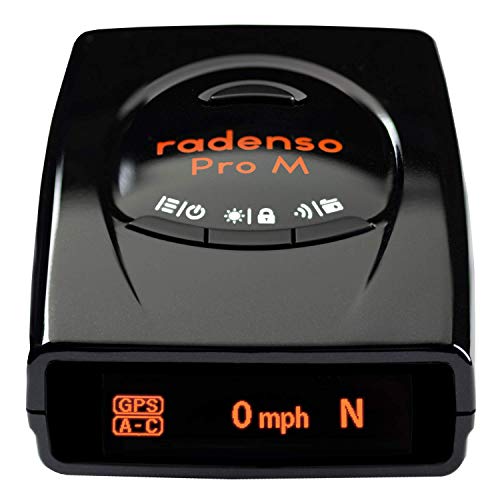
Best for long range without a screaming cabin
- Very aggressive false-alert filtering
- MultaRadar (MRCD/MRCT) detection
- GPS lockouts, no programming needed
- Small footprint, US-based support
Why buy it: the enthusiast pick for drivers who found flagship detectors unbearable in traffic — long reach, dramatically fewer interruptions.

Best for flagship range with Wi-Fi updating built in
- 360° awareness with directional arrows
- Wi-Fi and Bluetooth with the R/TACH app
- GPS with real-time voice alerts
- Red light and speed camera alerts
Why buy it: the newest Uniden flagship — the same long-range architecture with the connectivity the R7 and R8 always lacked, at a price that reflects it.
Prices are pulled from Amazon and were accurate as of Aug 22, 2026, 6:54 PM EDT. Product prices and availability are subject to change — the live price is shown on Amazon.
Cobra, Escort Max 360 MkII and Affordable Long-Range Options
The Unidens lead on raw reach, but a few alternatives suit different buyers. The Escort Max 360 MkII pairs solid range with front-and-rear arrows and hands-off filtering, the choice for drivers who want performance without tuning. Cobra’s flagships and various mid-tier units are the more affordable step down, trading some sensitivity for a lower price. As of 2025, owners consistently report that the older Uniden R7 remains the value benchmark against police radar, delivering most of the R8’s distance for far less. Match the unit to how far you actually need to hear Ka.
The Uniden Radar Detector App and Smartphone Convenience
Modern detectors increasingly lean on a phone. The Uniden radar app and rivals like Escort Live add crowd-sourced alerts, red-light-camera databases and easier firmware updates, so a detector app turns a standalone unit into a connected one. Owners value the plug-and-play convenience: mount the detector, pair it once, and let the app handle marked-location lockouts and updates. It is not a substitute for receiver sensitivity — the app cannot make a weak Ka signal louder — but for keeping camera data current and day-to-day convenience, app integration is a genuine reason some buyers pick one flagship over another.
How to Choose a Long-Range Detector
Be honest about your roads first. Range only converts into warning when you have sightlines to use it. Rural interstate, open two-lane state routes, long desert and plains driving — that is where a flagship earns its price, and where a mid-range unit genuinely leaves warning on the table. If most of your miles are suburban, you will get more benefit from filtering, and our value ranking is the better page for you.
Decide whether you want arrows. At distance they are worth more than anywhere else. All six picks here have a rear antenna except the Radenso Pro M, which trades arrows for exceptional filtering and a small footprint.
Think about noise tolerance. A maximally sensitive detector hears more of everything, including the blind-spot radar in the car beside you. The Unidens give you granular per-band control to manage that yourself; the Escorts and the Radenso do more of it automatically. Choose based on whether you enjoy tuning settings or want it handled.
Check the physical size against your car. This trips up more buyers than any spec. Measure where it will actually sit before you commit.
What Determines Long Range
Receiver sensitivity on Ka. The core of it. A better front end pulls a weaker signal out of the background noise, which is what converts into distance. No manufacturer publishes comparable figures, so this is where independent enthusiast measurement is the only real evidence available.
Sweep strategy. Detectors scan across Ka sub-bands. Scanning fewer segments means revisiting each one faster and catching brief instant-on transmissions — several units let you disable unused segments, which is one of the most effective tuning changes available.
Antenna count and placement. A rear antenna does not add forward range, but it adds rear detection and enables the arrows that make long-range alerts interpretable.
Filtering quality. Counterintuitively, this affects usable range. A detector so noisy that you mute it or ignore it has an effective range of zero. The band specifics are covered in K band vs Ka band, and tuning is covered in reducing false alerts.
Mistakes at the Top of the Market
Buying range for roads that cannot use it. The most common and most expensive mistake in this category. A $650 detector on a 20-minute urban commute is largely wasted money.
Leaving every Ka segment enabled. Factory defaults scan segments US enforcement does not use, which slows the sweep. Trimming them is free performance.
Mounting it high and centered. High looks right and is exactly what several states restrict, and on some cars puts the detector in the mirror's shadow. Low and slightly off-center, with a clean forward view, generally performs better.
Believing range solves laser. It does not. LIDAR is a narrow aimed beam; no detector at any price gives useful advance warning of it. The separate device class is covered — with its much tighter legal picture — in best laser jammer.
How We Rank
We do not have a lab, a test car or a radar gun, and we will not pretend to have measured distance we have not measured. This ranking aggregates owner reviews and star ratings at scale, reads the themes owners repeat, and weighs the result against published specifications and — heavily, on this page in particular — the published comparison work of the radar-detector enthusiast community, which runs controlled range tests against real enforcement equipment and documents how it does so.
We lean on that community evidence hardest for range claims specifically, because owner reviews are poor instruments for measuring distance: a driver knows the detector alerted early, not how many hundred feet early. Owner evidence is far better for the other three criteria we weight — false-alert behavior, build and reliability over years of use, and value against the tier below. Where community measurement and owner sentiment disagree, we say so on the page instead of averaging them into a false consensus. Prices quoted were current at the time of writing.
The Verdict
If you want the longest reach available with directional arrows, the Uniden R8 is the detector owners and the enthusiast community most consistently name, and it is our pick. The Uniden R7 gets you most of the way there for around $200 less, which makes it the better value for the majority of buyers. The Escort Redline 360c is the choice if you would rather the filtering be handled for you than tuned by you, and the Radenso Pro M is for drivers whose real complaint about flagship detectors was the noise.
If any of this is more detector than your roads justify, be honest about it — the sub-$300 tier covers most people better, the budget ranking covers the rest, and the whole field sits in best radar detector. Riders should read best motorcycle radar detector instead. And whatever you run up front, a dash cam is the accessory most likely to actually help you after an incident, because it records rather than warns.
Quick Comparison
Uniden R8 Extreme Long-Range Radar/Laser Detector
Best for the longest reach with arrows, at a sane price
Best Value
Uniden R7 Extreme Long-Range Laser/Radar Detector
$549.99 · Check Price on Amazon
Best Premium
Escort Redline 360c Radar Detector
$799.95 · Check Price on Amazon
Best for Enthusiasts
Valentine One V1 Gen2 Radar Detector
$706.28 · Check Price on Amazon
Best for Low False Alerts
Radenso Pro M Radar Detector
Check Price on Amazon
Best Connected
Uniden R8W Extreme Long Range Laser/Radar Detector
$799.99 · Check Price on Amazon