

Affiliate Disclosure
Some links on this page are affiliate links. As an Amazon Associate, we earn from qualifying purchases — at no extra cost to you. We do not buy, test, or physically handle the products we cover; our rankings come from aggregated owner reviews, ratings and expert consensus. Commissions never change our verdicts. How we rank & full disclosure.
The short version: a compression tester reads your engine’s mechanical vital signs — it tells you whether each cylinder’s rings, valves and head gasket are sealing. Our overall pick is the OTC 5605 Deluxe kit for its accurate gauge and the screw-in adapters that seal properly on most engines. The real skill is interpreting the results: readings should be uniform across cylinders (within ~10%), and the dry-then-wet test tells you whether a low cylinder’s problem is the rings (reading jumps with oil) or the valves/head gasket (reading barely changes). When a misfire is not electrical, this is the tool that finds out why.
Top Picks at a Glance
Our #1 Pick: OTC 5605 Deluxe Kit
The OTC 5605 takes the top spot as the complete, pro-grade kit that just works: an accurate, easy-read gauge, a release valve for repeat tests, and — crucially — both screw-in and push-in adapters so you can get a proper seal in the spark-plug hole on most gasoline engines. A reliable seal is what makes compression readings trustworthy, and the screw-in adapters deliver it without a helper holding the gauge. It is the kit that earns its keep whether you are diagnosing a weak cylinder or checking out a used engine. If you want digital record-and-playback, the OTC 5605-DG steps up; if you want to spend less, the INNOVA 3612 is the value.
Best Compression Testers 2026: The Ranked Field
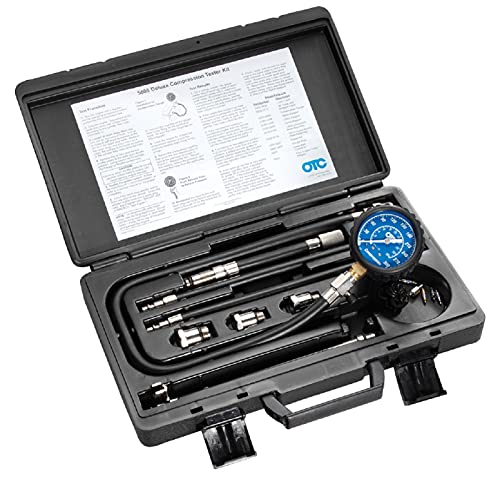
Best for a complete, pro-grade kit with the right adapters
- Screw-in & push-in adapters included
- Accurate, easy-read gauge
- Covers most gasoline engines
- Sturdy pro-grade build
Why buy it: the compression kit owners trust for accurate, repeatable readings — screw-in adapters seal properly, and the case has the fittings for most gasoline engines.

Best for recording and comparing readings digitally
- Digital gauge with record/playback
- Stores readings for up to 12 cylinders
- Screw-in adapter set
- Easy cylinder-to-cylinder comparison
Why buy it: the digital kit that records and plays back each cylinder — no scribbling numbers, just compare them side by side to spot the weak one.
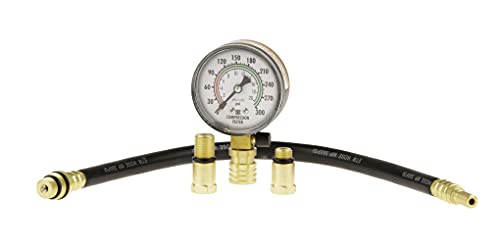
Best for accurate testing without the big kit price
- Common adapters for most engines
- Clear, accurate gauge
- Release valve for repeat tests
- Great value
Why buy it: the value kit owners buy for reliable compression readings — the essential adapters and an accurate gauge for a fraction of a pro kit.

Best for wider adapter coverage in one case
- Extra adapters for more engines
- Accurate dial gauge
- Push-in and screw-in fittings
- Organized carry case
Why buy it: the bigger INNOVA kit for people who work on varied engines — more adapters mean you can seal the plug hole on more vehicles.

Best for a dependable basic tester for occasional use
- Core adapters included
- Readable gauge with release valve
- Low cost
- Fine for occasional testing
Why buy it: the budget set owners grab for an occasional compression check — the essentials to diagnose a weak cylinder without spending much.

Best for a quality kit from a diagnostics specialist
- Quality gauge and adapters
- Good sealing fittings
- Trusted diagnostics brand
- Durable case
Why buy it: the enthusiast’s kit from a respected diagnostics maker — quality fittings that seal cleanly for readings you can trust across cylinders.
Reading the Results (This Is the Skill)
The tool is easy; interpreting it is the value. Two principles. First, uniformity matters more than the exact number: healthy cylinders should read within about 10% of each other, and while most gas engines land somewhere around 130–180 PSI, your service manual has the real spec. A cylinder that is 15–20% or more below its neighbors has a sealing problem even if the absolute PSI looks acceptable. Second, look for the outlier — one low cylinder among healthy ones points you straight at the trouble. Test every cylinder under the same conditions (warm engine, throttle wide open, same number of cranks) so the comparison is fair.
The Dry vs Wet Test
Here is the trick that locates the fault without pulling the engine apart. Do a dry test first — measure each cylinder as-is. For any cylinder that reads low, do a wet test: squirt a little engine oil into that cylinder through the plug hole and test again. If the reading jumps up with the oil, the leak is at the piston rings (the oil temporarily sealed them). If the reading barely changes, the oil could not seal it, so the leak is higher — the valves or head gasket. That single comparison turns "cylinder 3 is low" into "cylinder 3’s rings are worn," which is exactly the information you need.
How to Test Safely
Warm the engine, then shut it off and disable ignition and fuel (pull the fuel-pump fuse or relay and unplug the coils/injectors) so it cannot start or fire. Remove all the spark plugs, fit the tester to the first cylinder, hold the throttle wide open, and crank for several compression strokes until the gauge peaks; record it and repeat for every cylinder. Screw-in adapters give the most reliable seal — a poor seal is the most common cause of a false low reading. If the check-engine light led you here, read the misfire code first with a scanner from our OBD2 hub to know which cylinder to focus on.
Complete the Diagnosis
Compression testing pairs with your other diagnostics: read the code with a scanner, rule out electrical misfire causes with a multimeter, and check fuel delivery with a fuel pressure tester. If the engine checks out mechanically, your service and fluids are covered in the oil change hub. The sockets and a spark-plug socket you need live in the garage tools hub.
Cylinder Pressure and Engine Health: Why an Accurate Gauge Matters
A compression tester reads the combustion pressure each cylinder builds, which is the clearest mechanical window into engine health you can get without opening it up. That makes an accurate, well-sealing gauge the whole point: a cheap gauge that reads a few PSI off, or a fitting that leaks at the plug hole, hands you numbers you cannot trust. Quality gauges hold calibration and pair with screw-in adapters that seal cleanly, so the readings are repeatable cylinder to cylinder. When you are trying to discover whether a weak cylinder is rings or valves, the tool has to be trustworthy first.
Compression Tester vs Leak-Down Tester
The two tools are complementary. A compression tester is quick and cheap and tells you which cylinder is weak — the ideal first test and all most DIYers need. A cylinder leak-down (leakdown) tester goes further: it pressurizes a cylinder with compressed air at top dead center and measures how fast it leaks, and listening to where the air escapes pinpoints the cause — intake valve, exhaust valve, rings, or head gasket. Start with a compression tester to find the weak cylinder; add a leak-down tester when you need to isolate exactly where that cylinder is losing its seal.
Brands to Trust: INNOVA, Mityvac, Snap-on and NAPA Parts
Several names earn owner trust across price tiers. INNOVA and OTC dominate the value-to-pro range, Mityvac is a respected diagnostics specialist, Lisle makes quality adapters, and VEVOR covers the budget end. At the professional level Snap-on kits are the shop standard, and you can also pick up a tester as an off-the-shelf part from NAPA and similar auto-parts stores. Whatever the brand, prioritize a kit whose adapters seal well and whose gauge performance owners vouch for — a well-sealing mid-price kit beats a poorly-sealing cheap one every time.
Where to Buy or Borrow: AutoZone and O'Reilly Loaner Gauges
Before you buy, know that many owners discover they can borrow a compression tester for free. Parts chains like AutoZone and O'Reilly run loaner-tool programs where you pay a deposit, use the gauges, and get the money back on return — handy for a one-time check on a used-engine inspection. Forum recommendations and community suggestions often point first-timers to that loaner route before spending on a kit. If you test compression more than once or twice, though, owning a well-sealing kit pays for itself and spares you a trip and a deposit each time.
Testing High-Compression and Performance Engines
Standard kits are sized for ordinary engines, but a high-compression or forced-induction build reads higher, so check the gauge's range covers it. A performance engine, a turbo motor or a diesel builds far more combustion pressure than a stock four-cylinder, and a gauge that tops out too low gives you a useless pegged reading. Screw-in Lisle and OTC adapters seal the deep plug wells these engines often have. For diesels specifically, use a dedicated high-range diesel compression kit — the pressures are well beyond what a gasoline gauge can read, and the adapters thread into the glow-plug or injector port instead.
How We Rank
Compression testers are a tool category, so we rank on aggregated owner ratings, review volume and the qualities owners report. We weigh four things. Accuracy and sealing — a reliable gauge and adapters (especially screw-in) that seal cleanly. Adapter coverage — the fittings to test most engines. Usability — a readable gauge, release valve, and digital record where offered. And value for the kit. We do not run a calibration test; we read owner consensus and specs. Prices were current at the time of writing.
Quick Comparison
OTC 5605 Deluxe Compression Tester Kit
Best for a complete, pro-grade kit with the right adapters
Best Premium
OTC 5605-DG Deluxe Digital Compression Tester Kit
Check Price on Amazon
Best Value
INNOVA 3612 Compression Tester (4-Piece Kit)
Check Price on Amazon
Best Complete Kit
INNOVA 3614 Compression Tester Plus (6-Piece Kit)
Check Price on Amazon
Best Budget
OEMTOOLS 37138 Compression Tester Gauge Set
Check Price on Amazon
Best for Enthusiasts
Mityvac MV5530 Engine Compression Test Kit
Check Price on Amazon
The Verdict
For a complete, accurate kit that seals properly, the OTC 5605 Deluxe is our overall pick, with the digital OTC 5605-DG the premium and the INNOVA 3612 the value. Remember the skill is in the reading: compare cylinders (within ~10%), and use the dry-then-wet test to tell rings from valves. Check Price on Amazon →