
Affiliate Disclosure
Some links on this page are affiliate links. As an Amazon Associate, we earn from qualifying purchases — at no extra cost to you. We do not buy, test, or physically handle the products we cover; our rankings come from aggregated owner reviews, ratings and expert consensus. Commissions never change our verdicts. How we rank & full disclosure.
Ceramic Spray
A low-solids SiO2 spray sealant that wipes on in half an hour and cross-links into a thin, slick, hydrophobic layer. It delivers most of the visible ceramic behavior with none of the commitment.
Best for: Daily drivers, garage-less owners, and anyone who wants ceramic behavior without a correction weekend
Roughly $15–$30 for a 16 oz bottle — typically 4–8 full-car applications
- Whole car protected in 20–45 minutes with no correction required first
- High spots and streaks buff away immediately instead of needing a polish
- Works in a driveway — no controlled temperature, humidity or lighting needed
- Cheap enough to reapply every wash cycle if you enjoy the beading
- Layers happily over wax, sealant or an existing coating as a topper
- Durability measured in months, not years — realistically 3 to 8
- Thin film offers far less chemical and etching resistance than a real coating
- Needs reapplication every few months, so the labor is recurring
- Cheap formulas can be little more than a spray wax wearing a ceramic label
Ceramic Coating
A high-solids SiO2 or SiC resin that chemically bonds to bare clear coat and cures into a hard, semi-permanent sacrificial layer. It is the most durable paint protection short of film.
Best for: New cars, corrected paint, and owners keeping a vehicle three or more years
DIY bottles $50–$120 for 30–50 ml; professional installs $800–$2,500 depending on prep
- Two to five years of protection from a single application
- Genuinely harder surface — far better resistance to bird droppings, sap and chemical etching
- Locks in a corrected finish so the gloss you paid for stays visible
- Dramatically easier washing, and dirt releases with far less contact
- Best long-term cost per year of protection if the car is kept
- Only as good as the prep — the paint must be corrected, decontaminated and wiped bare
- A full DIY job realistically takes 8–20 hours across a weekend
- High spots that flash before you level them must be polished out
- Needs a controlled environment: 60–75°F, moderate humidity, and 12–24 hours dry
How they score, side by side
Scores reflect aggregated owner reviews and expert consensus — not our own bench testing.
- Durability410
- Ease of application104
- Etch and chemical resistance59
- Gloss and depth79
- Water beading and sheeting89
- Upfront cost104
- Long-term value if you keep the car69
Spec-by-spec comparison chart
| Factor | Ceramic Spray | Ceramic Coating |
|---|---|---|
| Realistic durability | 3–8 months | 2–5 years (DIY 1–3, pro 3–5) |
| SiO2 solids content | Typically 3–10% | Typically 60–80% |
| Film thickness | Sub-micron | ~1–3 microns |
| Paint correction required first | No | Yes — defects get locked in |
| Application time, full car | 20–45 minutes | 8–20 hours including prep |
| Cure time before rain | 1–2 hours | 12–24 hours dry, ~7 days full cure |
| Environment needed | Any shaded driveway | 60–75°F, controlled humidity, good lighting |
| Fixing a mistake | Wipe and reapply | Machine polish the panel |
| Chemical / etch resistance | Moderate | High |
| Cost per year of protection | ~$30–$60 | ~$25–$40 DIY, $200–$600 pro |
| Beginner difficulty | Easy | Moderate to hard |
Our Top 3 Picks
The three highest-rated options in this category, if you'd rather skip straight to a proven pick.

Best for the best DIY durability and gloss
- Graphene-infused hardness
- 2–5 year durability
- Slick, high-gloss finish
- Beginner-friendly kit
Why buy it: the best all-round DIY kit — long life and an easy application.

Best for maximum longevity
- Pro-grade hardness
- 2+ year protection
- Deep, warm gloss
Why buy it: a detailer favorite that survives years with proper prep.

Best for fast spray-on protection
- Spray-on / wipe-off
- SiO2 hydrophobic layer
- Great for beginners
Why buy it: spray-on ceramic protection in minutes with no cure fuss.
Prices are pulled from Amazon and were accurate as of Aug 22, 2026, 6:54 PM EDT. Product prices and availability are subject to change — the live price is shown on Amazon.
Same chemistry, very different products
Both categories are built on silica — silicon dioxide, SiO2 — dissolved in a solvent carrier. When the carrier flashes off, the silica cross-links into a glass-like network on the paint. That shared chemistry is why a $20 spray and a $100 coating both produce the same tight water beading, and it is exactly why the marketing on both is so confusing.
The difference is concentration and cross-link density. A ceramic spray typically carries somewhere in the range of 3 to 10 percent SiO2 solids, often blended with silicone resins and polymers to make it wipe out easily and forgive uneven application. A true ceramic coating carries 60 to 80 percent solids, cures into a film roughly one to three microns thick, and forms a far denser, harder network. One is a very good sealant with silica in it. The other is a semi-permanent sacrificial layer.
Neither claim about hardness should be taken too literally. Coating marketing loves the "9H" figure, which comes from a pencil-hardness scratch test that has nothing to do with automotive swirl resistance. A coating will not stop swirl marks from bad wash technique. What it genuinely does is resist chemical etching, make contamination harder to bond, and let dirt release with far less contact — which reduces swirls indirectly, by making the wash gentler. Our ceramic coating guide goes deeper on what the ratings do and do not mean.
What the durability numbers actually mean
Manufacturer durability claims are best treated as ceilings under ideal conditions, and aggregated owner reviews consistently land well below them. Here is the pattern that shows up repeatedly:
- Ceramic sprays are marketed at 6 to 12 months and typically deliver 3 to 8 months of strong beading on a garaged car, less on one parked outside through a full winter of road salt.
- DIY coatings are marketed at 2 to 5 years and typically deliver 1 to 3 years, with the spread driven almost entirely by prep quality and wash habits.
- Professionally installed coatings land closest to their claims — 3 to 5 years — because the installer is doing multi-stage correction, a thorough solvent wipe, and applying in a controlled booth.
Two things degrade both faster than anything else. Automatic car washes with brushes abrade the layer mechanically. Strong alkaline degreasers and wheel cleaners strip it chemically. Owners who switch to a pH-neutral soap and a two-bucket or touchless wash routinely report their coating outlasting the estimates above, while owners running a coated car through a tunnel wash weekly report losing beading inside a year.
Worth noting: durability is not the same as protection. A coating whose beading has faded is often still providing a meaningful chemical barrier — the hydrophobic top layer has worn but the bonded silica has not fully gone. Beading is the most visible indicator, not the most important one.
Prep is the whole game with a real coating
This is the single most important thing to understand before spending $100 on a coating bottle. A coating is optically transparent and permanently bonded, which means every swirl, every scratch and every bit of embedded contamination underneath it gets locked in for years. Coating over uncorrected paint does not improve the paint. It preserves it exactly as it is.
The full prep sequence is genuinely demanding:
- Decontaminate — iron remover to dissolve embedded ferrous fallout, then clay for anything mechanical still bonded. Our decontamination guide covers the order that saves the most time.
- Correct — machine polish out the swirls. This is the four-to-eight-hour part, and it is the step people skip.
- Panel wipe — isopropyl alcohol or a dedicated prep solution to strip every trace of polishing oil. Coatings will not bond through residue, and this is where most DIY failures actually originate.
- Apply thin, level immediately — one panel at a time, watching for the rainbow flash, then buffing to a uniform finish before it hardens.
Get the last step wrong and you have a high spot — a visible cloudy streak of over-thick, cured coating that cannot be wiped away. The only fix is to machine polish that panel and re-coat it. This is precisely the failure mode a ceramic spray does not have: apply too much, notice a streak, wipe it, done.
Real cost per year, DIY and professional
Run the arithmetic over three years and the picture gets clearer than the sticker prices suggest. A ceramic spray at $20 a bottle, giving four to eight applications, reapplied three or four times a year, costs roughly $30 to $60 annually in product plus about two hours of labor a year. Nothing else is required.
A DIY coating at $50 to $120 covers one car and lasts one to three years, which looks like $25 to $40 a year — cheaper on paper. But that ignores the entry cost of the tools: a dual-action polisher, pads and polish will run $150 to $300 if you do not already own them, plus panel wipe, applicators and suede cloths. Add the 8 to 20 hours of labor and the honest first-year cost is closer to $250 to $400 for someone starting from zero.
A professional install at $800 to $2,500 buys the correction, the controlled environment, and the installer's experience with high spots. Spread over four years that is $200 to $600 a year, which is real money — but for owners of new or high-value cars who were never going to spend a weekend polishing, it is the only route to a properly prepped coating. Aggregated owner reviews suggest the satisfaction gap between a professional install and a rushed DIY one is enormous, and it is almost entirely a prep gap.
Using a spray as a topper — the best of both
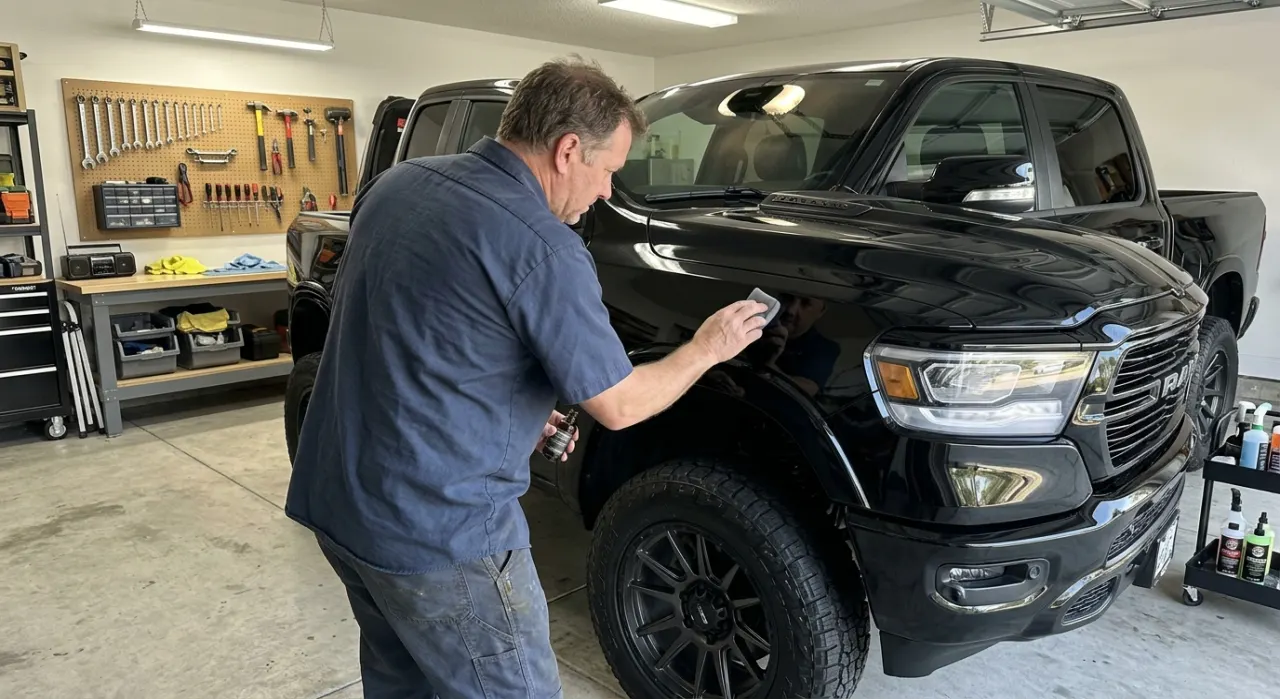
The framing that most experienced detailers actually use is not either-or. A ceramic spray makes an excellent topper over a coating: it refreshes hydrophobic behavior as the coating's top layer wears, adds a sacrificial layer that takes the abuse instead of the coating, and costs almost nothing to reapply. Many coating manufacturers sell their own SiO2 maintenance spray for exactly this reason, and using one is the cheapest way to stretch a coating toward the upper end of its claimed life.
It works in the other direction too. If you are not ready for a coating, a ceramic spray layered every few months over a good synthetic sealant gives you continuous protection with no correction commitment. The comparison against traditional protection is worth reading alongside this one — see ceramic coating vs wax and wax vs ceramic spray for how the three-way trade-off actually shakes out.
Common myths and mistakes
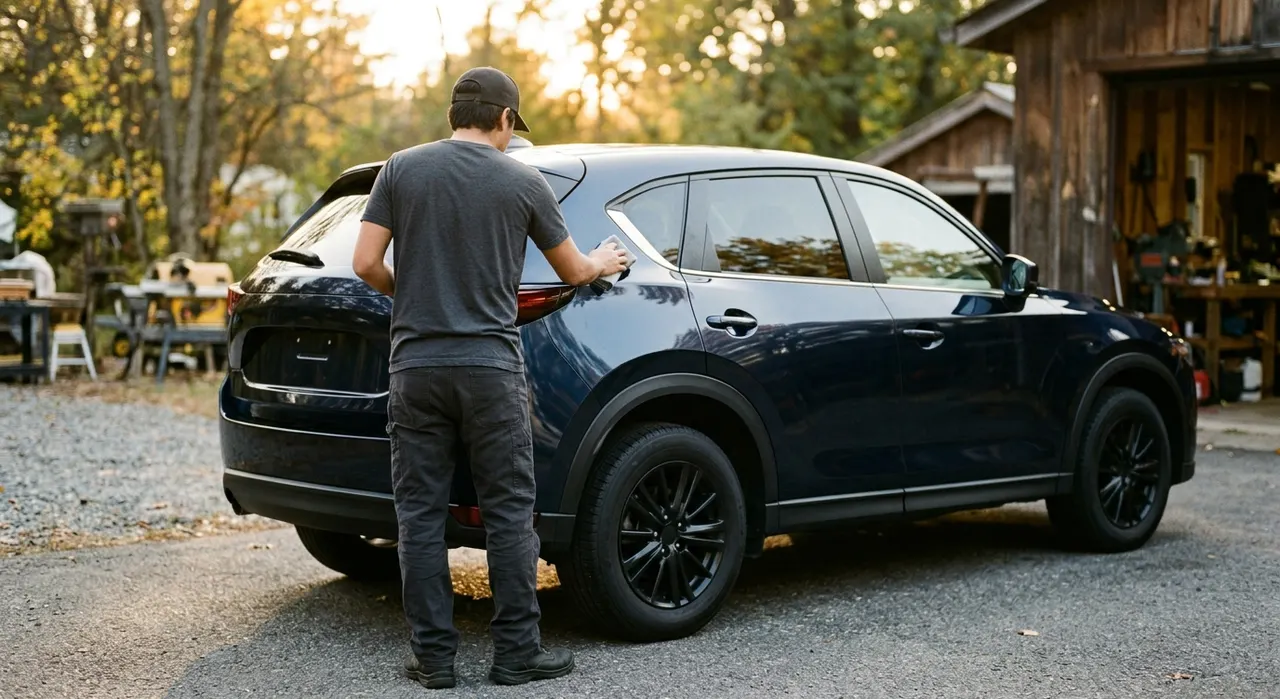
"A ceramic spray is just a coating in a spray bottle." No. The solids content differs by roughly an order of magnitude, and so does the cured film. A spray behaves like a coating for a few months; it is not one.
"9H means it resists scratches." The 9H figure comes from a pencil-hardness test on a flat coupon. It does not translate to swirl resistance from wash mitts, brushes or towels. Coated cars still get swirled by bad technique.
"Coating means I never have to wax again — or wash as carefully." Half right. You do not need wax, but wash technique matters more, not less, because you are protecting a layer you paid a lot for. Tunnel washes with brushes will destroy it.
"I'll coat over the swirls and sort them out later." You cannot. Polishing a coated car removes the coating along with the swirls, so you have paid for a coating and thrown it away. Correct first, then coat.
Which should you buy — and how to decide
Most people should buy the ceramic spray. Not because it protects better — it plainly does not — but because it protects reliably for the way most owners actually work. It goes on in 30 minutes in a driveway, forgives every mistake, costs $20, and delivers the beading, gloss and easy washing that people are really buying ceramic products for. Reapplied three or four times a year it produces a consistently well-protected car with almost no risk of an expensive error.
Buy the full ceramic coating if the car is brand new with undamaged paint, or you have already corrected it; you are keeping the vehicle three or more years; you have a garage with decent lighting and stable temperature; and you genuinely intend to do the prep. Under those conditions it is the better product by a wide margin, and the cost per year is lower.
Buy a professional install if the car is high-value, the paint needs multi-stage correction, or you want the result without the weekend. Ask specifically what correction is included — a $900 quote with one-step polish and a $2,000 quote with multi-stage correction are not the same product.
Buy both if you are coating the car. Coat once, then top with an SiO2 spray every few months to keep the surface behaving like new and take the wear that would otherwise land on the coating. That combination is what our exterior protection guide recommends for anyone serious about keeping a finish long-term.
Recommended Products
Our top picks in this category, ranked on aggregated owner reviews.
Best for the best DIY durability and gloss
- Graphene-infused hardness
- 2–5 year durability
- Slick, high-gloss finish
- Beginner-friendly kit
Why buy it: the best all-round DIY kit — long life and an easy application.
Best for maximum longevity
- Pro-grade hardness
- 2+ year protection
- Deep, warm gloss
Why buy it: a detailer favorite that survives years with proper prep.
Best for fast spray-on protection
- Spray-on / wipe-off
- SiO2 hydrophobic layer
- Great for beginners
Why buy it: spray-on ceramic protection in minutes with no cure fuss.

Best for the closest thing to a pro coating
- Near-professional hardness
- 5+ year durability
- Superb chemical resistance
Why buy it: pro-tier protection you can still apply at home.
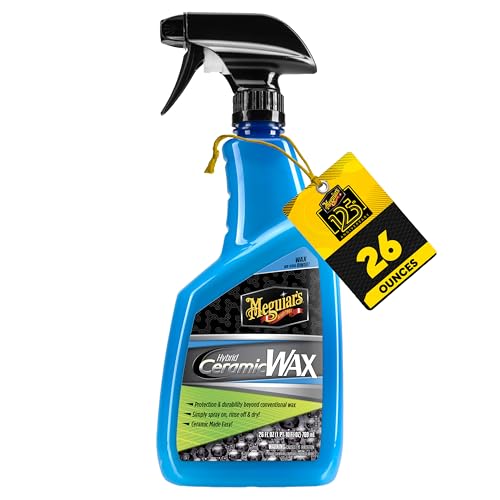
Best for cheap ceramic beading
- Spray on wet or dry
- Strong water beading
- Cheapest per use
Why buy it: the cheapest way to get ceramic-style beading fast.

Best for a complete beginner bundle
- Coating + applicators included
- Simple instructions
- Widely available
Why buy it: an all-in-one beginner bundle with everything you need.
Prices are pulled from Amazon and were accurate as of Aug 22, 2026, 6:54 PM EDT. Product prices and availability are subject to change — the live price is shown on Amazon.