

Affiliate Disclosure
Some links on this page are affiliate links. As an Amazon Associate, we earn from qualifying purchases — at no extra cost to you. We do not buy, test, or physically handle the products we cover; our rankings come from aggregated owner reviews, ratings and expert consensus. Commissions never change our verdicts. How we rank & full disclosure.
Group 35 Battery
A BCI group size measuring roughly 9.1 x 6.9 x 8.9 inches with top posts. It is the standard fitment on a huge share of Japanese-brand cars and crossovers sold in the US.
Best for: Subaru, Toyota, Nissan, Honda and Mazda models whose tray and hold-down were built around the 35 footprint
Typically $130–$200 flooded, $210–$300 AGM
- Shorter case, so it fits tighter engine bays and trays that a Group 24 will not clear
- Very widely stocked in the US — flooded, AGM and enhanced flooded versions are easy to find
- Common ratings land around 550–720 CCA, plenty for most four- and six-cylinder engines
- Same 6.9 x 8.9 inch width and height as Group 24, so cable reach is usually similar
- Strong aftermarket support for performance and deep-cycle style AGM options in this size
- Roughly an inch shorter case means slightly less plate area, so reserve capacity is usually a touch lower
- Not a drop-in for a tray and hold-down designed around a longer Group 24 case
- Fewer very-high-CCA options than the larger truck-oriented group sizes
- Terminal orientation will not match every vehicle — you must verify before ordering
Group 24 / 24F Battery
A slightly larger BCI group size at roughly 10.25 x 6.8 x 8.9 inches. The plain 24 and the 24F share the same case but reverse the terminal positions, which is exactly where owners get caught out.
Best for: Vehicles whose factory tray is built for the longer case — many Toyota, Honda, Acura and older domestic applications
Typically $140–$210 flooded, $220–$310 AGM
- Longer case allows more plate area, so reserve capacity is typically higher than a Group 35
- Common ratings reach roughly 550–800 CCA depending on construction
- The extra reserve capacity helps on vehicles with heavy accessory or parasitic loads
- Widely available in both flooded and AGM, including marine and dual-purpose versions
- Will not physically fit a tray sized for a Group 35 — the case is about an inch longer
- The 24 vs 24F terminal difference causes constant ordering mistakes and cables that will not reach
- Slightly heavier, which matters if you are lifting it into a deep engine bay
- Marine-labeled Group 24 batteries are often the wrong design for automotive starting duty
How they score, side by side
Scores reflect aggregated owner reviews and expert consensus — not our own bench testing.
- Cranking power available88
- Reserve capacity78
- Fits tight engine bays96
- US availability98
- Price per amp-hour88
- Risk of ordering the wrong one75
Spec-by-spec comparison chart
| Factor | Group 35 Battery | Group 24 / 24F Battery |
|---|---|---|
| BCI case size (L x W x H) | ~9 1/16 x 6 13/16 x 8 7/8 in | ~10 1/4 x 6 13/16 x 8 7/8 in |
| Length difference | Shorter by roughly 1 3/16 in | Longer by roughly 1 3/16 in |
| Terminal type | Top post | Top post |
| Terminal layout | Fixed orientation — verify against your old battery | 24 and 24F are mirrored — verify before ordering |
| Typical CCA range | ~550–720 CCA | ~550–800 CCA |
| Typical reserve capacity | ~90–120 minutes | ~110–140 minutes |
| Typical weight | ~35–45 lb flooded, ~45–50 lb AGM | ~40–50 lb flooded, ~50–55 lb AGM |
| Common fitment | Many Subaru, Nissan, Mazda, Toyota, Honda models | Many Toyota, Honda, Acura and older domestic models |
| Typical price (flooded) | $130–$200 | $140–$210 |
| Typical price (AGM) | $210–$300 | $220–$310 |
| Interchangeable? | Only if the tray, hold-down and cables allow | Only if the tray, hold-down and cables allow |
Our Top 3 Picks
The three highest-rated options in this category, if you'd rather skip straight to a proven pick.

Best for recovering a flat car or truck battery in an afternoon
- 10A on 6V and 12V, 12V repair mode
- Selectable AGM and lithium profiles
- Thermal sensor adjusts for ambient temp
- Force mode charges from 0 volts
Why buy it: the 10-amp smart charger owners rate highest — fast enough to refill a dead group-35 battery in a few hours, then safe to leave on float indefinitely.

Best for one car, one charger, no complications
- 5A four-stage switch-mode charging
- Lead-acid, AGM, gel and lithium settings
- Automatic float when charging completes
- Clamps plus quick-connect ring harness
Why buy it: the sensible middle of the range — 5 amps suits a normal car battery, and owners like that it drops to float and can simply stay connected.
Best for app monitoring and adjustable charge profiles
- 15A adaptive multi-stage charging
- Bluetooth app with live and historic data
- IP65 water and dust resistant housing
- Lead-acid and LiFePO4 algorithms
Why buy it: the charger enthusiasts and van owners buy once — you can watch every stage on your phone and tune the profile to the exact battery.
Prices are pulled from Amazon and were accurate as of Aug 22, 2026, 6:44 PM EDT. Product prices and availability are subject to change — the live price is shown on Amazon.
What a BCI group size actually means
Before anything else, clear up the biggest misconception: a group size is not a performance rating. Group 35 and Group 24 are codes from the Battery Council International, and all they describe is the physical package — case length, width and height, terminal type, and where the positive and negative posts sit. A Group 35 is not "better" or "worse" than a Group 24 any more than a size 10 shoe is better than a size 11.
The published dimensions tell the whole story. Group 35 is approximately 9 1/16 inches long, 6 13/16 wide and 8 7/8 tall. Group 24 is approximately 10 1/4 inches long, with the same width and height. The two are identical in width and height and differ by a little over an inch in length, and both use conventional top posts.
That one-inch difference is why this is a fitment question. A tray, a hold-down clamp and a set of cables are all engineered around a specific case. Put a Group 24 into a Group 35 tray and it either will not drop in or it will sit proud of the retainer. Put a Group 35 into a Group 24 tray and it drops in with a gap — and a battery that can shift will eventually chafe a cable, crack a case, or short against the hood.
A second variable catches more people than length: terminal orientation. The "F" in Group 24F denotes a terminal arrangement mirrored relative to the plain Group 24. Order the wrong one and the positive cable ends up on the wrong side, either too short or forced to stretch across the top of the battery — a genuine short-circuit hazard. Always compare the posts on your existing battery to the listing photo before you buy.

Fitment: tray length, hold-down and cable reach
Three things have to work, and all three are physical:
- The tray. The case has to sit flat and fully supported. A battery hanging over the edge of a tray puts stress on the case seams and is a common cause of premature failure and acid weeping on flooded batteries.
- The hold-down. Most vehicles use either a top bar with J-hooks or a bottom ledge clamp. Both are sized for a specific case length. The consensus among mechanics is unambiguous here: a battery that is not firmly clamped will fail early. Vibration is one of the leading killers of lead-acid batteries because it physically shakes active material off the plates.
- Cable reach and orientation. Factory cables are cut to length with almost no slack. Move a post an inch or reverse the polarity layout and a cable that used to seat comfortably now has to be stretched or routed over the top of the case.
The fastest way to get this right takes thirty seconds: read the label on the battery currently in the car. Almost every one prints its group size on the top or the side. If the label is unreadable, measure the case length and compare it against the two dimensions above, then photograph the terminal layout before you go shopping.

CCA, reserve capacity and what the extra inch buys
Once the size is settled, the numbers that actually matter are cold cranking amps and reserve capacity.
Cold cranking amps (CCA) is the current a battery can deliver for 30 seconds at 0°F while holding at least 7.2 volts. Both group sizes overlap heavily — published specs commonly show Group 35 around 550–720 CCA and Group 24 around 550–800 CCA. The practical rule: meet or modestly exceed the vehicle's OEM CCA specification. Buying far more than the car calls for buys very little, because the starter only draws what it draws.
Reserve capacity (RC) is the more interesting number and the one that is genuinely different between these sizes. RC is how many minutes the battery can supply 25 amps before dropping to 10.5 volts — effectively, how long the car keeps running if the alternator quits, and how well it tolerates parasitic loads while parked. Because a Group 24 case is longer, it can hold more plate area, and published specs typically show it at roughly 110–140 minutes against 90–120 for a Group 35.
Is that extra reserve worth chasing? Only if your vehicle came with it. The correct way to get more reserve is to buy the best battery available in your correct group size, not to force a bigger case in. Within either group, switching from flooded to AGM buys more real-world resilience than the difference between the two sizes does; our AGM vs flooded battery comparison covers that trade.
Can you swap one for the other?
Sometimes — but only when the physical checks pass, and it is rarely worth the trouble.
Going from Group 35 to Group 24 means finding an extra inch of tray length. Some engine bays have it; many do not. Even where the battery fits, the factory hold-down usually will not, and improvising a clamp with a strap is exactly the shortcut that ends with a shifted battery and a chafed positive cable.
Going from Group 24 to Group 35 is physically easier because the smaller case always drops into the larger tray — but it leaves an inch of slop. Use a proper spacer or adapter tray so the case is fully located, confirm the hold-down actually clamps the shorter battery, and check that the cables reach without tension.
The honest position: unless you have a specific reason, buy the group size the vehicle was designed around. Electrically nothing goes wrong when a battery of the right voltage and adequate CCA is installed. Mechanically, a great deal can go wrong when it is not secured properly.

Real cost and where the money actually matters
Pricing between the two sizes is close enough to be irrelevant. Flooded batteries in either group typically run $130–$210 and AGM versions $210–$310, with Group 24 a few dollars higher purely because it contains more material.
Where money genuinely changes the outcome is chemistry and freshness:
- Chemistry. AGM costs 40–60% more up front but tolerates deep discharge, vibration and heat far better, and is effectively required on vehicles with start-stop systems. On a car that sits for weeks or carries accessory loads, the premium usually pays back in service life.
- Date code. Every battery carries a manufacture date — usually a letter for the month and a digit for the year, stamped or on a sticker. A battery that has been sitting on a shelf for eight months has already lost part of its life. Owners consistently report better service life from units under three months old at purchase.
- Maintenance. The single biggest lever on lifespan is not letting the battery sit partially discharged. A $40 maintainer will outlast several batteries; see our battery charger vs maintainer comparison for which type you need.
Whatever you buy, keep a way to get moving if it fails at the worst moment — our jump starter guide covers the compact lithium units that live in a glovebox.

Common myths and mistakes
"Group 24 is an upgrade over Group 35." It is a different size, not a higher grade. A premium AGM Group 35 will outperform a budget flooded Group 24 on almost every metric that matters.
"More CCA is always better." Beyond the OEM specification, extra CCA delivers diminishing returns. Reserve capacity, build quality and freshness affect real-world reliability far more.
"24 and 24F are basically the same." They share a case size and mirror the terminal positions. Order the wrong one and your cables will not reach correctly. This is the most common ordering error in this whole category.
"A little movement in the tray is fine." It is not. Vibration is one of the leading causes of premature battery failure, and an unsecured battery is a fire and short-circuit risk. If the case does not fill the tray, use a spacer.
"Any Group 24 will do — this marine one is cheaper." Marine and deep-cycle Group 24 batteries are built for sustained low-current draw, not the high-amperage burst a starter needs. Buy an automotive starting or dual-purpose unit for a car.
Which should you buy — and how to decide
There is no winner here, and any article that declares one is answering the wrong question. Buy the group size your vehicle's tray, hold-down and cables were designed for. That is the entire decision.
The thirty-second process: open the hood, read the group size printed on the battery already in the car, photograph the terminal layout so you can match positive and negative positions, note the OEM CCA rating, and buy that group size with equal or slightly higher CCA. If the label is gone, measure the case length — roughly 9 inches means Group 35, roughly 10 1/4 inches means Group 24 or 24F — and confirm terminal orientation against your photo.
Spend your upgrade budget on chemistry, not size. If your car sits for long periods, has start-stop, or carries accessory loads like a hard-wired dash cam or an aftermarket audio system, step from flooded to AGM within your correct group size. That change delivers far more real-world benefit than an extra inch of case ever will.
Then check the date code before you pay, secure the hold-down properly, clean the terminals to bare metal, and keep a maintainer on the car if it sits. Get those right and either group size will give you the five to seven years owners consistently report from a well-treated battery.
Recommended Products
Our top picks in this category, ranked on aggregated owner reviews.
Best for recovering a flat car or truck battery in an afternoon
- 10A on 6V and 12V, 12V repair mode
- Selectable AGM and lithium profiles
- Thermal sensor adjusts for ambient temp
- Force mode charges from 0 volts
Why buy it: the 10-amp smart charger owners rate highest — fast enough to refill a dead group-35 battery in a few hours, then safe to leave on float indefinitely.
Best for one car, one charger, no complications
- 5A four-stage switch-mode charging
- Lead-acid, AGM, gel and lithium settings
- Automatic float when charging completes
- Clamps plus quick-connect ring harness
Why buy it: the sensible middle of the range — 5 amps suits a normal car battery, and owners like that it drops to float and can simply stay connected.
Best for app monitoring and adjustable charge profiles
- 15A adaptive multi-stage charging
- Bluetooth app with live and historic data
- IP65 water and dust resistant housing
- Lead-acid and LiFePO4 algorithms
Why buy it: the charger enthusiasts and van owners buy once — you can watch every stage on your phone and tune the profile to the exact battery.

Best for a charger that can also crank the engine right now
- 6A charge, 30A boost, 100A engine start
- 6V and 12V, automatic voltage detection
- Built-in battery and alternator tester
- Float mode for long-term maintenance
Why buy it: the do-everything wall charger — owners keep it for the engine-start mode that gets a dead vehicle moving without a second device.
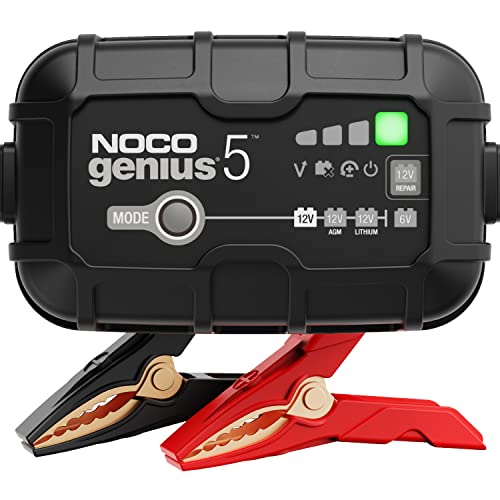
Best for a small charger that still charges properly
- 5A on 6V and 12V, palm-sized housing
- AGM, lithium and repair modes
- Charges batteries down to 1 volt
- Mounting bracket and eyelets included
Why buy it: the charger that fits in a glovebox but behaves like a full smart charger — the best pick if garage wall space is the constraint.

Best for trucks, fleets and deeply discharged big batteries
- 30A bench charge, 80A engine start
- 2A maintainer mode built in
- 120V AC power outlet on the unit
- Digital display with alternator check
Why buy it: the shop-grade unit owners with diesel trucks and multiple vehicles buy — 30 amps refills a big battery fast when time actually matters.
Prices are pulled from Amazon and were accurate as of Aug 22, 2026, 6:44 PM EDT. Product prices and availability are subject to change — the live price is shown on Amazon.