
Affiliate Disclosure
Some links on this page are affiliate links. As an Amazon Associate, we earn from qualifying purchases — at no extra cost to you. We do not buy, test, or physically handle the products we cover; our rankings come from aggregated owner reviews, ratings and expert consensus. Commissions never change our verdicts. How we rank & full disclosure.
Spare Tire
An actual mounted wheel and tire carried in the vehicle — either a full-size match or a compact temporary "donut." It replaces the damaged tire outright rather than trying to fix it.
Best for: Anyone who wants a fix that works regardless of what actually happened to the tire
Compact spare kit $150–$350 used or aftermarket; full-size spare $150–$400 plus a matching wheel
- Handles every failure mode — sidewall cuts, blowouts, bead damage, a shredded tread, a bent wheel edge
- Works on a tire that already ran flat, which a repair kit does not
- No cure time, no sealant residue and no shop cleanup bill afterward
- A full-size spare can simply stay on the car and rejoin the rotation
- Nothing to expire — a spare does not have a four-year shelf life the way sealant does
- Compact donuts are speed and distance limited, commonly 50 mph and 50 miles
- Adds roughly 25–45 lb and eats trunk or under-floor space
- Requires a working jack, lug wrench and enough room to safely change a wheel roadside
- Frequently forgotten — owners consistently report finding the spare flat when they finally need it
Tire Repair Kit
Either a sealant canister paired with a 12V compressor (the factory "mobility kit") or a manual plug kit with reamer, insertion tool and rope plugs. It fixes the tire in place instead of replacing it.
Best for: Small tread punctures, cars with no spare well, and anyone who cannot safely jack up a car roadside
Factory-style sealant and compressor kit $40–$90; manual plug kit $10–$30; quality inflator $40–$120
- Light and compact — a plug kit and inflator take up less room than a bag of groceries
- No jacking, no wheel removal, and no kneeling beside a live traffic lane
- A properly installed rope plug is a genuinely effective temporary fix for a tread puncture
- Cheap enough that keeping one in every vehicle is trivial
- Only works on tread punctures — never sidewall or shoulder damage, and never a tire that ran flat
- Sealant can foul a TPMS sensor and usually adds a cleanup charge at the tire shop
- Sealant has a shelf life, commonly four to eight years, and it does expire
- Useless against a blowout, a bead tear or a wheel that is bent
How they score, side by side
Scores reflect aggregated owner reviews and expert consensus — not our own bench testing.
- Range of failures it fixes104
- Ease of use roadside59
- Weight and space penalty410
- Reliability when you need it96
- Cost to own69
- Long-term tire outcome96
Spec-by-spec comparison chart
| Factor | Spare Tire | Tire Repair Kit |
|---|---|---|
| Fixes a tread puncture | Yes — by replacing the wheel | Yes — this is its one job |
| Fixes sidewall damage | Yes | No — never attempt it |
| Works after a blowout | Yes | No |
| Works on a tire run flat | Yes | No — the casing is already compromised |
| Requires jacking the car | Yes | No |
| Weight carried | ~25–45 lb (donut) or 40–60 lb (full size) | ~3–8 lb |
| Space used | A full wheel well or trunk floor | A small bag |
| Speed / distance limit after use | Donut: ~50 mph, ~50 miles. Full size: none | Plug: drive to a shop. Sealant: ~50 mph, short distance |
| Shelf life | Indefinite — but check pressure twice a year | Sealant expires, commonly 4–8 years |
| Aftermath at the tire shop | None | Sealant often adds a cleanup fee; TPMS may need service |
| Typical cost | $150–$400 to add if the car has no spare | $10–$90 for the kit, plus an inflator |
Our Top 3 Picks
The three highest-rated options in this category, if you'd rather skip straight to a proven pick.
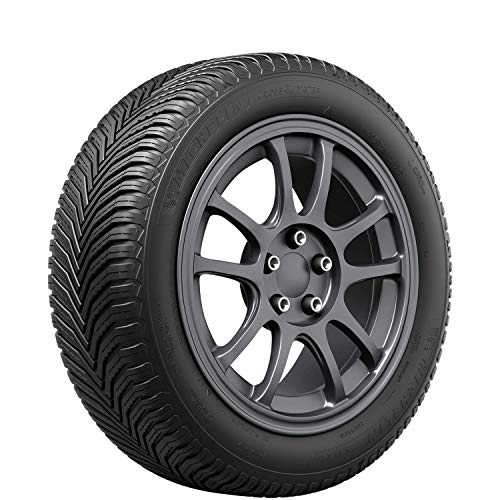
Best for the best all-round grip, wear and light-snow ability
- V-shaped tread with 3-peak-mountain-snowflake rating
- Class-leading wet and dry braking
- 60,000-mile treadwear warranty
- Real light-snow traction for an all-season
Why buy it: the tire owners and experts keep crowning as the best all-rounder — it brakes shorter in the wet than most rivals and genuinely handles snow, so it fits almost any driver in a four-season climate.

Best for the longest tread life on a sedan or minivan
- Up to 80,000-mile treadwear warranty
- Quiet, comfortable highway ride
- Strong wet grip and even wear
- Michelin’s longest-lasting all-season
Why buy it: the set-and-forget touring tire owners rate for outlasting everything else — fit it once and forget about tires for years.

Best for premium wet braking at a mid-range price
- Up to 80,000-mile treadwear warranty
- EcoPlus compound for shorter wet stops
- Fuel-efficient, low rolling resistance
- Wear indicators built into the tread
Why buy it: a hugely popular touring tire that delivers premium-brand wet performance and an 80k warranty for less than the flagships.
Prices are pulled from Amazon and were accurate as of Aug 22, 2026, 6:54 PM EDT. Product prices and availability are subject to change — the live price is shown on Amazon.
What each one actually covers
Roughly a third of new vehicles sold in the US now leave the factory without a spare tire, replaced by a sealant-and-compressor "mobility kit" in a foam tray. Manufacturers do it for weight, fuel economy and packaging. Whether that is a fair trade depends entirely on what goes wrong with your tire.
A spare tire sidesteps the problem. It does not care what happened to the damaged tire, because it replaces the whole assembly. Nail in the tread, gash in the sidewall, blowout at highway speed, wheel bent on a pothole — you take the broken one off and bolt a working one on. No repair kit can match that.
A tire repair kit comes in two very different forms that get confused constantly:
- The factory sealant kit — latex-based sealant and a 12V compressor. You inject it through the valve stem, inflate, and drive slowly so it distributes and plugs the hole from the inside. Quick, needs no tools, and coats the inside of the tire and the TPMS sensor with goo.
- The manual plug kit — a T-handle reamer, an insertion needle, rubber rope plugs and cement. Owners and mechanics consistently rate a well-installed rope plug as far more reliable than sealant, and it leaves nothing inside the tire.
Both share the same hard limit: they only work on a puncture in the tread, roughly a quarter inch in diameter or smaller, in a tire that has not been driven on while flat. Outside that envelope neither one is a repair — it is a hazard. Our tire plug vs patch comparison covers what counts as a permanent repair once you reach a shop.
Which failures each one can actually fix
Line the realistic roadside failures up against the two options and the gap becomes obvious.
- Screw or nail in the tread. The most common failure by a wide margin, and both work — a plug kit is arguably faster than jacking the car.
- Slow leak from a corroded rim or a bad valve stem. A spare fixes it. Sealant may temporarily mask a bead leak; a plug does nothing.
- Sidewall or shoulder damage. Spare only. The sidewall flexes constantly and carries the structural load — there is no legitimate repair for it, roadside or in a shop, and the shoulder is outside the repairable zone for the same reason.
- Blowout. Spare only. Nothing seals a torn casing.
- Driven several miles flat. Spare only. Once the sidewalls have folded and heated, the internal structure is compromised even if the tire holds air afterward.
- Bent wheel from a pothole. Spare only, and only if the spare and its wheel are intact.
That tally is why the honest recommendation leans toward the spare. The consensus among tire technicians is that a repair kit handles the single most common failure well and roughly half of the realistic failure list not at all.
The counterargument is real, though: a spare only helps if you can actually use it. Changing a wheel on the shoulder of an interstate at night, in traffic, is genuinely dangerous — and for some drivers physically not an option. A plug kit and a good inflator let you fix a tread puncture without ever getting the car off the ground.
The safety limits of a repair kit
Industry repair standards, tire manufacturers and shop practice all converge on the same boundaries:
- Tread only. Repairs are permitted only within the crown area of the tread, excluding roughly the outermost inch on each side. Never repair a sidewall or shoulder — that repair can fail without warning at speed.
- Quarter inch maximum. A puncture larger than about 1/4 inch (6 mm) is not repairable, and neither is a slit or a cut.
- Never a tire that ran flat. If it has been driven on while significantly under-inflated, the internal structure may already be damaged, and sealing it hides that rather than fixing it.
- Never two repairs that overlap — a tire that keeps collecting punctures should be replaced.
- An external plug is a temporary repair. The permanent fix is a combination patch-plug installed from the inside by a technician who can inspect the casing for hidden damage.
Two practical warnings on sealant. Most tire shops charge a cleanup fee — commonly $25–$50 per tire — for removing latex sealant, and some refuse to dismount a sealant-filled tire at all. And sealant can coat and disable a TPMS sensor; some are labeled TPMS-safe and many are not, with a replacement sensor typically $50–$120 fitted. Respect the expiry date on the bottle, too: sealant commonly ages out in four to eight years.
Whatever you carry, carry a way to check pressure. A quality inflator turns a slow leak from a tow into an inconvenience — see our tire inflator guide — and it belongs alongside the rest of your roadside emergency kit.
Donut spare rules: 50 mph, 50 miles
A compact temporary spare has its own set of limits, and they are printed right on the tire for a reason. The widely published guidance is 50 mph maximum and roughly 50 miles of range, and it is not a suggestion. A donut has a narrower, shallower tread, a much higher inflation pressure (commonly 60 psi) and far less heat capacity than a full-size tire.
Beyond the speed limit, three consequences are worth knowing:
- Braking and stability change. The smaller contact patch means less grip on that corner, and ABS and stability control are calibrated for four matching tires.
- Never fit a donut to a driven axle on an AWD vehicle if you can avoid it — the mismatched rolling diameter forces the center differential or coupling to work continuously, and extended driving that way can cause expensive driveline damage. Many manuals direct you to move a full-size tire to that corner instead.
- Check the pressure now, not later. Compact spares sit under a trunk floor for years and lose air. Owners consistently report discovering a flat spare at exactly the wrong moment.
A full-size spare has none of these limits, which is why anyone who drives long distances or off pavement tends to prefer one. The trade is weight, cost and a trunk floor you can no longer use.
Real cost, weight and what it does to your trunk
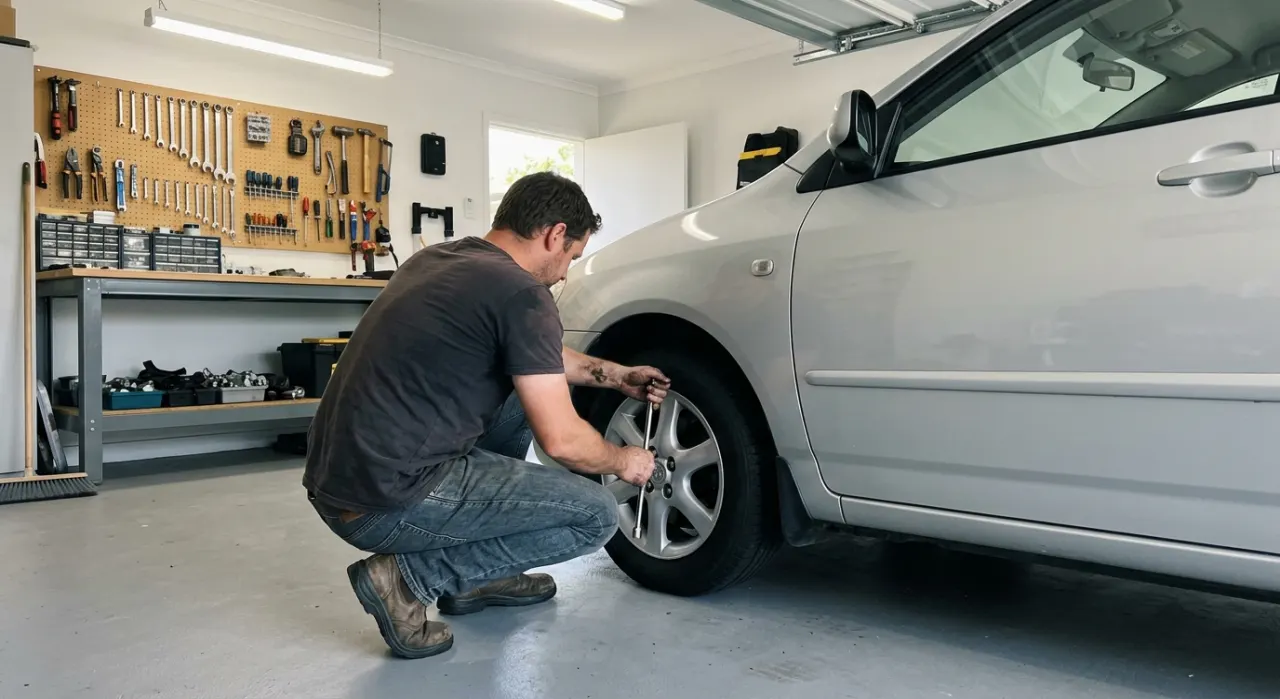
If your car came with a spare, keeping it costs you nothing but roughly 25–45 lb of weight for a donut, or 40–60 lb for a full-size wheel and tire — a fraction of a percent in fuel economy on a typical sedan, and far smaller than the marketing around spare deletion implies.
If your car came without one, adding a spare is a project: a wheel that fits the hub and clears the brakes, a tire, a jack, a lug wrench and somewhere to put it all. A used OEM compact spare kit typically lands at $150–$350 complete. A repair kit is trivially cheap by comparison — $10–$30 for a manual plug kit, $40–$90 for a sealant and compressor kit, $40–$120 for a decent inflator. The hidden costs show up later: sealant cleanup fees, a possible TPMS sensor, and a bottle you have to replace every few years.
The realistic best-value setup is not either/or. It is keep the spare you already have, verify its pressure twice a year, and add a $25 plug kit plus a good inflator. Under $150 added, and it covers both the five-minute tread puncture and the ruined sidewall.
Common myths and mistakes
"Sealant fixes any flat." It fixes small tread punctures. It does nothing for a sidewall, a blowout, a bead leak or a bent wheel.
"A plug is a permanent repair." An external rope plug gets you to a shop. The industry-standard permanent repair is a combination patch-plug fitted from inside after a full internal inspection.
"My donut is fine, I've never used it." Unused does not mean inflated. Compact spares call for around 60 psi and lose pressure over years of sitting.
"Run-flats mean I need neither." Run-flats buy you a limited distance at reduced speed after a pressure loss, and they cannot be repaired once run flat. They are a different trade-off, not an exemption — our run-flat vs regular tires comparison covers what you actually give up.
Which should you buy — and how to decide
Keep the spare if your car has one. It is the only option that solves every failure mode, and the weight penalty is small next to being stranded by a sidewall cut. Check its pressure twice a year and confirm the jack and lug wrench are actually in the car.
Add a plug kit and a quality inflator regardless. They cover the most common failure — a nail in the tread — without jacking the car up beside traffic, which is a real safety benefit at night or in bad weather.
Rely on a repair kit alone only if your vehicle genuinely has no spare well. In that case buy a good plug kit rather than depending on the factory sealant canister alone, and know your recovery plan for the failures a kit cannot fix.
Consider a full-size spare if you take long trips, drive unpaved roads, or run an AWD vehicle where a mismatched rolling diameter causes driveline problems. It removes the 50 mph limit and can rejoin the rotation.
And whichever route you take, hold the safety line: tread punctures only, under a quarter inch, never a sidewall, never a shoulder, never a tire that has already run flat — and treat every roadside fix as temporary until a technician has inspected the tire from the inside.
Recommended Products
Our top picks in this category, ranked on aggregated owner reviews.
Best for the best all-round grip, wear and light-snow ability
- V-shaped tread with 3-peak-mountain-snowflake rating
- Class-leading wet and dry braking
- 60,000-mile treadwear warranty
- Real light-snow traction for an all-season
Why buy it: the tire owners and experts keep crowning as the best all-rounder — it brakes shorter in the wet than most rivals and genuinely handles snow, so it fits almost any driver in a four-season climate.
Best for the longest tread life on a sedan or minivan
- Up to 80,000-mile treadwear warranty
- Quiet, comfortable highway ride
- Strong wet grip and even wear
- Michelin’s longest-lasting all-season
Why buy it: the set-and-forget touring tire owners rate for outlasting everything else — fit it once and forget about tires for years.
Best for premium wet braking at a mid-range price
- Up to 80,000-mile treadwear warranty
- EcoPlus compound for shorter wet stops
- Fuel-efficient, low rolling resistance
- Wear indicators built into the tread
Why buy it: a hugely popular touring tire that delivers premium-brand wet performance and an 80k warranty for less than the flagships.

Best for the most tire for the money
- Up to 75,000-mile treadwear warranty
- "Replace Tire" wear indicator in the tread
- Reliable wet braking and light-snow grip
- Backed by Continental’s parent company
Why buy it: the value pick owners rate again and again — a genuinely good touring tire with a 75k warranty at a bargain price.

Best for confidence in rain and winter slush
- 3-peak-mountain-snowflake certified
- Evolving Traction Grooves for wet grip
- 60,000-mile treadwear warranty
- Strong all-weather safety focus
Why buy it: the pick for drivers who see a lot of rain and the occasional storm — a true all-weather tire that carries the winter certification most all-seasons lack.

Best for sporty cars that still need year-round use
- Ultra-high-performance all-season design
- Excellent dry, wet and light-snow grip
- Tread wear indicators (DWS letters)
- A perennial enthusiast favorite
Why buy it: the enthusiast’s all-season — near-summer-tire dry grip with real wet and light-snow ability, so a sports sedan can run one set all year.
Prices are pulled from Amazon and were accurate as of Aug 22, 2026, 6:54 PM EDT. Product prices and availability are subject to change — the live price is shown on Amazon.