

Affiliate Disclosure
Some links on this page are affiliate links. As an Amazon Associate, we earn from qualifying purchases — at no extra cost to you. We do not buy, test, or physically handle the products we cover; our rankings come from aggregated owner reviews, ratings and expert consensus. Commissions never change our verdicts. How we rank & full disclosure.
Beam Blades
A single-piece, pre-tensioned spring steel strip with an integrated wind spoiler and no exposed joints. It presses evenly along its whole length and uses airflow to push itself down instead of lifting.
Best for: Modern curved windshields, highway driving, and anywhere it snows or ices
Typically $18–$40 each; Bosch Icon, Rain-X Latitude and Michelin Stealth sit in that band
- Continuous, even pressure across the full length instead of 4–8 discrete contact points
- Conforms to the tight curvature of modern windshields far better than a rigid frame
- Integrated spoiler converts airflow into downforce, so no lift or chatter at 70 mph
- No hinges or joints for snow and ice to pack into — the biggest winter advantage there is
- Low profile means less wind noise and a cleaner look at rest
- Roughly double the price of a comparable conventional blade
- Needs the correct arm adapter, and a wrong one causes chatter or a poor sweep
- A worn-out beam is one disposable unit — nothing on it is serviceable
- On some older, flatter windshields the tighter pre-curve can leave a light streak
Conventional Blades
The traditional bracket design: a metal or plastic frame with four, six or eight articulated pressure points that spread the wiper arm’s force across a rubber refill.
Best for: Older or flatter windshields, tight budgets, rear wipers, and mild climates
Typically $8–$18 each; premium winter versions with rubber boots run $15–$25
- The cheapest way to get a fresh, functional wiping edge on the glass
- Stocked everywhere, in every length, at every parts counter and big-box store
- The simple J-hook fitment is close to universal on older vehicles
- Rubber-booted winter versions seal the frame against ice on a proven design
- Refillable on some designs, though few people bother anymore
- The open frame catches air and lifts above roughly 55–65 mph, causing streaks
- Joints pack with snow and ice, freezing the frame into an arc that cannot follow the glass
- Only 4–8 pressure points, so contact is uneven across a strongly curved windshield
- Taller profile creates more wind noise and more visual obstruction at rest
How they score, side by side
Scores reflect aggregated owner reviews and expert consensus — not our own bench testing.
- High-speed performance95
- Winter and ice performance95
- Streak-free wipe on curved glass96
- Quietness86
- Value for money69
- Availability and fitment simplicity79
Spec-by-spec comparison chart
| Factor | Beam Blades | Conventional Blades |
|---|---|---|
| Structure | One-piece pre-tensioned spring steel | Articulated metal or plastic bracket frame |
| Pressure points | Continuous along the full length | 4, 6 or 8 discrete points |
| Aerodynamics | Integrated spoiler generates downforce | Open frame catches air and lifts |
| Lift at 70 mph | Minimal | Common — the usual cause of highway streaking |
| Ice and snow | No joints to pack; stays flexible | Joints freeze; blade locks into an arc |
| Curved-glass conformity | Excellent | Fair to good, degrading with curvature |
| Wind noise | Low | Moderate |
| Fitment | Needs the correct adapter for the arm type | J-hook fits most older arms directly |
| Typical life | 6–12 months | 6–12 months |
| Price each | $18–$40 | $8–$18 |
Our Top 3 Picks
The three highest-rated options in this category, if you'd rather skip straight to a proven pick.

Best for the best mix of brand pedigree, warranty and price
- 72-tooth ratchets for a 5° swing arc
- Polished chrome-vanadium, anti-slip sockets
- DEWALT full lifetime warranty
- Compact SAE + metric set in a blow-mould case
Why buy it: a name-brand kit that owners rate at the very top of the budget class — the lifetime warranty and fine-tooth ratchets punch well above the price, which is why it keeps getting recommended to first-time wrenchers.
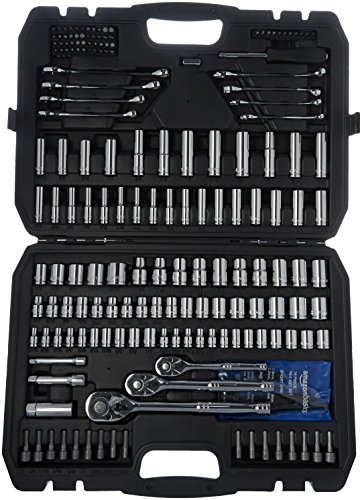
Best for the most sockets and bits per dollar
- 201 pieces across 1/4", 3/8" and 1/2" drives
- Chrome-vanadium forged, polished-chrome finish
- Full SAE + metric coverage
- Molded case keeps every socket in its slot
Why buy it: a socket-heavy kit that owners repeatedly call the best money-for-metal buy on Amazon — if your jobs are mostly nuts and bolts, nothing here gives you more drive tools for the outlay.

Best for trusted-brand tools with a lifetime guarantee
- 72-tooth reversible ratchets
- Alloy-steel sockets, off-corner loading grip
- Crescent lifetime warranty
- Closed, latching blow-mould case
Why buy it: an Apex Tool Group set that owners rate for genuine fit and finish — the off-corner grip protects rounded fasteners, and the lifetime backing means a cracked socket is a free swap.
Prices are pulled from Amazon and were accurate as of Aug 22, 2026, 6:44 PM EDT. Product prices and availability are subject to change — the live price is shown on Amazon.
What actually separates a beam from a bracket
Both designs are solving the same mechanical problem: a wiper arm applies force at a single pivot, and that force has to be spread evenly along 16 to 28 inches of rubber that is pressed against curved glass. How each design solves it explains every performance difference between them.
A conventional blade — bracket, frame or "traditional" — solves it with a lever tree. The arm pushes a primary yoke, which splits to secondary yokes and sometimes tertiary claws, producing four, six or eight discrete pressure points on a flexible backing strip. It works, but pressure between those points is lower than at them, and the whole assembly is an open lattice sitting in the airstream.
A beam blade — flat blade, bracketless, or "beam" — throws the lever tree away. Instead it uses a single strip of spring steel that has been pre-curved to a tighter radius than the windshield. Pressing that strip flat against the glass loads it evenly along its entire length, exactly the way a leaf spring works. Over the top of it goes a molded rubber housing with an integrated aerodynamic spoiler. There are no hinges, no joints, and nothing to catch air.
The consensus among installers is that this is why beam blades took over as original equipment: more consistent contact on deeply curved modern glass, and no exposure to the two failure modes bracket blades are known for — lift at speed and ice in the joints.
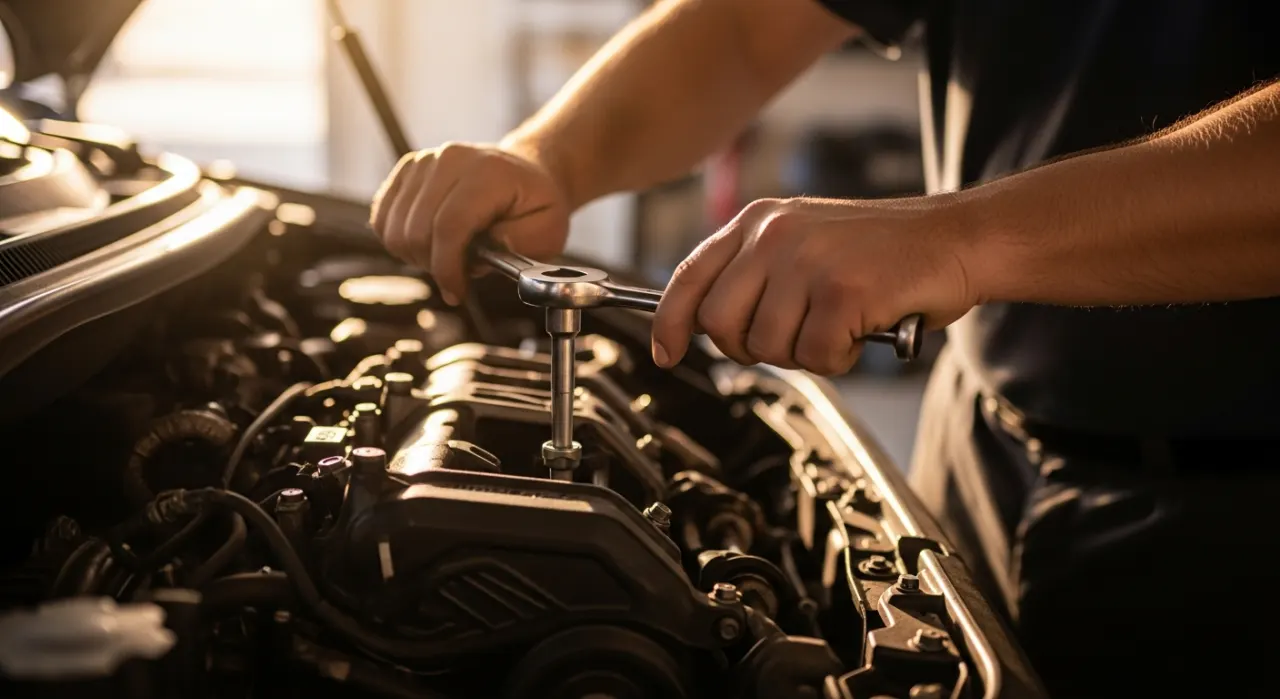
Pressure distribution and lift at highway speed
Windshield curvature has increased steadily for decades, driven by aerodynamics and raked A-pillars. A bracket blade approximates that curve with straight segments between its pressure points — fine on the mild glass of a 1995 sedan, progressively worse on a current crossover. Owners report the symptom rather than the cause: a persistent unwiped band near the top of the sweep or out at the corners that no amount of new rubber fixes. That band is where pressure between contact points fell below what the rubber needs to seal. The beam's continuous spring loading follows compound curvature the way a strip of tape does, and typically clears the full arc cleanly.
Aerodynamic lift is the second and more dramatic difference. A conventional frame is a stack of open brackets standing up in a 70 mph airstream, and as speed rises the air pushing under it progressively unloads the blade from the glass. Owners commonly describe streaking and chatter that appears above roughly 55–65 mph and disappears when they slow down. That is textbook lift.
A beam blade's molded spoiler does the opposite: airflow over it generates downforce, so the faster you go the harder the blade presses onto the glass — a rear wing applied to a $25 part. For mostly-highway drivers this alone justifies the upgrade, and it stacks with a hydrophobic glass treatment, which solves the other half of the same visibility problem. Our guide to windshield water repellents covers the coating side.
Ice, snow and the winter case
Winter is where the gap becomes least arguable, and it comes down to one thing: joints.
Wet snow and freezing rain pack into the articulation points of a bracket blade and freeze solid. The frame can then no longer flex, so the blade sweeps as a rigid arc and contacts curved glass in perhaps two places — the familiar winter experience of a blade that smears a stripe of slush and clears nothing. The accumulated ice also adds leverage that can bend the frame permanently, which is why a bracket blade often never wipes properly again after a bad storm.
A beam blade has no joints to pack. Snow sits on the smooth housing and gets flung off, and the spring steel stays flexible enough to follow the glass. Aggregated owner reviews from northern states are close to unanimous on this — beam blades are the winter recommendation, and the ones marketed as winter or all-season beams simply add a more cold-tolerant rubber compound to the same structure.
The one counterargument worth respecting is the traditional rubber-booted winter blade — a conventional frame encased in a rubber sleeve so ice cannot reach the joints. It is proven and cheap, but the boot ruins summer aerodynamics and stiffens in extreme cold, making it a seasonal blade you swap twice a year rather than a year-round answer.
Two habits matter more than blade choice in winter, whichever you buy: lift the arms off the glass before an ice storm so the rubber does not freeze down and tear, and never use the wipers to clear ice. Scrape first.
Rubber compound matters more than the frame
Here is the honest caveat to everything above: the frame determines how evenly pressure is applied, but the wiping edge determines whether the glass comes clean. A worn beam blade is worse than a fresh conventional one, every time.
What separates a good edge from a bad one:
- Compound. Natural rubber is soft, wipes beautifully and degrades fastest under UV and ozone. Halogen-hardened and synthetic compounds trade a little initial suppleness for substantially longer life. Silicone blades last longest and leave a mild hydrophobic film on the glass, at a price premium.
- Coating. Graphite or PTFE treatment on the wiping edge lowers friction, which reduces the stick-slip that causes chatter and juddering. Most of that coating wears off within a few months, which is one reason new blades feel better than they do at six months.
- Edge profile. The rubber must flip cleanly at each direction change. A hardened, cracked or set edge drags instead of flipping, and that produces the streaking most people blame on the blade design.
Contamination is the other half, and it is why a large share of "bad blade" complaints are not about the blade at all. Road film, wax overspray, sap and old repellent residue break the water sheet and produce streaks no new blade will fix. Claying or polishing the glass, then cleaning it properly, resolves more wiper complaints than replacement does — see cleaning a windshield streak-free, and our wiper blades hub for types, sizes and fitment.
Cost per season and how long they really last
Both types wear out on roughly the same clock — six to twelve months — because the enemy is UV, ozone, heat cycling and grit, none of which care about the frame. Arizona and Florida owners replace at the short end; mild coastal climates stretch it.
Run the annual math on a pair:
- Conventional: $16–$36 a pair, replaced once or twice a year. Call it $20–$60 a year.
- Beam: $36–$80 a pair on the same schedule, so $45–$120 a year.
The real difference is $25–$60 a year — small against what you get in heavy rain at speed, and smaller still against a windshield scratched by a blade nobody checked. Two notes that matter more than the frame choice: buy in pairs, since a fresh blade next to a worn one just relocates the streak, and check your sizes, since driver and passenger blades are usually different lengths.
One place not to spend up: the rear wiper. Rear glass is small, flat and out of the airstream, so the beam advantages barely apply — a cheap conventional blade in the right size is the correct purchase.
Common myths and mistakes
"Beam blades are just a styling upgrade." No. The continuous spring loading and the spoiler are functional, and they change behavior measurably on curved glass and at highway speed. The looks are a byproduct.
"My wipers chatter, so I need better blades." Chatter is usually the wiper arm, not the blade. If the arm's torsion has shifted so the rubber does not flip cleanly at direction changes, any blade will judder. It can also be a contaminated windshield. Diagnose both before buying again.
"Replacing the blades will fix my streaks." Only if the rubber is the problem. Baked-on road film, wax residue and old repellent break the water sheet all by themselves — decontaminate the glass first and you will often find the old blades were fine.
"Any beam blade will fit." Fitment is where beam upgrades most often go wrong. Arms come in J-hook, pinch tab, bayonet, side lock and push button versions, and using the wrong adapter changes the blade's angle to the glass, which causes exactly the chatter you were trying to fix. Verify the connector, not just the length.
Which should you buy — and how to decide
Buy beam blades if your car was built in roughly the last twenty years, if you drive highway miles, or if you see snow and ice. That covers most drivers. Match the connector type to your arm, buy the correct length for each side, and replace both fronts together.
Buy conventional blades if you are running an older vehicle with flatter glass, you are replacing a rear wiper, or the budget is genuinely tight this month. A fresh conventional blade correctly sized and fitted beats a tired beam blade every single time, and that trade is a perfectly rational one to make.
Consider a hybrid for a middle path — a bracket frame wrapped in an aerodynamic shell. It picks up most of the beam's high-speed stability while keeping familiar fitment, at a price between the two.
Whichever you pick, change them on a schedule rather than waiting for the streak, clean the glass first, and add a hydrophobic treatment on top — see our rain repellent guide. That combination costs less than a tank of gas and transforms heavy-rain visibility.
Recommended Products
Our top picks in this category, ranked on aggregated owner reviews.
Best for the best mix of brand pedigree, warranty and price
- 72-tooth ratchets for a 5° swing arc
- Polished chrome-vanadium, anti-slip sockets
- DEWALT full lifetime warranty
- Compact SAE + metric set in a blow-mould case
Why buy it: a name-brand kit that owners rate at the very top of the budget class — the lifetime warranty and fine-tooth ratchets punch well above the price, which is why it keeps getting recommended to first-time wrenchers.
Best for the most sockets and bits per dollar
- 201 pieces across 1/4", 3/8" and 1/2" drives
- Chrome-vanadium forged, polished-chrome finish
- Full SAE + metric coverage
- Molded case keeps every socket in its slot
Why buy it: a socket-heavy kit that owners repeatedly call the best money-for-metal buy on Amazon — if your jobs are mostly nuts and bolts, nothing here gives you more drive tools for the outlay.
Best for trusted-brand tools with a lifetime guarantee
- 72-tooth reversible ratchets
- Alloy-steel sockets, off-corner loading grip
- Crescent lifetime warranty
- Closed, latching blow-mould case
Why buy it: an Apex Tool Group set that owners rate for genuine fit and finish — the off-corner grip protects rounded fasteners, and the lifetime backing means a cracked socket is a free swap.

Best for a first-ever kit that covers the whole garage and house
- Sockets, wrenches, screwdrivers, hammer, pliers
- Heat-treated carbon steel, rust-resistant
- Compact blow-mould carry case
- One of Amazon’s best-selling tool kits
Why buy it: the entry point owners recommend for a first toolbox — rated across tens of thousands of reviews, it handles light auto work and household jobs without asking much of your wallet.
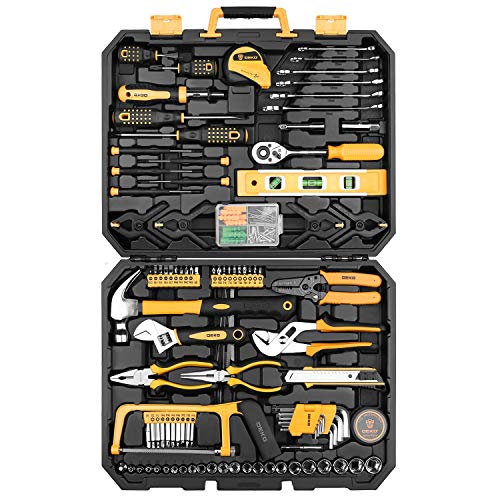
Best for a purpose-built car-repair combination
- 168-piece socket + wrench combination
- Ratchet handle, extension bars, spark-plug socket
- Chrome-vanadium and carbon-steel mix
- Deep plastic storage case
Why buy it: a combination set owners lean on for actual under-hood jobs — the spark-plug socket, extensions and combination wrenches mean fewer trips to buy the one tool you’re missing.

Best for the most complete kit before you leave the budget tier
- 201-piece mechanics set, SAE + metric
- 72-tooth quick-release ratchets
- Black-chrome sockets with laser-etched sizes
- Sturdy structural-foam case
Why buy it: the ceiling of the budget class — owners rate its ratchets and easy-read sockets highly, and the Stanley name carries a reputation that a no-name kit can’t match at the same money.
Prices are pulled from Amazon and were accurate as of Aug 22, 2026, 6:44 PM EDT. Product prices and availability are subject to change — the live price is shown on Amazon.