

Affiliate Disclosure
Some links on this page are affiliate links. As an Amazon Associate, we earn from qualifying purchases — at no extra cost to you. We do not buy, test, or physically handle the products we cover; our rankings come from aggregated owner reviews, ratings and expert consensus. Commissions never change our verdicts. How we rank & full disclosure.
The short version: a 12V charger is the tool that turns a dead battery back into a working one, and unlike a jump starter it actually puts energy back in. Ranked across tens of thousands of owner reviews, our #1 pick is the NOCO GENIUS10: ten amps recovers a flat car battery in an afternoon, the AGM and lithium modes cover every battery in a modern driveway, and it is safe to leave connected once it reaches float. Want to spend less? The 5 amp Battery Tender does the same job on one car. Want a charger that can also crank the engine? That is the Schumacher SC1281. Below is the full ranked field and how we rank it.
Worth separating before you buy: a charger refills a discharged battery over hours, a maintainer holds a healthy one at float for months (ranked in best trickle charger), and a jump starter supplies a burst of cranking current and charges nothing at all. If the engine will not turn over in the next five minutes, you want the third one — the jump starters hub covers that.
Top Picks at a Glance

Why the NOCO GENIUS10 Is Our #1
Ten amps is the amperage that makes a charger genuinely useful rather than merely convenient. At 5 amps a flat 50Ah battery is an overnight job; at 10 amps it is done between lunch and dinner, and owners consistently say that difference is what makes them actually use the charger instead of borrowing a jump pack. The GENIUS10 delivers that on both 6V and 12V, with an integrated thermal sensor that raises the charge voltage in a freezing garage and pulls it back in a hot one — the single feature that separates chargers that survive real winters from chargers that do not.
The chemistry selection is the other reason it tops the field. Explicit AGM and lithium profiles matter because a modern driveway rarely has one battery type: a stop-start car with AGM, a bike with LiFePO4 and an old flooded truck battery all want different absorption voltages. A single button changes the curve, and the 12V repair mode is deliberately separate so it never fires at a battery that should not receive it. Force mode is the practical bonus — it will push current into a battery that has fallen to zero volts, where most chargers simply refuse to start.
The honest complaints: it is not cheap for a 10 amp unit, the short flashing-LED language takes a manual read to decode, and owners occasionally report the unit refusing to leave the diagnostic stage on a battery that is genuinely at end of life — which is arguably correct behavior, but reads as a fault. For a single-vehicle household the 5 amp models below save real money.
Best 12V Battery Chargers 2026: The Ranked Field

Best for recovering a flat car or truck battery in an afternoon
- 10A on 6V and 12V, 12V repair mode
- Selectable AGM and lithium profiles
- Thermal sensor adjusts for ambient temp
- Force mode charges from 0 volts
Why buy it: the 10-amp smart charger owners rate highest — fast enough to refill a dead group-35 battery in a few hours, then safe to leave on float indefinitely.

Best for one car, one charger, no complications
- 5A four-stage switch-mode charging
- Lead-acid, AGM, gel and lithium settings
- Automatic float when charging completes
- Clamps plus quick-connect ring harness
Why buy it: the sensible middle of the range — 5 amps suits a normal car battery, and owners like that it drops to float and can simply stay connected.
Best for app monitoring and adjustable charge profiles
- 15A adaptive multi-stage charging
- Bluetooth app with live and historic data
- IP65 water and dust resistant housing
- Lead-acid and LiFePO4 algorithms
Why buy it: the charger enthusiasts and van owners buy once — you can watch every stage on your phone and tune the profile to the exact battery.

Best for a charger that can also crank the engine right now
- 6A charge, 30A boost, 100A engine start
- 6V and 12V, automatic voltage detection
- Built-in battery and alternator tester
- Float mode for long-term maintenance
Why buy it: the do-everything wall charger — owners keep it for the engine-start mode that gets a dead vehicle moving without a second device.

Best for a small charger that still charges properly
- 5A on 6V and 12V, palm-sized housing
- AGM, lithium and repair modes
- Charges batteries down to 1 volt
- Mounting bracket and eyelets included
Why buy it: the charger that fits in a glovebox but behaves like a full smart charger — the best pick if garage wall space is the constraint.

Best for trucks, fleets and deeply discharged big batteries
- 30A bench charge, 80A engine start
- 2A maintainer mode built in
- 120V AC power outlet on the unit
- Digital display with alternator check
Why buy it: the shop-grade unit owners with diesel trucks and multiple vehicles buy — 30 amps refills a big battery fast when time actually matters.
Prices are pulled from Amazon and were accurate as of Aug 22, 2026, 6:44 PM EDT. Product prices and availability are subject to change — the live price is shown on Amazon.

How to Choose a 12V Charger
Three decisions cover it. Amperage first: aim for roughly 10 percent of the battery's amp-hour rating, which puts a normal car at 5 amps and a truck or dual-battery setup at 10 to 30. Faster is not automatically better — high current on a small battery makes heat, and heat is what kills lead-acid plates. Chemistry second: buy a unit with labeled AGM and lithium modes unless you are certain you will only ever charge flooded batteries. Third, decide whether you want engine start. A charger with a start mode delivers 80 to 100 amps for a few seconds so a dead vehicle can be driven to a shop; it is genuinely useful, but it makes the charger big, heavy and mains-tethered, which is why many owners keep a small smart charger on the wall and a lithium jump pack in the trunk instead.
Two smaller things worth checking. Cable length decides whether the charger reaches the battery from the nearest outlet — 6 feet of AC and 6 feet of DC is the practical minimum in a real garage. And a quick-connect ring terminal harness, bolted to the battery once and left there, is what turns charging from a chore into a ten-second plug-in.
The Specs Decoded
Charge stages. A modern charger runs diagnosis, desulfation (on lead-acid only), bulk, absorption and float. Bulk pushes maximum current until the battery reaches absorption voltage; absorption holds that voltage while current tapers; float drops to a maintenance level. A charger without a float stage is not one to leave connected.
Temperature compensation. Lead-acid batteries need a higher charge voltage when cold and a lower one when hot. Chargers with a thermal sensor adjust automatically, which matters enormously in an unheated garage.
Repair or recondition mode. A controlled high-voltage pulse intended to break down sulfation on a tired flooded battery. It is a lead-acid tool. It should never be applied to a lithium battery, and most AGM manufacturers advise against it too — details in battery desulfation explained.
Engine start amps. A brief cranking burst, not a charge rate. An 80A start mode is not comparable to a 1,000A lithium jump pack — see jump starter vs jumper cables for where each fits.
Common Mistakes
Charging a frozen battery. A deeply discharged battery can freeze, and charging one that is frozen risks rupturing the case. Let it warm up first.
Charging in a sealed space. Flooded batteries vent hydrogen while charging. Ventilate, and connect the negative clamp to a ground point away from the battery so any spark happens somewhere harmless.
Using the wrong chemistry profile. A lead-acid curve on a LiFePO4 battery can push it outside its safe voltage window; a desulfation pulse on AGM or lithium is a real risk. Set the mode before you plug it in.
Charging a battery that is already finished. A battery that will not hold 12.4 volts after a full charge is worn out. Test it — how to test a car battery — rather than fighting it.

How We Rank
We have no lab and we do not bench-test chargers ourselves. We rank by aggregating owner ratings, review volume and the themes buyers repeat over years of ownership, then weigh that against published specifications and the consensus among mechanics. Four things carry the most weight. Charging behavior — a genuine multi-stage curve with a real float stage, and temperature compensation where the price justifies it. Chemistry support — explicit AGM and lithium modes rank above a single profile, because mismatches are a safety matter rather than a preference. Durability — the recurring reports from owners several years in, which is where cheap chargers separate themselves from good ones. And value — what you pay per usable amp, including the harness and cables in the box. Prices were current at the time of writing.
The Verdict
For a driveway with more than one vehicle, the NOCO GENIUS10 is the charger owners rate highest — fast enough to be genuinely useful, safe enough to leave connected, and smart enough to handle every chemistry you are likely to own. One car and a tighter budget points to the 5 amp Battery Tender. Enthusiasts who want visibility into every stage should buy the Victron Blue Smart IP65, and anyone who regularly deals with dead vehicles will get more out of the Schumacher SC1281 and its engine-start mode.
Related reading: best smart battery charger for the multi-stage field, AGM chargers and lithium chargers for chemistry-specific picks, the flagship best battery charger ranking, and the full battery chargers hub. For the rest of the wall, see garage tools.
Portable vs Bench 12V Chargers
Chargers split by where they live. A portable smart charger is palm-sized, clips to a battery in the car, and stores in a glovebox — ideal if garage wall space is tight or you charge more than one vehicle in different spots. A bench or wall-mounted unit is bigger, pushes more amps, and stays put near an outlet. Owners consistently report that a portable 5-amp unit covers a normal car, while anyone who works on several vehicles keeps a heavier bench charger for speed. Portability costs you amps: the smallest units top out around 5 amps, so match the form factor to how fast you actually need a flat 12V battery back.
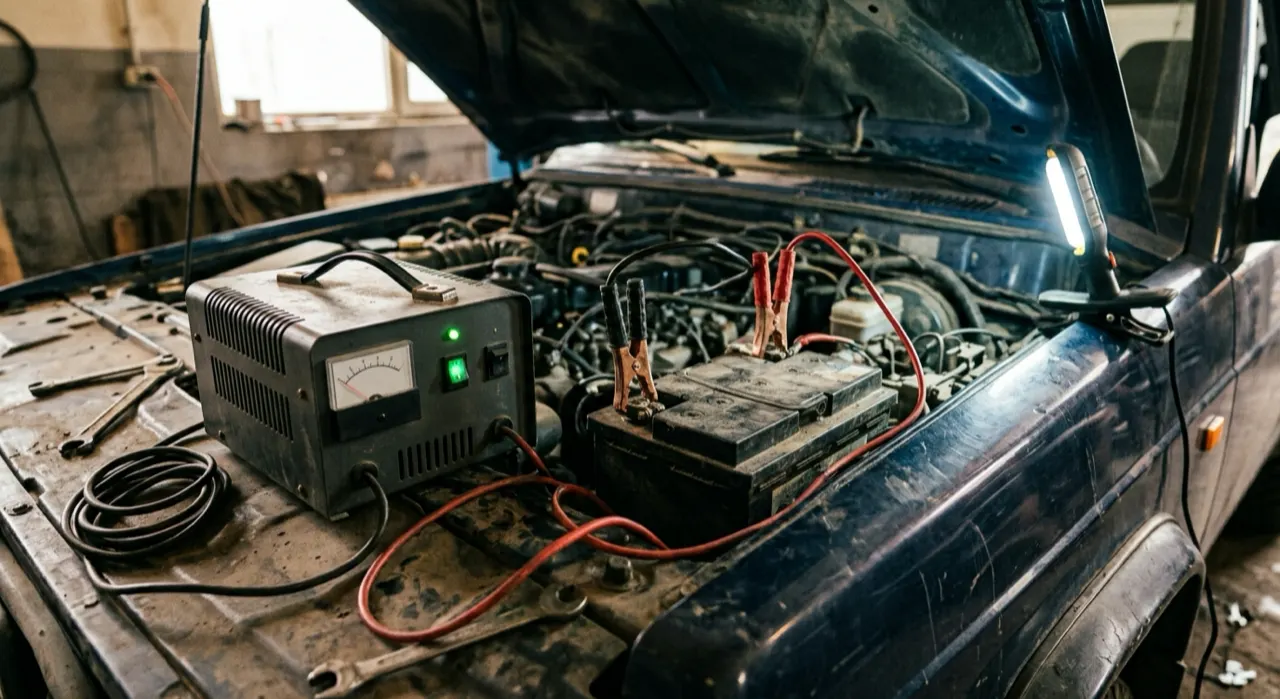
Heavy-Duty Chargers for Trucks and Diesels
A big diesel or a dual-battery truck asks more of a charger than a compact car does. Heavy-duty units like the DEWALT push 30 amps of bench charging plus an 80-amp engine start, refilling a large group-31 battery in a fraction of the time a 5-amp unit needs. Owners who run diesel trucks, RVs or a small fleet consistently report the extra current is worth it because time on the charger is time the vehicle is off the road. The trade-off is size, weight and price — a heavy-duty charger is a shop tool, not something you toss in the trunk, so most drivers pair one with a small portable unit for everyday use.
Chargers That Double as Maintainers
The best modern 12V chargers are also maintainers, and knowing the difference saves buying twice. In charge mode the unit pushes real current to refill a flat battery; once full, a genuine float or maintenance stage drops to a trickle that holds the battery for months without cooking it. Owners consistently report leaving a combo unit connected all winter on a seasonal car with no harm. Dedicated maintainers still exist for permanent under-hood mounting, but for most people a single smart charger that both recovers and maintains is the tidier buy. Check the spec sheet names a float or maintenance stage before you leave any charger connected unattended.
Quick Comparison
NOCO GENIUS10 (10A)
Best for recovering a flat car or truck battery in an afternoon
Best Value
Battery Tender 5A 12V (022-0186G-DL-WH)
Check Price on Amazon
Best Premium
Victron Blue Smart IP65 12V 15A
Check Price on Amazon
Best with Engine Start
Schumacher SC1281 (6A + 100A Start)
$89.99 · Check Price on Amazon
Best Compact
NOCO GENIUS5 (5A)
$69.95 · Check Price on Amazon
Best Heavy-Duty
DEWALT DXAEC80 (30A + 80A Start)
Check Price on Amazon
Prices are pulled from Amazon and were accurate as of Aug 22, 2026, 6:44 PM EDT. Product prices and availability are subject to change — the live price is shown on Amazon.