
Affiliate Disclosure
Some links on this page are affiliate links. As an Amazon Associate, we earn from qualifying purchases — at no extra cost to you. We do not buy, test, or physically handle the products we cover; our rankings come from aggregated owner reviews, ratings and expert consensus. Commissions never change our verdicts. How we rank & full disclosure.
Short version: All three do the same job — protect your paint and make it shine — but they trade off differently on cost, durability, gloss and effort. Wax is cheap, warm-looking and short-lived. Sealant is the practical middle ground: months of protection, easy to apply. Ceramic is the long-haul option: years of protection, but real prep and no room for error. For most drivers, a sealant is the right answer. Here's the full comparison so you can pick with confidence.
Meet the three contenders
Wax is the classic. Usually natural carnauba, it's what your dad used on Sunday mornings. It lays down a warm, deep glow, it's cheap, and it's the easiest to apply and remove. The catch is durability — you're looking at six to eight weeks before it's gone, less if the car lives outside.
Sealant is the synthetic evolution of wax. Lab-engineered polymers bond to your clear coat and last months instead of weeks. It handles heat and UV better than wax and gives a sharper, more mirror-like finish. It's still easy to apply — wipe on, haze, buff off — but it lasts four to six times longer than wax.
Ceramic coating is the heavy hitter. A liquid that chemically bonds to your paint and cures into a hard, glass-like layer lasting one to five years. It sheds water aggressively, resists chemicals and UV, and makes cleaning almost effortless. The trade-off is prep and precision: the paint has to be spotless, and mistakes show up as high spots that are a pain to remove.
Durability: the headline difference
This is where they separate most clearly, and it's usually the deciding factor.
- Wax: roughly 6–8 weeks. A ritual you repeat often.
- Sealant: roughly 4–6 months. A couple of applications a year covers you.
- Ceramic: 1–5 years depending on the product and how well it was applied. A once-in-a-long-while job.
If you hate reapplying, that ladder tells you everything. But durability isn't free — the longer-lasting options demand better prep. Wax forgives dirty paint; ceramic punishes it. We cover the prep that makes or breaks a coating in clay bar decontamination.
Effort and skill floor
Ease of application runs in the opposite direction to durability, which is the whole tension of this decision.
- Wax is the most forgiving. Wipe on, buff off, streaks are easy to fix. You could hand it to a total beginner.
- Sealant is nearly as easy, with one rule: go thin and work on cool paint in the shade. Do that and it's almost foolproof.
- Ceramic is the demanding one. The paint must be washed, decontaminated and often polished first. You apply small sections, level immediately, and watch for high spots before they cure. Rush it and you'll be buffing out streaks for an hour.
The honest read: if you're new to this, a sealant gives you 80% of the benefit for 20% of the difficulty. If you enjoy the process and want the ultimate result, ceramic rewards the effort.
Gloss and looks
People assume ceramic looks dramatically better. It doesn't, not by as much as the price suggests. Freshly applied, all three look excellent — the differences are a matter of character. Carnauba wax gives a warm, wet, slightly softer glow. Sealant gives a crisp, glassy, mirror reflection. Ceramic gives a slick, deep, candy-like clarity with insane water beading. If you put all three on the same car and squinted, most people couldn't reliably call the winner. Choose on durability and effort; treat the exact gloss flavor as a tiebreaker for your taste.
Cost — upfront vs over time
Wax is cheapest per bottle, ceramic is most expensive, sealant sits in between. But the smarter way to think about it is cost over time. A cheap wax you reapply every six weeks eats bottles and Sunday afternoons. A ceramic coating costs more upfront but you apply it once a year or less. For a lot of people, sealant wins the true-cost math: modest bottle price, only a couple of applications a year, minimal time.
How to choose
Match it to how you actually live with your car:
- You love the ritual and don't mind frequent reapplication: wax. Enjoy it.
- You want easy, durable protection with minimal fuss: sealant. This is most people's answer. Our best paint sealant guide covers the field.
- You keep your cars for years and want set-and-forget protection: ceramic.
- You want physical chip protection, not just gloss: that's a different product entirely — see paint protection film. And if you're weighing the two big-money options head to head, PPF vs Ceramic settles it.
Can you combine them?
Yes, and enthusiasts do. The classic stack is a sealant base with a carnauba wax on top — durable protection underneath, warm glow on the surface. Ceramic can be topped with a spray sealant or ceramic booster to refresh its water-shedding between full applications. The one rule: order matters. Durable synthetics go down first as the base; wax goes on top. Never bury wax under a sealant or coating, because it blocks the bond underneath.
The reason layering works at all comes down to how each product bonds. Sealant and ceramic grip bare clear coat directly, so they have to touch clean paint to do their job — that's why they're always the base. Wax, by contrast, is happy sitting on top of almost anything, which is exactly why it's the finishing touch rather than the foundation. If you ever want to change your base — strip a tired sealant and start fresh — a wash with a stronger, wax-stripping shampoo resets the paint so your next layer bonds cleanly. Think of it as a stack you can rebuild from the bottom up whenever the protection underneath wears out.
See our top picks: for the protection gear reviewers rate highly, browse our exterior protection roundup.
Recommended Products
One well-rated pick from each camp so you can act on the verdict above: a sealant for most people, two carnauba waxes for warmth and ritual, and three ceramic options from an easy spray to a years-long coating. Match it to how much time you'll spend and how long you want it to last.

Best for the practical middle ground most drivers should pick
- Carnauba-polymer hybrid — sealant durability, warm glow
- Months of protection from an easy wipe-on layer
- Beloved, decades-old formula with a huge review base
- The forgiving, hard-to-mess-up sweet spot
Why buy it: the answer for most people — sealant-grade longevity that still goes on as easily as a wax, exactly the balance this page recommends.

Best for the enthusiast who loves the ritual and the warm look
- High carnauba content — deep, warm, wet glow
- Wipes on and off easily, forgiving for beginners
- A cult-favourite show wax
- Weeks, not months — you will be reapplying
Why buy it: the wax pick for warmth and ritual — gorgeous depth, easy to use, as long as you accept the short lifespan.

Best for maximum carnauba shine on a well-prepped car
- Carnauba-packed for a high-gloss finishing layer
- Buttery to apply and buff
- Excellent as the warm top layer over a sealant base
- Wax durability — treat it as a finishing touch
Why buy it: the premium wax to lay over a sealant base — the classic durable-underneath, warm-on-top stack this page describes.

Best for ceramic-level water beading with almost no skill floor
- SiO2 spray — the easy on-ramp to ceramic
- Wipe on after a wash, no long cure or high-spot drama
- Big review base for a spray coating
- Not as durable as a true bottled coating
Why buy it: the easiest way to taste ceramic — the slick, hydrophobic feel without the unforgiving prep of a full coating.

Best for years of set-and-forget protection if you prep properly
- Quartz-based coating — years of protection per application
- Aggressive water sheeting, easy washing after
- Enthusiast-favourite DIY coating
- Demands spotless prep — mistakes cure as high spots
Why buy it: the long-haul option this page points serious owners to — the most durability on offer, if you respect the prep it needs.
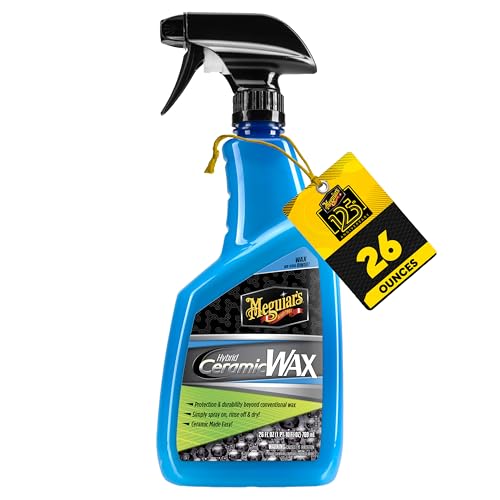
Best for a fast ceramic-boosted refresh between bigger jobs
- Spray-on ceramic-wax hybrid, rinse-activated
- Adds gloss and beading in minutes
- Ideal to top up a sealant or coating
- A booster, not a standalone long-term coating
Why buy it: the between-details refresher — a ceramic booster that keeps water beading tight without a full reapplication.
Prices are pulled from Amazon and were accurate as of Aug 22, 2026, 6:54 PM EDT. Product prices and availability are subject to change — the live price is shown on Amazon.
The bottom line
Wax for warmth and ritual, sealant for practical everyday protection, ceramic for the long haul. There's no single right answer — only the right answer for how much time you'll spend and how long you want it to last. If you make us pick one for the average driver, it's a sealant every time: easy, durable, glossy, and forgiving. For the full protection picture, head back to our exterior protection hub.